


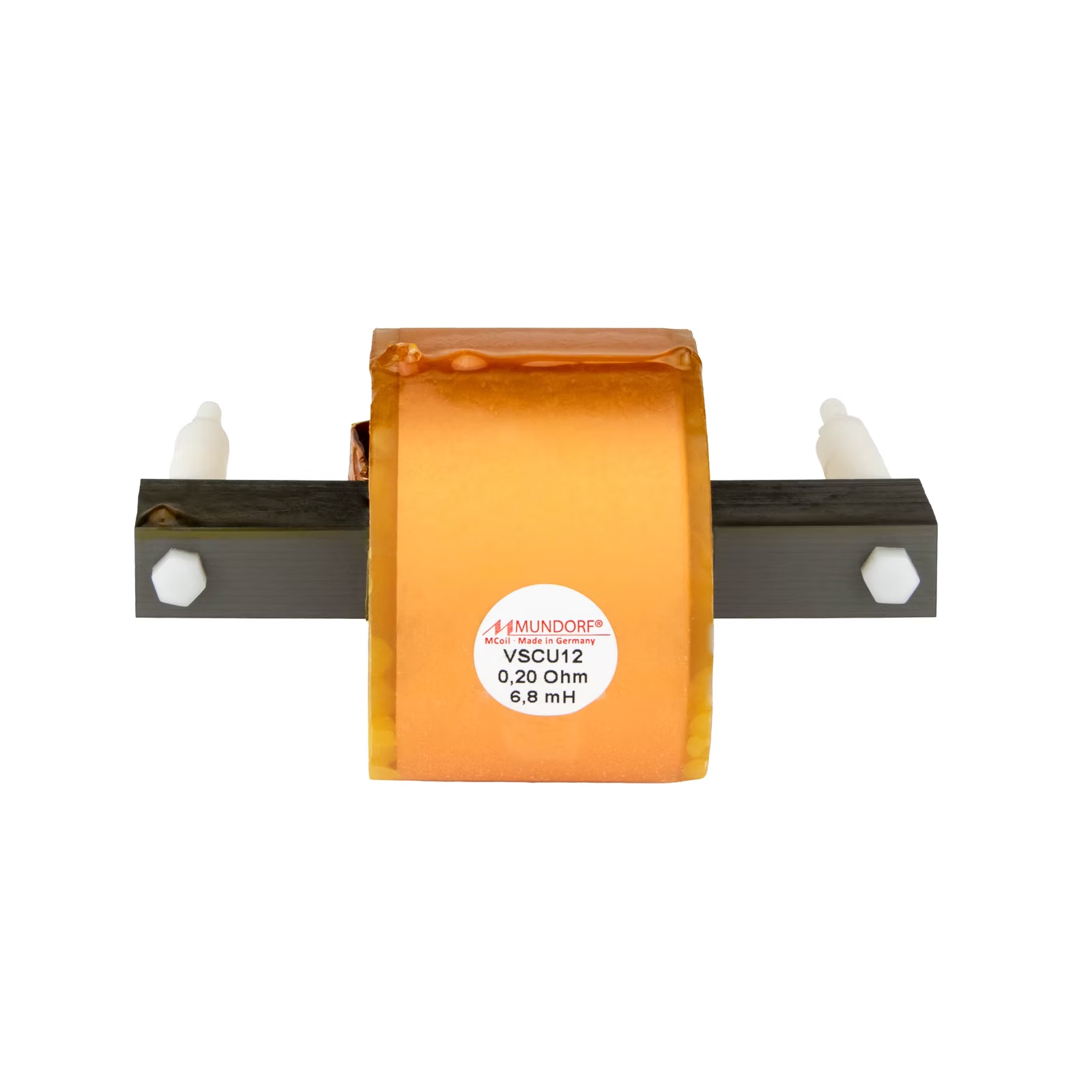
VSCU9
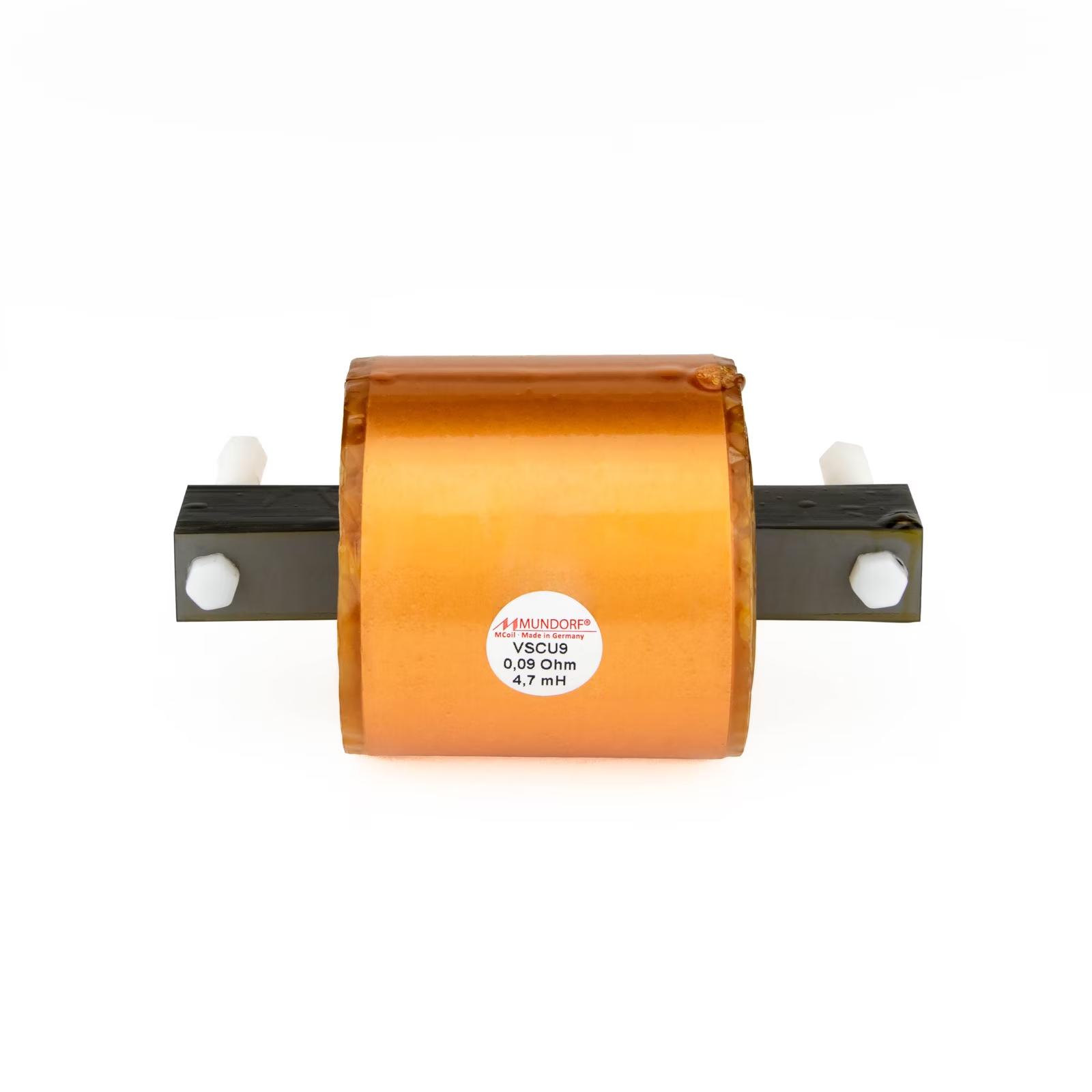
Feron-I core coil with copper foil conductor (AWG9) and paper insulator – maximum current handling capacity in a compact I-core design with very low Macro-Microphony; for maximum control and composure under load.
Technologies
Real metal foil increases current resistance, reduces vibrations and remains very stable.
Massive Metal Foil
Solid metal foil means: A real metal foil forms the electrode — not a wafer-thin coating. This provides very high, uniform conductivity along the coil, reduces field gradients and enables high current carrying capacity. The higher film weight reduces field force-related vibrations and the electrode remains stable even under impulse load. This creates a robust basis for demanding applications that transfers energy directly and in a load-stable manner — without “flickering” on the electrode side.
Tonal effects
- More pressure and control in the bass/root tone, with clearer contours instead of buzzing
- Superior at level peaks: less compression, more headroom and punch without harshness
- Cleaner transients and more stable dynamics, even with fast pulse trains
- Quieter, more ordered sound: less flicker/internal discolouration, better audibility in complex passages
Fixes the windings to form a stable unit. Vibrations are effectively damped.
Baked Varnish Wire/ Resin Soaking
Baked varnish wire is enamel-insulated wire with an additional, activatable hot-melt outer layer, which has an adhesive effect when heated. The windings are thus fixed together.
Impact in practice
- The coil becomes mechanically stable and „works“ significantly less
- Micro-movements between windings are reduced
- In particular, this reduces macro-microphonic effects (the windings „work“ less) and increases “silence” during operation
Resin soaking as an alternative to baked varnish wire
If no baked lacquer wire is used, resin soaking carried out under vacuum can take over the mechanical fixing. The resin penetrates into the wrap, reduces cavities and degrees of freedom of movement and transforms the wrap into a stable compound. The result: significantly less macro microphones and an overall quieter, more precise operation of the coil.
Characterized by a purity of at least 99.995% copper
OFC Copper
- Purity: at least 99.995% Cu, often 99.999% (4N) or higher
- Feature: almost oxygen-free (typically <10 ppm)
- Result: more stable grain boundaries, less oxide formation, more uniform electron flow
Compact, PCB-compatible Feron performance with high load capacity and very clean signal behavior.
Feron I-Core
The Feron I-Core coil uses a rod core made of grain-oriented Feron sheet metal and incorporates the material advantages of Feron in a particularly compact design. It integrates seamlessly and is frequently used on printed circuit boards.
Due to its open-core design, it remains exceptionally robust for its size and operates very cleanly at both low and high signal levels. The RDC is higher than the E-Core or Zero Ohm, but the design is significantly more economical and space-saving.
A clean layout remains important, as the magnetic stray field must be considered for PCB mounting.

Highest level of Macro-Microphony suppression
Resin-Soaked Film Spools with Paper Insulator
Resin-soaked paper serves as an insulator in film coils and at the same time as a mechanical stabilizer of the wrapping package. As a result of the vacuum, the impregnating medium penetrates deeply, fills pores and cavities and combines the layers to form a compact composite.
This reduces macro microphony—i.e. the swirling of the wrap—to a minimum. The result is maximum silence, higher fine-tuning and superior dynamics, particularly in the bass and fundamental tone region.
We are happy to advise you
Whether ideal components, technical know-how or individual solutions. Let us find the best solution for your application together!
For industrial customers
Order free samples
Would you like to test our products in yours? As a business customer, you can request free samples and see the quality and design for yourself.
NEWSLETTER
News and tips straight to your inbox. Subscribe to our newsletter and choose which topics matter to you.

OFC Copper
- Purity: at least 99.995% Cu, often 99.999% (4N) or higher
- Feature: almost oxygen-free (typically <10 ppm)
- Result: more stable grain boundaries, less oxide formation, more uniform electron flow
Massive Metal Foil
Solid metal foil means: A real metal foil forms the electrode — not a wafer-thin coating. This provides very high, uniform conductivity along the coil, reduces field gradients and enables high current carrying capacity. The higher film weight reduces field force-related vibrations and the electrode remains stable even under impulse load. This creates a robust basis for demanding applications that transfers energy directly and in a load-stable manner — without “flickering” on the electrode side.
Tonal effects
- More pressure and control in the bass/root tone, with clearer contours instead of buzzing
- Superior at level peaks: less compression, more headroom and punch without harshness
- Cleaner transients and more stable dynamics, even with fast pulse trains
- Quieter, more ordered sound: less flicker/internal discolouration, better audibility in complex passages
Baked Varnish Wire/ Resin Soaking
Baked varnish wire is enamel-insulated wire with an additional, activatable hot-melt outer layer, which has an adhesive effect when heated. The windings are thus fixed together.
Impact in practice
- The coil becomes mechanically stable and „works“ significantly less
- Micro-movements between windings are reduced
- In particular, this reduces macro-microphonic effects (the windings „work“ less) and increases “silence” during operation
Resin soaking as an alternative to baked varnish wire
If no baked lacquer wire is used, resin soaking carried out under vacuum can take over the mechanical fixing. The resin penetrates into the wrap, reduces cavities and degrees of freedom of movement and transforms the wrap into a stable compound. The result: significantly less macro microphones and an overall quieter, more precise operation of the coil.
Feron I-Core
The Feron I-Core coil uses a rod core made of grain-oriented Feron sheet metal and incorporates the material advantages of Feron in a particularly compact design. It integrates seamlessly and is frequently used on printed circuit boards.
Due to its open-core design, it remains exceptionally robust for its size and operates very cleanly at both low and high signal levels. The RDC is higher than the E-Core or Zero Ohm, but the design is significantly more economical and space-saving.
A clean layout remains important, as the magnetic stray field must be considered for PCB mounting.
Resin-Soaked Film Spools with Paper Insulator
Resin-soaked paper serves as an insulator in film coils and at the same time as a mechanical stabilizer of the wrapping package. As a result of the vacuum, the impregnating medium penetrates deeply, fills pores and cavities and combines the layers to form a compact composite.
This reduces macro microphony—i.e. the swirling of the wrap—to a minimum. The result is maximum silence, higher fine-tuning and superior dynamics, particularly in the bass and fundamental tone region.

OFC Copper
- Purity: at least 99.995% Cu, often 99.999% (4N) or higher
- Feature: almost oxygen-free (typically <10 ppm)
- Result: more stable grain boundaries, less oxide formation, more uniform electron flow
Massive Metal Foil
Solid metal foil means: A real metal foil forms the electrode — not a wafer-thin coating. This provides very high, uniform conductivity along the coil, reduces field gradients and enables high current carrying capacity. The higher film weight reduces field force-related vibrations and the electrode remains stable even under impulse load. This creates a robust basis for demanding applications that transfers energy directly and in a load-stable manner — without “flickering” on the electrode side.
Tonal effects
- More pressure and control in the bass/root tone, with clearer contours instead of buzzing
- Superior at level peaks: less compression, more headroom and punch without harshness
- Cleaner transients and more stable dynamics, even with fast pulse trains
- Quieter, more ordered sound: less flicker/internal discolouration, better audibility in complex passages
Baked Varnish Wire/ Resin Soaking
Baked varnish wire is enamel-insulated wire with an additional, activatable hot-melt outer layer, which has an adhesive effect when heated. The windings are thus fixed together.
Impact in practice
- The coil becomes mechanically stable and „works“ significantly less
- Micro-movements between windings are reduced
- In particular, this reduces macro-microphonic effects (the windings „work“ less) and increases “silence” during operation
Resin soaking as an alternative to baked varnish wire
If no baked lacquer wire is used, resin soaking carried out under vacuum can take over the mechanical fixing. The resin penetrates into the wrap, reduces cavities and degrees of freedom of movement and transforms the wrap into a stable compound. The result: significantly less macro microphones and an overall quieter, more precise operation of the coil.
Feron I-Core
The Feron I-Core coil uses a rod core made of grain-oriented Feron sheet metal and incorporates the material advantages of Feron in a particularly compact design. It integrates seamlessly and is frequently used on printed circuit boards.
Due to its open-core design, it remains exceptionally robust for its size and operates very cleanly at both low and high signal levels. The RDC is higher than the E-Core or Zero Ohm, but the design is significantly more economical and space-saving.
A clean layout remains important, as the magnetic stray field must be considered for PCB mounting.
Resin-Soaked Film Spools with Paper Insulator
Resin-soaked paper serves as an insulator in film coils and at the same time as a mechanical stabilizer of the wrapping package. As a result of the vacuum, the impregnating medium penetrates deeply, fills pores and cavities and combines the layers to form a compact composite.
This reduces macro microphony—i.e. the swirling of the wrap—to a minimum. The result is maximum silence, higher fine-tuning and superior dynamics, particularly in the bass and fundamental tone region.

OFC Copper
- Purity: at least 99.995% Cu, often 99.999% (4N) or higher
- Feature: almost oxygen-free (typically <10 ppm)
- Result: more stable grain boundaries, less oxide formation, more uniform electron flow
Massive Metal Foil
Solid metal foil means: A real metal foil forms the electrode — not a wafer-thin coating. This provides very high, uniform conductivity along the coil, reduces field gradients and enables high current carrying capacity. The higher film weight reduces field force-related vibrations and the electrode remains stable even under impulse load. This creates a robust basis for demanding applications that transfers energy directly and in a load-stable manner — without “flickering” on the electrode side.
Tonal effects
- More pressure and control in the bass/root tone, with clearer contours instead of buzzing
- Superior at level peaks: less compression, more headroom and punch without harshness
- Cleaner transients and more stable dynamics, even with fast pulse trains
- Quieter, more ordered sound: less flicker/internal discolouration, better audibility in complex passages
Baked Varnish Wire/ Resin Soaking
Baked varnish wire is enamel-insulated wire with an additional, activatable hot-melt outer layer, which has an adhesive effect when heated. The windings are thus fixed together.
Impact in practice
- The coil becomes mechanically stable and „works“ significantly less
- Micro-movements between windings are reduced
- In particular, this reduces macro-microphonic effects (the windings „work“ less) and increases “silence” during operation
Resin soaking as an alternative to baked varnish wire
If no baked lacquer wire is used, resin soaking carried out under vacuum can take over the mechanical fixing. The resin penetrates into the wrap, reduces cavities and degrees of freedom of movement and transforms the wrap into a stable compound. The result: significantly less macro microphones and an overall quieter, more precise operation of the coil.
Feron I-Core
The Feron I-Core coil uses a rod core made of grain-oriented Feron sheet metal and incorporates the material advantages of Feron in a particularly compact design. It integrates seamlessly and is frequently used on printed circuit boards.
Due to its open-core design, it remains exceptionally robust for its size and operates very cleanly at both low and high signal levels. The RDC is higher than the E-Core or Zero Ohm, but the design is significantly more economical and space-saving.
A clean layout remains important, as the magnetic stray field must be considered for PCB mounting.
Resin-Soaked Film Spools with Paper Insulator
Resin-soaked paper serves as an insulator in film coils and at the same time as a mechanical stabilizer of the wrapping package. As a result of the vacuum, the impregnating medium penetrates deeply, fills pores and cavities and combines the layers to form a compact composite.
This reduces macro microphony—i.e. the swirling of the wrap—to a minimum. The result is maximum silence, higher fine-tuning and superior dynamics, particularly in the bass and fundamental tone region.

OFC Copper
- Purity: at least 99.995% Cu, often 99.999% (4N) or higher
- Feature: almost oxygen-free (typically <10 ppm)
- Result: more stable grain boundaries, less oxide formation, more uniform electron flow
Massive Metal Foil
Solid metal foil means: A real metal foil forms the electrode — not a wafer-thin coating. This provides very high, uniform conductivity along the coil, reduces field gradients and enables high current carrying capacity. The higher film weight reduces field force-related vibrations and the electrode remains stable even under impulse load. This creates a robust basis for demanding applications that transfers energy directly and in a load-stable manner — without “flickering” on the electrode side.
Tonal effects
- More pressure and control in the bass/root tone, with clearer contours instead of buzzing
- Superior at level peaks: less compression, more headroom and punch without harshness
- Cleaner transients and more stable dynamics, even with fast pulse trains
- Quieter, more ordered sound: less flicker/internal discolouration, better audibility in complex passages
Baked Varnish Wire/ Resin Soaking
Baked varnish wire is enamel-insulated wire with an additional, activatable hot-melt outer layer, which has an adhesive effect when heated. The windings are thus fixed together.
Impact in practice
- The coil becomes mechanically stable and „works“ significantly less
- Micro-movements between windings are reduced
- In particular, this reduces macro-microphonic effects (the windings „work“ less) and increases “silence” during operation
Resin soaking as an alternative to baked varnish wire
If no baked lacquer wire is used, resin soaking carried out under vacuum can take over the mechanical fixing. The resin penetrates into the wrap, reduces cavities and degrees of freedom of movement and transforms the wrap into a stable compound. The result: significantly less macro microphones and an overall quieter, more precise operation of the coil.
Feron I-Core
The Feron I-Core coil uses a rod core made of grain-oriented Feron sheet metal and incorporates the material advantages of Feron in a particularly compact design. It integrates seamlessly and is frequently used on printed circuit boards.
Due to its open-core design, it remains exceptionally robust for its size and operates very cleanly at both low and high signal levels. The RDC is higher than the E-Core or Zero Ohm, but the design is significantly more economical and space-saving.
A clean layout remains important, as the magnetic stray field must be considered for PCB mounting.
Resin-Soaked Film Spools with Paper Insulator
Resin-soaked paper serves as an insulator in film coils and at the same time as a mechanical stabilizer of the wrapping package. As a result of the vacuum, the impregnating medium penetrates deeply, fills pores and cavities and combines the layers to form a compact composite.
This reduces macro microphony—i.e. the swirling of the wrap—to a minimum. The result is maximum silence, higher fine-tuning and superior dynamics, particularly in the bass and fundamental tone region.

OFC Copper
- Purity: at least 99.995% Cu, often 99.999% (4N) or higher
- Feature: almost oxygen-free (typically <10 ppm)
- Result: more stable grain boundaries, less oxide formation, more uniform electron flow
Massive Metal Foil
Solid metal foil means: A real metal foil forms the electrode — not a wafer-thin coating. This provides very high, uniform conductivity along the coil, reduces field gradients and enables high current carrying capacity. The higher film weight reduces field force-related vibrations and the electrode remains stable even under impulse load. This creates a robust basis for demanding applications that transfers energy directly and in a load-stable manner — without “flickering” on the electrode side.
Tonal effects
- More pressure and control in the bass/root tone, with clearer contours instead of buzzing
- Superior at level peaks: less compression, more headroom and punch without harshness
- Cleaner transients and more stable dynamics, even with fast pulse trains
- Quieter, more ordered sound: less flicker/internal discolouration, better audibility in complex passages
Baked Varnish Wire/ Resin Soaking
Baked varnish wire is enamel-insulated wire with an additional, activatable hot-melt outer layer, which has an adhesive effect when heated. The windings are thus fixed together.
Impact in practice
- The coil becomes mechanically stable and „works“ significantly less
- Micro-movements between windings are reduced
- In particular, this reduces macro-microphonic effects (the windings „work“ less) and increases “silence” during operation
Resin soaking as an alternative to baked varnish wire
If no baked lacquer wire is used, resin soaking carried out under vacuum can take over the mechanical fixing. The resin penetrates into the wrap, reduces cavities and degrees of freedom of movement and transforms the wrap into a stable compound. The result: significantly less macro microphones and an overall quieter, more precise operation of the coil.
Feron I-Core
The Feron I-Core coil uses a rod core made of grain-oriented Feron sheet metal and incorporates the material advantages of Feron in a particularly compact design. It integrates seamlessly and is frequently used on printed circuit boards.
Due to its open-core design, it remains exceptionally robust for its size and operates very cleanly at both low and high signal levels. The RDC is higher than the E-Core or Zero Ohm, but the design is significantly more economical and space-saving.
A clean layout remains important, as the magnetic stray field must be considered for PCB mounting.
Resin-Soaked Film Spools with Paper Insulator
Resin-soaked paper serves as an insulator in film coils and at the same time as a mechanical stabilizer of the wrapping package. As a result of the vacuum, the impregnating medium penetrates deeply, fills pores and cavities and combines the layers to form a compact composite.
This reduces macro microphony—i.e. the swirling of the wrap—to a minimum. The result is maximum silence, higher fine-tuning and superior dynamics, particularly in the bass and fundamental tone region.

OFC Copper
- Purity: at least 99.995% Cu, often 99.999% (4N) or higher
- Feature: almost oxygen-free (typically <10 ppm)
- Result: more stable grain boundaries, less oxide formation, more uniform electron flow
Massive Metal Foil
Solid metal foil means: A real metal foil forms the electrode — not a wafer-thin coating. This provides very high, uniform conductivity along the coil, reduces field gradients and enables high current carrying capacity. The higher film weight reduces field force-related vibrations and the electrode remains stable even under impulse load. This creates a robust basis for demanding applications that transfers energy directly and in a load-stable manner — without “flickering” on the electrode side.
Tonal effects
- More pressure and control in the bass/root tone, with clearer contours instead of buzzing
- Superior at level peaks: less compression, more headroom and punch without harshness
- Cleaner transients and more stable dynamics, even with fast pulse trains
- Quieter, more ordered sound: less flicker/internal discolouration, better audibility in complex passages
Baked Varnish Wire/ Resin Soaking
Baked varnish wire is enamel-insulated wire with an additional, activatable hot-melt outer layer, which has an adhesive effect when heated. The windings are thus fixed together.
Impact in practice
- The coil becomes mechanically stable and „works“ significantly less
- Micro-movements between windings are reduced
- In particular, this reduces macro-microphonic effects (the windings „work“ less) and increases “silence” during operation
Resin soaking as an alternative to baked varnish wire
If no baked lacquer wire is used, resin soaking carried out under vacuum can take over the mechanical fixing. The resin penetrates into the wrap, reduces cavities and degrees of freedom of movement and transforms the wrap into a stable compound. The result: significantly less macro microphones and an overall quieter, more precise operation of the coil.
Feron I-Core
The Feron I-Core coil uses a rod core made of grain-oriented Feron sheet metal and incorporates the material advantages of Feron in a particularly compact design. It integrates seamlessly and is frequently used on printed circuit boards.
Due to its open-core design, it remains exceptionally robust for its size and operates very cleanly at both low and high signal levels. The RDC is higher than the E-Core or Zero Ohm, but the design is significantly more economical and space-saving.
A clean layout remains important, as the magnetic stray field must be considered for PCB mounting.
Resin-Soaked Film Spools with Paper Insulator
Resin-soaked paper serves as an insulator in film coils and at the same time as a mechanical stabilizer of the wrapping package. As a result of the vacuum, the impregnating medium penetrates deeply, fills pores and cavities and combines the layers to form a compact composite.
This reduces macro microphony—i.e. the swirling of the wrap—to a minimum. The result is maximum silence, higher fine-tuning and superior dynamics, particularly in the bass and fundamental tone region.

OFC Copper
- Purity: at least 99.995% Cu, often 99.999% (4N) or higher
- Feature: almost oxygen-free (typically <10 ppm)
- Result: more stable grain boundaries, less oxide formation, more uniform electron flow
Massive Metal Foil
Solid metal foil means: A real metal foil forms the electrode — not a wafer-thin coating. This provides very high, uniform conductivity along the coil, reduces field gradients and enables high current carrying capacity. The higher film weight reduces field force-related vibrations and the electrode remains stable even under impulse load. This creates a robust basis for demanding applications that transfers energy directly and in a load-stable manner — without “flickering” on the electrode side.
Tonal effects
- More pressure and control in the bass/root tone, with clearer contours instead of buzzing
- Superior at level peaks: less compression, more headroom and punch without harshness
- Cleaner transients and more stable dynamics, even with fast pulse trains
- Quieter, more ordered sound: less flicker/internal discolouration, better audibility in complex passages
Baked Varnish Wire/ Resin Soaking
Baked varnish wire is enamel-insulated wire with an additional, activatable hot-melt outer layer, which has an adhesive effect when heated. The windings are thus fixed together.
Impact in practice
- The coil becomes mechanically stable and „works“ significantly less
- Micro-movements between windings are reduced
- In particular, this reduces macro-microphonic effects (the windings „work“ less) and increases “silence” during operation
Resin soaking as an alternative to baked varnish wire
If no baked lacquer wire is used, resin soaking carried out under vacuum can take over the mechanical fixing. The resin penetrates into the wrap, reduces cavities and degrees of freedom of movement and transforms the wrap into a stable compound. The result: significantly less macro microphones and an overall quieter, more precise operation of the coil.
Feron I-Core
The Feron I-Core coil uses a rod core made of grain-oriented Feron sheet metal and incorporates the material advantages of Feron in a particularly compact design. It integrates seamlessly and is frequently used on printed circuit boards.
Due to its open-core design, it remains exceptionally robust for its size and operates very cleanly at both low and high signal levels. The RDC is higher than the E-Core or Zero Ohm, but the design is significantly more economical and space-saving.
A clean layout remains important, as the magnetic stray field must be considered for PCB mounting.
Resin-Soaked Film Spools with Paper Insulator
Resin-soaked paper serves as an insulator in film coils and at the same time as a mechanical stabilizer of the wrapping package. As a result of the vacuum, the impregnating medium penetrates deeply, fills pores and cavities and combines the layers to form a compact composite.
This reduces macro microphony—i.e. the swirling of the wrap—to a minimum. The result is maximum silence, higher fine-tuning and superior dynamics, particularly in the bass and fundamental tone region.

OFC Copper
- Purity: at least 99.995% Cu, often 99.999% (4N) or higher
- Feature: almost oxygen-free (typically <10 ppm)
- Result: more stable grain boundaries, less oxide formation, more uniform electron flow
Massive Metal Foil
Solid metal foil means: A real metal foil forms the electrode — not a wafer-thin coating. This provides very high, uniform conductivity along the coil, reduces field gradients and enables high current carrying capacity. The higher film weight reduces field force-related vibrations and the electrode remains stable even under impulse load. This creates a robust basis for demanding applications that transfers energy directly and in a load-stable manner — without “flickering” on the electrode side.
Tonal effects
- More pressure and control in the bass/root tone, with clearer contours instead of buzzing
- Superior at level peaks: less compression, more headroom and punch without harshness
- Cleaner transients and more stable dynamics, even with fast pulse trains
- Quieter, more ordered sound: less flicker/internal discolouration, better audibility in complex passages
Baked Varnish Wire/ Resin Soaking
Baked varnish wire is enamel-insulated wire with an additional, activatable hot-melt outer layer, which has an adhesive effect when heated. The windings are thus fixed together.
Impact in practice
- The coil becomes mechanically stable and „works“ significantly less
- Micro-movements between windings are reduced
- In particular, this reduces macro-microphonic effects (the windings „work“ less) and increases “silence” during operation
Resin soaking as an alternative to baked varnish wire
If no baked lacquer wire is used, resin soaking carried out under vacuum can take over the mechanical fixing. The resin penetrates into the wrap, reduces cavities and degrees of freedom of movement and transforms the wrap into a stable compound. The result: significantly less macro microphones and an overall quieter, more precise operation of the coil.
Feron I-Core
The Feron I-Core coil uses a rod core made of grain-oriented Feron sheet metal and incorporates the material advantages of Feron in a particularly compact design. It integrates seamlessly and is frequently used on printed circuit boards.
Due to its open-core design, it remains exceptionally robust for its size and operates very cleanly at both low and high signal levels. The RDC is higher than the E-Core or Zero Ohm, but the design is significantly more economical and space-saving.
A clean layout remains important, as the magnetic stray field must be considered for PCB mounting.
Resin-Soaked Film Spools with Paper Insulator
Resin-soaked paper serves as an insulator in film coils and at the same time as a mechanical stabilizer of the wrapping package. As a result of the vacuum, the impregnating medium penetrates deeply, fills pores and cavities and combines the layers to form a compact composite.
This reduces macro microphony—i.e. the swirling of the wrap—to a minimum. The result is maximum silence, higher fine-tuning and superior dynamics, particularly in the bass and fundamental tone region.

OFC Copper
- Purity: at least 99.995% Cu, often 99.999% (4N) or higher
- Feature: almost oxygen-free (typically <10 ppm)
- Result: more stable grain boundaries, less oxide formation, more uniform electron flow
Massive Metal Foil
Solid metal foil means: A real metal foil forms the electrode — not a wafer-thin coating. This provides very high, uniform conductivity along the coil, reduces field gradients and enables high current carrying capacity. The higher film weight reduces field force-related vibrations and the electrode remains stable even under impulse load. This creates a robust basis for demanding applications that transfers energy directly and in a load-stable manner — without “flickering” on the electrode side.
Tonal effects
- More pressure and control in the bass/root tone, with clearer contours instead of buzzing
- Superior at level peaks: less compression, more headroom and punch without harshness
- Cleaner transients and more stable dynamics, even with fast pulse trains
- Quieter, more ordered sound: less flicker/internal discolouration, better audibility in complex passages
Baked Varnish Wire/ Resin Soaking
Baked varnish wire is enamel-insulated wire with an additional, activatable hot-melt outer layer, which has an adhesive effect when heated. The windings are thus fixed together.
Impact in practice
- The coil becomes mechanically stable and „works“ significantly less
- Micro-movements between windings are reduced
- In particular, this reduces macro-microphonic effects (the windings „work“ less) and increases “silence” during operation
Resin soaking as an alternative to baked varnish wire
If no baked lacquer wire is used, resin soaking carried out under vacuum can take over the mechanical fixing. The resin penetrates into the wrap, reduces cavities and degrees of freedom of movement and transforms the wrap into a stable compound. The result: significantly less macro microphones and an overall quieter, more precise operation of the coil.
Feron I-Core
The Feron I-Core coil uses a rod core made of grain-oriented Feron sheet metal and incorporates the material advantages of Feron in a particularly compact design. It integrates seamlessly and is frequently used on printed circuit boards.
Due to its open-core design, it remains exceptionally robust for its size and operates very cleanly at both low and high signal levels. The RDC is higher than the E-Core or Zero Ohm, but the design is significantly more economical and space-saving.
A clean layout remains important, as the magnetic stray field must be considered for PCB mounting.
Resin-Soaked Film Spools with Paper Insulator
Resin-soaked paper serves as an insulator in film coils and at the same time as a mechanical stabilizer of the wrapping package. As a result of the vacuum, the impregnating medium penetrates deeply, fills pores and cavities and combines the layers to form a compact composite.
This reduces macro microphony—i.e. the swirling of the wrap—to a minimum. The result is maximum silence, higher fine-tuning and superior dynamics, particularly in the bass and fundamental tone region.

OFC Copper
- Purity: at least 99.995% Cu, often 99.999% (4N) or higher
- Feature: almost oxygen-free (typically <10 ppm)
- Result: more stable grain boundaries, less oxide formation, more uniform electron flow
Massive Metal Foil
Solid metal foil means: A real metal foil forms the electrode — not a wafer-thin coating. This provides very high, uniform conductivity along the coil, reduces field gradients and enables high current carrying capacity. The higher film weight reduces field force-related vibrations and the electrode remains stable even under impulse load. This creates a robust basis for demanding applications that transfers energy directly and in a load-stable manner — without “flickering” on the electrode side.
Tonal effects
- More pressure and control in the bass/root tone, with clearer contours instead of buzzing
- Superior at level peaks: less compression, more headroom and punch without harshness
- Cleaner transients and more stable dynamics, even with fast pulse trains
- Quieter, more ordered sound: less flicker/internal discolouration, better audibility in complex passages
Baked Varnish Wire/ Resin Soaking
Baked varnish wire is enamel-insulated wire with an additional, activatable hot-melt outer layer, which has an adhesive effect when heated. The windings are thus fixed together.
Impact in practice
- The coil becomes mechanically stable and „works“ significantly less
- Micro-movements between windings are reduced
- In particular, this reduces macro-microphonic effects (the windings „work“ less) and increases “silence” during operation
Resin soaking as an alternative to baked varnish wire
If no baked lacquer wire is used, resin soaking carried out under vacuum can take over the mechanical fixing. The resin penetrates into the wrap, reduces cavities and degrees of freedom of movement and transforms the wrap into a stable compound. The result: significantly less macro microphones and an overall quieter, more precise operation of the coil.
Feron I-Core
The Feron I-Core coil uses a rod core made of grain-oriented Feron sheet metal and incorporates the material advantages of Feron in a particularly compact design. It integrates seamlessly and is frequently used on printed circuit boards.
Due to its open-core design, it remains exceptionally robust for its size and operates very cleanly at both low and high signal levels. The RDC is higher than the E-Core or Zero Ohm, but the design is significantly more economical and space-saving.
A clean layout remains important, as the magnetic stray field must be considered for PCB mounting.
Resin-Soaked Film Spools with Paper Insulator
Resin-soaked paper serves as an insulator in film coils and at the same time as a mechanical stabilizer of the wrapping package. As a result of the vacuum, the impregnating medium penetrates deeply, fills pores and cavities and combines the layers to form a compact composite.
This reduces macro microphony—i.e. the swirling of the wrap—to a minimum. The result is maximum silence, higher fine-tuning and superior dynamics, particularly in the bass and fundamental tone region.

OFC Copper
- Purity: at least 99.995% Cu, often 99.999% (4N) or higher
- Feature: almost oxygen-free (typically <10 ppm)
- Result: more stable grain boundaries, less oxide formation, more uniform electron flow
Massive Metal Foil
Solid metal foil means: A real metal foil forms the electrode — not a wafer-thin coating. This provides very high, uniform conductivity along the coil, reduces field gradients and enables high current carrying capacity. The higher film weight reduces field force-related vibrations and the electrode remains stable even under impulse load. This creates a robust basis for demanding applications that transfers energy directly and in a load-stable manner — without “flickering” on the electrode side.
Tonal effects
- More pressure and control in the bass/root tone, with clearer contours instead of buzzing
- Superior at level peaks: less compression, more headroom and punch without harshness
- Cleaner transients and more stable dynamics, even with fast pulse trains
- Quieter, more ordered sound: less flicker/internal discolouration, better audibility in complex passages
Baked Varnish Wire/ Resin Soaking
Baked varnish wire is enamel-insulated wire with an additional, activatable hot-melt outer layer, which has an adhesive effect when heated. The windings are thus fixed together.
Impact in practice
- The coil becomes mechanically stable and „works“ significantly less
- Micro-movements between windings are reduced
- In particular, this reduces macro-microphonic effects (the windings „work“ less) and increases “silence” during operation
Resin soaking as an alternative to baked varnish wire
If no baked lacquer wire is used, resin soaking carried out under vacuum can take over the mechanical fixing. The resin penetrates into the wrap, reduces cavities and degrees of freedom of movement and transforms the wrap into a stable compound. The result: significantly less macro microphones and an overall quieter, more precise operation of the coil.
Feron I-Core
The Feron I-Core coil uses a rod core made of grain-oriented Feron sheet metal and incorporates the material advantages of Feron in a particularly compact design. It integrates seamlessly and is frequently used on printed circuit boards.
Due to its open-core design, it remains exceptionally robust for its size and operates very cleanly at both low and high signal levels. The RDC is higher than the E-Core or Zero Ohm, but the design is significantly more economical and space-saving.
A clean layout remains important, as the magnetic stray field must be considered for PCB mounting.
Resin-Soaked Film Spools with Paper Insulator
Resin-soaked paper serves as an insulator in film coils and at the same time as a mechanical stabilizer of the wrapping package. As a result of the vacuum, the impregnating medium penetrates deeply, fills pores and cavities and combines the layers to form a compact composite.
This reduces macro microphony—i.e. the swirling of the wrap—to a minimum. The result is maximum silence, higher fine-tuning and superior dynamics, particularly in the bass and fundamental tone region.

OFC Copper
- Purity: at least 99.995% Cu, often 99.999% (4N) or higher
- Feature: almost oxygen-free (typically <10 ppm)
- Result: more stable grain boundaries, less oxide formation, more uniform electron flow
Massive Metal Foil
Solid metal foil means: A real metal foil forms the electrode — not a wafer-thin coating. This provides very high, uniform conductivity along the coil, reduces field gradients and enables high current carrying capacity. The higher film weight reduces field force-related vibrations and the electrode remains stable even under impulse load. This creates a robust basis for demanding applications that transfers energy directly and in a load-stable manner — without “flickering” on the electrode side.
Tonal effects
- More pressure and control in the bass/root tone, with clearer contours instead of buzzing
- Superior at level peaks: less compression, more headroom and punch without harshness
- Cleaner transients and more stable dynamics, even with fast pulse trains
- Quieter, more ordered sound: less flicker/internal discolouration, better audibility in complex passages
Baked Varnish Wire/ Resin Soaking
Baked varnish wire is enamel-insulated wire with an additional, activatable hot-melt outer layer, which has an adhesive effect when heated. The windings are thus fixed together.
Impact in practice
- The coil becomes mechanically stable and „works“ significantly less
- Micro-movements between windings are reduced
- In particular, this reduces macro-microphonic effects (the windings „work“ less) and increases “silence” during operation
Resin soaking as an alternative to baked varnish wire
If no baked lacquer wire is used, resin soaking carried out under vacuum can take over the mechanical fixing. The resin penetrates into the wrap, reduces cavities and degrees of freedom of movement and transforms the wrap into a stable compound. The result: significantly less macro microphones and an overall quieter, more precise operation of the coil.
Feron I-Core
The Feron I-Core coil uses a rod core made of grain-oriented Feron sheet metal and incorporates the material advantages of Feron in a particularly compact design. It integrates seamlessly and is frequently used on printed circuit boards.
Due to its open-core design, it remains exceptionally robust for its size and operates very cleanly at both low and high signal levels. The RDC is higher than the E-Core or Zero Ohm, but the design is significantly more economical and space-saving.
A clean layout remains important, as the magnetic stray field must be considered for PCB mounting.
Resin-Soaked Film Spools with Paper Insulator
Resin-soaked paper serves as an insulator in film coils and at the same time as a mechanical stabilizer of the wrapping package. As a result of the vacuum, the impregnating medium penetrates deeply, fills pores and cavities and combines the layers to form a compact composite.
This reduces macro microphony—i.e. the swirling of the wrap—to a minimum. The result is maximum silence, higher fine-tuning and superior dynamics, particularly in the bass and fundamental tone region.

OFC Copper
- Purity: at least 99.995% Cu, often 99.999% (4N) or higher
- Feature: almost oxygen-free (typically <10 ppm)
- Result: more stable grain boundaries, less oxide formation, more uniform electron flow
Massive Metal Foil
Solid metal foil means: A real metal foil forms the electrode — not a wafer-thin coating. This provides very high, uniform conductivity along the coil, reduces field gradients and enables high current carrying capacity. The higher film weight reduces field force-related vibrations and the electrode remains stable even under impulse load. This creates a robust basis for demanding applications that transfers energy directly and in a load-stable manner — without “flickering” on the electrode side.
Tonal effects
- More pressure and control in the bass/root tone, with clearer contours instead of buzzing
- Superior at level peaks: less compression, more headroom and punch without harshness
- Cleaner transients and more stable dynamics, even with fast pulse trains
- Quieter, more ordered sound: less flicker/internal discolouration, better audibility in complex passages
Baked Varnish Wire/ Resin Soaking
Baked varnish wire is enamel-insulated wire with an additional, activatable hot-melt outer layer, which has an adhesive effect when heated. The windings are thus fixed together.
Impact in practice
- The coil becomes mechanically stable and „works“ significantly less
- Micro-movements between windings are reduced
- In particular, this reduces macro-microphonic effects (the windings „work“ less) and increases “silence” during operation
Resin soaking as an alternative to baked varnish wire
If no baked lacquer wire is used, resin soaking carried out under vacuum can take over the mechanical fixing. The resin penetrates into the wrap, reduces cavities and degrees of freedom of movement and transforms the wrap into a stable compound. The result: significantly less macro microphones and an overall quieter, more precise operation of the coil.
Feron I-Core
The Feron I-Core coil uses a rod core made of grain-oriented Feron sheet metal and incorporates the material advantages of Feron in a particularly compact design. It integrates seamlessly and is frequently used on printed circuit boards.
Due to its open-core design, it remains exceptionally robust for its size and operates very cleanly at both low and high signal levels. The RDC is higher than the E-Core or Zero Ohm, but the design is significantly more economical and space-saving.
A clean layout remains important, as the magnetic stray field must be considered for PCB mounting.
Resin-Soaked Film Spools with Paper Insulator
Resin-soaked paper serves as an insulator in film coils and at the same time as a mechanical stabilizer of the wrapping package. As a result of the vacuum, the impregnating medium penetrates deeply, fills pores and cavities and combines the layers to form a compact composite.
This reduces macro microphony—i.e. the swirling of the wrap—to a minimum. The result is maximum silence, higher fine-tuning and superior dynamics, particularly in the bass and fundamental tone region.

OFC Copper
- Purity: at least 99.995% Cu, often 99.999% (4N) or higher
- Feature: almost oxygen-free (typically <10 ppm)
- Result: more stable grain boundaries, less oxide formation, more uniform electron flow
Massive Metal Foil
Solid metal foil means: A real metal foil forms the electrode — not a wafer-thin coating. This provides very high, uniform conductivity along the coil, reduces field gradients and enables high current carrying capacity. The higher film weight reduces field force-related vibrations and the electrode remains stable even under impulse load. This creates a robust basis for demanding applications that transfers energy directly and in a load-stable manner — without “flickering” on the electrode side.
Tonal effects
- More pressure and control in the bass/root tone, with clearer contours instead of buzzing
- Superior at level peaks: less compression, more headroom and punch without harshness
- Cleaner transients and more stable dynamics, even with fast pulse trains
- Quieter, more ordered sound: less flicker/internal discolouration, better audibility in complex passages
Baked Varnish Wire/ Resin Soaking
Baked varnish wire is enamel-insulated wire with an additional, activatable hot-melt outer layer, which has an adhesive effect when heated. The windings are thus fixed together.
Impact in practice
- The coil becomes mechanically stable and „works“ significantly less
- Micro-movements between windings are reduced
- In particular, this reduces macro-microphonic effects (the windings „work“ less) and increases “silence” during operation
Resin soaking as an alternative to baked varnish wire
If no baked lacquer wire is used, resin soaking carried out under vacuum can take over the mechanical fixing. The resin penetrates into the wrap, reduces cavities and degrees of freedom of movement and transforms the wrap into a stable compound. The result: significantly less macro microphones and an overall quieter, more precise operation of the coil.
Feron I-Core
The Feron I-Core coil uses a rod core made of grain-oriented Feron sheet metal and incorporates the material advantages of Feron in a particularly compact design. It integrates seamlessly and is frequently used on printed circuit boards.
Due to its open-core design, it remains exceptionally robust for its size and operates very cleanly at both low and high signal levels. The RDC is higher than the E-Core or Zero Ohm, but the design is significantly more economical and space-saving.
A clean layout remains important, as the magnetic stray field must be considered for PCB mounting.
Resin-Soaked Film Spools with Paper Insulator
Resin-soaked paper serves as an insulator in film coils and at the same time as a mechanical stabilizer of the wrapping package. As a result of the vacuum, the impregnating medium penetrates deeply, fills pores and cavities and combines the layers to form a compact composite.
This reduces macro microphony—i.e. the swirling of the wrap—to a minimum. The result is maximum silence, higher fine-tuning and superior dynamics, particularly in the bass and fundamental tone region.

OFC Copper
- Purity: at least 99.995% Cu, often 99.999% (4N) or higher
- Feature: almost oxygen-free (typically <10 ppm)
- Result: more stable grain boundaries, less oxide formation, more uniform electron flow
Massive Metal Foil
Solid metal foil means: A real metal foil forms the electrode — not a wafer-thin coating. This provides very high, uniform conductivity along the coil, reduces field gradients and enables high current carrying capacity. The higher film weight reduces field force-related vibrations and the electrode remains stable even under impulse load. This creates a robust basis for demanding applications that transfers energy directly and in a load-stable manner — without “flickering” on the electrode side.
Tonal effects
- More pressure and control in the bass/root tone, with clearer contours instead of buzzing
- Superior at level peaks: less compression, more headroom and punch without harshness
- Cleaner transients and more stable dynamics, even with fast pulse trains
- Quieter, more ordered sound: less flicker/internal discolouration, better audibility in complex passages
Baked Varnish Wire/ Resin Soaking
Baked varnish wire is enamel-insulated wire with an additional, activatable hot-melt outer layer, which has an adhesive effect when heated. The windings are thus fixed together.
Impact in practice
- The coil becomes mechanically stable and „works“ significantly less
- Micro-movements between windings are reduced
- In particular, this reduces macro-microphonic effects (the windings „work“ less) and increases “silence” during operation
Resin soaking as an alternative to baked varnish wire
If no baked lacquer wire is used, resin soaking carried out under vacuum can take over the mechanical fixing. The resin penetrates into the wrap, reduces cavities and degrees of freedom of movement and transforms the wrap into a stable compound. The result: significantly less macro microphones and an overall quieter, more precise operation of the coil.
Feron I-Core
The Feron I-Core coil uses a rod core made of grain-oriented Feron sheet metal and incorporates the material advantages of Feron in a particularly compact design. It integrates seamlessly and is frequently used on printed circuit boards.
Due to its open-core design, it remains exceptionally robust for its size and operates very cleanly at both low and high signal levels. The RDC is higher than the E-Core or Zero Ohm, but the design is significantly more economical and space-saving.
A clean layout remains important, as the magnetic stray field must be considered for PCB mounting.
Resin-Soaked Film Spools with Paper Insulator
Resin-soaked paper serves as an insulator in film coils and at the same time as a mechanical stabilizer of the wrapping package. As a result of the vacuum, the impregnating medium penetrates deeply, fills pores and cavities and combines the layers to form a compact composite.
This reduces macro microphony—i.e. the swirling of the wrap—to a minimum. The result is maximum silence, higher fine-tuning and superior dynamics, particularly in the bass and fundamental tone region.

OFC Copper
- Purity: at least 99.995% Cu, often 99.999% (4N) or higher
- Feature: almost oxygen-free (typically <10 ppm)
- Result: more stable grain boundaries, less oxide formation, more uniform electron flow
Massive Metal Foil
Solid metal foil means: A real metal foil forms the electrode — not a wafer-thin coating. This provides very high, uniform conductivity along the coil, reduces field gradients and enables high current carrying capacity. The higher film weight reduces field force-related vibrations and the electrode remains stable even under impulse load. This creates a robust basis for demanding applications that transfers energy directly and in a load-stable manner — without “flickering” on the electrode side.
Tonal effects
- More pressure and control in the bass/root tone, with clearer contours instead of buzzing
- Superior at level peaks: less compression, more headroom and punch without harshness
- Cleaner transients and more stable dynamics, even with fast pulse trains
- Quieter, more ordered sound: less flicker/internal discolouration, better audibility in complex passages
Baked Varnish Wire/ Resin Soaking
Baked varnish wire is enamel-insulated wire with an additional, activatable hot-melt outer layer, which has an adhesive effect when heated. The windings are thus fixed together.
Impact in practice
- The coil becomes mechanically stable and „works“ significantly less
- Micro-movements between windings are reduced
- In particular, this reduces macro-microphonic effects (the windings „work“ less) and increases “silence” during operation
Resin soaking as an alternative to baked varnish wire
If no baked lacquer wire is used, resin soaking carried out under vacuum can take over the mechanical fixing. The resin penetrates into the wrap, reduces cavities and degrees of freedom of movement and transforms the wrap into a stable compound. The result: significantly less macro microphones and an overall quieter, more precise operation of the coil.
Feron I-Core
The Feron I-Core coil uses a rod core made of grain-oriented Feron sheet metal and incorporates the material advantages of Feron in a particularly compact design. It integrates seamlessly and is frequently used on printed circuit boards.
Due to its open-core design, it remains exceptionally robust for its size and operates very cleanly at both low and high signal levels. The RDC is higher than the E-Core or Zero Ohm, but the design is significantly more economical and space-saving.
A clean layout remains important, as the magnetic stray field must be considered for PCB mounting.
Resin-Soaked Film Spools with Paper Insulator
Resin-soaked paper serves as an insulator in film coils and at the same time as a mechanical stabilizer of the wrapping package. As a result of the vacuum, the impregnating medium penetrates deeply, fills pores and cavities and combines the layers to form a compact composite.
This reduces macro microphony—i.e. the swirling of the wrap—to a minimum. The result is maximum silence, higher fine-tuning and superior dynamics, particularly in the bass and fundamental tone region.

OFC Copper
- Purity: at least 99.995% Cu, often 99.999% (4N) or higher
- Feature: almost oxygen-free (typically <10 ppm)
- Result: more stable grain boundaries, less oxide formation, more uniform electron flow
Massive Metal Foil
Solid metal foil means: A real metal foil forms the electrode — not a wafer-thin coating. This provides very high, uniform conductivity along the coil, reduces field gradients and enables high current carrying capacity. The higher film weight reduces field force-related vibrations and the electrode remains stable even under impulse load. This creates a robust basis for demanding applications that transfers energy directly and in a load-stable manner — without “flickering” on the electrode side.
Tonal effects
- More pressure and control in the bass/root tone, with clearer contours instead of buzzing
- Superior at level peaks: less compression, more headroom and punch without harshness
- Cleaner transients and more stable dynamics, even with fast pulse trains
- Quieter, more ordered sound: less flicker/internal discolouration, better audibility in complex passages
Baked Varnish Wire/ Resin Soaking
Baked varnish wire is enamel-insulated wire with an additional, activatable hot-melt outer layer, which has an adhesive effect when heated. The windings are thus fixed together.
Impact in practice
- The coil becomes mechanically stable and „works“ significantly less
- Micro-movements between windings are reduced
- In particular, this reduces macro-microphonic effects (the windings „work“ less) and increases “silence” during operation
Resin soaking as an alternative to baked varnish wire
If no baked lacquer wire is used, resin soaking carried out under vacuum can take over the mechanical fixing. The resin penetrates into the wrap, reduces cavities and degrees of freedom of movement and transforms the wrap into a stable compound. The result: significantly less macro microphones and an overall quieter, more precise operation of the coil.
Feron I-Core
The Feron I-Core coil uses a rod core made of grain-oriented Feron sheet metal and incorporates the material advantages of Feron in a particularly compact design. It integrates seamlessly and is frequently used on printed circuit boards.
Due to its open-core design, it remains exceptionally robust for its size and operates very cleanly at both low and high signal levels. The RDC is higher than the E-Core or Zero Ohm, but the design is significantly more economical and space-saving.
A clean layout remains important, as the magnetic stray field must be considered for PCB mounting.
Resin-Soaked Film Spools with Paper Insulator
Resin-soaked paper serves as an insulator in film coils and at the same time as a mechanical stabilizer of the wrapping package. As a result of the vacuum, the impregnating medium penetrates deeply, fills pores and cavities and combines the layers to form a compact composite.
This reduces macro microphony—i.e. the swirling of the wrap—to a minimum. The result is maximum silence, higher fine-tuning and superior dynamics, particularly in the bass and fundamental tone region.

OFC Copper
- Purity: at least 99.995% Cu, often 99.999% (4N) or higher
- Feature: almost oxygen-free (typically <10 ppm)
- Result: more stable grain boundaries, less oxide formation, more uniform electron flow
Massive Metal Foil
Solid metal foil means: A real metal foil forms the electrode — not a wafer-thin coating. This provides very high, uniform conductivity along the coil, reduces field gradients and enables high current carrying capacity. The higher film weight reduces field force-related vibrations and the electrode remains stable even under impulse load. This creates a robust basis for demanding applications that transfers energy directly and in a load-stable manner — without “flickering” on the electrode side.
Tonal effects
- More pressure and control in the bass/root tone, with clearer contours instead of buzzing
- Superior at level peaks: less compression, more headroom and punch without harshness
- Cleaner transients and more stable dynamics, even with fast pulse trains
- Quieter, more ordered sound: less flicker/internal discolouration, better audibility in complex passages
Baked Varnish Wire/ Resin Soaking
Baked varnish wire is enamel-insulated wire with an additional, activatable hot-melt outer layer, which has an adhesive effect when heated. The windings are thus fixed together.
Impact in practice
- The coil becomes mechanically stable and „works“ significantly less
- Micro-movements between windings are reduced
- In particular, this reduces macro-microphonic effects (the windings „work“ less) and increases “silence” during operation
Resin soaking as an alternative to baked varnish wire
If no baked lacquer wire is used, resin soaking carried out under vacuum can take over the mechanical fixing. The resin penetrates into the wrap, reduces cavities and degrees of freedom of movement and transforms the wrap into a stable compound. The result: significantly less macro microphones and an overall quieter, more precise operation of the coil.
Feron I-Core
The Feron I-Core coil uses a rod core made of grain-oriented Feron sheet metal and incorporates the material advantages of Feron in a particularly compact design. It integrates seamlessly and is frequently used on printed circuit boards.
Due to its open-core design, it remains exceptionally robust for its size and operates very cleanly at both low and high signal levels. The RDC is higher than the E-Core or Zero Ohm, but the design is significantly more economical and space-saving.
A clean layout remains important, as the magnetic stray field must be considered for PCB mounting.
Resin-Soaked Film Spools with Paper Insulator
Resin-soaked paper serves as an insulator in film coils and at the same time as a mechanical stabilizer of the wrapping package. As a result of the vacuum, the impregnating medium penetrates deeply, fills pores and cavities and combines the layers to form a compact composite.
This reduces macro microphony—i.e. the swirling of the wrap—to a minimum. The result is maximum silence, higher fine-tuning and superior dynamics, particularly in the bass and fundamental tone region.

OFC Copper
- Purity: at least 99.995% Cu, often 99.999% (4N) or higher
- Feature: almost oxygen-free (typically <10 ppm)
- Result: more stable grain boundaries, less oxide formation, more uniform electron flow
Massive Metal Foil
Solid metal foil means: A real metal foil forms the electrode — not a wafer-thin coating. This provides very high, uniform conductivity along the coil, reduces field gradients and enables high current carrying capacity. The higher film weight reduces field force-related vibrations and the electrode remains stable even under impulse load. This creates a robust basis for demanding applications that transfers energy directly and in a load-stable manner — without “flickering” on the electrode side.
Tonal effects
- More pressure and control in the bass/root tone, with clearer contours instead of buzzing
- Superior at level peaks: less compression, more headroom and punch without harshness
- Cleaner transients and more stable dynamics, even with fast pulse trains
- Quieter, more ordered sound: less flicker/internal discolouration, better audibility in complex passages
Baked Varnish Wire/ Resin Soaking
Baked varnish wire is enamel-insulated wire with an additional, activatable hot-melt outer layer, which has an adhesive effect when heated. The windings are thus fixed together.
Impact in practice
- The coil becomes mechanically stable and „works“ significantly less
- Micro-movements between windings are reduced
- In particular, this reduces macro-microphonic effects (the windings „work“ less) and increases “silence” during operation
Resin soaking as an alternative to baked varnish wire
If no baked lacquer wire is used, resin soaking carried out under vacuum can take over the mechanical fixing. The resin penetrates into the wrap, reduces cavities and degrees of freedom of movement and transforms the wrap into a stable compound. The result: significantly less macro microphones and an overall quieter, more precise operation of the coil.
Feron I-Core
The Feron I-Core coil uses a rod core made of grain-oriented Feron sheet metal and incorporates the material advantages of Feron in a particularly compact design. It integrates seamlessly and is frequently used on printed circuit boards.
Due to its open-core design, it remains exceptionally robust for its size and operates very cleanly at both low and high signal levels. The RDC is higher than the E-Core or Zero Ohm, but the design is significantly more economical and space-saving.
A clean layout remains important, as the magnetic stray field must be considered for PCB mounting.
Resin-Soaked Film Spools with Paper Insulator
Resin-soaked paper serves as an insulator in film coils and at the same time as a mechanical stabilizer of the wrapping package. As a result of the vacuum, the impregnating medium penetrates deeply, fills pores and cavities and combines the layers to form a compact composite.
This reduces macro microphony—i.e. the swirling of the wrap—to a minimum. The result is maximum silence, higher fine-tuning and superior dynamics, particularly in the bass and fundamental tone region.

OFC Copper
- Purity: at least 99.995% Cu, often 99.999% (4N) or higher
- Feature: almost oxygen-free (typically <10 ppm)
- Result: more stable grain boundaries, less oxide formation, more uniform electron flow
Massive Metal Foil
Solid metal foil means: A real metal foil forms the electrode — not a wafer-thin coating. This provides very high, uniform conductivity along the coil, reduces field gradients and enables high current carrying capacity. The higher film weight reduces field force-related vibrations and the electrode remains stable even under impulse load. This creates a robust basis for demanding applications that transfers energy directly and in a load-stable manner — without “flickering” on the electrode side.
Tonal effects
- More pressure and control in the bass/root tone, with clearer contours instead of buzzing
- Superior at level peaks: less compression, more headroom and punch without harshness
- Cleaner transients and more stable dynamics, even with fast pulse trains
- Quieter, more ordered sound: less flicker/internal discolouration, better audibility in complex passages
Baked Varnish Wire/ Resin Soaking
Baked varnish wire is enamel-insulated wire with an additional, activatable hot-melt outer layer, which has an adhesive effect when heated. The windings are thus fixed together.
Impact in practice
- The coil becomes mechanically stable and „works“ significantly less
- Micro-movements between windings are reduced
- In particular, this reduces macro-microphonic effects (the windings „work“ less) and increases “silence” during operation
Resin soaking as an alternative to baked varnish wire
If no baked lacquer wire is used, resin soaking carried out under vacuum can take over the mechanical fixing. The resin penetrates into the wrap, reduces cavities and degrees of freedom of movement and transforms the wrap into a stable compound. The result: significantly less macro microphones and an overall quieter, more precise operation of the coil.
Feron I-Core
The Feron I-Core coil uses a rod core made of grain-oriented Feron sheet metal and incorporates the material advantages of Feron in a particularly compact design. It integrates seamlessly and is frequently used on printed circuit boards.
Due to its open-core design, it remains exceptionally robust for its size and operates very cleanly at both low and high signal levels. The RDC is higher than the E-Core or Zero Ohm, but the design is significantly more economical and space-saving.
A clean layout remains important, as the magnetic stray field must be considered for PCB mounting.
Resin-Soaked Film Spools with Paper Insulator
Resin-soaked paper serves as an insulator in film coils and at the same time as a mechanical stabilizer of the wrapping package. As a result of the vacuum, the impregnating medium penetrates deeply, fills pores and cavities and combines the layers to form a compact composite.
This reduces macro microphony—i.e. the swirling of the wrap—to a minimum. The result is maximum silence, higher fine-tuning and superior dynamics, particularly in the bass and fundamental tone region.

OFC Copper
- Purity: at least 99.995% Cu, often 99.999% (4N) or higher
- Feature: almost oxygen-free (typically <10 ppm)
- Result: more stable grain boundaries, less oxide formation, more uniform electron flow
Massive Metal Foil
Solid metal foil means: A real metal foil forms the electrode — not a wafer-thin coating. This provides very high, uniform conductivity along the coil, reduces field gradients and enables high current carrying capacity. The higher film weight reduces field force-related vibrations and the electrode remains stable even under impulse load. This creates a robust basis for demanding applications that transfers energy directly and in a load-stable manner — without “flickering” on the electrode side.
Tonal effects
- More pressure and control in the bass/root tone, with clearer contours instead of buzzing
- Superior at level peaks: less compression, more headroom and punch without harshness
- Cleaner transients and more stable dynamics, even with fast pulse trains
- Quieter, more ordered sound: less flicker/internal discolouration, better audibility in complex passages
Baked Varnish Wire/ Resin Soaking
Baked varnish wire is enamel-insulated wire with an additional, activatable hot-melt outer layer, which has an adhesive effect when heated. The windings are thus fixed together.
Impact in practice
- The coil becomes mechanically stable and „works“ significantly less
- Micro-movements between windings are reduced
- In particular, this reduces macro-microphonic effects (the windings „work“ less) and increases “silence” during operation
Resin soaking as an alternative to baked varnish wire
If no baked lacquer wire is used, resin soaking carried out under vacuum can take over the mechanical fixing. The resin penetrates into the wrap, reduces cavities and degrees of freedom of movement and transforms the wrap into a stable compound. The result: significantly less macro microphones and an overall quieter, more precise operation of the coil.
Feron I-Core
The Feron I-Core coil uses a rod core made of grain-oriented Feron sheet metal and incorporates the material advantages of Feron in a particularly compact design. It integrates seamlessly and is frequently used on printed circuit boards.
Due to its open-core design, it remains exceptionally robust for its size and operates very cleanly at both low and high signal levels. The RDC is higher than the E-Core or Zero Ohm, but the design is significantly more economical and space-saving.
A clean layout remains important, as the magnetic stray field must be considered for PCB mounting.
Resin-Soaked Film Spools with Paper Insulator
Resin-soaked paper serves as an insulator in film coils and at the same time as a mechanical stabilizer of the wrapping package. As a result of the vacuum, the impregnating medium penetrates deeply, fills pores and cavities and combines the layers to form a compact composite.
This reduces macro microphony—i.e. the swirling of the wrap—to a minimum. The result is maximum silence, higher fine-tuning and superior dynamics, particularly in the bass and fundamental tone region.

OFC Copper
- Purity: at least 99.995% Cu, often 99.999% (4N) or higher
- Feature: almost oxygen-free (typically <10 ppm)
- Result: more stable grain boundaries, less oxide formation, more uniform electron flow
Massive Metal Foil
Solid metal foil means: A real metal foil forms the electrode — not a wafer-thin coating. This provides very high, uniform conductivity along the coil, reduces field gradients and enables high current carrying capacity. The higher film weight reduces field force-related vibrations and the electrode remains stable even under impulse load. This creates a robust basis for demanding applications that transfers energy directly and in a load-stable manner — without “flickering” on the electrode side.
Tonal effects
- More pressure and control in the bass/root tone, with clearer contours instead of buzzing
- Superior at level peaks: less compression, more headroom and punch without harshness
- Cleaner transients and more stable dynamics, even with fast pulse trains
- Quieter, more ordered sound: less flicker/internal discolouration, better audibility in complex passages
Baked Varnish Wire/ Resin Soaking
Baked varnish wire is enamel-insulated wire with an additional, activatable hot-melt outer layer, which has an adhesive effect when heated. The windings are thus fixed together.
Impact in practice
- The coil becomes mechanically stable and „works“ significantly less
- Micro-movements between windings are reduced
- In particular, this reduces macro-microphonic effects (the windings „work“ less) and increases “silence” during operation
Resin soaking as an alternative to baked varnish wire
If no baked lacquer wire is used, resin soaking carried out under vacuum can take over the mechanical fixing. The resin penetrates into the wrap, reduces cavities and degrees of freedom of movement and transforms the wrap into a stable compound. The result: significantly less macro microphones and an overall quieter, more precise operation of the coil.
Feron I-Core
The Feron I-Core coil uses a rod core made of grain-oriented Feron sheet metal and incorporates the material advantages of Feron in a particularly compact design. It integrates seamlessly and is frequently used on printed circuit boards.
Due to its open-core design, it remains exceptionally robust for its size and operates very cleanly at both low and high signal levels. The RDC is higher than the E-Core or Zero Ohm, but the design is significantly more economical and space-saving.
A clean layout remains important, as the magnetic stray field must be considered for PCB mounting.
Resin-Soaked Film Spools with Paper Insulator
Resin-soaked paper serves as an insulator in film coils and at the same time as a mechanical stabilizer of the wrapping package. As a result of the vacuum, the impregnating medium penetrates deeply, fills pores and cavities and combines the layers to form a compact composite.
This reduces macro microphony—i.e. the swirling of the wrap—to a minimum. The result is maximum silence, higher fine-tuning and superior dynamics, particularly in the bass and fundamental tone region.

OFC Copper
- Purity: at least 99.995% Cu, often 99.999% (4N) or higher
- Feature: almost oxygen-free (typically <10 ppm)
- Result: more stable grain boundaries, less oxide formation, more uniform electron flow
Massive Metal Foil
Solid metal foil means: A real metal foil forms the electrode — not a wafer-thin coating. This provides very high, uniform conductivity along the coil, reduces field gradients and enables high current carrying capacity. The higher film weight reduces field force-related vibrations and the electrode remains stable even under impulse load. This creates a robust basis for demanding applications that transfers energy directly and in a load-stable manner — without “flickering” on the electrode side.
Tonal effects
- More pressure and control in the bass/root tone, with clearer contours instead of buzzing
- Superior at level peaks: less compression, more headroom and punch without harshness
- Cleaner transients and more stable dynamics, even with fast pulse trains
- Quieter, more ordered sound: less flicker/internal discolouration, better audibility in complex passages
Baked Varnish Wire/ Resin Soaking
Baked varnish wire is enamel-insulated wire with an additional, activatable hot-melt outer layer, which has an adhesive effect when heated. The windings are thus fixed together.
Impact in practice
- The coil becomes mechanically stable and „works“ significantly less
- Micro-movements between windings are reduced
- In particular, this reduces macro-microphonic effects (the windings „work“ less) and increases “silence” during operation
Resin soaking as an alternative to baked varnish wire
If no baked lacquer wire is used, resin soaking carried out under vacuum can take over the mechanical fixing. The resin penetrates into the wrap, reduces cavities and degrees of freedom of movement and transforms the wrap into a stable compound. The result: significantly less macro microphones and an overall quieter, more precise operation of the coil.
Feron I-Core
The Feron I-Core coil uses a rod core made of grain-oriented Feron sheet metal and incorporates the material advantages of Feron in a particularly compact design. It integrates seamlessly and is frequently used on printed circuit boards.
Due to its open-core design, it remains exceptionally robust for its size and operates very cleanly at both low and high signal levels. The RDC is higher than the E-Core or Zero Ohm, but the design is significantly more economical and space-saving.
A clean layout remains important, as the magnetic stray field must be considered for PCB mounting.
Resin-Soaked Film Spools with Paper Insulator
Resin-soaked paper serves as an insulator in film coils and at the same time as a mechanical stabilizer of the wrapping package. As a result of the vacuum, the impregnating medium penetrates deeply, fills pores and cavities and combines the layers to form a compact composite.
This reduces macro microphony—i.e. the swirling of the wrap—to a minimum. The result is maximum silence, higher fine-tuning and superior dynamics, particularly in the bass and fundamental tone region.

OFC Copper
- Purity: at least 99.995% Cu, often 99.999% (4N) or higher
- Feature: almost oxygen-free (typically <10 ppm)
- Result: more stable grain boundaries, less oxide formation, more uniform electron flow
Massive Metal Foil
Solid metal foil means: A real metal foil forms the electrode — not a wafer-thin coating. This provides very high, uniform conductivity along the coil, reduces field gradients and enables high current carrying capacity. The higher film weight reduces field force-related vibrations and the electrode remains stable even under impulse load. This creates a robust basis for demanding applications that transfers energy directly and in a load-stable manner — without “flickering” on the electrode side.
Tonal effects
- More pressure and control in the bass/root tone, with clearer contours instead of buzzing
- Superior at level peaks: less compression, more headroom and punch without harshness
- Cleaner transients and more stable dynamics, even with fast pulse trains
- Quieter, more ordered sound: less flicker/internal discolouration, better audibility in complex passages
Baked Varnish Wire/ Resin Soaking
Baked varnish wire is enamel-insulated wire with an additional, activatable hot-melt outer layer, which has an adhesive effect when heated. The windings are thus fixed together.
Impact in practice
- The coil becomes mechanically stable and „works“ significantly less
- Micro-movements between windings are reduced
- In particular, this reduces macro-microphonic effects (the windings „work“ less) and increases “silence” during operation
Resin soaking as an alternative to baked varnish wire
If no baked lacquer wire is used, resin soaking carried out under vacuum can take over the mechanical fixing. The resin penetrates into the wrap, reduces cavities and degrees of freedom of movement and transforms the wrap into a stable compound. The result: significantly less macro microphones and an overall quieter, more precise operation of the coil.
Feron I-Core
The Feron I-Core coil uses a rod core made of grain-oriented Feron sheet metal and incorporates the material advantages of Feron in a particularly compact design. It integrates seamlessly and is frequently used on printed circuit boards.
Due to its open-core design, it remains exceptionally robust for its size and operates very cleanly at both low and high signal levels. The RDC is higher than the E-Core or Zero Ohm, but the design is significantly more economical and space-saving.
A clean layout remains important, as the magnetic stray field must be considered for PCB mounting.
Resin-Soaked Film Spools with Paper Insulator
Resin-soaked paper serves as an insulator in film coils and at the same time as a mechanical stabilizer of the wrapping package. As a result of the vacuum, the impregnating medium penetrates deeply, fills pores and cavities and combines the layers to form a compact composite.
This reduces macro microphony—i.e. the swirling of the wrap—to a minimum. The result is maximum silence, higher fine-tuning and superior dynamics, particularly in the bass and fundamental tone region.

OFC Copper
- Purity: at least 99.995% Cu, often 99.999% (4N) or higher
- Feature: almost oxygen-free (typically <10 ppm)
- Result: more stable grain boundaries, less oxide formation, more uniform electron flow
Massive Metal Foil
Solid metal foil means: A real metal foil forms the electrode — not a wafer-thin coating. This provides very high, uniform conductivity along the coil, reduces field gradients and enables high current carrying capacity. The higher film weight reduces field force-related vibrations and the electrode remains stable even under impulse load. This creates a robust basis for demanding applications that transfers energy directly and in a load-stable manner — without “flickering” on the electrode side.
Tonal effects
- More pressure and control in the bass/root tone, with clearer contours instead of buzzing
- Superior at level peaks: less compression, more headroom and punch without harshness
- Cleaner transients and more stable dynamics, even with fast pulse trains
- Quieter, more ordered sound: less flicker/internal discolouration, better audibility in complex passages
Baked Varnish Wire/ Resin Soaking
Baked varnish wire is enamel-insulated wire with an additional, activatable hot-melt outer layer, which has an adhesive effect when heated. The windings are thus fixed together.
Impact in practice
- The coil becomes mechanically stable and „works“ significantly less
- Micro-movements between windings are reduced
- In particular, this reduces macro-microphonic effects (the windings „work“ less) and increases “silence” during operation
Resin soaking as an alternative to baked varnish wire
If no baked lacquer wire is used, resin soaking carried out under vacuum can take over the mechanical fixing. The resin penetrates into the wrap, reduces cavities and degrees of freedom of movement and transforms the wrap into a stable compound. The result: significantly less macro microphones and an overall quieter, more precise operation of the coil.
Feron I-Core
The Feron I-Core coil uses a rod core made of grain-oriented Feron sheet metal and incorporates the material advantages of Feron in a particularly compact design. It integrates seamlessly and is frequently used on printed circuit boards.
Due to its open-core design, it remains exceptionally robust for its size and operates very cleanly at both low and high signal levels. The RDC is higher than the E-Core or Zero Ohm, but the design is significantly more economical and space-saving.
A clean layout remains important, as the magnetic stray field must be considered for PCB mounting.
Resin-Soaked Film Spools with Paper Insulator
Resin-soaked paper serves as an insulator in film coils and at the same time as a mechanical stabilizer of the wrapping package. As a result of the vacuum, the impregnating medium penetrates deeply, fills pores and cavities and combines the layers to form a compact composite.
This reduces macro microphony—i.e. the swirling of the wrap—to a minimum. The result is maximum silence, higher fine-tuning and superior dynamics, particularly in the bass and fundamental tone region.

OFC Copper
- Purity: at least 99.995% Cu, often 99.999% (4N) or higher
- Feature: almost oxygen-free (typically <10 ppm)
- Result: more stable grain boundaries, less oxide formation, more uniform electron flow
Massive Metal Foil
Solid metal foil means: A real metal foil forms the electrode — not a wafer-thin coating. This provides very high, uniform conductivity along the coil, reduces field gradients and enables high current carrying capacity. The higher film weight reduces field force-related vibrations and the electrode remains stable even under impulse load. This creates a robust basis for demanding applications that transfers energy directly and in a load-stable manner — without “flickering” on the electrode side.
Tonal effects
- More pressure and control in the bass/root tone, with clearer contours instead of buzzing
- Superior at level peaks: less compression, more headroom and punch without harshness
- Cleaner transients and more stable dynamics, even with fast pulse trains
- Quieter, more ordered sound: less flicker/internal discolouration, better audibility in complex passages
Baked Varnish Wire/ Resin Soaking
Baked varnish wire is enamel-insulated wire with an additional, activatable hot-melt outer layer, which has an adhesive effect when heated. The windings are thus fixed together.
Impact in practice
- The coil becomes mechanically stable and „works“ significantly less
- Micro-movements between windings are reduced
- In particular, this reduces macro-microphonic effects (the windings „work“ less) and increases “silence” during operation
Resin soaking as an alternative to baked varnish wire
If no baked lacquer wire is used, resin soaking carried out under vacuum can take over the mechanical fixing. The resin penetrates into the wrap, reduces cavities and degrees of freedom of movement and transforms the wrap into a stable compound. The result: significantly less macro microphones and an overall quieter, more precise operation of the coil.
Feron I-Core
The Feron I-Core coil uses a rod core made of grain-oriented Feron sheet metal and incorporates the material advantages of Feron in a particularly compact design. It integrates seamlessly and is frequently used on printed circuit boards.
Due to its open-core design, it remains exceptionally robust for its size and operates very cleanly at both low and high signal levels. The RDC is higher than the E-Core or Zero Ohm, but the design is significantly more economical and space-saving.
A clean layout remains important, as the magnetic stray field must be considered for PCB mounting.
Resin-Soaked Film Spools with Paper Insulator
Resin-soaked paper serves as an insulator in film coils and at the same time as a mechanical stabilizer of the wrapping package. As a result of the vacuum, the impregnating medium penetrates deeply, fills pores and cavities and combines the layers to form a compact composite.
This reduces macro microphony—i.e. the swirling of the wrap—to a minimum. The result is maximum silence, higher fine-tuning and superior dynamics, particularly in the bass and fundamental tone region.

OFC Copper
- Purity: at least 99.995% Cu, often 99.999% (4N) or higher
- Feature: almost oxygen-free (typically <10 ppm)
- Result: more stable grain boundaries, less oxide formation, more uniform electron flow
Massive Metal Foil
Solid metal foil means: A real metal foil forms the electrode — not a wafer-thin coating. This provides very high, uniform conductivity along the coil, reduces field gradients and enables high current carrying capacity. The higher film weight reduces field force-related vibrations and the electrode remains stable even under impulse load. This creates a robust basis for demanding applications that transfers energy directly and in a load-stable manner — without “flickering” on the electrode side.
Tonal effects
- More pressure and control in the bass/root tone, with clearer contours instead of buzzing
- Superior at level peaks: less compression, more headroom and punch without harshness
- Cleaner transients and more stable dynamics, even with fast pulse trains
- Quieter, more ordered sound: less flicker/internal discolouration, better audibility in complex passages
Baked Varnish Wire/ Resin Soaking
Baked varnish wire is enamel-insulated wire with an additional, activatable hot-melt outer layer, which has an adhesive effect when heated. The windings are thus fixed together.
Impact in practice
- The coil becomes mechanically stable and „works“ significantly less
- Micro-movements between windings are reduced
- In particular, this reduces macro-microphonic effects (the windings „work“ less) and increases “silence” during operation
Resin soaking as an alternative to baked varnish wire
If no baked lacquer wire is used, resin soaking carried out under vacuum can take over the mechanical fixing. The resin penetrates into the wrap, reduces cavities and degrees of freedom of movement and transforms the wrap into a stable compound. The result: significantly less macro microphones and an overall quieter, more precise operation of the coil.
Feron I-Core
The Feron I-Core coil uses a rod core made of grain-oriented Feron sheet metal and incorporates the material advantages of Feron in a particularly compact design. It integrates seamlessly and is frequently used on printed circuit boards.
Due to its open-core design, it remains exceptionally robust for its size and operates very cleanly at both low and high signal levels. The RDC is higher than the E-Core or Zero Ohm, but the design is significantly more economical and space-saving.
A clean layout remains important, as the magnetic stray field must be considered for PCB mounting.
Resin-Soaked Film Spools with Paper Insulator
Resin-soaked paper serves as an insulator in film coils and at the same time as a mechanical stabilizer of the wrapping package. As a result of the vacuum, the impregnating medium penetrates deeply, fills pores and cavities and combines the layers to form a compact composite.
This reduces macro microphony—i.e. the swirling of the wrap—to a minimum. The result is maximum silence, higher fine-tuning and superior dynamics, particularly in the bass and fundamental tone region.

OFC Copper
- Purity: at least 99.995% Cu, often 99.999% (4N) or higher
- Feature: almost oxygen-free (typically <10 ppm)
- Result: more stable grain boundaries, less oxide formation, more uniform electron flow
Massive Metal Foil
Solid metal foil means: A real metal foil forms the electrode — not a wafer-thin coating. This provides very high, uniform conductivity along the coil, reduces field gradients and enables high current carrying capacity. The higher film weight reduces field force-related vibrations and the electrode remains stable even under impulse load. This creates a robust basis for demanding applications that transfers energy directly and in a load-stable manner — without “flickering” on the electrode side.
Tonal effects
- More pressure and control in the bass/root tone, with clearer contours instead of buzzing
- Superior at level peaks: less compression, more headroom and punch without harshness
- Cleaner transients and more stable dynamics, even with fast pulse trains
- Quieter, more ordered sound: less flicker/internal discolouration, better audibility in complex passages
Baked Varnish Wire/ Resin Soaking
Baked varnish wire is enamel-insulated wire with an additional, activatable hot-melt outer layer, which has an adhesive effect when heated. The windings are thus fixed together.
Impact in practice
- The coil becomes mechanically stable and „works“ significantly less
- Micro-movements between windings are reduced
- In particular, this reduces macro-microphonic effects (the windings „work“ less) and increases “silence” during operation
Resin soaking as an alternative to baked varnish wire
If no baked lacquer wire is used, resin soaking carried out under vacuum can take over the mechanical fixing. The resin penetrates into the wrap, reduces cavities and degrees of freedom of movement and transforms the wrap into a stable compound. The result: significantly less macro microphones and an overall quieter, more precise operation of the coil.
Feron I-Core
The Feron I-Core coil uses a rod core made of grain-oriented Feron sheet metal and incorporates the material advantages of Feron in a particularly compact design. It integrates seamlessly and is frequently used on printed circuit boards.
Due to its open-core design, it remains exceptionally robust for its size and operates very cleanly at both low and high signal levels. The RDC is higher than the E-Core or Zero Ohm, but the design is significantly more economical and space-saving.
A clean layout remains important, as the magnetic stray field must be considered for PCB mounting.
Resin-Soaked Film Spools with Paper Insulator
Resin-soaked paper serves as an insulator in film coils and at the same time as a mechanical stabilizer of the wrapping package. As a result of the vacuum, the impregnating medium penetrates deeply, fills pores and cavities and combines the layers to form a compact composite.
This reduces macro microphony—i.e. the swirling of the wrap—to a minimum. The result is maximum silence, higher fine-tuning and superior dynamics, particularly in the bass and fundamental tone region.

Massive Metal Foil
Solid metal foil means: A real metal foil forms the electrode — not a wafer-thin coating. This provides very high, uniform conductivity along the coil, reduces field gradients and enables high current carrying capacity. The higher film weight reduces field force-related vibrations and the electrode remains stable even under impulse load. This creates a robust basis for demanding applications that transfers energy directly and in a load-stable manner — without “flickering” on the electrode side.
Tonal effects
- More pressure and control in the bass/root tone, with clearer contours instead of buzzing
- Superior at level peaks: less compression, more headroom and punch without harshness
- Cleaner transients and more stable dynamics, even with fast pulse trains
- Quieter, more ordered sound: less flicker/internal discolouration, better audibility in complex passages
Baked Varnish Wire/ Resin Soaking
Baked varnish wire is enamel-insulated wire with an additional, activatable hot-melt outer layer, which has an adhesive effect when heated. The windings are thus fixed together.
Impact in practice
- The coil becomes mechanically stable and „works“ significantly less
- Micro-movements between windings are reduced
- In particular, this reduces macro-microphonic effects (the windings „work“ less) and increases “silence” during operation
Resin soaking as an alternative to baked varnish wire
If no baked lacquer wire is used, resin soaking carried out under vacuum can take over the mechanical fixing. The resin penetrates into the wrap, reduces cavities and degrees of freedom of movement and transforms the wrap into a stable compound. The result: significantly less macro microphones and an overall quieter, more precise operation of the coil.
OFC Copper
- Purity: at least 99.995% Cu, often 99.999% (4N) or higher
- Feature: almost oxygen-free (typically <10 ppm)
- Result: more stable grain boundaries, less oxide formation, more uniform electron flow
Feron I-Core
The Feron I-Core coil uses a rod core made of grain-oriented Feron sheet metal and incorporates the material advantages of Feron in a particularly compact design. It integrates seamlessly and is frequently used on printed circuit boards.
Due to its open-core design, it remains exceptionally robust for its size and operates very cleanly at both low and high signal levels. The RDC is higher than the E-Core or Zero Ohm, but the design is significantly more economical and space-saving.
A clean layout remains important, as the magnetic stray field must be considered for PCB mounting.
Resin-Soaked Film Spools with Paper Insulator
Resin-soaked paper serves as an insulator in film coils and at the same time as a mechanical stabilizer of the wrapping package. As a result of the vacuum, the impregnating medium penetrates deeply, fills pores and cavities and combines the layers to form a compact composite.
This reduces macro microphony—i.e. the swirling of the wrap—to a minimum. The result is maximum silence, higher fine-tuning and superior dynamics, particularly in the bass and fundamental tone region.

Massive Metal Foil
Solid metal foil means: A real metal foil forms the electrode — not a wafer-thin coating. This provides very high, uniform conductivity along the coil, reduces field gradients and enables high current carrying capacity. The higher film weight reduces field force-related vibrations and the electrode remains stable even under impulse load. This creates a robust basis for demanding applications that transfers energy directly and in a load-stable manner — without “flickering” on the electrode side.
Tonal effects
- More pressure and control in the bass/root tone, with clearer contours instead of buzzing
- Superior at level peaks: less compression, more headroom and punch without harshness
- Cleaner transients and more stable dynamics, even with fast pulse trains
- Quieter, more ordered sound: less flicker/internal discolouration, better audibility in complex passages
Baked Varnish Wire/ Resin Soaking
Baked varnish wire is enamel-insulated wire with an additional, activatable hot-melt outer layer, which has an adhesive effect when heated. The windings are thus fixed together.
Impact in practice
- The coil becomes mechanically stable and „works“ significantly less
- Micro-movements between windings are reduced
- In particular, this reduces macro-microphonic effects (the windings „work“ less) and increases “silence” during operation
Resin soaking as an alternative to baked varnish wire
If no baked lacquer wire is used, resin soaking carried out under vacuum can take over the mechanical fixing. The resin penetrates into the wrap, reduces cavities and degrees of freedom of movement and transforms the wrap into a stable compound. The result: significantly less macro microphones and an overall quieter, more precise operation of the coil.
OFC Copper
- Purity: at least 99.995% Cu, often 99.999% (4N) or higher
- Feature: almost oxygen-free (typically <10 ppm)
- Result: more stable grain boundaries, less oxide formation, more uniform electron flow
Feron I-Core
The Feron I-Core coil uses a rod core made of grain-oriented Feron sheet metal and incorporates the material advantages of Feron in a particularly compact design. It integrates seamlessly and is frequently used on printed circuit boards.
Due to its open-core design, it remains exceptionally robust for its size and operates very cleanly at both low and high signal levels. The RDC is higher than the E-Core or Zero Ohm, but the design is significantly more economical and space-saving.
A clean layout remains important, as the magnetic stray field must be considered for PCB mounting.
Resin-Soaked Film Spools with Paper Insulator
Resin-soaked paper serves as an insulator in film coils and at the same time as a mechanical stabilizer of the wrapping package. As a result of the vacuum, the impregnating medium penetrates deeply, fills pores and cavities and combines the layers to form a compact composite.
This reduces macro microphony—i.e. the swirling of the wrap—to a minimum. The result is maximum silence, higher fine-tuning and superior dynamics, particularly in the bass and fundamental tone region.

Massive Metal Foil
Solid metal foil means: A real metal foil forms the electrode — not a wafer-thin coating. This provides very high, uniform conductivity along the coil, reduces field gradients and enables high current carrying capacity. The higher film weight reduces field force-related vibrations and the electrode remains stable even under impulse load. This creates a robust basis for demanding applications that transfers energy directly and in a load-stable manner — without “flickering” on the electrode side.
Tonal effects
- More pressure and control in the bass/root tone, with clearer contours instead of buzzing
- Superior at level peaks: less compression, more headroom and punch without harshness
- Cleaner transients and more stable dynamics, even with fast pulse trains
- Quieter, more ordered sound: less flicker/internal discolouration, better audibility in complex passages
Baked Varnish Wire/ Resin Soaking
Baked varnish wire is enamel-insulated wire with an additional, activatable hot-melt outer layer, which has an adhesive effect when heated. The windings are thus fixed together.
Impact in practice
- The coil becomes mechanically stable and „works“ significantly less
- Micro-movements between windings are reduced
- In particular, this reduces macro-microphonic effects (the windings „work“ less) and increases “silence” during operation
Resin soaking as an alternative to baked varnish wire
If no baked lacquer wire is used, resin soaking carried out under vacuum can take over the mechanical fixing. The resin penetrates into the wrap, reduces cavities and degrees of freedom of movement and transforms the wrap into a stable compound. The result: significantly less macro microphones and an overall quieter, more precise operation of the coil.
OFC Copper
- Purity: at least 99.995% Cu, often 99.999% (4N) or higher
- Feature: almost oxygen-free (typically <10 ppm)
- Result: more stable grain boundaries, less oxide formation, more uniform electron flow
Feron I-Core
The Feron I-Core coil uses a rod core made of grain-oriented Feron sheet metal and incorporates the material advantages of Feron in a particularly compact design. It integrates seamlessly and is frequently used on printed circuit boards.
Due to its open-core design, it remains exceptionally robust for its size and operates very cleanly at both low and high signal levels. The RDC is higher than the E-Core or Zero Ohm, but the design is significantly more economical and space-saving.
A clean layout remains important, as the magnetic stray field must be considered for PCB mounting.
Resin-Soaked Film Spools with Paper Insulator
Resin-soaked paper serves as an insulator in film coils and at the same time as a mechanical stabilizer of the wrapping package. As a result of the vacuum, the impregnating medium penetrates deeply, fills pores and cavities and combines the layers to form a compact composite.
This reduces macro microphony—i.e. the swirling of the wrap—to a minimum. The result is maximum silence, higher fine-tuning and superior dynamics, particularly in the bass and fundamental tone region.

Massive Metal Foil
Solid metal foil means: A real metal foil forms the electrode — not a wafer-thin coating. This provides very high, uniform conductivity along the coil, reduces field gradients and enables high current carrying capacity. The higher film weight reduces field force-related vibrations and the electrode remains stable even under impulse load. This creates a robust basis for demanding applications that transfers energy directly and in a load-stable manner — without “flickering” on the electrode side.
Tonal effects
- More pressure and control in the bass/root tone, with clearer contours instead of buzzing
- Superior at level peaks: less compression, more headroom and punch without harshness
- Cleaner transients and more stable dynamics, even with fast pulse trains
- Quieter, more ordered sound: less flicker/internal discolouration, better audibility in complex passages
Baked Varnish Wire/ Resin Soaking
Baked varnish wire is enamel-insulated wire with an additional, activatable hot-melt outer layer, which has an adhesive effect when heated. The windings are thus fixed together.
Impact in practice
- The coil becomes mechanically stable and „works“ significantly less
- Micro-movements between windings are reduced
- In particular, this reduces macro-microphonic effects (the windings „work“ less) and increases “silence” during operation
Resin soaking as an alternative to baked varnish wire
If no baked lacquer wire is used, resin soaking carried out under vacuum can take over the mechanical fixing. The resin penetrates into the wrap, reduces cavities and degrees of freedom of movement and transforms the wrap into a stable compound. The result: significantly less macro microphones and an overall quieter, more precise operation of the coil.
OFC Copper
- Purity: at least 99.995% Cu, often 99.999% (4N) or higher
- Feature: almost oxygen-free (typically <10 ppm)
- Result: more stable grain boundaries, less oxide formation, more uniform electron flow
Feron I-Core
The Feron I-Core coil uses a rod core made of grain-oriented Feron sheet metal and incorporates the material advantages of Feron in a particularly compact design. It integrates seamlessly and is frequently used on printed circuit boards.
Due to its open-core design, it remains exceptionally robust for its size and operates very cleanly at both low and high signal levels. The RDC is higher than the E-Core or Zero Ohm, but the design is significantly more economical and space-saving.
A clean layout remains important, as the magnetic stray field must be considered for PCB mounting.
Resin-Soaked Film Spools with Paper Insulator
Resin-soaked paper serves as an insulator in film coils and at the same time as a mechanical stabilizer of the wrapping package. As a result of the vacuum, the impregnating medium penetrates deeply, fills pores and cavities and combines the layers to form a compact composite.
This reduces macro microphony—i.e. the swirling of the wrap—to a minimum. The result is maximum silence, higher fine-tuning and superior dynamics, particularly in the bass and fundamental tone region.

Massive Metal Foil
Solid metal foil means: A real metal foil forms the electrode — not a wafer-thin coating. This provides very high, uniform conductivity along the coil, reduces field gradients and enables high current carrying capacity. The higher film weight reduces field force-related vibrations and the electrode remains stable even under impulse load. This creates a robust basis for demanding applications that transfers energy directly and in a load-stable manner — without “flickering” on the electrode side.
Tonal effects
- More pressure and control in the bass/root tone, with clearer contours instead of buzzing
- Superior at level peaks: less compression, more headroom and punch without harshness
- Cleaner transients and more stable dynamics, even with fast pulse trains
- Quieter, more ordered sound: less flicker/internal discolouration, better audibility in complex passages
Baked Varnish Wire/ Resin Soaking
Baked varnish wire is enamel-insulated wire with an additional, activatable hot-melt outer layer, which has an adhesive effect when heated. The windings are thus fixed together.
Impact in practice
- The coil becomes mechanically stable and „works“ significantly less
- Micro-movements between windings are reduced
- In particular, this reduces macro-microphonic effects (the windings „work“ less) and increases “silence” during operation
Resin soaking as an alternative to baked varnish wire
If no baked lacquer wire is used, resin soaking carried out under vacuum can take over the mechanical fixing. The resin penetrates into the wrap, reduces cavities and degrees of freedom of movement and transforms the wrap into a stable compound. The result: significantly less macro microphones and an overall quieter, more precise operation of the coil.
OFC Copper
- Purity: at least 99.995% Cu, often 99.999% (4N) or higher
- Feature: almost oxygen-free (typically <10 ppm)
- Result: more stable grain boundaries, less oxide formation, more uniform electron flow
Feron I-Core
The Feron I-Core coil uses a rod core made of grain-oriented Feron sheet metal and incorporates the material advantages of Feron in a particularly compact design. It integrates seamlessly and is frequently used on printed circuit boards.
Due to its open-core design, it remains exceptionally robust for its size and operates very cleanly at both low and high signal levels. The RDC is higher than the E-Core or Zero Ohm, but the design is significantly more economical and space-saving.
A clean layout remains important, as the magnetic stray field must be considered for PCB mounting.
Resin-Soaked Film Spools with Paper Insulator
Resin-soaked paper serves as an insulator in film coils and at the same time as a mechanical stabilizer of the wrapping package. As a result of the vacuum, the impregnating medium penetrates deeply, fills pores and cavities and combines the layers to form a compact composite.
This reduces macro microphony—i.e. the swirling of the wrap—to a minimum. The result is maximum silence, higher fine-tuning and superior dynamics, particularly in the bass and fundamental tone region.

Massive Metal Foil
Solid metal foil means: A real metal foil forms the electrode — not a wafer-thin coating. This provides very high, uniform conductivity along the coil, reduces field gradients and enables high current carrying capacity. The higher film weight reduces field force-related vibrations and the electrode remains stable even under impulse load. This creates a robust basis for demanding applications that transfers energy directly and in a load-stable manner — without “flickering” on the electrode side.
Tonal effects
- More pressure and control in the bass/root tone, with clearer contours instead of buzzing
- Superior at level peaks: less compression, more headroom and punch without harshness
- Cleaner transients and more stable dynamics, even with fast pulse trains
- Quieter, more ordered sound: less flicker/internal discolouration, better audibility in complex passages
Baked Varnish Wire/ Resin Soaking
Baked varnish wire is enamel-insulated wire with an additional, activatable hot-melt outer layer, which has an adhesive effect when heated. The windings are thus fixed together.
Impact in practice
- The coil becomes mechanically stable and „works“ significantly less
- Micro-movements between windings are reduced
- In particular, this reduces macro-microphonic effects (the windings „work“ less) and increases “silence” during operation
Resin soaking as an alternative to baked varnish wire
If no baked lacquer wire is used, resin soaking carried out under vacuum can take over the mechanical fixing. The resin penetrates into the wrap, reduces cavities and degrees of freedom of movement and transforms the wrap into a stable compound. The result: significantly less macro microphones and an overall quieter, more precise operation of the coil.
OFC Copper
- Purity: at least 99.995% Cu, often 99.999% (4N) or higher
- Feature: almost oxygen-free (typically <10 ppm)
- Result: more stable grain boundaries, less oxide formation, more uniform electron flow
Feron I-Core
The Feron I-Core coil uses a rod core made of grain-oriented Feron sheet metal and incorporates the material advantages of Feron in a particularly compact design. It integrates seamlessly and is frequently used on printed circuit boards.
Due to its open-core design, it remains exceptionally robust for its size and operates very cleanly at both low and high signal levels. The RDC is higher than the E-Core or Zero Ohm, but the design is significantly more economical and space-saving.
A clean layout remains important, as the magnetic stray field must be considered for PCB mounting.
Resin-Soaked Film Spools with Paper Insulator
Resin-soaked paper serves as an insulator in film coils and at the same time as a mechanical stabilizer of the wrapping package. As a result of the vacuum, the impregnating medium penetrates deeply, fills pores and cavities and combines the layers to form a compact composite.
This reduces macro microphony—i.e. the swirling of the wrap—to a minimum. The result is maximum silence, higher fine-tuning and superior dynamics, particularly in the bass and fundamental tone region.

Massive Metal Foil
Solid metal foil means: A real metal foil forms the electrode — not a wafer-thin coating. This provides very high, uniform conductivity along the coil, reduces field gradients and enables high current carrying capacity. The higher film weight reduces field force-related vibrations and the electrode remains stable even under impulse load. This creates a robust basis for demanding applications that transfers energy directly and in a load-stable manner — without “flickering” on the electrode side.
Tonal effects
- More pressure and control in the bass/root tone, with clearer contours instead of buzzing
- Superior at level peaks: less compression, more headroom and punch without harshness
- Cleaner transients and more stable dynamics, even with fast pulse trains
- Quieter, more ordered sound: less flicker/internal discolouration, better audibility in complex passages
Baked Varnish Wire/ Resin Soaking
Baked varnish wire is enamel-insulated wire with an additional, activatable hot-melt outer layer, which has an adhesive effect when heated. The windings are thus fixed together.
Impact in practice
- The coil becomes mechanically stable and „works“ significantly less
- Micro-movements between windings are reduced
- In particular, this reduces macro-microphonic effects (the windings „work“ less) and increases “silence” during operation
Resin soaking as an alternative to baked varnish wire
If no baked lacquer wire is used, resin soaking carried out under vacuum can take over the mechanical fixing. The resin penetrates into the wrap, reduces cavities and degrees of freedom of movement and transforms the wrap into a stable compound. The result: significantly less macro microphones and an overall quieter, more precise operation of the coil.
OFC Copper
- Purity: at least 99.995% Cu, often 99.999% (4N) or higher
- Feature: almost oxygen-free (typically <10 ppm)
- Result: more stable grain boundaries, less oxide formation, more uniform electron flow
Feron I-Core
The Feron I-Core coil uses a rod core made of grain-oriented Feron sheet metal and incorporates the material advantages of Feron in a particularly compact design. It integrates seamlessly and is frequently used on printed circuit boards.
Due to its open-core design, it remains exceptionally robust for its size and operates very cleanly at both low and high signal levels. The RDC is higher than the E-Core or Zero Ohm, but the design is significantly more economical and space-saving.
A clean layout remains important, as the magnetic stray field must be considered for PCB mounting.
Resin-Soaked Film Spools with Paper Insulator
Resin-soaked paper serves as an insulator in film coils and at the same time as a mechanical stabilizer of the wrapping package. As a result of the vacuum, the impregnating medium penetrates deeply, fills pores and cavities and combines the layers to form a compact composite.
This reduces macro microphony—i.e. the swirling of the wrap—to a minimum. The result is maximum silence, higher fine-tuning and superior dynamics, particularly in the bass and fundamental tone region.

Massive Metal Foil
Solid metal foil means: A real metal foil forms the electrode — not a wafer-thin coating. This provides very high, uniform conductivity along the coil, reduces field gradients and enables high current carrying capacity. The higher film weight reduces field force-related vibrations and the electrode remains stable even under impulse load. This creates a robust basis for demanding applications that transfers energy directly and in a load-stable manner — without “flickering” on the electrode side.
Tonal effects
- More pressure and control in the bass/root tone, with clearer contours instead of buzzing
- Superior at level peaks: less compression, more headroom and punch without harshness
- Cleaner transients and more stable dynamics, even with fast pulse trains
- Quieter, more ordered sound: less flicker/internal discolouration, better audibility in complex passages
Baked Varnish Wire/ Resin Soaking
Baked varnish wire is enamel-insulated wire with an additional, activatable hot-melt outer layer, which has an adhesive effect when heated. The windings are thus fixed together.
Impact in practice
- The coil becomes mechanically stable and „works“ significantly less
- Micro-movements between windings are reduced
- In particular, this reduces macro-microphonic effects (the windings „work“ less) and increases “silence” during operation
Resin soaking as an alternative to baked varnish wire
If no baked lacquer wire is used, resin soaking carried out under vacuum can take over the mechanical fixing. The resin penetrates into the wrap, reduces cavities and degrees of freedom of movement and transforms the wrap into a stable compound. The result: significantly less macro microphones and an overall quieter, more precise operation of the coil.
OFC Copper
- Purity: at least 99.995% Cu, often 99.999% (4N) or higher
- Feature: almost oxygen-free (typically <10 ppm)
- Result: more stable grain boundaries, less oxide formation, more uniform electron flow
Feron I-Core
The Feron I-Core coil uses a rod core made of grain-oriented Feron sheet metal and incorporates the material advantages of Feron in a particularly compact design. It integrates seamlessly and is frequently used on printed circuit boards.
Due to its open-core design, it remains exceptionally robust for its size and operates very cleanly at both low and high signal levels. The RDC is higher than the E-Core or Zero Ohm, but the design is significantly more economical and space-saving.
A clean layout remains important, as the magnetic stray field must be considered for PCB mounting.
Resin-Soaked Film Spools with Paper Insulator
Resin-soaked paper serves as an insulator in film coils and at the same time as a mechanical stabilizer of the wrapping package. As a result of the vacuum, the impregnating medium penetrates deeply, fills pores and cavities and combines the layers to form a compact composite.
This reduces macro microphony—i.e. the swirling of the wrap—to a minimum. The result is maximum silence, higher fine-tuning and superior dynamics, particularly in the bass and fundamental tone region.

Massive Metal Foil
Solid metal foil means: A real metal foil forms the electrode — not a wafer-thin coating. This provides very high, uniform conductivity along the coil, reduces field gradients and enables high current carrying capacity. The higher film weight reduces field force-related vibrations and the electrode remains stable even under impulse load. This creates a robust basis for demanding applications that transfers energy directly and in a load-stable manner — without “flickering” on the electrode side.
Tonal effects
- More pressure and control in the bass/root tone, with clearer contours instead of buzzing
- Superior at level peaks: less compression, more headroom and punch without harshness
- Cleaner transients and more stable dynamics, even with fast pulse trains
- Quieter, more ordered sound: less flicker/internal discolouration, better audibility in complex passages
Baked Varnish Wire/ Resin Soaking
Baked varnish wire is enamel-insulated wire with an additional, activatable hot-melt outer layer, which has an adhesive effect when heated. The windings are thus fixed together.
Impact in practice
- The coil becomes mechanically stable and „works“ significantly less
- Micro-movements between windings are reduced
- In particular, this reduces macro-microphonic effects (the windings „work“ less) and increases “silence” during operation
Resin soaking as an alternative to baked varnish wire
If no baked lacquer wire is used, resin soaking carried out under vacuum can take over the mechanical fixing. The resin penetrates into the wrap, reduces cavities and degrees of freedom of movement and transforms the wrap into a stable compound. The result: significantly less macro microphones and an overall quieter, more precise operation of the coil.
OFC Copper
- Purity: at least 99.995% Cu, often 99.999% (4N) or higher
- Feature: almost oxygen-free (typically <10 ppm)
- Result: more stable grain boundaries, less oxide formation, more uniform electron flow
Feron I-Core
The Feron I-Core coil uses a rod core made of grain-oriented Feron sheet metal and incorporates the material advantages of Feron in a particularly compact design. It integrates seamlessly and is frequently used on printed circuit boards.
Due to its open-core design, it remains exceptionally robust for its size and operates very cleanly at both low and high signal levels. The RDC is higher than the E-Core or Zero Ohm, but the design is significantly more economical and space-saving.
A clean layout remains important, as the magnetic stray field must be considered for PCB mounting.
Resin-Soaked Film Spools with Paper Insulator
Resin-soaked paper serves as an insulator in film coils and at the same time as a mechanical stabilizer of the wrapping package. As a result of the vacuum, the impregnating medium penetrates deeply, fills pores and cavities and combines the layers to form a compact composite.
This reduces macro microphony—i.e. the swirling of the wrap—to a minimum. The result is maximum silence, higher fine-tuning and superior dynamics, particularly in the bass and fundamental tone region.

Massive Metal Foil
Solid metal foil means: A real metal foil forms the electrode — not a wafer-thin coating. This provides very high, uniform conductivity along the coil, reduces field gradients and enables high current carrying capacity. The higher film weight reduces field force-related vibrations and the electrode remains stable even under impulse load. This creates a robust basis for demanding applications that transfers energy directly and in a load-stable manner — without “flickering” on the electrode side.
Tonal effects
- More pressure and control in the bass/root tone, with clearer contours instead of buzzing
- Superior at level peaks: less compression, more headroom and punch without harshness
- Cleaner transients and more stable dynamics, even with fast pulse trains
- Quieter, more ordered sound: less flicker/internal discolouration, better audibility in complex passages
Baked Varnish Wire/ Resin Soaking
Baked varnish wire is enamel-insulated wire with an additional, activatable hot-melt outer layer, which has an adhesive effect when heated. The windings are thus fixed together.
Impact in practice
- The coil becomes mechanically stable and „works“ significantly less
- Micro-movements between windings are reduced
- In particular, this reduces macro-microphonic effects (the windings „work“ less) and increases “silence” during operation
Resin soaking as an alternative to baked varnish wire
If no baked lacquer wire is used, resin soaking carried out under vacuum can take over the mechanical fixing. The resin penetrates into the wrap, reduces cavities and degrees of freedom of movement and transforms the wrap into a stable compound. The result: significantly less macro microphones and an overall quieter, more precise operation of the coil.
OFC Copper
- Purity: at least 99.995% Cu, often 99.999% (4N) or higher
- Feature: almost oxygen-free (typically <10 ppm)
- Result: more stable grain boundaries, less oxide formation, more uniform electron flow
Feron I-Core
The Feron I-Core coil uses a rod core made of grain-oriented Feron sheet metal and incorporates the material advantages of Feron in a particularly compact design. It integrates seamlessly and is frequently used on printed circuit boards.
Due to its open-core design, it remains exceptionally robust for its size and operates very cleanly at both low and high signal levels. The RDC is higher than the E-Core or Zero Ohm, but the design is significantly more economical and space-saving.
A clean layout remains important, as the magnetic stray field must be considered for PCB mounting.
Resin-Soaked Film Spools with Paper Insulator
Resin-soaked paper serves as an insulator in film coils and at the same time as a mechanical stabilizer of the wrapping package. As a result of the vacuum, the impregnating medium penetrates deeply, fills pores and cavities and combines the layers to form a compact composite.
This reduces macro microphony—i.e. the swirling of the wrap—to a minimum. The result is maximum silence, higher fine-tuning and superior dynamics, particularly in the bass and fundamental tone region.

Massive Metal Foil
Solid metal foil means: A real metal foil forms the electrode — not a wafer-thin coating. This provides very high, uniform conductivity along the coil, reduces field gradients and enables high current carrying capacity. The higher film weight reduces field force-related vibrations and the electrode remains stable even under impulse load. This creates a robust basis for demanding applications that transfers energy directly and in a load-stable manner — without “flickering” on the electrode side.
Tonal effects
- More pressure and control in the bass/root tone, with clearer contours instead of buzzing
- Superior at level peaks: less compression, more headroom and punch without harshness
- Cleaner transients and more stable dynamics, even with fast pulse trains
- Quieter, more ordered sound: less flicker/internal discolouration, better audibility in complex passages
Baked Varnish Wire/ Resin Soaking
Baked varnish wire is enamel-insulated wire with an additional, activatable hot-melt outer layer, which has an adhesive effect when heated. The windings are thus fixed together.
Impact in practice
- The coil becomes mechanically stable and „works“ significantly less
- Micro-movements between windings are reduced
- In particular, this reduces macro-microphonic effects (the windings „work“ less) and increases “silence” during operation
Resin soaking as an alternative to baked varnish wire
If no baked lacquer wire is used, resin soaking carried out under vacuum can take over the mechanical fixing. The resin penetrates into the wrap, reduces cavities and degrees of freedom of movement and transforms the wrap into a stable compound. The result: significantly less macro microphones and an overall quieter, more precise operation of the coil.
OFC Copper
- Purity: at least 99.995% Cu, often 99.999% (4N) or higher
- Feature: almost oxygen-free (typically <10 ppm)
- Result: more stable grain boundaries, less oxide formation, more uniform electron flow
Feron I-Core
The Feron I-Core coil uses a rod core made of grain-oriented Feron sheet metal and incorporates the material advantages of Feron in a particularly compact design. It integrates seamlessly and is frequently used on printed circuit boards.
Due to its open-core design, it remains exceptionally robust for its size and operates very cleanly at both low and high signal levels. The RDC is higher than the E-Core or Zero Ohm, but the design is significantly more economical and space-saving.
A clean layout remains important, as the magnetic stray field must be considered for PCB mounting.
Resin-Soaked Film Spools with Paper Insulator
Resin-soaked paper serves as an insulator in film coils and at the same time as a mechanical stabilizer of the wrapping package. As a result of the vacuum, the impregnating medium penetrates deeply, fills pores and cavities and combines the layers to form a compact composite.
This reduces macro microphony—i.e. the swirling of the wrap—to a minimum. The result is maximum silence, higher fine-tuning and superior dynamics, particularly in the bass and fundamental tone region.

Massive Metal Foil
Solid metal foil means: A real metal foil forms the electrode — not a wafer-thin coating. This provides very high, uniform conductivity along the coil, reduces field gradients and enables high current carrying capacity. The higher film weight reduces field force-related vibrations and the electrode remains stable even under impulse load. This creates a robust basis for demanding applications that transfers energy directly and in a load-stable manner — without “flickering” on the electrode side.
Tonal effects
- More pressure and control in the bass/root tone, with clearer contours instead of buzzing
- Superior at level peaks: less compression, more headroom and punch without harshness
- Cleaner transients and more stable dynamics, even with fast pulse trains
- Quieter, more ordered sound: less flicker/internal discolouration, better audibility in complex passages
Baked Varnish Wire/ Resin Soaking
Baked varnish wire is enamel-insulated wire with an additional, activatable hot-melt outer layer, which has an adhesive effect when heated. The windings are thus fixed together.
Impact in practice
- The coil becomes mechanically stable and „works“ significantly less
- Micro-movements between windings are reduced
- In particular, this reduces macro-microphonic effects (the windings „work“ less) and increases “silence” during operation
Resin soaking as an alternative to baked varnish wire
If no baked lacquer wire is used, resin soaking carried out under vacuum can take over the mechanical fixing. The resin penetrates into the wrap, reduces cavities and degrees of freedom of movement and transforms the wrap into a stable compound. The result: significantly less macro microphones and an overall quieter, more precise operation of the coil.
OFC Copper
- Purity: at least 99.995% Cu, often 99.999% (4N) or higher
- Feature: almost oxygen-free (typically <10 ppm)
- Result: more stable grain boundaries, less oxide formation, more uniform electron flow
Feron I-Core
The Feron I-Core coil uses a rod core made of grain-oriented Feron sheet metal and incorporates the material advantages of Feron in a particularly compact design. It integrates seamlessly and is frequently used on printed circuit boards.
Due to its open-core design, it remains exceptionally robust for its size and operates very cleanly at both low and high signal levels. The RDC is higher than the E-Core or Zero Ohm, but the design is significantly more economical and space-saving.
A clean layout remains important, as the magnetic stray field must be considered for PCB mounting.
Resin-Soaked Film Spools with Paper Insulator
Resin-soaked paper serves as an insulator in film coils and at the same time as a mechanical stabilizer of the wrapping package. As a result of the vacuum, the impregnating medium penetrates deeply, fills pores and cavities and combines the layers to form a compact composite.
This reduces macro microphony—i.e. the swirling of the wrap—to a minimum. The result is maximum silence, higher fine-tuning and superior dynamics, particularly in the bass and fundamental tone region.

OFC Copper
- Purity: at least 99.995% Cu, often 99.999% (4N) or higher
- Feature: almost oxygen-free (typically <10 ppm)
- Result: more stable grain boundaries, less oxide formation, more uniform electron flow
Massive Metal Foil
Solid metal foil means: A real metal foil forms the electrode — not a wafer-thin coating. This provides very high, uniform conductivity along the coil, reduces field gradients and enables high current carrying capacity. The higher film weight reduces field force-related vibrations and the electrode remains stable even under impulse load. This creates a robust basis for demanding applications that transfers energy directly and in a load-stable manner — without “flickering” on the electrode side.
Tonal effects
- More pressure and control in the bass/root tone, with clearer contours instead of buzzing
- Superior at level peaks: less compression, more headroom and punch without harshness
- Cleaner transients and more stable dynamics, even with fast pulse trains
- Quieter, more ordered sound: less flicker/internal discolouration, better audibility in complex passages
Baked Varnish Wire/ Resin Soaking
Baked varnish wire is enamel-insulated wire with an additional, activatable hot-melt outer layer, which has an adhesive effect when heated. The windings are thus fixed together.
Impact in practice
- The coil becomes mechanically stable and „works“ significantly less
- Micro-movements between windings are reduced
- In particular, this reduces macro-microphonic effects (the windings „work“ less) and increases “silence” during operation
Resin soaking as an alternative to baked varnish wire
If no baked lacquer wire is used, resin soaking carried out under vacuum can take over the mechanical fixing. The resin penetrates into the wrap, reduces cavities and degrees of freedom of movement and transforms the wrap into a stable compound. The result: significantly less macro microphones and an overall quieter, more precise operation of the coil.
Feron I-Core
The Feron I-Core coil uses a rod core made of grain-oriented Feron sheet metal and incorporates the material advantages of Feron in a particularly compact design. It integrates seamlessly and is frequently used on printed circuit boards.
Due to its open-core design, it remains exceptionally robust for its size and operates very cleanly at both low and high signal levels. The RDC is higher than the E-Core or Zero Ohm, but the design is significantly more economical and space-saving.
A clean layout remains important, as the magnetic stray field must be considered for PCB mounting.
Resin-Soaked Film Spools with Paper Insulator
Resin-soaked paper serves as an insulator in film coils and at the same time as a mechanical stabilizer of the wrapping package. As a result of the vacuum, the impregnating medium penetrates deeply, fills pores and cavities and combines the layers to form a compact composite.
This reduces macro microphony—i.e. the swirling of the wrap—to a minimum. The result is maximum silence, higher fine-tuning and superior dynamics, particularly in the bass and fundamental tone region.