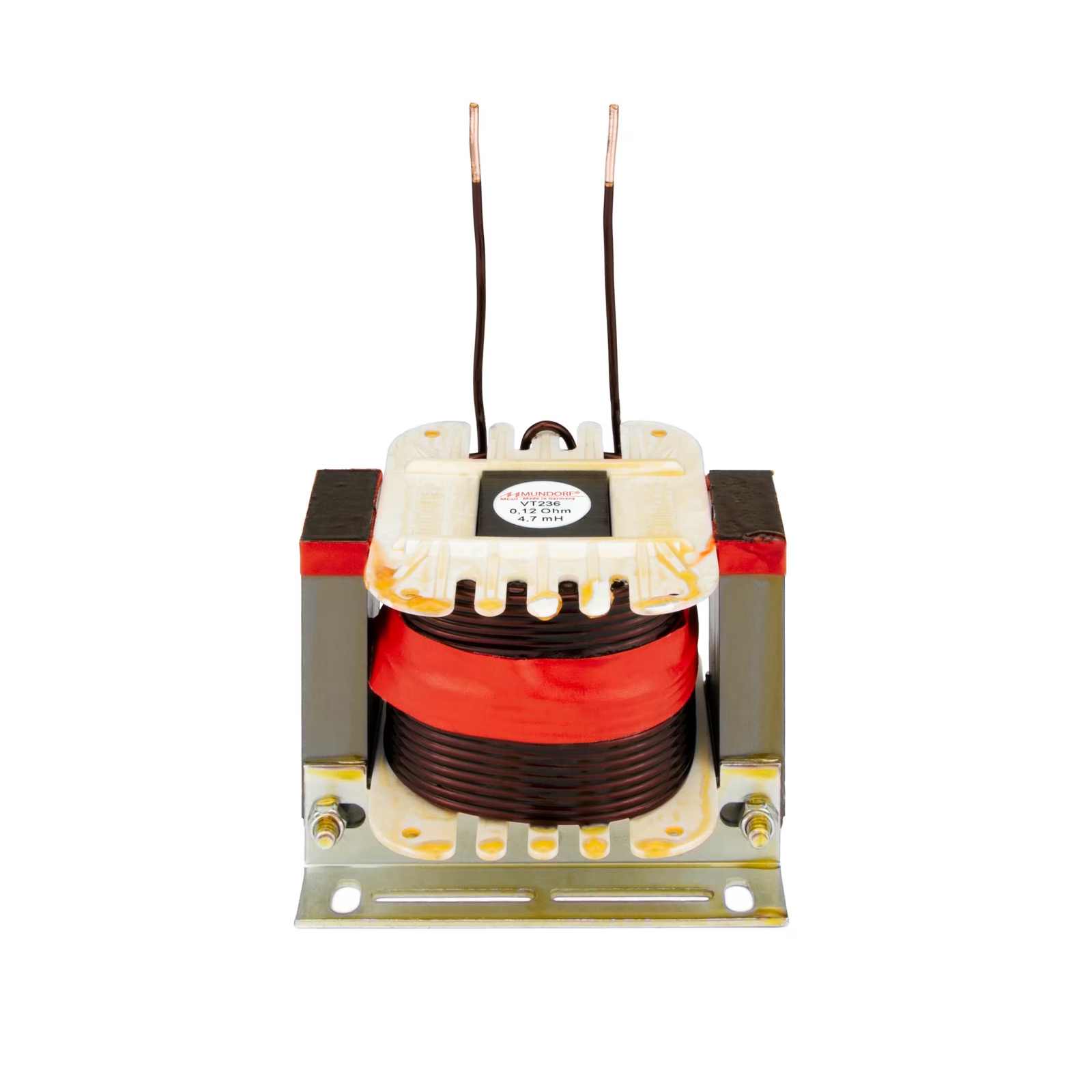
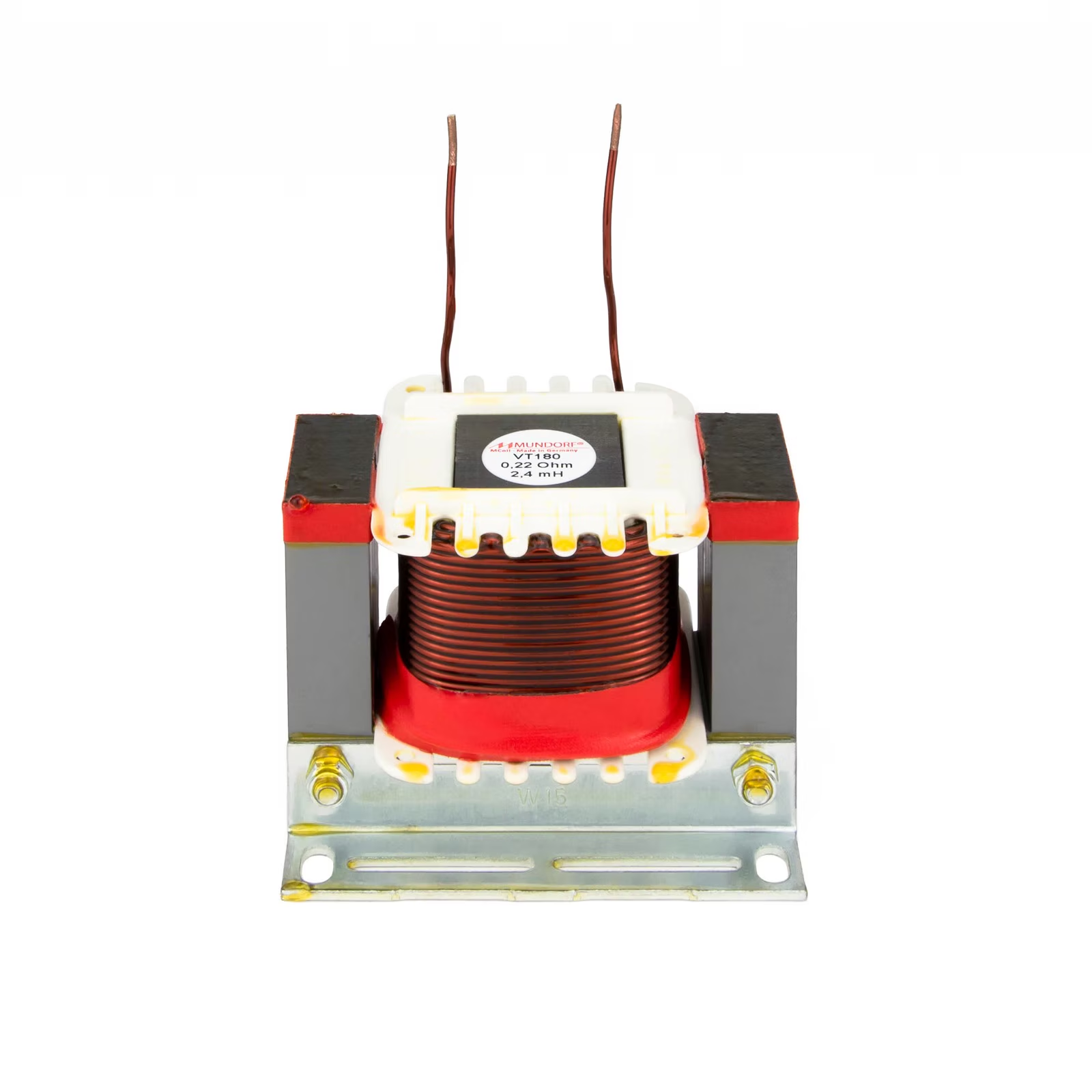
VT180-15
The MCoil VT is our Feron transformer core coil (E-core) with resin-soaked round wire – for very low RDC and maximum control at high inductance levels. Feron ensures clean small-signal response and very late saturation under load. The power handling capacity is typically over 1000 watts, making it ideal for PA applications. The resin soaking significantly reduces Macro-Microphony and adds additional clarity, contour, and fine dynamics.
Technologies
Characterized by a purity of at least 99.995% copper
OFC Copper
- Purity: at least 99.995% Cu, often 99.999% (4N) or higher
- Feature: almost oxygen-free (typically <10 ppm)
- Result: more stable grain boundaries, less oxide formation, more uniform electron flow
Fixes the windings to form a stable unit. Vibrations are effectively damped.
Baked Varnish Wire/ Resin Soaking
Baked varnish wire is enamel-insulated wire with an additional, activatable hot-melt outer layer, which has an adhesive effect when heated. The windings are thus fixed together.
Impact in practice
- The coil becomes mechanically stable and „works“ significantly less
- Micro-movements between windings are reduced
- In particular, this reduces macro-microphonic effects (the windings „work“ less) and increases “silence” during operation
Resin soaking as an alternative to baked varnish wire
If no baked lacquer wire is used, resin soaking carried out under vacuum can take over the mechanical fixing. The resin penetrates into the wrap, reduces cavities and degrees of freedom of movement and transforms the wrap into a stable compound. The result: significantly less macro microphones and an overall quieter, more precise operation of the coil.
Feron transformer cores (E-core): the power solution for large inductors with extremely low RDC and maximum load capacity.
Feron Transformer Core
The Feron transformer core coil uses an E core made of grain-oriented Feron sheet and has a significantly stronger magnetic circuit than the I core. This makes it possible to achieve even large inductors with very low internal resistance — ideal for bass and root tone.
The load capacity is usually above 1000 watts . This design is typically mechanically mounted in the housing, not on the printed circuit board.
The result: maximum control, level stability and dynamics under load.
Make sure that the left and right channels work identically, important for stable stage and positioning.
Tight Tolerances
Tight tolerances in capacitance, inductance, and resistance ensure that capacitors of one type are very close together in terms of their electrical properties. In crossovers, the left and right channels therefore work virtually identically: crossover frequencies, level ratios and phase positions match closely. This is the basis for stable, precise stereo imaging and reproducible results — in series production and also after service.
Tonal Effects
- precise, stable soundstage without drifting
- Coherent overall impression: left and right channels fuse into a single, seamless whole
- characteristic sound is reliably retained even after component replacement/repair
- More stable virtual center and clearer spatial layering
Similar configurations
1 VARIANTS
We are happy to advise you
Whether ideal components, technical know-how or individual solutions. Let us find the best solution for your application together!
For industrial customers
Order free samples
Would you like to test our products in yours? As a business customer, you can request free samples and see the quality and design for yourself.
NEWSLETTER
News and tips straight to your inbox. Subscribe to our newsletter and choose which topics matter to you.
Our services for manufacturers and cooperation partners
We manufacture coils in-house. This gives us flexibility—from material selection and micro-series production to standard products.
Material & design
Which coil material and design are best suited for your application? We provide independent advice, regardless of whether you ultimately choose a standard product or a custom solution.
Your material and parameter mix
Do you have a specific vision for the material, winding type, and electrical parameters? We can implement combinations outside of our standard range—either using our modular system or through a new development.
Custom small and micro-series
Thanks to our in-house production, we can manufacture coils in very small quantities—starting from a batch size of 1, provided it is economically viable. We can also provide approval samples before full-scale production upon request.

OFC Copper
- Purity: at least 99.995% Cu, often 99.999% (4N) or higher
- Feature: almost oxygen-free (typically <10 ppm)
- Result: more stable grain boundaries, less oxide formation, more uniform electron flow
Baked Varnish Wire/ Resin Soaking
Baked varnish wire is enamel-insulated wire with an additional, activatable hot-melt outer layer, which has an adhesive effect when heated. The windings are thus fixed together.
Impact in practice
- The coil becomes mechanically stable and „works“ significantly less
- Micro-movements between windings are reduced
- In particular, this reduces macro-microphonic effects (the windings „work“ less) and increases “silence” during operation
Resin soaking as an alternative to baked varnish wire
If no baked lacquer wire is used, resin soaking carried out under vacuum can take over the mechanical fixing. The resin penetrates into the wrap, reduces cavities and degrees of freedom of movement and transforms the wrap into a stable compound. The result: significantly less macro microphones and an overall quieter, more precise operation of the coil.
Feron Transformer Core
The Feron transformer core coil uses an E core made of grain-oriented Feron sheet and has a significantly stronger magnetic circuit than the I core. This makes it possible to achieve even large inductors with very low internal resistance — ideal for bass and root tone.
The load capacity is usually above 1000 watts . This design is typically mechanically mounted in the housing, not on the printed circuit board.
The result: maximum control, level stability and dynamics under load.
Tight Tolerances
Tight tolerances in capacitance, inductance, and resistance ensure that capacitors of one type are very close together in terms of their electrical properties. In crossovers, the left and right channels therefore work virtually identically: crossover frequencies, level ratios and phase positions match closely. This is the basis for stable, precise stereo imaging and reproducible results — in series production and also after service.
Tonal Effects
- precise, stable soundstage without drifting
- Coherent overall impression: left and right channels fuse into a single, seamless whole
- characteristic sound is reliably retained even after component replacement/repair
- More stable virtual center and clearer spatial layering

OFC Copper
- Purity: at least 99.995% Cu, often 99.999% (4N) or higher
- Feature: almost oxygen-free (typically <10 ppm)
- Result: more stable grain boundaries, less oxide formation, more uniform electron flow
Baked Varnish Wire/ Resin Soaking
Baked varnish wire is enamel-insulated wire with an additional, activatable hot-melt outer layer, which has an adhesive effect when heated. The windings are thus fixed together.
Impact in practice
- The coil becomes mechanically stable and „works“ significantly less
- Micro-movements between windings are reduced
- In particular, this reduces macro-microphonic effects (the windings „work“ less) and increases “silence” during operation
Resin soaking as an alternative to baked varnish wire
If no baked lacquer wire is used, resin soaking carried out under vacuum can take over the mechanical fixing. The resin penetrates into the wrap, reduces cavities and degrees of freedom of movement and transforms the wrap into a stable compound. The result: significantly less macro microphones and an overall quieter, more precise operation of the coil.
Feron Transformer Core
The Feron transformer core coil uses an E core made of grain-oriented Feron sheet and has a significantly stronger magnetic circuit than the I core. This makes it possible to achieve even large inductors with very low internal resistance — ideal for bass and root tone.
The load capacity is usually above 1000 watts . This design is typically mechanically mounted in the housing, not on the printed circuit board.
The result: maximum control, level stability and dynamics under load.
Tight Tolerances
Tight tolerances in capacitance, inductance, and resistance ensure that capacitors of one type are very close together in terms of their electrical properties. In crossovers, the left and right channels therefore work virtually identically: crossover frequencies, level ratios and phase positions match closely. This is the basis for stable, precise stereo imaging and reproducible results — in series production and also after service.
Tonal Effects
- precise, stable soundstage without drifting
- Coherent overall impression: left and right channels fuse into a single, seamless whole
- characteristic sound is reliably retained even after component replacement/repair
- More stable virtual center and clearer spatial layering

OFC Copper
- Purity: at least 99.995% Cu, often 99.999% (4N) or higher
- Feature: almost oxygen-free (typically <10 ppm)
- Result: more stable grain boundaries, less oxide formation, more uniform electron flow
Baked Varnish Wire/ Resin Soaking
Baked varnish wire is enamel-insulated wire with an additional, activatable hot-melt outer layer, which has an adhesive effect when heated. The windings are thus fixed together.
Impact in practice
- The coil becomes mechanically stable and „works“ significantly less
- Micro-movements between windings are reduced
- In particular, this reduces macro-microphonic effects (the windings „work“ less) and increases “silence” during operation
Resin soaking as an alternative to baked varnish wire
If no baked lacquer wire is used, resin soaking carried out under vacuum can take over the mechanical fixing. The resin penetrates into the wrap, reduces cavities and degrees of freedom of movement and transforms the wrap into a stable compound. The result: significantly less macro microphones and an overall quieter, more precise operation of the coil.
Feron Transformer Core
The Feron transformer core coil uses an E core made of grain-oriented Feron sheet and has a significantly stronger magnetic circuit than the I core. This makes it possible to achieve even large inductors with very low internal resistance — ideal for bass and root tone.
The load capacity is usually above 1000 watts . This design is typically mechanically mounted in the housing, not on the printed circuit board.
The result: maximum control, level stability and dynamics under load.
Tight Tolerances
Tight tolerances in capacitance, inductance, and resistance ensure that capacitors of one type are very close together in terms of their electrical properties. In crossovers, the left and right channels therefore work virtually identically: crossover frequencies, level ratios and phase positions match closely. This is the basis for stable, precise stereo imaging and reproducible results — in series production and also after service.
Tonal Effects
- precise, stable soundstage without drifting
- Coherent overall impression: left and right channels fuse into a single, seamless whole
- characteristic sound is reliably retained even after component replacement/repair
- More stable virtual center and clearer spatial layering

OFC Copper
- Purity: at least 99.995% Cu, often 99.999% (4N) or higher
- Feature: almost oxygen-free (typically <10 ppm)
- Result: more stable grain boundaries, less oxide formation, more uniform electron flow
Baked Varnish Wire/ Resin Soaking
Baked varnish wire is enamel-insulated wire with an additional, activatable hot-melt outer layer, which has an adhesive effect when heated. The windings are thus fixed together.
Impact in practice
- The coil becomes mechanically stable and „works“ significantly less
- Micro-movements between windings are reduced
- In particular, this reduces macro-microphonic effects (the windings „work“ less) and increases “silence” during operation
Resin soaking as an alternative to baked varnish wire
If no baked lacquer wire is used, resin soaking carried out under vacuum can take over the mechanical fixing. The resin penetrates into the wrap, reduces cavities and degrees of freedom of movement and transforms the wrap into a stable compound. The result: significantly less macro microphones and an overall quieter, more precise operation of the coil.
Feron Transformer Core
The Feron transformer core coil uses an E core made of grain-oriented Feron sheet and has a significantly stronger magnetic circuit than the I core. This makes it possible to achieve even large inductors with very low internal resistance — ideal for bass and root tone.
The load capacity is usually above 1000 watts . This design is typically mechanically mounted in the housing, not on the printed circuit board.
The result: maximum control, level stability and dynamics under load.
Tight Tolerances
Tight tolerances in capacitance, inductance, and resistance ensure that capacitors of one type are very close together in terms of their electrical properties. In crossovers, the left and right channels therefore work virtually identically: crossover frequencies, level ratios and phase positions match closely. This is the basis for stable, precise stereo imaging and reproducible results — in series production and also after service.
Tonal Effects
- precise, stable soundstage without drifting
- Coherent overall impression: left and right channels fuse into a single, seamless whole
- characteristic sound is reliably retained even after component replacement/repair
- More stable virtual center and clearer spatial layering

OFC Copper
- Purity: at least 99.995% Cu, often 99.999% (4N) or higher
- Feature: almost oxygen-free (typically <10 ppm)
- Result: more stable grain boundaries, less oxide formation, more uniform electron flow
Baked Varnish Wire/ Resin Soaking
Baked varnish wire is enamel-insulated wire with an additional, activatable hot-melt outer layer, which has an adhesive effect when heated. The windings are thus fixed together.
Impact in practice
- The coil becomes mechanically stable and „works“ significantly less
- Micro-movements between windings are reduced
- In particular, this reduces macro-microphonic effects (the windings „work“ less) and increases “silence” during operation
Resin soaking as an alternative to baked varnish wire
If no baked lacquer wire is used, resin soaking carried out under vacuum can take over the mechanical fixing. The resin penetrates into the wrap, reduces cavities and degrees of freedom of movement and transforms the wrap into a stable compound. The result: significantly less macro microphones and an overall quieter, more precise operation of the coil.
Feron Transformer Core
The Feron transformer core coil uses an E core made of grain-oriented Feron sheet and has a significantly stronger magnetic circuit than the I core. This makes it possible to achieve even large inductors with very low internal resistance — ideal for bass and root tone.
The load capacity is usually above 1000 watts . This design is typically mechanically mounted in the housing, not on the printed circuit board.
The result: maximum control, level stability and dynamics under load.
Tight Tolerances
Tight tolerances in capacitance, inductance, and resistance ensure that capacitors of one type are very close together in terms of their electrical properties. In crossovers, the left and right channels therefore work virtually identically: crossover frequencies, level ratios and phase positions match closely. This is the basis for stable, precise stereo imaging and reproducible results — in series production and also after service.
Tonal Effects
- precise, stable soundstage without drifting
- Coherent overall impression: left and right channels fuse into a single, seamless whole
- characteristic sound is reliably retained even after component replacement/repair
- More stable virtual center and clearer spatial layering

OFC Copper
- Purity: at least 99.995% Cu, often 99.999% (4N) or higher
- Feature: almost oxygen-free (typically <10 ppm)
- Result: more stable grain boundaries, less oxide formation, more uniform electron flow
Baked Varnish Wire/ Resin Soaking
Baked varnish wire is enamel-insulated wire with an additional, activatable hot-melt outer layer, which has an adhesive effect when heated. The windings are thus fixed together.
Impact in practice
- The coil becomes mechanically stable and „works“ significantly less
- Micro-movements between windings are reduced
- In particular, this reduces macro-microphonic effects (the windings „work“ less) and increases “silence” during operation
Resin soaking as an alternative to baked varnish wire
If no baked lacquer wire is used, resin soaking carried out under vacuum can take over the mechanical fixing. The resin penetrates into the wrap, reduces cavities and degrees of freedom of movement and transforms the wrap into a stable compound. The result: significantly less macro microphones and an overall quieter, more precise operation of the coil.
Feron Transformer Core
The Feron transformer core coil uses an E core made of grain-oriented Feron sheet and has a significantly stronger magnetic circuit than the I core. This makes it possible to achieve even large inductors with very low internal resistance — ideal for bass and root tone.
The load capacity is usually above 1000 watts . This design is typically mechanically mounted in the housing, not on the printed circuit board.
The result: maximum control, level stability and dynamics under load.
Tight Tolerances
Tight tolerances in capacitance, inductance, and resistance ensure that capacitors of one type are very close together in terms of their electrical properties. In crossovers, the left and right channels therefore work virtually identically: crossover frequencies, level ratios and phase positions match closely. This is the basis for stable, precise stereo imaging and reproducible results — in series production and also after service.
Tonal Effects
- precise, stable soundstage without drifting
- Coherent overall impression: left and right channels fuse into a single, seamless whole
- characteristic sound is reliably retained even after component replacement/repair
- More stable virtual center and clearer spatial layering

OFC Copper
- Purity: at least 99.995% Cu, often 99.999% (4N) or higher
- Feature: almost oxygen-free (typically <10 ppm)
- Result: more stable grain boundaries, less oxide formation, more uniform electron flow
Baked Varnish Wire/ Resin Soaking
Baked varnish wire is enamel-insulated wire with an additional, activatable hot-melt outer layer, which has an adhesive effect when heated. The windings are thus fixed together.
Impact in practice
- The coil becomes mechanically stable and „works“ significantly less
- Micro-movements between windings are reduced
- In particular, this reduces macro-microphonic effects (the windings „work“ less) and increases “silence” during operation
Resin soaking as an alternative to baked varnish wire
If no baked lacquer wire is used, resin soaking carried out under vacuum can take over the mechanical fixing. The resin penetrates into the wrap, reduces cavities and degrees of freedom of movement and transforms the wrap into a stable compound. The result: significantly less macro microphones and an overall quieter, more precise operation of the coil.
Feron Transformer Core
The Feron transformer core coil uses an E core made of grain-oriented Feron sheet and has a significantly stronger magnetic circuit than the I core. This makes it possible to achieve even large inductors with very low internal resistance — ideal for bass and root tone.
The load capacity is usually above 1000 watts . This design is typically mechanically mounted in the housing, not on the printed circuit board.
The result: maximum control, level stability and dynamics under load.
Tight Tolerances
Tight tolerances in capacitance, inductance, and resistance ensure that capacitors of one type are very close together in terms of their electrical properties. In crossovers, the left and right channels therefore work virtually identically: crossover frequencies, level ratios and phase positions match closely. This is the basis for stable, precise stereo imaging and reproducible results — in series production and also after service.
Tonal Effects
- precise, stable soundstage without drifting
- Coherent overall impression: left and right channels fuse into a single, seamless whole
- characteristic sound is reliably retained even after component replacement/repair
- More stable virtual center and clearer spatial layering

OFC Copper
- Purity: at least 99.995% Cu, often 99.999% (4N) or higher
- Feature: almost oxygen-free (typically <10 ppm)
- Result: more stable grain boundaries, less oxide formation, more uniform electron flow
Baked Varnish Wire/ Resin Soaking
Baked varnish wire is enamel-insulated wire with an additional, activatable hot-melt outer layer, which has an adhesive effect when heated. The windings are thus fixed together.
Impact in practice
- The coil becomes mechanically stable and „works“ significantly less
- Micro-movements between windings are reduced
- In particular, this reduces macro-microphonic effects (the windings „work“ less) and increases “silence” during operation
Resin soaking as an alternative to baked varnish wire
If no baked lacquer wire is used, resin soaking carried out under vacuum can take over the mechanical fixing. The resin penetrates into the wrap, reduces cavities and degrees of freedom of movement and transforms the wrap into a stable compound. The result: significantly less macro microphones and an overall quieter, more precise operation of the coil.
Feron Transformer Core
The Feron transformer core coil uses an E core made of grain-oriented Feron sheet and has a significantly stronger magnetic circuit than the I core. This makes it possible to achieve even large inductors with very low internal resistance — ideal for bass and root tone.
The load capacity is usually above 1000 watts . This design is typically mechanically mounted in the housing, not on the printed circuit board.
The result: maximum control, level stability and dynamics under load.
Tight Tolerances
Tight tolerances in capacitance, inductance, and resistance ensure that capacitors of one type are very close together in terms of their electrical properties. In crossovers, the left and right channels therefore work virtually identically: crossover frequencies, level ratios and phase positions match closely. This is the basis for stable, precise stereo imaging and reproducible results — in series production and also after service.
Tonal Effects
- precise, stable soundstage without drifting
- Coherent overall impression: left and right channels fuse into a single, seamless whole
- characteristic sound is reliably retained even after component replacement/repair
- More stable virtual center and clearer spatial layering

OFC Copper
- Purity: at least 99.995% Cu, often 99.999% (4N) or higher
- Feature: almost oxygen-free (typically <10 ppm)
- Result: more stable grain boundaries, less oxide formation, more uniform electron flow
Baked Varnish Wire/ Resin Soaking
Baked varnish wire is enamel-insulated wire with an additional, activatable hot-melt outer layer, which has an adhesive effect when heated. The windings are thus fixed together.
Impact in practice
- The coil becomes mechanically stable and „works“ significantly less
- Micro-movements between windings are reduced
- In particular, this reduces macro-microphonic effects (the windings „work“ less) and increases “silence” during operation
Resin soaking as an alternative to baked varnish wire
If no baked lacquer wire is used, resin soaking carried out under vacuum can take over the mechanical fixing. The resin penetrates into the wrap, reduces cavities and degrees of freedom of movement and transforms the wrap into a stable compound. The result: significantly less macro microphones and an overall quieter, more precise operation of the coil.
Feron Transformer Core
The Feron transformer core coil uses an E core made of grain-oriented Feron sheet and has a significantly stronger magnetic circuit than the I core. This makes it possible to achieve even large inductors with very low internal resistance — ideal for bass and root tone.
The load capacity is usually above 1000 watts . This design is typically mechanically mounted in the housing, not on the printed circuit board.
The result: maximum control, level stability and dynamics under load.
Tight Tolerances
Tight tolerances in capacitance, inductance, and resistance ensure that capacitors of one type are very close together in terms of their electrical properties. In crossovers, the left and right channels therefore work virtually identically: crossover frequencies, level ratios and phase positions match closely. This is the basis for stable, precise stereo imaging and reproducible results — in series production and also after service.
Tonal Effects
- precise, stable soundstage without drifting
- Coherent overall impression: left and right channels fuse into a single, seamless whole
- characteristic sound is reliably retained even after component replacement/repair
- More stable virtual center and clearer spatial layering

OFC Copper
- Purity: at least 99.995% Cu, often 99.999% (4N) or higher
- Feature: almost oxygen-free (typically <10 ppm)
- Result: more stable grain boundaries, less oxide formation, more uniform electron flow
Baked Varnish Wire/ Resin Soaking
Baked varnish wire is enamel-insulated wire with an additional, activatable hot-melt outer layer, which has an adhesive effect when heated. The windings are thus fixed together.
Impact in practice
- The coil becomes mechanically stable and „works“ significantly less
- Micro-movements between windings are reduced
- In particular, this reduces macro-microphonic effects (the windings „work“ less) and increases “silence” during operation
Resin soaking as an alternative to baked varnish wire
If no baked lacquer wire is used, resin soaking carried out under vacuum can take over the mechanical fixing. The resin penetrates into the wrap, reduces cavities and degrees of freedom of movement and transforms the wrap into a stable compound. The result: significantly less macro microphones and an overall quieter, more precise operation of the coil.
Feron Transformer Core
The Feron transformer core coil uses an E core made of grain-oriented Feron sheet and has a significantly stronger magnetic circuit than the I core. This makes it possible to achieve even large inductors with very low internal resistance — ideal for bass and root tone.
The load capacity is usually above 1000 watts . This design is typically mechanically mounted in the housing, not on the printed circuit board.
The result: maximum control, level stability and dynamics under load.
Tight Tolerances
Tight tolerances in capacitance, inductance, and resistance ensure that capacitors of one type are very close together in terms of their electrical properties. In crossovers, the left and right channels therefore work virtually identically: crossover frequencies, level ratios and phase positions match closely. This is the basis for stable, precise stereo imaging and reproducible results — in series production and also after service.
Tonal Effects
- precise, stable soundstage without drifting
- Coherent overall impression: left and right channels fuse into a single, seamless whole
- characteristic sound is reliably retained even after component replacement/repair
- More stable virtual center and clearer spatial layering

OFC Copper
- Purity: at least 99.995% Cu, often 99.999% (4N) or higher
- Feature: almost oxygen-free (typically <10 ppm)
- Result: more stable grain boundaries, less oxide formation, more uniform electron flow
Baked Varnish Wire/ Resin Soaking
Baked varnish wire is enamel-insulated wire with an additional, activatable hot-melt outer layer, which has an adhesive effect when heated. The windings are thus fixed together.
Impact in practice
- The coil becomes mechanically stable and „works“ significantly less
- Micro-movements between windings are reduced
- In particular, this reduces macro-microphonic effects (the windings „work“ less) and increases “silence” during operation
Resin soaking as an alternative to baked varnish wire
If no baked lacquer wire is used, resin soaking carried out under vacuum can take over the mechanical fixing. The resin penetrates into the wrap, reduces cavities and degrees of freedom of movement and transforms the wrap into a stable compound. The result: significantly less macro microphones and an overall quieter, more precise operation of the coil.
Feron Transformer Core
The Feron transformer core coil uses an E core made of grain-oriented Feron sheet and has a significantly stronger magnetic circuit than the I core. This makes it possible to achieve even large inductors with very low internal resistance — ideal for bass and root tone.
The load capacity is usually above 1000 watts . This design is typically mechanically mounted in the housing, not on the printed circuit board.
The result: maximum control, level stability and dynamics under load.
Tight Tolerances
Tight tolerances in capacitance, inductance, and resistance ensure that capacitors of one type are very close together in terms of their electrical properties. In crossovers, the left and right channels therefore work virtually identically: crossover frequencies, level ratios and phase positions match closely. This is the basis for stable, precise stereo imaging and reproducible results — in series production and also after service.
Tonal Effects
- precise, stable soundstage without drifting
- Coherent overall impression: left and right channels fuse into a single, seamless whole
- characteristic sound is reliably retained even after component replacement/repair
- More stable virtual center and clearer spatial layering

OFC Copper
- Purity: at least 99.995% Cu, often 99.999% (4N) or higher
- Feature: almost oxygen-free (typically <10 ppm)
- Result: more stable grain boundaries, less oxide formation, more uniform electron flow
Baked Varnish Wire/ Resin Soaking
Baked varnish wire is enamel-insulated wire with an additional, activatable hot-melt outer layer, which has an adhesive effect when heated. The windings are thus fixed together.
Impact in practice
- The coil becomes mechanically stable and „works“ significantly less
- Micro-movements between windings are reduced
- In particular, this reduces macro-microphonic effects (the windings „work“ less) and increases “silence” during operation
Resin soaking as an alternative to baked varnish wire
If no baked lacquer wire is used, resin soaking carried out under vacuum can take over the mechanical fixing. The resin penetrates into the wrap, reduces cavities and degrees of freedom of movement and transforms the wrap into a stable compound. The result: significantly less macro microphones and an overall quieter, more precise operation of the coil.
Feron Transformer Core
The Feron transformer core coil uses an E core made of grain-oriented Feron sheet and has a significantly stronger magnetic circuit than the I core. This makes it possible to achieve even large inductors with very low internal resistance — ideal for bass and root tone.
The load capacity is usually above 1000 watts . This design is typically mechanically mounted in the housing, not on the printed circuit board.
The result: maximum control, level stability and dynamics under load.
Tight Tolerances
Tight tolerances in capacitance, inductance, and resistance ensure that capacitors of one type are very close together in terms of their electrical properties. In crossovers, the left and right channels therefore work virtually identically: crossover frequencies, level ratios and phase positions match closely. This is the basis for stable, precise stereo imaging and reproducible results — in series production and also after service.
Tonal Effects
- precise, stable soundstage without drifting
- Coherent overall impression: left and right channels fuse into a single, seamless whole
- characteristic sound is reliably retained even after component replacement/repair
- More stable virtual center and clearer spatial layering

OFC Copper
- Purity: at least 99.995% Cu, often 99.999% (4N) or higher
- Feature: almost oxygen-free (typically <10 ppm)
- Result: more stable grain boundaries, less oxide formation, more uniform electron flow
Baked Varnish Wire/ Resin Soaking
Baked varnish wire is enamel-insulated wire with an additional, activatable hot-melt outer layer, which has an adhesive effect when heated. The windings are thus fixed together.
Impact in practice
- The coil becomes mechanically stable and „works“ significantly less
- Micro-movements between windings are reduced
- In particular, this reduces macro-microphonic effects (the windings „work“ less) and increases “silence” during operation
Resin soaking as an alternative to baked varnish wire
If no baked lacquer wire is used, resin soaking carried out under vacuum can take over the mechanical fixing. The resin penetrates into the wrap, reduces cavities and degrees of freedom of movement and transforms the wrap into a stable compound. The result: significantly less macro microphones and an overall quieter, more precise operation of the coil.
Feron Transformer Core
The Feron transformer core coil uses an E core made of grain-oriented Feron sheet and has a significantly stronger magnetic circuit than the I core. This makes it possible to achieve even large inductors with very low internal resistance — ideal for bass and root tone.
The load capacity is usually above 1000 watts . This design is typically mechanically mounted in the housing, not on the printed circuit board.
The result: maximum control, level stability and dynamics under load.
Tight Tolerances
Tight tolerances in capacitance, inductance, and resistance ensure that capacitors of one type are very close together in terms of their electrical properties. In crossovers, the left and right channels therefore work virtually identically: crossover frequencies, level ratios and phase positions match closely. This is the basis for stable, precise stereo imaging and reproducible results — in series production and also after service.
Tonal Effects
- precise, stable soundstage without drifting
- Coherent overall impression: left and right channels fuse into a single, seamless whole
- characteristic sound is reliably retained even after component replacement/repair
- More stable virtual center and clearer spatial layering

OFC Copper
- Purity: at least 99.995% Cu, often 99.999% (4N) or higher
- Feature: almost oxygen-free (typically <10 ppm)
- Result: more stable grain boundaries, less oxide formation, more uniform electron flow
Baked Varnish Wire/ Resin Soaking
Baked varnish wire is enamel-insulated wire with an additional, activatable hot-melt outer layer, which has an adhesive effect when heated. The windings are thus fixed together.
Impact in practice
- The coil becomes mechanically stable and „works“ significantly less
- Micro-movements between windings are reduced
- In particular, this reduces macro-microphonic effects (the windings „work“ less) and increases “silence” during operation
Resin soaking as an alternative to baked varnish wire
If no baked lacquer wire is used, resin soaking carried out under vacuum can take over the mechanical fixing. The resin penetrates into the wrap, reduces cavities and degrees of freedom of movement and transforms the wrap into a stable compound. The result: significantly less macro microphones and an overall quieter, more precise operation of the coil.
Feron Transformer Core
The Feron transformer core coil uses an E core made of grain-oriented Feron sheet and has a significantly stronger magnetic circuit than the I core. This makes it possible to achieve even large inductors with very low internal resistance — ideal for bass and root tone.
The load capacity is usually above 1000 watts . This design is typically mechanically mounted in the housing, not on the printed circuit board.
The result: maximum control, level stability and dynamics under load.
Tight Tolerances
Tight tolerances in capacitance, inductance, and resistance ensure that capacitors of one type are very close together in terms of their electrical properties. In crossovers, the left and right channels therefore work virtually identically: crossover frequencies, level ratios and phase positions match closely. This is the basis for stable, precise stereo imaging and reproducible results — in series production and also after service.
Tonal Effects
- precise, stable soundstage without drifting
- Coherent overall impression: left and right channels fuse into a single, seamless whole
- characteristic sound is reliably retained even after component replacement/repair
- More stable virtual center and clearer spatial layering

OFC Copper
- Purity: at least 99.995% Cu, often 99.999% (4N) or higher
- Feature: almost oxygen-free (typically <10 ppm)
- Result: more stable grain boundaries, less oxide formation, more uniform electron flow
Baked Varnish Wire/ Resin Soaking
Baked varnish wire is enamel-insulated wire with an additional, activatable hot-melt outer layer, which has an adhesive effect when heated. The windings are thus fixed together.
Impact in practice
- The coil becomes mechanically stable and „works“ significantly less
- Micro-movements between windings are reduced
- In particular, this reduces macro-microphonic effects (the windings „work“ less) and increases “silence” during operation
Resin soaking as an alternative to baked varnish wire
If no baked lacquer wire is used, resin soaking carried out under vacuum can take over the mechanical fixing. The resin penetrates into the wrap, reduces cavities and degrees of freedom of movement and transforms the wrap into a stable compound. The result: significantly less macro microphones and an overall quieter, more precise operation of the coil.
Feron Transformer Core
The Feron transformer core coil uses an E core made of grain-oriented Feron sheet and has a significantly stronger magnetic circuit than the I core. This makes it possible to achieve even large inductors with very low internal resistance — ideal for bass and root tone.
The load capacity is usually above 1000 watts . This design is typically mechanically mounted in the housing, not on the printed circuit board.
The result: maximum control, level stability and dynamics under load.
Tight Tolerances
Tight tolerances in capacitance, inductance, and resistance ensure that capacitors of one type are very close together in terms of their electrical properties. In crossovers, the left and right channels therefore work virtually identically: crossover frequencies, level ratios and phase positions match closely. This is the basis for stable, precise stereo imaging and reproducible results — in series production and also after service.
Tonal Effects
- precise, stable soundstage without drifting
- Coherent overall impression: left and right channels fuse into a single, seamless whole
- characteristic sound is reliably retained even after component replacement/repair
- More stable virtual center and clearer spatial layering

OFC Copper
- Purity: at least 99.995% Cu, often 99.999% (4N) or higher
- Feature: almost oxygen-free (typically <10 ppm)
- Result: more stable grain boundaries, less oxide formation, more uniform electron flow
Baked Varnish Wire/ Resin Soaking
Baked varnish wire is enamel-insulated wire with an additional, activatable hot-melt outer layer, which has an adhesive effect when heated. The windings are thus fixed together.
Impact in practice
- The coil becomes mechanically stable and „works“ significantly less
- Micro-movements between windings are reduced
- In particular, this reduces macro-microphonic effects (the windings „work“ less) and increases “silence” during operation
Resin soaking as an alternative to baked varnish wire
If no baked lacquer wire is used, resin soaking carried out under vacuum can take over the mechanical fixing. The resin penetrates into the wrap, reduces cavities and degrees of freedom of movement and transforms the wrap into a stable compound. The result: significantly less macro microphones and an overall quieter, more precise operation of the coil.
Feron Transformer Core
The Feron transformer core coil uses an E core made of grain-oriented Feron sheet and has a significantly stronger magnetic circuit than the I core. This makes it possible to achieve even large inductors with very low internal resistance — ideal for bass and root tone.
The load capacity is usually above 1000 watts . This design is typically mechanically mounted in the housing, not on the printed circuit board.
The result: maximum control, level stability and dynamics under load.
Tight Tolerances
Tight tolerances in capacitance, inductance, and resistance ensure that capacitors of one type are very close together in terms of their electrical properties. In crossovers, the left and right channels therefore work virtually identically: crossover frequencies, level ratios and phase positions match closely. This is the basis for stable, precise stereo imaging and reproducible results — in series production and also after service.
Tonal Effects
- precise, stable soundstage without drifting
- Coherent overall impression: left and right channels fuse into a single, seamless whole
- characteristic sound is reliably retained even after component replacement/repair
- More stable virtual center and clearer spatial layering

OFC Copper
- Purity: at least 99.995% Cu, often 99.999% (4N) or higher
- Feature: almost oxygen-free (typically <10 ppm)
- Result: more stable grain boundaries, less oxide formation, more uniform electron flow
Baked Varnish Wire/ Resin Soaking
Baked varnish wire is enamel-insulated wire with an additional, activatable hot-melt outer layer, which has an adhesive effect when heated. The windings are thus fixed together.
Impact in practice
- The coil becomes mechanically stable and „works“ significantly less
- Micro-movements between windings are reduced
- In particular, this reduces macro-microphonic effects (the windings „work“ less) and increases “silence” during operation
Resin soaking as an alternative to baked varnish wire
If no baked lacquer wire is used, resin soaking carried out under vacuum can take over the mechanical fixing. The resin penetrates into the wrap, reduces cavities and degrees of freedom of movement and transforms the wrap into a stable compound. The result: significantly less macro microphones and an overall quieter, more precise operation of the coil.
Feron Transformer Core
The Feron transformer core coil uses an E core made of grain-oriented Feron sheet and has a significantly stronger magnetic circuit than the I core. This makes it possible to achieve even large inductors with very low internal resistance — ideal for bass and root tone.
The load capacity is usually above 1000 watts . This design is typically mechanically mounted in the housing, not on the printed circuit board.
The result: maximum control, level stability and dynamics under load.
Tight Tolerances
Tight tolerances in capacitance, inductance, and resistance ensure that capacitors of one type are very close together in terms of their electrical properties. In crossovers, the left and right channels therefore work virtually identically: crossover frequencies, level ratios and phase positions match closely. This is the basis for stable, precise stereo imaging and reproducible results — in series production and also after service.
Tonal Effects
- precise, stable soundstage without drifting
- Coherent overall impression: left and right channels fuse into a single, seamless whole
- characteristic sound is reliably retained even after component replacement/repair
- More stable virtual center and clearer spatial layering

OFC Copper
- Purity: at least 99.995% Cu, often 99.999% (4N) or higher
- Feature: almost oxygen-free (typically <10 ppm)
- Result: more stable grain boundaries, less oxide formation, more uniform electron flow
Baked Varnish Wire/ Resin Soaking
Baked varnish wire is enamel-insulated wire with an additional, activatable hot-melt outer layer, which has an adhesive effect when heated. The windings are thus fixed together.
Impact in practice
- The coil becomes mechanically stable and „works“ significantly less
- Micro-movements between windings are reduced
- In particular, this reduces macro-microphonic effects (the windings „work“ less) and increases “silence” during operation
Resin soaking as an alternative to baked varnish wire
If no baked lacquer wire is used, resin soaking carried out under vacuum can take over the mechanical fixing. The resin penetrates into the wrap, reduces cavities and degrees of freedom of movement and transforms the wrap into a stable compound. The result: significantly less macro microphones and an overall quieter, more precise operation of the coil.
Feron Transformer Core
The Feron transformer core coil uses an E core made of grain-oriented Feron sheet and has a significantly stronger magnetic circuit than the I core. This makes it possible to achieve even large inductors with very low internal resistance — ideal for bass and root tone.
The load capacity is usually above 1000 watts . This design is typically mechanically mounted in the housing, not on the printed circuit board.
The result: maximum control, level stability and dynamics under load.
Tight Tolerances
Tight tolerances in capacitance, inductance, and resistance ensure that capacitors of one type are very close together in terms of their electrical properties. In crossovers, the left and right channels therefore work virtually identically: crossover frequencies, level ratios and phase positions match closely. This is the basis for stable, precise stereo imaging and reproducible results — in series production and also after service.
Tonal Effects
- precise, stable soundstage without drifting
- Coherent overall impression: left and right channels fuse into a single, seamless whole
- characteristic sound is reliably retained even after component replacement/repair
- More stable virtual center and clearer spatial layering

OFC Copper
- Purity: at least 99.995% Cu, often 99.999% (4N) or higher
- Feature: almost oxygen-free (typically <10 ppm)
- Result: more stable grain boundaries, less oxide formation, more uniform electron flow
Baked Varnish Wire/ Resin Soaking
Baked varnish wire is enamel-insulated wire with an additional, activatable hot-melt outer layer, which has an adhesive effect when heated. The windings are thus fixed together.
Impact in practice
- The coil becomes mechanically stable and „works“ significantly less
- Micro-movements between windings are reduced
- In particular, this reduces macro-microphonic effects (the windings „work“ less) and increases “silence” during operation
Resin soaking as an alternative to baked varnish wire
If no baked lacquer wire is used, resin soaking carried out under vacuum can take over the mechanical fixing. The resin penetrates into the wrap, reduces cavities and degrees of freedom of movement and transforms the wrap into a stable compound. The result: significantly less macro microphones and an overall quieter, more precise operation of the coil.
Feron Transformer Core
The Feron transformer core coil uses an E core made of grain-oriented Feron sheet and has a significantly stronger magnetic circuit than the I core. This makes it possible to achieve even large inductors with very low internal resistance — ideal for bass and root tone.
The load capacity is usually above 1000 watts . This design is typically mechanically mounted in the housing, not on the printed circuit board.
The result: maximum control, level stability and dynamics under load.
Tight Tolerances
Tight tolerances in capacitance, inductance, and resistance ensure that capacitors of one type are very close together in terms of their electrical properties. In crossovers, the left and right channels therefore work virtually identically: crossover frequencies, level ratios and phase positions match closely. This is the basis for stable, precise stereo imaging and reproducible results — in series production and also after service.
Tonal Effects
- precise, stable soundstage without drifting
- Coherent overall impression: left and right channels fuse into a single, seamless whole
- characteristic sound is reliably retained even after component replacement/repair
- More stable virtual center and clearer spatial layering

OFC Copper
- Purity: at least 99.995% Cu, often 99.999% (4N) or higher
- Feature: almost oxygen-free (typically <10 ppm)
- Result: more stable grain boundaries, less oxide formation, more uniform electron flow
Baked Varnish Wire/ Resin Soaking
Baked varnish wire is enamel-insulated wire with an additional, activatable hot-melt outer layer, which has an adhesive effect when heated. The windings are thus fixed together.
Impact in practice
- The coil becomes mechanically stable and „works“ significantly less
- Micro-movements between windings are reduced
- In particular, this reduces macro-microphonic effects (the windings „work“ less) and increases “silence” during operation
Resin soaking as an alternative to baked varnish wire
If no baked lacquer wire is used, resin soaking carried out under vacuum can take over the mechanical fixing. The resin penetrates into the wrap, reduces cavities and degrees of freedom of movement and transforms the wrap into a stable compound. The result: significantly less macro microphones and an overall quieter, more precise operation of the coil.
Feron Transformer Core
The Feron transformer core coil uses an E core made of grain-oriented Feron sheet and has a significantly stronger magnetic circuit than the I core. This makes it possible to achieve even large inductors with very low internal resistance — ideal for bass and root tone.
The load capacity is usually above 1000 watts . This design is typically mechanically mounted in the housing, not on the printed circuit board.
The result: maximum control, level stability and dynamics under load.
Tight Tolerances
Tight tolerances in capacitance, inductance, and resistance ensure that capacitors of one type are very close together in terms of their electrical properties. In crossovers, the left and right channels therefore work virtually identically: crossover frequencies, level ratios and phase positions match closely. This is the basis for stable, precise stereo imaging and reproducible results — in series production and also after service.
Tonal Effects
- precise, stable soundstage without drifting
- Coherent overall impression: left and right channels fuse into a single, seamless whole
- characteristic sound is reliably retained even after component replacement/repair
- More stable virtual center and clearer spatial layering

OFC Copper
- Purity: at least 99.995% Cu, often 99.999% (4N) or higher
- Feature: almost oxygen-free (typically <10 ppm)
- Result: more stable grain boundaries, less oxide formation, more uniform electron flow
Baked Varnish Wire/ Resin Soaking
Baked varnish wire is enamel-insulated wire with an additional, activatable hot-melt outer layer, which has an adhesive effect when heated. The windings are thus fixed together.
Impact in practice
- The coil becomes mechanically stable and „works“ significantly less
- Micro-movements between windings are reduced
- In particular, this reduces macro-microphonic effects (the windings „work“ less) and increases “silence” during operation
Resin soaking as an alternative to baked varnish wire
If no baked lacquer wire is used, resin soaking carried out under vacuum can take over the mechanical fixing. The resin penetrates into the wrap, reduces cavities and degrees of freedom of movement and transforms the wrap into a stable compound. The result: significantly less macro microphones and an overall quieter, more precise operation of the coil.
Feron Transformer Core
The Feron transformer core coil uses an E core made of grain-oriented Feron sheet and has a significantly stronger magnetic circuit than the I core. This makes it possible to achieve even large inductors with very low internal resistance — ideal for bass and root tone.
The load capacity is usually above 1000 watts . This design is typically mechanically mounted in the housing, not on the printed circuit board.
The result: maximum control, level stability and dynamics under load.
Tight Tolerances
Tight tolerances in capacitance, inductance, and resistance ensure that capacitors of one type are very close together in terms of their electrical properties. In crossovers, the left and right channels therefore work virtually identically: crossover frequencies, level ratios and phase positions match closely. This is the basis for stable, precise stereo imaging and reproducible results — in series production and also after service.
Tonal Effects
- precise, stable soundstage without drifting
- Coherent overall impression: left and right channels fuse into a single, seamless whole
- characteristic sound is reliably retained even after component replacement/repair
- More stable virtual center and clearer spatial layering

OFC Copper
- Purity: at least 99.995% Cu, often 99.999% (4N) or higher
- Feature: almost oxygen-free (typically <10 ppm)
- Result: more stable grain boundaries, less oxide formation, more uniform electron flow
Baked Varnish Wire/ Resin Soaking
Baked varnish wire is enamel-insulated wire with an additional, activatable hot-melt outer layer, which has an adhesive effect when heated. The windings are thus fixed together.
Impact in practice
- The coil becomes mechanically stable and „works“ significantly less
- Micro-movements between windings are reduced
- In particular, this reduces macro-microphonic effects (the windings „work“ less) and increases “silence” during operation
Resin soaking as an alternative to baked varnish wire
If no baked lacquer wire is used, resin soaking carried out under vacuum can take over the mechanical fixing. The resin penetrates into the wrap, reduces cavities and degrees of freedom of movement and transforms the wrap into a stable compound. The result: significantly less macro microphones and an overall quieter, more precise operation of the coil.
Feron Transformer Core
The Feron transformer core coil uses an E core made of grain-oriented Feron sheet and has a significantly stronger magnetic circuit than the I core. This makes it possible to achieve even large inductors with very low internal resistance — ideal for bass and root tone.
The load capacity is usually above 1000 watts . This design is typically mechanically mounted in the housing, not on the printed circuit board.
The result: maximum control, level stability and dynamics under load.
Tight Tolerances
Tight tolerances in capacitance, inductance, and resistance ensure that capacitors of one type are very close together in terms of their electrical properties. In crossovers, the left and right channels therefore work virtually identically: crossover frequencies, level ratios and phase positions match closely. This is the basis for stable, precise stereo imaging and reproducible results — in series production and also after service.
Tonal Effects
- precise, stable soundstage without drifting
- Coherent overall impression: left and right channels fuse into a single, seamless whole
- characteristic sound is reliably retained even after component replacement/repair
- More stable virtual center and clearer spatial layering

OFC Copper
- Purity: at least 99.995% Cu, often 99.999% (4N) or higher
- Feature: almost oxygen-free (typically <10 ppm)
- Result: more stable grain boundaries, less oxide formation, more uniform electron flow
Baked Varnish Wire/ Resin Soaking
Baked varnish wire is enamel-insulated wire with an additional, activatable hot-melt outer layer, which has an adhesive effect when heated. The windings are thus fixed together.
Impact in practice
- The coil becomes mechanically stable and „works“ significantly less
- Micro-movements between windings are reduced
- In particular, this reduces macro-microphonic effects (the windings „work“ less) and increases “silence” during operation
Resin soaking as an alternative to baked varnish wire
If no baked lacquer wire is used, resin soaking carried out under vacuum can take over the mechanical fixing. The resin penetrates into the wrap, reduces cavities and degrees of freedom of movement and transforms the wrap into a stable compound. The result: significantly less macro microphones and an overall quieter, more precise operation of the coil.
Feron Transformer Core
The Feron transformer core coil uses an E core made of grain-oriented Feron sheet and has a significantly stronger magnetic circuit than the I core. This makes it possible to achieve even large inductors with very low internal resistance — ideal for bass and root tone.
The load capacity is usually above 1000 watts . This design is typically mechanically mounted in the housing, not on the printed circuit board.
The result: maximum control, level stability and dynamics under load.
Tight Tolerances
Tight tolerances in capacitance, inductance, and resistance ensure that capacitors of one type are very close together in terms of their electrical properties. In crossovers, the left and right channels therefore work virtually identically: crossover frequencies, level ratios and phase positions match closely. This is the basis for stable, precise stereo imaging and reproducible results — in series production and also after service.
Tonal Effects
- precise, stable soundstage without drifting
- Coherent overall impression: left and right channels fuse into a single, seamless whole
- characteristic sound is reliably retained even after component replacement/repair
- More stable virtual center and clearer spatial layering

OFC Copper
- Purity: at least 99.995% Cu, often 99.999% (4N) or higher
- Feature: almost oxygen-free (typically <10 ppm)
- Result: more stable grain boundaries, less oxide formation, more uniform electron flow
Baked Varnish Wire/ Resin Soaking
Baked varnish wire is enamel-insulated wire with an additional, activatable hot-melt outer layer, which has an adhesive effect when heated. The windings are thus fixed together.
Impact in practice
- The coil becomes mechanically stable and „works“ significantly less
- Micro-movements between windings are reduced
- In particular, this reduces macro-microphonic effects (the windings „work“ less) and increases “silence” during operation
Resin soaking as an alternative to baked varnish wire
If no baked lacquer wire is used, resin soaking carried out under vacuum can take over the mechanical fixing. The resin penetrates into the wrap, reduces cavities and degrees of freedom of movement and transforms the wrap into a stable compound. The result: significantly less macro microphones and an overall quieter, more precise operation of the coil.
Feron Transformer Core
The Feron transformer core coil uses an E core made of grain-oriented Feron sheet and has a significantly stronger magnetic circuit than the I core. This makes it possible to achieve even large inductors with very low internal resistance — ideal for bass and root tone.
The load capacity is usually above 1000 watts . This design is typically mechanically mounted in the housing, not on the printed circuit board.
The result: maximum control, level stability and dynamics under load.
Tight Tolerances
Tight tolerances in capacitance, inductance, and resistance ensure that capacitors of one type are very close together in terms of their electrical properties. In crossovers, the left and right channels therefore work virtually identically: crossover frequencies, level ratios and phase positions match closely. This is the basis for stable, precise stereo imaging and reproducible results — in series production and also after service.
Tonal Effects
- precise, stable soundstage without drifting
- Coherent overall impression: left and right channels fuse into a single, seamless whole
- characteristic sound is reliably retained even after component replacement/repair
- More stable virtual center and clearer spatial layering

OFC Copper
- Purity: at least 99.995% Cu, often 99.999% (4N) or higher
- Feature: almost oxygen-free (typically <10 ppm)
- Result: more stable grain boundaries, less oxide formation, more uniform electron flow
Baked Varnish Wire/ Resin Soaking
Baked varnish wire is enamel-insulated wire with an additional, activatable hot-melt outer layer, which has an adhesive effect when heated. The windings are thus fixed together.
Impact in practice
- The coil becomes mechanically stable and „works“ significantly less
- Micro-movements between windings are reduced
- In particular, this reduces macro-microphonic effects (the windings „work“ less) and increases “silence” during operation
Resin soaking as an alternative to baked varnish wire
If no baked lacquer wire is used, resin soaking carried out under vacuum can take over the mechanical fixing. The resin penetrates into the wrap, reduces cavities and degrees of freedom of movement and transforms the wrap into a stable compound. The result: significantly less macro microphones and an overall quieter, more precise operation of the coil.
Feron Transformer Core
The Feron transformer core coil uses an E core made of grain-oriented Feron sheet and has a significantly stronger magnetic circuit than the I core. This makes it possible to achieve even large inductors with very low internal resistance — ideal for bass and root tone.
The load capacity is usually above 1000 watts . This design is typically mechanically mounted in the housing, not on the printed circuit board.
The result: maximum control, level stability and dynamics under load.
Tight Tolerances
Tight tolerances in capacitance, inductance, and resistance ensure that capacitors of one type are very close together in terms of their electrical properties. In crossovers, the left and right channels therefore work virtually identically: crossover frequencies, level ratios and phase positions match closely. This is the basis for stable, precise stereo imaging and reproducible results — in series production and also after service.
Tonal Effects
- precise, stable soundstage without drifting
- Coherent overall impression: left and right channels fuse into a single, seamless whole
- characteristic sound is reliably retained even after component replacement/repair
- More stable virtual center and clearer spatial layering

OFC Copper
- Purity: at least 99.995% Cu, often 99.999% (4N) or higher
- Feature: almost oxygen-free (typically <10 ppm)
- Result: more stable grain boundaries, less oxide formation, more uniform electron flow
Baked Varnish Wire/ Resin Soaking
Baked varnish wire is enamel-insulated wire with an additional, activatable hot-melt outer layer, which has an adhesive effect when heated. The windings are thus fixed together.
Impact in practice
- The coil becomes mechanically stable and „works“ significantly less
- Micro-movements between windings are reduced
- In particular, this reduces macro-microphonic effects (the windings „work“ less) and increases “silence” during operation
Resin soaking as an alternative to baked varnish wire
If no baked lacquer wire is used, resin soaking carried out under vacuum can take over the mechanical fixing. The resin penetrates into the wrap, reduces cavities and degrees of freedom of movement and transforms the wrap into a stable compound. The result: significantly less macro microphones and an overall quieter, more precise operation of the coil.
Feron Transformer Core
The Feron transformer core coil uses an E core made of grain-oriented Feron sheet and has a significantly stronger magnetic circuit than the I core. This makes it possible to achieve even large inductors with very low internal resistance — ideal for bass and root tone.
The load capacity is usually above 1000 watts . This design is typically mechanically mounted in the housing, not on the printed circuit board.
The result: maximum control, level stability and dynamics under load.
Tight Tolerances
Tight tolerances in capacitance, inductance, and resistance ensure that capacitors of one type are very close together in terms of their electrical properties. In crossovers, the left and right channels therefore work virtually identically: crossover frequencies, level ratios and phase positions match closely. This is the basis for stable, precise stereo imaging and reproducible results — in series production and also after service.
Tonal Effects
- precise, stable soundstage without drifting
- Coherent overall impression: left and right channels fuse into a single, seamless whole
- characteristic sound is reliably retained even after component replacement/repair
- More stable virtual center and clearer spatial layering

OFC Copper
- Purity: at least 99.995% Cu, often 99.999% (4N) or higher
- Feature: almost oxygen-free (typically <10 ppm)
- Result: more stable grain boundaries, less oxide formation, more uniform electron flow
Baked Varnish Wire/ Resin Soaking
Baked varnish wire is enamel-insulated wire with an additional, activatable hot-melt outer layer, which has an adhesive effect when heated. The windings are thus fixed together.
Impact in practice
- The coil becomes mechanically stable and „works“ significantly less
- Micro-movements between windings are reduced
- In particular, this reduces macro-microphonic effects (the windings „work“ less) and increases “silence” during operation
Resin soaking as an alternative to baked varnish wire
If no baked lacquer wire is used, resin soaking carried out under vacuum can take over the mechanical fixing. The resin penetrates into the wrap, reduces cavities and degrees of freedom of movement and transforms the wrap into a stable compound. The result: significantly less macro microphones and an overall quieter, more precise operation of the coil.
Feron Transformer Core
The Feron transformer core coil uses an E core made of grain-oriented Feron sheet and has a significantly stronger magnetic circuit than the I core. This makes it possible to achieve even large inductors with very low internal resistance — ideal for bass and root tone.
The load capacity is usually above 1000 watts . This design is typically mechanically mounted in the housing, not on the printed circuit board.
The result: maximum control, level stability and dynamics under load.
Tight Tolerances
Tight tolerances in capacitance, inductance, and resistance ensure that capacitors of one type are very close together in terms of their electrical properties. In crossovers, the left and right channels therefore work virtually identically: crossover frequencies, level ratios and phase positions match closely. This is the basis for stable, precise stereo imaging and reproducible results — in series production and also after service.
Tonal Effects
- precise, stable soundstage without drifting
- Coherent overall impression: left and right channels fuse into a single, seamless whole
- characteristic sound is reliably retained even after component replacement/repair
- More stable virtual center and clearer spatial layering

OFC Copper
- Purity: at least 99.995% Cu, often 99.999% (4N) or higher
- Feature: almost oxygen-free (typically <10 ppm)
- Result: more stable grain boundaries, less oxide formation, more uniform electron flow
Baked Varnish Wire/ Resin Soaking
Baked varnish wire is enamel-insulated wire with an additional, activatable hot-melt outer layer, which has an adhesive effect when heated. The windings are thus fixed together.
Impact in practice
- The coil becomes mechanically stable and „works“ significantly less
- Micro-movements between windings are reduced
- In particular, this reduces macro-microphonic effects (the windings „work“ less) and increases “silence” during operation
Resin soaking as an alternative to baked varnish wire
If no baked lacquer wire is used, resin soaking carried out under vacuum can take over the mechanical fixing. The resin penetrates into the wrap, reduces cavities and degrees of freedom of movement and transforms the wrap into a stable compound. The result: significantly less macro microphones and an overall quieter, more precise operation of the coil.
Feron Transformer Core
The Feron transformer core coil uses an E core made of grain-oriented Feron sheet and has a significantly stronger magnetic circuit than the I core. This makes it possible to achieve even large inductors with very low internal resistance — ideal for bass and root tone.
The load capacity is usually above 1000 watts . This design is typically mechanically mounted in the housing, not on the printed circuit board.
The result: maximum control, level stability and dynamics under load.
Tight Tolerances
Tight tolerances in capacitance, inductance, and resistance ensure that capacitors of one type are very close together in terms of their electrical properties. In crossovers, the left and right channels therefore work virtually identically: crossover frequencies, level ratios and phase positions match closely. This is the basis for stable, precise stereo imaging and reproducible results — in series production and also after service.
Tonal Effects
- precise, stable soundstage without drifting
- Coherent overall impression: left and right channels fuse into a single, seamless whole
- characteristic sound is reliably retained even after component replacement/repair
- More stable virtual center and clearer spatial layering

OFC Copper
- Purity: at least 99.995% Cu, often 99.999% (4N) or higher
- Feature: almost oxygen-free (typically <10 ppm)
- Result: more stable grain boundaries, less oxide formation, more uniform electron flow
Baked Varnish Wire/ Resin Soaking
Baked varnish wire is enamel-insulated wire with an additional, activatable hot-melt outer layer, which has an adhesive effect when heated. The windings are thus fixed together.
Impact in practice
- The coil becomes mechanically stable and „works“ significantly less
- Micro-movements between windings are reduced
- In particular, this reduces macro-microphonic effects (the windings „work“ less) and increases “silence” during operation
Resin soaking as an alternative to baked varnish wire
If no baked lacquer wire is used, resin soaking carried out under vacuum can take over the mechanical fixing. The resin penetrates into the wrap, reduces cavities and degrees of freedom of movement and transforms the wrap into a stable compound. The result: significantly less macro microphones and an overall quieter, more precise operation of the coil.
Feron Transformer Core
The Feron transformer core coil uses an E core made of grain-oriented Feron sheet and has a significantly stronger magnetic circuit than the I core. This makes it possible to achieve even large inductors with very low internal resistance — ideal for bass and root tone.
The load capacity is usually above 1000 watts . This design is typically mechanically mounted in the housing, not on the printed circuit board.
The result: maximum control, level stability and dynamics under load.
Tight Tolerances
Tight tolerances in capacitance, inductance, and resistance ensure that capacitors of one type are very close together in terms of their electrical properties. In crossovers, the left and right channels therefore work virtually identically: crossover frequencies, level ratios and phase positions match closely. This is the basis for stable, precise stereo imaging and reproducible results — in series production and also after service.
Tonal Effects
- precise, stable soundstage without drifting
- Coherent overall impression: left and right channels fuse into a single, seamless whole
- characteristic sound is reliably retained even after component replacement/repair
- More stable virtual center and clearer spatial layering

OFC Copper
- Purity: at least 99.995% Cu, often 99.999% (4N) or higher
- Feature: almost oxygen-free (typically <10 ppm)
- Result: more stable grain boundaries, less oxide formation, more uniform electron flow
Baked Varnish Wire/ Resin Soaking
Baked varnish wire is enamel-insulated wire with an additional, activatable hot-melt outer layer, which has an adhesive effect when heated. The windings are thus fixed together.
Impact in practice
- The coil becomes mechanically stable and „works“ significantly less
- Micro-movements between windings are reduced
- In particular, this reduces macro-microphonic effects (the windings „work“ less) and increases “silence” during operation
Resin soaking as an alternative to baked varnish wire
If no baked lacquer wire is used, resin soaking carried out under vacuum can take over the mechanical fixing. The resin penetrates into the wrap, reduces cavities and degrees of freedom of movement and transforms the wrap into a stable compound. The result: significantly less macro microphones and an overall quieter, more precise operation of the coil.
Feron Transformer Core
The Feron transformer core coil uses an E core made of grain-oriented Feron sheet and has a significantly stronger magnetic circuit than the I core. This makes it possible to achieve even large inductors with very low internal resistance — ideal for bass and root tone.
The load capacity is usually above 1000 watts . This design is typically mechanically mounted in the housing, not on the printed circuit board.
The result: maximum control, level stability and dynamics under load.
Tight Tolerances
Tight tolerances in capacitance, inductance, and resistance ensure that capacitors of one type are very close together in terms of their electrical properties. In crossovers, the left and right channels therefore work virtually identically: crossover frequencies, level ratios and phase positions match closely. This is the basis for stable, precise stereo imaging and reproducible results — in series production and also after service.
Tonal Effects
- precise, stable soundstage without drifting
- Coherent overall impression: left and right channels fuse into a single, seamless whole
- characteristic sound is reliably retained even after component replacement/repair
- More stable virtual center and clearer spatial layering

OFC Copper
- Purity: at least 99.995% Cu, often 99.999% (4N) or higher
- Feature: almost oxygen-free (typically <10 ppm)
- Result: more stable grain boundaries, less oxide formation, more uniform electron flow
Baked Varnish Wire/ Resin Soaking
Baked varnish wire is enamel-insulated wire with an additional, activatable hot-melt outer layer, which has an adhesive effect when heated. The windings are thus fixed together.
Impact in practice
- The coil becomes mechanically stable and „works“ significantly less
- Micro-movements between windings are reduced
- In particular, this reduces macro-microphonic effects (the windings „work“ less) and increases “silence” during operation
Resin soaking as an alternative to baked varnish wire
If no baked lacquer wire is used, resin soaking carried out under vacuum can take over the mechanical fixing. The resin penetrates into the wrap, reduces cavities and degrees of freedom of movement and transforms the wrap into a stable compound. The result: significantly less macro microphones and an overall quieter, more precise operation of the coil.
Feron Transformer Core
The Feron transformer core coil uses an E core made of grain-oriented Feron sheet and has a significantly stronger magnetic circuit than the I core. This makes it possible to achieve even large inductors with very low internal resistance — ideal for bass and root tone.
The load capacity is usually above 1000 watts . This design is typically mechanically mounted in the housing, not on the printed circuit board.
The result: maximum control, level stability and dynamics under load.
Tight Tolerances
Tight tolerances in capacitance, inductance, and resistance ensure that capacitors of one type are very close together in terms of their electrical properties. In crossovers, the left and right channels therefore work virtually identically: crossover frequencies, level ratios and phase positions match closely. This is the basis for stable, precise stereo imaging and reproducible results — in series production and also after service.
Tonal Effects
- precise, stable soundstage without drifting
- Coherent overall impression: left and right channels fuse into a single, seamless whole
- characteristic sound is reliably retained even after component replacement/repair
- More stable virtual center and clearer spatial layering

OFC Copper
- Purity: at least 99.995% Cu, often 99.999% (4N) or higher
- Feature: almost oxygen-free (typically <10 ppm)
- Result: more stable grain boundaries, less oxide formation, more uniform electron flow
Baked Varnish Wire/ Resin Soaking
Baked varnish wire is enamel-insulated wire with an additional, activatable hot-melt outer layer, which has an adhesive effect when heated. The windings are thus fixed together.
Impact in practice
- The coil becomes mechanically stable and „works“ significantly less
- Micro-movements between windings are reduced
- In particular, this reduces macro-microphonic effects (the windings „work“ less) and increases “silence” during operation
Resin soaking as an alternative to baked varnish wire
If no baked lacquer wire is used, resin soaking carried out under vacuum can take over the mechanical fixing. The resin penetrates into the wrap, reduces cavities and degrees of freedom of movement and transforms the wrap into a stable compound. The result: significantly less macro microphones and an overall quieter, more precise operation of the coil.
Feron Transformer Core
The Feron transformer core coil uses an E core made of grain-oriented Feron sheet and has a significantly stronger magnetic circuit than the I core. This makes it possible to achieve even large inductors with very low internal resistance — ideal for bass and root tone.
The load capacity is usually above 1000 watts . This design is typically mechanically mounted in the housing, not on the printed circuit board.
The result: maximum control, level stability and dynamics under load.
Tight Tolerances
Tight tolerances in capacitance, inductance, and resistance ensure that capacitors of one type are very close together in terms of their electrical properties. In crossovers, the left and right channels therefore work virtually identically: crossover frequencies, level ratios and phase positions match closely. This is the basis for stable, precise stereo imaging and reproducible results — in series production and also after service.
Tonal Effects
- precise, stable soundstage without drifting
- Coherent overall impression: left and right channels fuse into a single, seamless whole
- characteristic sound is reliably retained even after component replacement/repair
- More stable virtual center and clearer spatial layering

OFC Copper
- Purity: at least 99.995% Cu, often 99.999% (4N) or higher
- Feature: almost oxygen-free (typically <10 ppm)
- Result: more stable grain boundaries, less oxide formation, more uniform electron flow
Baked Varnish Wire/ Resin Soaking
Baked varnish wire is enamel-insulated wire with an additional, activatable hot-melt outer layer, which has an adhesive effect when heated. The windings are thus fixed together.
Impact in practice
- The coil becomes mechanically stable and „works“ significantly less
- Micro-movements between windings are reduced
- In particular, this reduces macro-microphonic effects (the windings „work“ less) and increases “silence” during operation
Resin soaking as an alternative to baked varnish wire
If no baked lacquer wire is used, resin soaking carried out under vacuum can take over the mechanical fixing. The resin penetrates into the wrap, reduces cavities and degrees of freedom of movement and transforms the wrap into a stable compound. The result: significantly less macro microphones and an overall quieter, more precise operation of the coil.
Feron Transformer Core
The Feron transformer core coil uses an E core made of grain-oriented Feron sheet and has a significantly stronger magnetic circuit than the I core. This makes it possible to achieve even large inductors with very low internal resistance — ideal for bass and root tone.
The load capacity is usually above 1000 watts . This design is typically mechanically mounted in the housing, not on the printed circuit board.
The result: maximum control, level stability and dynamics under load.
Tight Tolerances
Tight tolerances in capacitance, inductance, and resistance ensure that capacitors of one type are very close together in terms of their electrical properties. In crossovers, the left and right channels therefore work virtually identically: crossover frequencies, level ratios and phase positions match closely. This is the basis for stable, precise stereo imaging and reproducible results — in series production and also after service.
Tonal Effects
- precise, stable soundstage without drifting
- Coherent overall impression: left and right channels fuse into a single, seamless whole
- characteristic sound is reliably retained even after component replacement/repair
- More stable virtual center and clearer spatial layering

OFC Copper
- Purity: at least 99.995% Cu, often 99.999% (4N) or higher
- Feature: almost oxygen-free (typically <10 ppm)
- Result: more stable grain boundaries, less oxide formation, more uniform electron flow
Baked Varnish Wire/ Resin Soaking
Baked varnish wire is enamel-insulated wire with an additional, activatable hot-melt outer layer, which has an adhesive effect when heated. The windings are thus fixed together.
Impact in practice
- The coil becomes mechanically stable and „works“ significantly less
- Micro-movements between windings are reduced
- In particular, this reduces macro-microphonic effects (the windings „work“ less) and increases “silence” during operation
Resin soaking as an alternative to baked varnish wire
If no baked lacquer wire is used, resin soaking carried out under vacuum can take over the mechanical fixing. The resin penetrates into the wrap, reduces cavities and degrees of freedom of movement and transforms the wrap into a stable compound. The result: significantly less macro microphones and an overall quieter, more precise operation of the coil.
Feron Transformer Core
The Feron transformer core coil uses an E core made of grain-oriented Feron sheet and has a significantly stronger magnetic circuit than the I core. This makes it possible to achieve even large inductors with very low internal resistance — ideal for bass and root tone.
The load capacity is usually above 1000 watts . This design is typically mechanically mounted in the housing, not on the printed circuit board.
The result: maximum control, level stability and dynamics under load.
Tight Tolerances
Tight tolerances in capacitance, inductance, and resistance ensure that capacitors of one type are very close together in terms of their electrical properties. In crossovers, the left and right channels therefore work virtually identically: crossover frequencies, level ratios and phase positions match closely. This is the basis for stable, precise stereo imaging and reproducible results — in series production and also after service.
Tonal Effects
- precise, stable soundstage without drifting
- Coherent overall impression: left and right channels fuse into a single, seamless whole
- characteristic sound is reliably retained even after component replacement/repair
- More stable virtual center and clearer spatial layering

OFC Copper
- Purity: at least 99.995% Cu, often 99.999% (4N) or higher
- Feature: almost oxygen-free (typically <10 ppm)
- Result: more stable grain boundaries, less oxide formation, more uniform electron flow
Baked Varnish Wire/ Resin Soaking
Baked varnish wire is enamel-insulated wire with an additional, activatable hot-melt outer layer, which has an adhesive effect when heated. The windings are thus fixed together.
Impact in practice
- The coil becomes mechanically stable and „works“ significantly less
- Micro-movements between windings are reduced
- In particular, this reduces macro-microphonic effects (the windings „work“ less) and increases “silence” during operation
Resin soaking as an alternative to baked varnish wire
If no baked lacquer wire is used, resin soaking carried out under vacuum can take over the mechanical fixing. The resin penetrates into the wrap, reduces cavities and degrees of freedom of movement and transforms the wrap into a stable compound. The result: significantly less macro microphones and an overall quieter, more precise operation of the coil.
Feron Transformer Core
The Feron transformer core coil uses an E core made of grain-oriented Feron sheet and has a significantly stronger magnetic circuit than the I core. This makes it possible to achieve even large inductors with very low internal resistance — ideal for bass and root tone.
The load capacity is usually above 1000 watts . This design is typically mechanically mounted in the housing, not on the printed circuit board.
The result: maximum control, level stability and dynamics under load.
Tight Tolerances
Tight tolerances in capacitance, inductance, and resistance ensure that capacitors of one type are very close together in terms of their electrical properties. In crossovers, the left and right channels therefore work virtually identically: crossover frequencies, level ratios and phase positions match closely. This is the basis for stable, precise stereo imaging and reproducible results — in series production and also after service.
Tonal Effects
- precise, stable soundstage without drifting
- Coherent overall impression: left and right channels fuse into a single, seamless whole
- characteristic sound is reliably retained even after component replacement/repair
- More stable virtual center and clearer spatial layering

OFC Copper
- Purity: at least 99.995% Cu, often 99.999% (4N) or higher
- Feature: almost oxygen-free (typically <10 ppm)
- Result: more stable grain boundaries, less oxide formation, more uniform electron flow
Baked Varnish Wire/ Resin Soaking
Baked varnish wire is enamel-insulated wire with an additional, activatable hot-melt outer layer, which has an adhesive effect when heated. The windings are thus fixed together.
Impact in practice
- The coil becomes mechanically stable and „works“ significantly less
- Micro-movements between windings are reduced
- In particular, this reduces macro-microphonic effects (the windings „work“ less) and increases “silence” during operation
Resin soaking as an alternative to baked varnish wire
If no baked lacquer wire is used, resin soaking carried out under vacuum can take over the mechanical fixing. The resin penetrates into the wrap, reduces cavities and degrees of freedom of movement and transforms the wrap into a stable compound. The result: significantly less macro microphones and an overall quieter, more precise operation of the coil.
Feron Transformer Core
The Feron transformer core coil uses an E core made of grain-oriented Feron sheet and has a significantly stronger magnetic circuit than the I core. This makes it possible to achieve even large inductors with very low internal resistance — ideal for bass and root tone.
The load capacity is usually above 1000 watts . This design is typically mechanically mounted in the housing, not on the printed circuit board.
The result: maximum control, level stability and dynamics under load.
Tight Tolerances
Tight tolerances in capacitance, inductance, and resistance ensure that capacitors of one type are very close together in terms of their electrical properties. In crossovers, the left and right channels therefore work virtually identically: crossover frequencies, level ratios and phase positions match closely. This is the basis for stable, precise stereo imaging and reproducible results — in series production and also after service.
Tonal Effects
- precise, stable soundstage without drifting
- Coherent overall impression: left and right channels fuse into a single, seamless whole
- characteristic sound is reliably retained even after component replacement/repair
- More stable virtual center and clearer spatial layering

OFC Copper
- Purity: at least 99.995% Cu, often 99.999% (4N) or higher
- Feature: almost oxygen-free (typically <10 ppm)
- Result: more stable grain boundaries, less oxide formation, more uniform electron flow
Baked Varnish Wire/ Resin Soaking
Baked varnish wire is enamel-insulated wire with an additional, activatable hot-melt outer layer, which has an adhesive effect when heated. The windings are thus fixed together.
Impact in practice
- The coil becomes mechanically stable and „works“ significantly less
- Micro-movements between windings are reduced
- In particular, this reduces macro-microphonic effects (the windings „work“ less) and increases “silence” during operation
Resin soaking as an alternative to baked varnish wire
If no baked lacquer wire is used, resin soaking carried out under vacuum can take over the mechanical fixing. The resin penetrates into the wrap, reduces cavities and degrees of freedom of movement and transforms the wrap into a stable compound. The result: significantly less macro microphones and an overall quieter, more precise operation of the coil.
Feron Transformer Core
The Feron transformer core coil uses an E core made of grain-oriented Feron sheet and has a significantly stronger magnetic circuit than the I core. This makes it possible to achieve even large inductors with very low internal resistance — ideal for bass and root tone.
The load capacity is usually above 1000 watts . This design is typically mechanically mounted in the housing, not on the printed circuit board.
The result: maximum control, level stability and dynamics under load.
Tight Tolerances
Tight tolerances in capacitance, inductance, and resistance ensure that capacitors of one type are very close together in terms of their electrical properties. In crossovers, the left and right channels therefore work virtually identically: crossover frequencies, level ratios and phase positions match closely. This is the basis for stable, precise stereo imaging and reproducible results — in series production and also after service.
Tonal Effects
- precise, stable soundstage without drifting
- Coherent overall impression: left and right channels fuse into a single, seamless whole
- characteristic sound is reliably retained even after component replacement/repair
- More stable virtual center and clearer spatial layering

OFC Copper
- Purity: at least 99.995% Cu, often 99.999% (4N) or higher
- Feature: almost oxygen-free (typically <10 ppm)
- Result: more stable grain boundaries, less oxide formation, more uniform electron flow
Baked Varnish Wire/ Resin Soaking
Baked varnish wire is enamel-insulated wire with an additional, activatable hot-melt outer layer, which has an adhesive effect when heated. The windings are thus fixed together.
Impact in practice
- The coil becomes mechanically stable and „works“ significantly less
- Micro-movements between windings are reduced
- In particular, this reduces macro-microphonic effects (the windings „work“ less) and increases “silence” during operation
Resin soaking as an alternative to baked varnish wire
If no baked lacquer wire is used, resin soaking carried out under vacuum can take over the mechanical fixing. The resin penetrates into the wrap, reduces cavities and degrees of freedom of movement and transforms the wrap into a stable compound. The result: significantly less macro microphones and an overall quieter, more precise operation of the coil.
Feron Transformer Core
The Feron transformer core coil uses an E core made of grain-oriented Feron sheet and has a significantly stronger magnetic circuit than the I core. This makes it possible to achieve even large inductors with very low internal resistance — ideal for bass and root tone.
The load capacity is usually above 1000 watts . This design is typically mechanically mounted in the housing, not on the printed circuit board.
The result: maximum control, level stability and dynamics under load.
Tight Tolerances
Tight tolerances in capacitance, inductance, and resistance ensure that capacitors of one type are very close together in terms of their electrical properties. In crossovers, the left and right channels therefore work virtually identically: crossover frequencies, level ratios and phase positions match closely. This is the basis for stable, precise stereo imaging and reproducible results — in series production and also after service.
Tonal Effects
- precise, stable soundstage without drifting
- Coherent overall impression: left and right channels fuse into a single, seamless whole
- characteristic sound is reliably retained even after component replacement/repair
- More stable virtual center and clearer spatial layering

OFC Copper
- Purity: at least 99.995% Cu, often 99.999% (4N) or higher
- Feature: almost oxygen-free (typically <10 ppm)
- Result: more stable grain boundaries, less oxide formation, more uniform electron flow
Baked Varnish Wire/ Resin Soaking
Baked varnish wire is enamel-insulated wire with an additional, activatable hot-melt outer layer, which has an adhesive effect when heated. The windings are thus fixed together.
Impact in practice
- The coil becomes mechanically stable and „works“ significantly less
- Micro-movements between windings are reduced
- In particular, this reduces macro-microphonic effects (the windings „work“ less) and increases “silence” during operation
Resin soaking as an alternative to baked varnish wire
If no baked lacquer wire is used, resin soaking carried out under vacuum can take over the mechanical fixing. The resin penetrates into the wrap, reduces cavities and degrees of freedom of movement and transforms the wrap into a stable compound. The result: significantly less macro microphones and an overall quieter, more precise operation of the coil.
Feron Transformer Core
The Feron transformer core coil uses an E core made of grain-oriented Feron sheet and has a significantly stronger magnetic circuit than the I core. This makes it possible to achieve even large inductors with very low internal resistance — ideal for bass and root tone.
The load capacity is usually above 1000 watts . This design is typically mechanically mounted in the housing, not on the printed circuit board.
The result: maximum control, level stability and dynamics under load.
Tight Tolerances
Tight tolerances in capacitance, inductance, and resistance ensure that capacitors of one type are very close together in terms of their electrical properties. In crossovers, the left and right channels therefore work virtually identically: crossover frequencies, level ratios and phase positions match closely. This is the basis for stable, precise stereo imaging and reproducible results — in series production and also after service.
Tonal Effects
- precise, stable soundstage without drifting
- Coherent overall impression: left and right channels fuse into a single, seamless whole
- characteristic sound is reliably retained even after component replacement/repair
- More stable virtual center and clearer spatial layering

OFC Copper
- Purity: at least 99.995% Cu, often 99.999% (4N) or higher
- Feature: almost oxygen-free (typically <10 ppm)
- Result: more stable grain boundaries, less oxide formation, more uniform electron flow
Baked Varnish Wire/ Resin Soaking
Baked varnish wire is enamel-insulated wire with an additional, activatable hot-melt outer layer, which has an adhesive effect when heated. The windings are thus fixed together.
Impact in practice
- The coil becomes mechanically stable and „works“ significantly less
- Micro-movements between windings are reduced
- In particular, this reduces macro-microphonic effects (the windings „work“ less) and increases “silence” during operation
Resin soaking as an alternative to baked varnish wire
If no baked lacquer wire is used, resin soaking carried out under vacuum can take over the mechanical fixing. The resin penetrates into the wrap, reduces cavities and degrees of freedom of movement and transforms the wrap into a stable compound. The result: significantly less macro microphones and an overall quieter, more precise operation of the coil.
Feron Transformer Core
The Feron transformer core coil uses an E core made of grain-oriented Feron sheet and has a significantly stronger magnetic circuit than the I core. This makes it possible to achieve even large inductors with very low internal resistance — ideal for bass and root tone.
The load capacity is usually above 1000 watts . This design is typically mechanically mounted in the housing, not on the printed circuit board.
The result: maximum control, level stability and dynamics under load.
Tight Tolerances
Tight tolerances in capacitance, inductance, and resistance ensure that capacitors of one type are very close together in terms of their electrical properties. In crossovers, the left and right channels therefore work virtually identically: crossover frequencies, level ratios and phase positions match closely. This is the basis for stable, precise stereo imaging and reproducible results — in series production and also after service.
Tonal Effects
- precise, stable soundstage without drifting
- Coherent overall impression: left and right channels fuse into a single, seamless whole
- characteristic sound is reliably retained even after component replacement/repair
- More stable virtual center and clearer spatial layering

OFC Copper
- Purity: at least 99.995% Cu, often 99.999% (4N) or higher
- Feature: almost oxygen-free (typically <10 ppm)
- Result: more stable grain boundaries, less oxide formation, more uniform electron flow
Baked Varnish Wire/ Resin Soaking
Baked varnish wire is enamel-insulated wire with an additional, activatable hot-melt outer layer, which has an adhesive effect when heated. The windings are thus fixed together.
Impact in practice
- The coil becomes mechanically stable and „works“ significantly less
- Micro-movements between windings are reduced
- In particular, this reduces macro-microphonic effects (the windings „work“ less) and increases “silence” during operation
Resin soaking as an alternative to baked varnish wire
If no baked lacquer wire is used, resin soaking carried out under vacuum can take over the mechanical fixing. The resin penetrates into the wrap, reduces cavities and degrees of freedom of movement and transforms the wrap into a stable compound. The result: significantly less macro microphones and an overall quieter, more precise operation of the coil.
Feron Transformer Core
The Feron transformer core coil uses an E core made of grain-oriented Feron sheet and has a significantly stronger magnetic circuit than the I core. This makes it possible to achieve even large inductors with very low internal resistance — ideal for bass and root tone.
The load capacity is usually above 1000 watts . This design is typically mechanically mounted in the housing, not on the printed circuit board.
The result: maximum control, level stability and dynamics under load.
Tight Tolerances
Tight tolerances in capacitance, inductance, and resistance ensure that capacitors of one type are very close together in terms of their electrical properties. In crossovers, the left and right channels therefore work virtually identically: crossover frequencies, level ratios and phase positions match closely. This is the basis for stable, precise stereo imaging and reproducible results — in series production and also after service.
Tonal Effects
- precise, stable soundstage without drifting
- Coherent overall impression: left and right channels fuse into a single, seamless whole
- characteristic sound is reliably retained even after component replacement/repair
- More stable virtual center and clearer spatial layering

OFC Copper
- Purity: at least 99.995% Cu, often 99.999% (4N) or higher
- Feature: almost oxygen-free (typically <10 ppm)
- Result: more stable grain boundaries, less oxide formation, more uniform electron flow
Baked Varnish Wire/ Resin Soaking
Baked varnish wire is enamel-insulated wire with an additional, activatable hot-melt outer layer, which has an adhesive effect when heated. The windings are thus fixed together.
Impact in practice
- The coil becomes mechanically stable and „works“ significantly less
- Micro-movements between windings are reduced
- In particular, this reduces macro-microphonic effects (the windings „work“ less) and increases “silence” during operation
Resin soaking as an alternative to baked varnish wire
If no baked lacquer wire is used, resin soaking carried out under vacuum can take over the mechanical fixing. The resin penetrates into the wrap, reduces cavities and degrees of freedom of movement and transforms the wrap into a stable compound. The result: significantly less macro microphones and an overall quieter, more precise operation of the coil.
Feron Transformer Core
The Feron transformer core coil uses an E core made of grain-oriented Feron sheet and has a significantly stronger magnetic circuit than the I core. This makes it possible to achieve even large inductors with very low internal resistance — ideal for bass and root tone.
The load capacity is usually above 1000 watts . This design is typically mechanically mounted in the housing, not on the printed circuit board.
The result: maximum control, level stability and dynamics under load.
Tight Tolerances
Tight tolerances in capacitance, inductance, and resistance ensure that capacitors of one type are very close together in terms of their electrical properties. In crossovers, the left and right channels therefore work virtually identically: crossover frequencies, level ratios and phase positions match closely. This is the basis for stable, precise stereo imaging and reproducible results — in series production and also after service.
Tonal Effects
- precise, stable soundstage without drifting
- Coherent overall impression: left and right channels fuse into a single, seamless whole
- characteristic sound is reliably retained even after component replacement/repair
- More stable virtual center and clearer spatial layering

OFC Copper
- Purity: at least 99.995% Cu, often 99.999% (4N) or higher
- Feature: almost oxygen-free (typically <10 ppm)
- Result: more stable grain boundaries, less oxide formation, more uniform electron flow
Baked Varnish Wire/ Resin Soaking
Baked varnish wire is enamel-insulated wire with an additional, activatable hot-melt outer layer, which has an adhesive effect when heated. The windings are thus fixed together.
Impact in practice
- The coil becomes mechanically stable and „works“ significantly less
- Micro-movements between windings are reduced
- In particular, this reduces macro-microphonic effects (the windings „work“ less) and increases “silence” during operation
Resin soaking as an alternative to baked varnish wire
If no baked lacquer wire is used, resin soaking carried out under vacuum can take over the mechanical fixing. The resin penetrates into the wrap, reduces cavities and degrees of freedom of movement and transforms the wrap into a stable compound. The result: significantly less macro microphones and an overall quieter, more precise operation of the coil.
Feron Transformer Core
The Feron transformer core coil uses an E core made of grain-oriented Feron sheet and has a significantly stronger magnetic circuit than the I core. This makes it possible to achieve even large inductors with very low internal resistance — ideal for bass and root tone.
The load capacity is usually above 1000 watts . This design is typically mechanically mounted in the housing, not on the printed circuit board.
The result: maximum control, level stability and dynamics under load.
Tight Tolerances
Tight tolerances in capacitance, inductance, and resistance ensure that capacitors of one type are very close together in terms of their electrical properties. In crossovers, the left and right channels therefore work virtually identically: crossover frequencies, level ratios and phase positions match closely. This is the basis for stable, precise stereo imaging and reproducible results — in series production and also after service.
Tonal Effects
- precise, stable soundstage without drifting
- Coherent overall impression: left and right channels fuse into a single, seamless whole
- characteristic sound is reliably retained even after component replacement/repair
- More stable virtual center and clearer spatial layering

OFC Copper
- Purity: at least 99.995% Cu, often 99.999% (4N) or higher
- Feature: almost oxygen-free (typically <10 ppm)
- Result: more stable grain boundaries, less oxide formation, more uniform electron flow
Baked Varnish Wire/ Resin Soaking
Baked varnish wire is enamel-insulated wire with an additional, activatable hot-melt outer layer, which has an adhesive effect when heated. The windings are thus fixed together.
Impact in practice
- The coil becomes mechanically stable and „works“ significantly less
- Micro-movements between windings are reduced
- In particular, this reduces macro-microphonic effects (the windings „work“ less) and increases “silence” during operation
Resin soaking as an alternative to baked varnish wire
If no baked lacquer wire is used, resin soaking carried out under vacuum can take over the mechanical fixing. The resin penetrates into the wrap, reduces cavities and degrees of freedom of movement and transforms the wrap into a stable compound. The result: significantly less macro microphones and an overall quieter, more precise operation of the coil.
Feron Transformer Core
The Feron transformer core coil uses an E core made of grain-oriented Feron sheet and has a significantly stronger magnetic circuit than the I core. This makes it possible to achieve even large inductors with very low internal resistance — ideal for bass and root tone.
The load capacity is usually above 1000 watts . This design is typically mechanically mounted in the housing, not on the printed circuit board.
The result: maximum control, level stability and dynamics under load.
Tight Tolerances
Tight tolerances in capacitance, inductance, and resistance ensure that capacitors of one type are very close together in terms of their electrical properties. In crossovers, the left and right channels therefore work virtually identically: crossover frequencies, level ratios and phase positions match closely. This is the basis for stable, precise stereo imaging and reproducible results — in series production and also after service.
Tonal Effects
- precise, stable soundstage without drifting
- Coherent overall impression: left and right channels fuse into a single, seamless whole
- characteristic sound is reliably retained even after component replacement/repair
- More stable virtual center and clearer spatial layering

OFC Copper
- Purity: at least 99.995% Cu, often 99.999% (4N) or higher
- Feature: almost oxygen-free (typically <10 ppm)
- Result: more stable grain boundaries, less oxide formation, more uniform electron flow
Baked Varnish Wire/ Resin Soaking
Baked varnish wire is enamel-insulated wire with an additional, activatable hot-melt outer layer, which has an adhesive effect when heated. The windings are thus fixed together.
Impact in practice
- The coil becomes mechanically stable and „works“ significantly less
- Micro-movements between windings are reduced
- In particular, this reduces macro-microphonic effects (the windings „work“ less) and increases “silence” during operation
Resin soaking as an alternative to baked varnish wire
If no baked lacquer wire is used, resin soaking carried out under vacuum can take over the mechanical fixing. The resin penetrates into the wrap, reduces cavities and degrees of freedom of movement and transforms the wrap into a stable compound. The result: significantly less macro microphones and an overall quieter, more precise operation of the coil.
Feron Transformer Core
The Feron transformer core coil uses an E core made of grain-oriented Feron sheet and has a significantly stronger magnetic circuit than the I core. This makes it possible to achieve even large inductors with very low internal resistance — ideal for bass and root tone.
The load capacity is usually above 1000 watts . This design is typically mechanically mounted in the housing, not on the printed circuit board.
The result: maximum control, level stability and dynamics under load.
Tight Tolerances
Tight tolerances in capacitance, inductance, and resistance ensure that capacitors of one type are very close together in terms of their electrical properties. In crossovers, the left and right channels therefore work virtually identically: crossover frequencies, level ratios and phase positions match closely. This is the basis for stable, precise stereo imaging and reproducible results — in series production and also after service.
Tonal Effects
- precise, stable soundstage without drifting
- Coherent overall impression: left and right channels fuse into a single, seamless whole
- characteristic sound is reliably retained even after component replacement/repair
- More stable virtual center and clearer spatial layering

OFC Copper
- Purity: at least 99.995% Cu, often 99.999% (4N) or higher
- Feature: almost oxygen-free (typically <10 ppm)
- Result: more stable grain boundaries, less oxide formation, more uniform electron flow
Baked Varnish Wire/ Resin Soaking
Baked varnish wire is enamel-insulated wire with an additional, activatable hot-melt outer layer, which has an adhesive effect when heated. The windings are thus fixed together.
Impact in practice
- The coil becomes mechanically stable and „works“ significantly less
- Micro-movements between windings are reduced
- In particular, this reduces macro-microphonic effects (the windings „work“ less) and increases “silence” during operation
Resin soaking as an alternative to baked varnish wire
If no baked lacquer wire is used, resin soaking carried out under vacuum can take over the mechanical fixing. The resin penetrates into the wrap, reduces cavities and degrees of freedom of movement and transforms the wrap into a stable compound. The result: significantly less macro microphones and an overall quieter, more precise operation of the coil.
Feron Transformer Core
The Feron transformer core coil uses an E core made of grain-oriented Feron sheet and has a significantly stronger magnetic circuit than the I core. This makes it possible to achieve even large inductors with very low internal resistance — ideal for bass and root tone.
The load capacity is usually above 1000 watts . This design is typically mechanically mounted in the housing, not on the printed circuit board.
The result: maximum control, level stability and dynamics under load.
Tight Tolerances
Tight tolerances in capacitance, inductance, and resistance ensure that capacitors of one type are very close together in terms of their electrical properties. In crossovers, the left and right channels therefore work virtually identically: crossover frequencies, level ratios and phase positions match closely. This is the basis for stable, precise stereo imaging and reproducible results — in series production and also after service.
Tonal Effects
- precise, stable soundstage without drifting
- Coherent overall impression: left and right channels fuse into a single, seamless whole
- characteristic sound is reliably retained even after component replacement/repair
- More stable virtual center and clearer spatial layering

OFC Copper
- Purity: at least 99.995% Cu, often 99.999% (4N) or higher
- Feature: almost oxygen-free (typically <10 ppm)
- Result: more stable grain boundaries, less oxide formation, more uniform electron flow
Baked Varnish Wire/ Resin Soaking
Baked varnish wire is enamel-insulated wire with an additional, activatable hot-melt outer layer, which has an adhesive effect when heated. The windings are thus fixed together.
Impact in practice
- The coil becomes mechanically stable and „works“ significantly less
- Micro-movements between windings are reduced
- In particular, this reduces macro-microphonic effects (the windings „work“ less) and increases “silence” during operation
Resin soaking as an alternative to baked varnish wire
If no baked lacquer wire is used, resin soaking carried out under vacuum can take over the mechanical fixing. The resin penetrates into the wrap, reduces cavities and degrees of freedom of movement and transforms the wrap into a stable compound. The result: significantly less macro microphones and an overall quieter, more precise operation of the coil.
Feron Transformer Core
The Feron transformer core coil uses an E core made of grain-oriented Feron sheet and has a significantly stronger magnetic circuit than the I core. This makes it possible to achieve even large inductors with very low internal resistance — ideal for bass and root tone.
The load capacity is usually above 1000 watts . This design is typically mechanically mounted in the housing, not on the printed circuit board.
The result: maximum control, level stability and dynamics under load.
Tight Tolerances
Tight tolerances in capacitance, inductance, and resistance ensure that capacitors of one type are very close together in terms of their electrical properties. In crossovers, the left and right channels therefore work virtually identically: crossover frequencies, level ratios and phase positions match closely. This is the basis for stable, precise stereo imaging and reproducible results — in series production and also after service.
Tonal Effects
- precise, stable soundstage without drifting
- Coherent overall impression: left and right channels fuse into a single, seamless whole
- characteristic sound is reliably retained even after component replacement/repair
- More stable virtual center and clearer spatial layering

OFC Copper
- Purity: at least 99.995% Cu, often 99.999% (4N) or higher
- Feature: almost oxygen-free (typically <10 ppm)
- Result: more stable grain boundaries, less oxide formation, more uniform electron flow
Baked Varnish Wire/ Resin Soaking
Baked varnish wire is enamel-insulated wire with an additional, activatable hot-melt outer layer, which has an adhesive effect when heated. The windings are thus fixed together.
Impact in practice
- The coil becomes mechanically stable and „works“ significantly less
- Micro-movements between windings are reduced
- In particular, this reduces macro-microphonic effects (the windings „work“ less) and increases “silence” during operation
Resin soaking as an alternative to baked varnish wire
If no baked lacquer wire is used, resin soaking carried out under vacuum can take over the mechanical fixing. The resin penetrates into the wrap, reduces cavities and degrees of freedom of movement and transforms the wrap into a stable compound. The result: significantly less macro microphones and an overall quieter, more precise operation of the coil.
Feron Transformer Core
The Feron transformer core coil uses an E core made of grain-oriented Feron sheet and has a significantly stronger magnetic circuit than the I core. This makes it possible to achieve even large inductors with very low internal resistance — ideal for bass and root tone.
The load capacity is usually above 1000 watts . This design is typically mechanically mounted in the housing, not on the printed circuit board.
The result: maximum control, level stability and dynamics under load.
Tight Tolerances
Tight tolerances in capacitance, inductance, and resistance ensure that capacitors of one type are very close together in terms of their electrical properties. In crossovers, the left and right channels therefore work virtually identically: crossover frequencies, level ratios and phase positions match closely. This is the basis for stable, precise stereo imaging and reproducible results — in series production and also after service.
Tonal Effects
- precise, stable soundstage without drifting
- Coherent overall impression: left and right channels fuse into a single, seamless whole
- characteristic sound is reliably retained even after component replacement/repair
- More stable virtual center and clearer spatial layering

OFC Copper
- Purity: at least 99.995% Cu, often 99.999% (4N) or higher
- Feature: almost oxygen-free (typically <10 ppm)
- Result: more stable grain boundaries, less oxide formation, more uniform electron flow
Baked Varnish Wire/ Resin Soaking
Baked varnish wire is enamel-insulated wire with an additional, activatable hot-melt outer layer, which has an adhesive effect when heated. The windings are thus fixed together.
Impact in practice
- The coil becomes mechanically stable and „works“ significantly less
- Micro-movements between windings are reduced
- In particular, this reduces macro-microphonic effects (the windings „work“ less) and increases “silence” during operation
Resin soaking as an alternative to baked varnish wire
If no baked lacquer wire is used, resin soaking carried out under vacuum can take over the mechanical fixing. The resin penetrates into the wrap, reduces cavities and degrees of freedom of movement and transforms the wrap into a stable compound. The result: significantly less macro microphones and an overall quieter, more precise operation of the coil.
Feron Transformer Core
The Feron transformer core coil uses an E core made of grain-oriented Feron sheet and has a significantly stronger magnetic circuit than the I core. This makes it possible to achieve even large inductors with very low internal resistance — ideal for bass and root tone.
The load capacity is usually above 1000 watts . This design is typically mechanically mounted in the housing, not on the printed circuit board.
The result: maximum control, level stability and dynamics under load.
Tight Tolerances
Tight tolerances in capacitance, inductance, and resistance ensure that capacitors of one type are very close together in terms of their electrical properties. In crossovers, the left and right channels therefore work virtually identically: crossover frequencies, level ratios and phase positions match closely. This is the basis for stable, precise stereo imaging and reproducible results — in series production and also after service.
Tonal Effects
- precise, stable soundstage without drifting
- Coherent overall impression: left and right channels fuse into a single, seamless whole
- characteristic sound is reliably retained even after component replacement/repair
- More stable virtual center and clearer spatial layering

OFC Copper
- Purity: at least 99.995% Cu, often 99.999% (4N) or higher
- Feature: almost oxygen-free (typically <10 ppm)
- Result: more stable grain boundaries, less oxide formation, more uniform electron flow
Baked Varnish Wire/ Resin Soaking
Baked varnish wire is enamel-insulated wire with an additional, activatable hot-melt outer layer, which has an adhesive effect when heated. The windings are thus fixed together.
Impact in practice
- The coil becomes mechanically stable and „works“ significantly less
- Micro-movements between windings are reduced
- In particular, this reduces macro-microphonic effects (the windings „work“ less) and increases “silence” during operation
Resin soaking as an alternative to baked varnish wire
If no baked lacquer wire is used, resin soaking carried out under vacuum can take over the mechanical fixing. The resin penetrates into the wrap, reduces cavities and degrees of freedom of movement and transforms the wrap into a stable compound. The result: significantly less macro microphones and an overall quieter, more precise operation of the coil.
Feron Transformer Core
The Feron transformer core coil uses an E core made of grain-oriented Feron sheet and has a significantly stronger magnetic circuit than the I core. This makes it possible to achieve even large inductors with very low internal resistance — ideal for bass and root tone.
The load capacity is usually above 1000 watts . This design is typically mechanically mounted in the housing, not on the printed circuit board.
The result: maximum control, level stability and dynamics under load.
Tight Tolerances
Tight tolerances in capacitance, inductance, and resistance ensure that capacitors of one type are very close together in terms of their electrical properties. In crossovers, the left and right channels therefore work virtually identically: crossover frequencies, level ratios and phase positions match closely. This is the basis for stable, precise stereo imaging and reproducible results — in series production and also after service.
Tonal Effects
- precise, stable soundstage without drifting
- Coherent overall impression: left and right channels fuse into a single, seamless whole
- characteristic sound is reliably retained even after component replacement/repair
- More stable virtual center and clearer spatial layering

OFC Copper
- Purity: at least 99.995% Cu, often 99.999% (4N) or higher
- Feature: almost oxygen-free (typically <10 ppm)
- Result: more stable grain boundaries, less oxide formation, more uniform electron flow
Baked Varnish Wire/ Resin Soaking
Baked varnish wire is enamel-insulated wire with an additional, activatable hot-melt outer layer, which has an adhesive effect when heated. The windings are thus fixed together.
Impact in practice
- The coil becomes mechanically stable and „works“ significantly less
- Micro-movements between windings are reduced
- In particular, this reduces macro-microphonic effects (the windings „work“ less) and increases “silence” during operation
Resin soaking as an alternative to baked varnish wire
If no baked lacquer wire is used, resin soaking carried out under vacuum can take over the mechanical fixing. The resin penetrates into the wrap, reduces cavities and degrees of freedom of movement and transforms the wrap into a stable compound. The result: significantly less macro microphones and an overall quieter, more precise operation of the coil.
Feron Transformer Core
The Feron transformer core coil uses an E core made of grain-oriented Feron sheet and has a significantly stronger magnetic circuit than the I core. This makes it possible to achieve even large inductors with very low internal resistance — ideal for bass and root tone.
The load capacity is usually above 1000 watts . This design is typically mechanically mounted in the housing, not on the printed circuit board.
The result: maximum control, level stability and dynamics under load.
Tight Tolerances
Tight tolerances in capacitance, inductance, and resistance ensure that capacitors of one type are very close together in terms of their electrical properties. In crossovers, the left and right channels therefore work virtually identically: crossover frequencies, level ratios and phase positions match closely. This is the basis for stable, precise stereo imaging and reproducible results — in series production and also after service.
Tonal Effects
- precise, stable soundstage without drifting
- Coherent overall impression: left and right channels fuse into a single, seamless whole
- characteristic sound is reliably retained even after component replacement/repair
- More stable virtual center and clearer spatial layering

OFC Copper
- Purity: at least 99.995% Cu, often 99.999% (4N) or higher
- Feature: almost oxygen-free (typically <10 ppm)
- Result: more stable grain boundaries, less oxide formation, more uniform electron flow
Baked Varnish Wire/ Resin Soaking
Baked varnish wire is enamel-insulated wire with an additional, activatable hot-melt outer layer, which has an adhesive effect when heated. The windings are thus fixed together.
Impact in practice
- The coil becomes mechanically stable and „works“ significantly less
- Micro-movements between windings are reduced
- In particular, this reduces macro-microphonic effects (the windings „work“ less) and increases “silence” during operation
Resin soaking as an alternative to baked varnish wire
If no baked lacquer wire is used, resin soaking carried out under vacuum can take over the mechanical fixing. The resin penetrates into the wrap, reduces cavities and degrees of freedom of movement and transforms the wrap into a stable compound. The result: significantly less macro microphones and an overall quieter, more precise operation of the coil.
Feron Transformer Core
The Feron transformer core coil uses an E core made of grain-oriented Feron sheet and has a significantly stronger magnetic circuit than the I core. This makes it possible to achieve even large inductors with very low internal resistance — ideal for bass and root tone.
The load capacity is usually above 1000 watts . This design is typically mechanically mounted in the housing, not on the printed circuit board.
The result: maximum control, level stability and dynamics under load.
Tight Tolerances
Tight tolerances in capacitance, inductance, and resistance ensure that capacitors of one type are very close together in terms of their electrical properties. In crossovers, the left and right channels therefore work virtually identically: crossover frequencies, level ratios and phase positions match closely. This is the basis for stable, precise stereo imaging and reproducible results — in series production and also after service.
Tonal Effects
- precise, stable soundstage without drifting
- Coherent overall impression: left and right channels fuse into a single, seamless whole
- characteristic sound is reliably retained even after component replacement/repair
- More stable virtual center and clearer spatial layering

OFC Copper
- Purity: at least 99.995% Cu, often 99.999% (4N) or higher
- Feature: almost oxygen-free (typically <10 ppm)
- Result: more stable grain boundaries, less oxide formation, more uniform electron flow
Baked Varnish Wire/ Resin Soaking
Baked varnish wire is enamel-insulated wire with an additional, activatable hot-melt outer layer, which has an adhesive effect when heated. The windings are thus fixed together.
Impact in practice
- The coil becomes mechanically stable and „works“ significantly less
- Micro-movements between windings are reduced
- In particular, this reduces macro-microphonic effects (the windings „work“ less) and increases “silence” during operation
Resin soaking as an alternative to baked varnish wire
If no baked lacquer wire is used, resin soaking carried out under vacuum can take over the mechanical fixing. The resin penetrates into the wrap, reduces cavities and degrees of freedom of movement and transforms the wrap into a stable compound. The result: significantly less macro microphones and an overall quieter, more precise operation of the coil.
Feron Transformer Core
The Feron transformer core coil uses an E core made of grain-oriented Feron sheet and has a significantly stronger magnetic circuit than the I core. This makes it possible to achieve even large inductors with very low internal resistance — ideal for bass and root tone.
The load capacity is usually above 1000 watts . This design is typically mechanically mounted in the housing, not on the printed circuit board.
The result: maximum control, level stability and dynamics under load.
Tight Tolerances
Tight tolerances in capacitance, inductance, and resistance ensure that capacitors of one type are very close together in terms of their electrical properties. In crossovers, the left and right channels therefore work virtually identically: crossover frequencies, level ratios and phase positions match closely. This is the basis for stable, precise stereo imaging and reproducible results — in series production and also after service.
Tonal Effects
- precise, stable soundstage without drifting
- Coherent overall impression: left and right channels fuse into a single, seamless whole
- characteristic sound is reliably retained even after component replacement/repair
- More stable virtual center and clearer spatial layering

OFC Copper
- Purity: at least 99.995% Cu, often 99.999% (4N) or higher
- Feature: almost oxygen-free (typically <10 ppm)
- Result: more stable grain boundaries, less oxide formation, more uniform electron flow
Baked Varnish Wire/ Resin Soaking
Baked varnish wire is enamel-insulated wire with an additional, activatable hot-melt outer layer, which has an adhesive effect when heated. The windings are thus fixed together.
Impact in practice
- The coil becomes mechanically stable and „works“ significantly less
- Micro-movements between windings are reduced
- In particular, this reduces macro-microphonic effects (the windings „work“ less) and increases “silence” during operation
Resin soaking as an alternative to baked varnish wire
If no baked lacquer wire is used, resin soaking carried out under vacuum can take over the mechanical fixing. The resin penetrates into the wrap, reduces cavities and degrees of freedom of movement and transforms the wrap into a stable compound. The result: significantly less macro microphones and an overall quieter, more precise operation of the coil.
Feron Transformer Core
The Feron transformer core coil uses an E core made of grain-oriented Feron sheet and has a significantly stronger magnetic circuit than the I core. This makes it possible to achieve even large inductors with very low internal resistance — ideal for bass and root tone.
The load capacity is usually above 1000 watts . This design is typically mechanically mounted in the housing, not on the printed circuit board.
The result: maximum control, level stability and dynamics under load.
Tight Tolerances
Tight tolerances in capacitance, inductance, and resistance ensure that capacitors of one type are very close together in terms of their electrical properties. In crossovers, the left and right channels therefore work virtually identically: crossover frequencies, level ratios and phase positions match closely. This is the basis for stable, precise stereo imaging and reproducible results — in series production and also after service.
Tonal Effects
- precise, stable soundstage without drifting
- Coherent overall impression: left and right channels fuse into a single, seamless whole
- characteristic sound is reliably retained even after component replacement/repair
- More stable virtual center and clearer spatial layering

OFC Copper
- Purity: at least 99.995% Cu, often 99.999% (4N) or higher
- Feature: almost oxygen-free (typically <10 ppm)
- Result: more stable grain boundaries, less oxide formation, more uniform electron flow
Baked Varnish Wire/ Resin Soaking
Baked varnish wire is enamel-insulated wire with an additional, activatable hot-melt outer layer, which has an adhesive effect when heated. The windings are thus fixed together.
Impact in practice
- The coil becomes mechanically stable and „works“ significantly less
- Micro-movements between windings are reduced
- In particular, this reduces macro-microphonic effects (the windings „work“ less) and increases “silence” during operation
Resin soaking as an alternative to baked varnish wire
If no baked lacquer wire is used, resin soaking carried out under vacuum can take over the mechanical fixing. The resin penetrates into the wrap, reduces cavities and degrees of freedom of movement and transforms the wrap into a stable compound. The result: significantly less macro microphones and an overall quieter, more precise operation of the coil.
Feron Transformer Core
The Feron transformer core coil uses an E core made of grain-oriented Feron sheet and has a significantly stronger magnetic circuit than the I core. This makes it possible to achieve even large inductors with very low internal resistance — ideal for bass and root tone.
The load capacity is usually above 1000 watts . This design is typically mechanically mounted in the housing, not on the printed circuit board.
The result: maximum control, level stability and dynamics under load.
Tight Tolerances
Tight tolerances in capacitance, inductance, and resistance ensure that capacitors of one type are very close together in terms of their electrical properties. In crossovers, the left and right channels therefore work virtually identically: crossover frequencies, level ratios and phase positions match closely. This is the basis for stable, precise stereo imaging and reproducible results — in series production and also after service.
Tonal Effects
- precise, stable soundstage without drifting
- Coherent overall impression: left and right channels fuse into a single, seamless whole
- characteristic sound is reliably retained even after component replacement/repair
- More stable virtual center and clearer spatial layering

OFC Copper
- Purity: at least 99.995% Cu, often 99.999% (4N) or higher
- Feature: almost oxygen-free (typically <10 ppm)
- Result: more stable grain boundaries, less oxide formation, more uniform electron flow
Baked Varnish Wire/ Resin Soaking
Baked varnish wire is enamel-insulated wire with an additional, activatable hot-melt outer layer, which has an adhesive effect when heated. The windings are thus fixed together.
Impact in practice
- The coil becomes mechanically stable and „works“ significantly less
- Micro-movements between windings are reduced
- In particular, this reduces macro-microphonic effects (the windings „work“ less) and increases “silence” during operation
Resin soaking as an alternative to baked varnish wire
If no baked lacquer wire is used, resin soaking carried out under vacuum can take over the mechanical fixing. The resin penetrates into the wrap, reduces cavities and degrees of freedom of movement and transforms the wrap into a stable compound. The result: significantly less macro microphones and an overall quieter, more precise operation of the coil.
Feron Transformer Core
The Feron transformer core coil uses an E core made of grain-oriented Feron sheet and has a significantly stronger magnetic circuit than the I core. This makes it possible to achieve even large inductors with very low internal resistance — ideal for bass and root tone.
The load capacity is usually above 1000 watts . This design is typically mechanically mounted in the housing, not on the printed circuit board.
The result: maximum control, level stability and dynamics under load.
Tight Tolerances
Tight tolerances in capacitance, inductance, and resistance ensure that capacitors of one type are very close together in terms of their electrical properties. In crossovers, the left and right channels therefore work virtually identically: crossover frequencies, level ratios and phase positions match closely. This is the basis for stable, precise stereo imaging and reproducible results — in series production and also after service.
Tonal Effects
- precise, stable soundstage without drifting
- Coherent overall impression: left and right channels fuse into a single, seamless whole
- characteristic sound is reliably retained even after component replacement/repair
- More stable virtual center and clearer spatial layering

Tight Tolerances
Tight tolerances in capacitance, inductance, and resistance ensure that capacitors of one type are very close together in terms of their electrical properties. In crossovers, the left and right channels therefore work virtually identically: crossover frequencies, level ratios and phase positions match closely. This is the basis for stable, precise stereo imaging and reproducible results — in series production and also after service.
Tonal Effects
- precise, stable soundstage without drifting
- Coherent overall impression: left and right channels fuse into a single, seamless whole
- characteristic sound is reliably retained even after component replacement/repair
- More stable virtual center and clearer spatial layering
Baked Varnish Wire/ Resin Soaking
Baked varnish wire is enamel-insulated wire with an additional, activatable hot-melt outer layer, which has an adhesive effect when heated. The windings are thus fixed together.
Impact in practice
- The coil becomes mechanically stable and „works“ significantly less
- Micro-movements between windings are reduced
- In particular, this reduces macro-microphonic effects (the windings „work“ less) and increases “silence” during operation
Resin soaking as an alternative to baked varnish wire
If no baked lacquer wire is used, resin soaking carried out under vacuum can take over the mechanical fixing. The resin penetrates into the wrap, reduces cavities and degrees of freedom of movement and transforms the wrap into a stable compound. The result: significantly less macro microphones and an overall quieter, more precise operation of the coil.
OFC Copper
- Purity: at least 99.995% Cu, often 99.999% (4N) or higher
- Feature: almost oxygen-free (typically <10 ppm)
- Result: more stable grain boundaries, less oxide formation, more uniform electron flow
Feron Transformer Core
The Feron transformer core coil uses an E core made of grain-oriented Feron sheet and has a significantly stronger magnetic circuit than the I core. This makes it possible to achieve even large inductors with very low internal resistance — ideal for bass and root tone.
The load capacity is usually above 1000 watts . This design is typically mechanically mounted in the housing, not on the printed circuit board.
The result: maximum control, level stability and dynamics under load.

Tight Tolerances
Tight tolerances in capacitance, inductance, and resistance ensure that capacitors of one type are very close together in terms of their electrical properties. In crossovers, the left and right channels therefore work virtually identically: crossover frequencies, level ratios and phase positions match closely. This is the basis for stable, precise stereo imaging and reproducible results — in series production and also after service.
Tonal Effects
- precise, stable soundstage without drifting
- Coherent overall impression: left and right channels fuse into a single, seamless whole
- characteristic sound is reliably retained even after component replacement/repair
- More stable virtual center and clearer spatial layering
Baked Varnish Wire/ Resin Soaking
Baked varnish wire is enamel-insulated wire with an additional, activatable hot-melt outer layer, which has an adhesive effect when heated. The windings are thus fixed together.
Impact in practice
- The coil becomes mechanically stable and „works“ significantly less
- Micro-movements between windings are reduced
- In particular, this reduces macro-microphonic effects (the windings „work“ less) and increases “silence” during operation
Resin soaking as an alternative to baked varnish wire
If no baked lacquer wire is used, resin soaking carried out under vacuum can take over the mechanical fixing. The resin penetrates into the wrap, reduces cavities and degrees of freedom of movement and transforms the wrap into a stable compound. The result: significantly less macro microphones and an overall quieter, more precise operation of the coil.
OFC Copper
- Purity: at least 99.995% Cu, often 99.999% (4N) or higher
- Feature: almost oxygen-free (typically <10 ppm)
- Result: more stable grain boundaries, less oxide formation, more uniform electron flow
Feron Transformer Core
The Feron transformer core coil uses an E core made of grain-oriented Feron sheet and has a significantly stronger magnetic circuit than the I core. This makes it possible to achieve even large inductors with very low internal resistance — ideal for bass and root tone.
The load capacity is usually above 1000 watts . This design is typically mechanically mounted in the housing, not on the printed circuit board.
The result: maximum control, level stability and dynamics under load.

Tight Tolerances
Tight tolerances in capacitance, inductance, and resistance ensure that capacitors of one type are very close together in terms of their electrical properties. In crossovers, the left and right channels therefore work virtually identically: crossover frequencies, level ratios and phase positions match closely. This is the basis for stable, precise stereo imaging and reproducible results — in series production and also after service.
Tonal Effects
- precise, stable soundstage without drifting
- Coherent overall impression: left and right channels fuse into a single, seamless whole
- characteristic sound is reliably retained even after component replacement/repair
- More stable virtual center and clearer spatial layering
Baked Varnish Wire/ Resin Soaking
Baked varnish wire is enamel-insulated wire with an additional, activatable hot-melt outer layer, which has an adhesive effect when heated. The windings are thus fixed together.
Impact in practice
- The coil becomes mechanically stable and „works“ significantly less
- Micro-movements between windings are reduced
- In particular, this reduces macro-microphonic effects (the windings „work“ less) and increases “silence” during operation
Resin soaking as an alternative to baked varnish wire
If no baked lacquer wire is used, resin soaking carried out under vacuum can take over the mechanical fixing. The resin penetrates into the wrap, reduces cavities and degrees of freedom of movement and transforms the wrap into a stable compound. The result: significantly less macro microphones and an overall quieter, more precise operation of the coil.
OFC Copper
- Purity: at least 99.995% Cu, often 99.999% (4N) or higher
- Feature: almost oxygen-free (typically <10 ppm)
- Result: more stable grain boundaries, less oxide formation, more uniform electron flow
Feron Transformer Core
The Feron transformer core coil uses an E core made of grain-oriented Feron sheet and has a significantly stronger magnetic circuit than the I core. This makes it possible to achieve even large inductors with very low internal resistance — ideal for bass and root tone.
The load capacity is usually above 1000 watts . This design is typically mechanically mounted in the housing, not on the printed circuit board.
The result: maximum control, level stability and dynamics under load.

Tight Tolerances
Tight tolerances in capacitance, inductance, and resistance ensure that capacitors of one type are very close together in terms of their electrical properties. In crossovers, the left and right channels therefore work virtually identically: crossover frequencies, level ratios and phase positions match closely. This is the basis for stable, precise stereo imaging and reproducible results — in series production and also after service.
Tonal Effects
- precise, stable soundstage without drifting
- Coherent overall impression: left and right channels fuse into a single, seamless whole
- characteristic sound is reliably retained even after component replacement/repair
- More stable virtual center and clearer spatial layering
Baked Varnish Wire/ Resin Soaking
Baked varnish wire is enamel-insulated wire with an additional, activatable hot-melt outer layer, which has an adhesive effect when heated. The windings are thus fixed together.
Impact in practice
- The coil becomes mechanically stable and „works“ significantly less
- Micro-movements between windings are reduced
- In particular, this reduces macro-microphonic effects (the windings „work“ less) and increases “silence” during operation
Resin soaking as an alternative to baked varnish wire
If no baked lacquer wire is used, resin soaking carried out under vacuum can take over the mechanical fixing. The resin penetrates into the wrap, reduces cavities and degrees of freedom of movement and transforms the wrap into a stable compound. The result: significantly less macro microphones and an overall quieter, more precise operation of the coil.
OFC Copper
- Purity: at least 99.995% Cu, often 99.999% (4N) or higher
- Feature: almost oxygen-free (typically <10 ppm)
- Result: more stable grain boundaries, less oxide formation, more uniform electron flow
Feron Transformer Core
The Feron transformer core coil uses an E core made of grain-oriented Feron sheet and has a significantly stronger magnetic circuit than the I core. This makes it possible to achieve even large inductors with very low internal resistance — ideal for bass and root tone.
The load capacity is usually above 1000 watts . This design is typically mechanically mounted in the housing, not on the printed circuit board.
The result: maximum control, level stability and dynamics under load.

Tight Tolerances
Tight tolerances in capacitance, inductance, and resistance ensure that capacitors of one type are very close together in terms of their electrical properties. In crossovers, the left and right channels therefore work virtually identically: crossover frequencies, level ratios and phase positions match closely. This is the basis for stable, precise stereo imaging and reproducible results — in series production and also after service.
Tonal Effects
- precise, stable soundstage without drifting
- Coherent overall impression: left and right channels fuse into a single, seamless whole
- characteristic sound is reliably retained even after component replacement/repair
- More stable virtual center and clearer spatial layering
Baked Varnish Wire/ Resin Soaking
Baked varnish wire is enamel-insulated wire with an additional, activatable hot-melt outer layer, which has an adhesive effect when heated. The windings are thus fixed together.
Impact in practice
- The coil becomes mechanically stable and „works“ significantly less
- Micro-movements between windings are reduced
- In particular, this reduces macro-microphonic effects (the windings „work“ less) and increases “silence” during operation
Resin soaking as an alternative to baked varnish wire
If no baked lacquer wire is used, resin soaking carried out under vacuum can take over the mechanical fixing. The resin penetrates into the wrap, reduces cavities and degrees of freedom of movement and transforms the wrap into a stable compound. The result: significantly less macro microphones and an overall quieter, more precise operation of the coil.
OFC Copper
- Purity: at least 99.995% Cu, often 99.999% (4N) or higher
- Feature: almost oxygen-free (typically <10 ppm)
- Result: more stable grain boundaries, less oxide formation, more uniform electron flow
Feron Transformer Core
The Feron transformer core coil uses an E core made of grain-oriented Feron sheet and has a significantly stronger magnetic circuit than the I core. This makes it possible to achieve even large inductors with very low internal resistance — ideal for bass and root tone.
The load capacity is usually above 1000 watts . This design is typically mechanically mounted in the housing, not on the printed circuit board.
The result: maximum control, level stability and dynamics under load.

Tight Tolerances
Tight tolerances in capacitance, inductance, and resistance ensure that capacitors of one type are very close together in terms of their electrical properties. In crossovers, the left and right channels therefore work virtually identically: crossover frequencies, level ratios and phase positions match closely. This is the basis for stable, precise stereo imaging and reproducible results — in series production and also after service.
Tonal Effects
- precise, stable soundstage without drifting
- Coherent overall impression: left and right channels fuse into a single, seamless whole
- characteristic sound is reliably retained even after component replacement/repair
- More stable virtual center and clearer spatial layering
Baked Varnish Wire/ Resin Soaking
Baked varnish wire is enamel-insulated wire with an additional, activatable hot-melt outer layer, which has an adhesive effect when heated. The windings are thus fixed together.
Impact in practice
- The coil becomes mechanically stable and „works“ significantly less
- Micro-movements between windings are reduced
- In particular, this reduces macro-microphonic effects (the windings „work“ less) and increases “silence” during operation
Resin soaking as an alternative to baked varnish wire
If no baked lacquer wire is used, resin soaking carried out under vacuum can take over the mechanical fixing. The resin penetrates into the wrap, reduces cavities and degrees of freedom of movement and transforms the wrap into a stable compound. The result: significantly less macro microphones and an overall quieter, more precise operation of the coil.
OFC Copper
- Purity: at least 99.995% Cu, often 99.999% (4N) or higher
- Feature: almost oxygen-free (typically <10 ppm)
- Result: more stable grain boundaries, less oxide formation, more uniform electron flow
Feron Transformer Core
The Feron transformer core coil uses an E core made of grain-oriented Feron sheet and has a significantly stronger magnetic circuit than the I core. This makes it possible to achieve even large inductors with very low internal resistance — ideal for bass and root tone.
The load capacity is usually above 1000 watts . This design is typically mechanically mounted in the housing, not on the printed circuit board.
The result: maximum control, level stability and dynamics under load.

Baked Varnish Wire/ Resin Soaking
Baked varnish wire is enamel-insulated wire with an additional, activatable hot-melt outer layer, which has an adhesive effect when heated. The windings are thus fixed together.
Impact in practice
- The coil becomes mechanically stable and „works“ significantly less
- Micro-movements between windings are reduced
- In particular, this reduces macro-microphonic effects (the windings „work“ less) and increases “silence” during operation
Resin soaking as an alternative to baked varnish wire
If no baked lacquer wire is used, resin soaking carried out under vacuum can take over the mechanical fixing. The resin penetrates into the wrap, reduces cavities and degrees of freedom of movement and transforms the wrap into a stable compound. The result: significantly less macro microphones and an overall quieter, more precise operation of the coil.
OFC Copper
- Purity: at least 99.995% Cu, often 99.999% (4N) or higher
- Feature: almost oxygen-free (typically <10 ppm)
- Result: more stable grain boundaries, less oxide formation, more uniform electron flow
Feron Transformer Core
The Feron transformer core coil uses an E core made of grain-oriented Feron sheet and has a significantly stronger magnetic circuit than the I core. This makes it possible to achieve even large inductors with very low internal resistance — ideal for bass and root tone.
The load capacity is usually above 1000 watts . This design is typically mechanically mounted in the housing, not on the printed circuit board.
The result: maximum control, level stability and dynamics under load.
Tight Tolerances
Tight tolerances in capacitance, inductance, and resistance ensure that capacitors of one type are very close together in terms of their electrical properties. In crossovers, the left and right channels therefore work virtually identically: crossover frequencies, level ratios and phase positions match closely. This is the basis for stable, precise stereo imaging and reproducible results — in series production and also after service.
Tonal Effects
- precise, stable soundstage without drifting
- Coherent overall impression: left and right channels fuse into a single, seamless whole
- characteristic sound is reliably retained even after component replacement/repair
- More stable virtual center and clearer spatial layering

Tight Tolerances
Tight tolerances in capacitance, inductance, and resistance ensure that capacitors of one type are very close together in terms of their electrical properties. In crossovers, the left and right channels therefore work virtually identically: crossover frequencies, level ratios and phase positions match closely. This is the basis for stable, precise stereo imaging and reproducible results — in series production and also after service.
Tonal Effects
- precise, stable soundstage without drifting
- Coherent overall impression: left and right channels fuse into a single, seamless whole
- characteristic sound is reliably retained even after component replacement/repair
- More stable virtual center and clearer spatial layering
Baked Varnish Wire/ Resin Soaking
Baked varnish wire is enamel-insulated wire with an additional, activatable hot-melt outer layer, which has an adhesive effect when heated. The windings are thus fixed together.
Impact in practice
- The coil becomes mechanically stable and „works“ significantly less
- Micro-movements between windings are reduced
- In particular, this reduces macro-microphonic effects (the windings „work“ less) and increases “silence” during operation
Resin soaking as an alternative to baked varnish wire
If no baked lacquer wire is used, resin soaking carried out under vacuum can take over the mechanical fixing. The resin penetrates into the wrap, reduces cavities and degrees of freedom of movement and transforms the wrap into a stable compound. The result: significantly less macro microphones and an overall quieter, more precise operation of the coil.
OFC Copper
- Purity: at least 99.995% Cu, often 99.999% (4N) or higher
- Feature: almost oxygen-free (typically <10 ppm)
- Result: more stable grain boundaries, less oxide formation, more uniform electron flow
Feron Transformer Core
The Feron transformer core coil uses an E core made of grain-oriented Feron sheet and has a significantly stronger magnetic circuit than the I core. This makes it possible to achieve even large inductors with very low internal resistance — ideal for bass and root tone.
The load capacity is usually above 1000 watts . This design is typically mechanically mounted in the housing, not on the printed circuit board.
The result: maximum control, level stability and dynamics under load.

Tight Tolerances
Tight tolerances in capacitance, inductance, and resistance ensure that capacitors of one type are very close together in terms of their electrical properties. In crossovers, the left and right channels therefore work virtually identically: crossover frequencies, level ratios and phase positions match closely. This is the basis for stable, precise stereo imaging and reproducible results — in series production and also after service.
Tonal Effects
- precise, stable soundstage without drifting
- Coherent overall impression: left and right channels fuse into a single, seamless whole
- characteristic sound is reliably retained even after component replacement/repair
- More stable virtual center and clearer spatial layering
Baked Varnish Wire/ Resin Soaking
Baked varnish wire is enamel-insulated wire with an additional, activatable hot-melt outer layer, which has an adhesive effect when heated. The windings are thus fixed together.
Impact in practice
- The coil becomes mechanically stable and „works“ significantly less
- Micro-movements between windings are reduced
- In particular, this reduces macro-microphonic effects (the windings „work“ less) and increases “silence” during operation
Resin soaking as an alternative to baked varnish wire
If no baked lacquer wire is used, resin soaking carried out under vacuum can take over the mechanical fixing. The resin penetrates into the wrap, reduces cavities and degrees of freedom of movement and transforms the wrap into a stable compound. The result: significantly less macro microphones and an overall quieter, more precise operation of the coil.
OFC Copper
- Purity: at least 99.995% Cu, often 99.999% (4N) or higher
- Feature: almost oxygen-free (typically <10 ppm)
- Result: more stable grain boundaries, less oxide formation, more uniform electron flow
Feron Transformer Core
The Feron transformer core coil uses an E core made of grain-oriented Feron sheet and has a significantly stronger magnetic circuit than the I core. This makes it possible to achieve even large inductors with very low internal resistance — ideal for bass and root tone.
The load capacity is usually above 1000 watts . This design is typically mechanically mounted in the housing, not on the printed circuit board.
The result: maximum control, level stability and dynamics under load.

Tight Tolerances
Tight tolerances in capacitance, inductance, and resistance ensure that capacitors of one type are very close together in terms of their electrical properties. In crossovers, the left and right channels therefore work virtually identically: crossover frequencies, level ratios and phase positions match closely. This is the basis for stable, precise stereo imaging and reproducible results — in series production and also after service.
Tonal Effects
- precise, stable soundstage without drifting
- Coherent overall impression: left and right channels fuse into a single, seamless whole
- characteristic sound is reliably retained even after component replacement/repair
- More stable virtual center and clearer spatial layering
Baked Varnish Wire/ Resin Soaking
Baked varnish wire is enamel-insulated wire with an additional, activatable hot-melt outer layer, which has an adhesive effect when heated. The windings are thus fixed together.
Impact in practice
- The coil becomes mechanically stable and „works“ significantly less
- Micro-movements between windings are reduced
- In particular, this reduces macro-microphonic effects (the windings „work“ less) and increases “silence” during operation
Resin soaking as an alternative to baked varnish wire
If no baked lacquer wire is used, resin soaking carried out under vacuum can take over the mechanical fixing. The resin penetrates into the wrap, reduces cavities and degrees of freedom of movement and transforms the wrap into a stable compound. The result: significantly less macro microphones and an overall quieter, more precise operation of the coil.
OFC Copper
- Purity: at least 99.995% Cu, often 99.999% (4N) or higher
- Feature: almost oxygen-free (typically <10 ppm)
- Result: more stable grain boundaries, less oxide formation, more uniform electron flow
Feron Transformer Core
The Feron transformer core coil uses an E core made of grain-oriented Feron sheet and has a significantly stronger magnetic circuit than the I core. This makes it possible to achieve even large inductors with very low internal resistance — ideal for bass and root tone.
The load capacity is usually above 1000 watts . This design is typically mechanically mounted in the housing, not on the printed circuit board.
The result: maximum control, level stability and dynamics under load.

Tight Tolerances
Tight tolerances in capacitance, inductance, and resistance ensure that capacitors of one type are very close together in terms of their electrical properties. In crossovers, the left and right channels therefore work virtually identically: crossover frequencies, level ratios and phase positions match closely. This is the basis for stable, precise stereo imaging and reproducible results — in series production and also after service.
Tonal Effects
- precise, stable soundstage without drifting
- Coherent overall impression: left and right channels fuse into a single, seamless whole
- characteristic sound is reliably retained even after component replacement/repair
- More stable virtual center and clearer spatial layering
Baked Varnish Wire/ Resin Soaking
Baked varnish wire is enamel-insulated wire with an additional, activatable hot-melt outer layer, which has an adhesive effect when heated. The windings are thus fixed together.
Impact in practice
- The coil becomes mechanically stable and „works“ significantly less
- Micro-movements between windings are reduced
- In particular, this reduces macro-microphonic effects (the windings „work“ less) and increases “silence” during operation
Resin soaking as an alternative to baked varnish wire
If no baked lacquer wire is used, resin soaking carried out under vacuum can take over the mechanical fixing. The resin penetrates into the wrap, reduces cavities and degrees of freedom of movement and transforms the wrap into a stable compound. The result: significantly less macro microphones and an overall quieter, more precise operation of the coil.
OFC Copper
- Purity: at least 99.995% Cu, often 99.999% (4N) or higher
- Feature: almost oxygen-free (typically <10 ppm)
- Result: more stable grain boundaries, less oxide formation, more uniform electron flow
Feron Transformer Core
The Feron transformer core coil uses an E core made of grain-oriented Feron sheet and has a significantly stronger magnetic circuit than the I core. This makes it possible to achieve even large inductors with very low internal resistance — ideal for bass and root tone.
The load capacity is usually above 1000 watts . This design is typically mechanically mounted in the housing, not on the printed circuit board.
The result: maximum control, level stability and dynamics under load.

Tight Tolerances
Tight tolerances in capacitance, inductance, and resistance ensure that capacitors of one type are very close together in terms of their electrical properties. In crossovers, the left and right channels therefore work virtually identically: crossover frequencies, level ratios and phase positions match closely. This is the basis for stable, precise stereo imaging and reproducible results — in series production and also after service.
Tonal Effects
- precise, stable soundstage without drifting
- Coherent overall impression: left and right channels fuse into a single, seamless whole
- characteristic sound is reliably retained even after component replacement/repair
- More stable virtual center and clearer spatial layering
Baked Varnish Wire/ Resin Soaking
Baked varnish wire is enamel-insulated wire with an additional, activatable hot-melt outer layer, which has an adhesive effect when heated. The windings are thus fixed together.
Impact in practice
- The coil becomes mechanically stable and „works“ significantly less
- Micro-movements between windings are reduced
- In particular, this reduces macro-microphonic effects (the windings „work“ less) and increases “silence” during operation
Resin soaking as an alternative to baked varnish wire
If no baked lacquer wire is used, resin soaking carried out under vacuum can take over the mechanical fixing. The resin penetrates into the wrap, reduces cavities and degrees of freedom of movement and transforms the wrap into a stable compound. The result: significantly less macro microphones and an overall quieter, more precise operation of the coil.
OFC Copper
- Purity: at least 99.995% Cu, often 99.999% (4N) or higher
- Feature: almost oxygen-free (typically <10 ppm)
- Result: more stable grain boundaries, less oxide formation, more uniform electron flow
Feron Transformer Core
The Feron transformer core coil uses an E core made of grain-oriented Feron sheet and has a significantly stronger magnetic circuit than the I core. This makes it possible to achieve even large inductors with very low internal resistance — ideal for bass and root tone.
The load capacity is usually above 1000 watts . This design is typically mechanically mounted in the housing, not on the printed circuit board.
The result: maximum control, level stability and dynamics under load.

Tight Tolerances
Tight tolerances in capacitance, inductance, and resistance ensure that capacitors of one type are very close together in terms of their electrical properties. In crossovers, the left and right channels therefore work virtually identically: crossover frequencies, level ratios and phase positions match closely. This is the basis for stable, precise stereo imaging and reproducible results — in series production and also after service.
Tonal Effects
- precise, stable soundstage without drifting
- Coherent overall impression: left and right channels fuse into a single, seamless whole
- characteristic sound is reliably retained even after component replacement/repair
- More stable virtual center and clearer spatial layering
Baked Varnish Wire/ Resin Soaking
Baked varnish wire is enamel-insulated wire with an additional, activatable hot-melt outer layer, which has an adhesive effect when heated. The windings are thus fixed together.
Impact in practice
- The coil becomes mechanically stable and „works“ significantly less
- Micro-movements between windings are reduced
- In particular, this reduces macro-microphonic effects (the windings „work“ less) and increases “silence” during operation
Resin soaking as an alternative to baked varnish wire
If no baked lacquer wire is used, resin soaking carried out under vacuum can take over the mechanical fixing. The resin penetrates into the wrap, reduces cavities and degrees of freedom of movement and transforms the wrap into a stable compound. The result: significantly less macro microphones and an overall quieter, more precise operation of the coil.
OFC Copper
- Purity: at least 99.995% Cu, often 99.999% (4N) or higher
- Feature: almost oxygen-free (typically <10 ppm)
- Result: more stable grain boundaries, less oxide formation, more uniform electron flow
Feron Transformer Core
The Feron transformer core coil uses an E core made of grain-oriented Feron sheet and has a significantly stronger magnetic circuit than the I core. This makes it possible to achieve even large inductors with very low internal resistance — ideal for bass and root tone.
The load capacity is usually above 1000 watts . This design is typically mechanically mounted in the housing, not on the printed circuit board.
The result: maximum control, level stability and dynamics under load.

Tight Tolerances
Tight tolerances in capacitance, inductance, and resistance ensure that capacitors of one type are very close together in terms of their electrical properties. In crossovers, the left and right channels therefore work virtually identically: crossover frequencies, level ratios and phase positions match closely. This is the basis for stable, precise stereo imaging and reproducible results — in series production and also after service.
Tonal Effects
- precise, stable soundstage without drifting
- Coherent overall impression: left and right channels fuse into a single, seamless whole
- characteristic sound is reliably retained even after component replacement/repair
- More stable virtual center and clearer spatial layering
Baked Varnish Wire/ Resin Soaking
Baked varnish wire is enamel-insulated wire with an additional, activatable hot-melt outer layer, which has an adhesive effect when heated. The windings are thus fixed together.
Impact in practice
- The coil becomes mechanically stable and „works“ significantly less
- Micro-movements between windings are reduced
- In particular, this reduces macro-microphonic effects (the windings „work“ less) and increases “silence” during operation
Resin soaking as an alternative to baked varnish wire
If no baked lacquer wire is used, resin soaking carried out under vacuum can take over the mechanical fixing. The resin penetrates into the wrap, reduces cavities and degrees of freedom of movement and transforms the wrap into a stable compound. The result: significantly less macro microphones and an overall quieter, more precise operation of the coil.
OFC Copper
- Purity: at least 99.995% Cu, often 99.999% (4N) or higher
- Feature: almost oxygen-free (typically <10 ppm)
- Result: more stable grain boundaries, less oxide formation, more uniform electron flow
Feron Transformer Core
The Feron transformer core coil uses an E core made of grain-oriented Feron sheet and has a significantly stronger magnetic circuit than the I core. This makes it possible to achieve even large inductors with very low internal resistance — ideal for bass and root tone.
The load capacity is usually above 1000 watts . This design is typically mechanically mounted in the housing, not on the printed circuit board.
The result: maximum control, level stability and dynamics under load.

OFC Copper
- Purity: at least 99.995% Cu, often 99.999% (4N) or higher
- Feature: almost oxygen-free (typically <10 ppm)
- Result: more stable grain boundaries, less oxide formation, more uniform electron flow
Baked Varnish Wire/ Resin Soaking
Baked varnish wire is enamel-insulated wire with an additional, activatable hot-melt outer layer, which has an adhesive effect when heated. The windings are thus fixed together.
Impact in practice
- The coil becomes mechanically stable and „works“ significantly less
- Micro-movements between windings are reduced
- In particular, this reduces macro-microphonic effects (the windings „work“ less) and increases “silence” during operation
Resin soaking as an alternative to baked varnish wire
If no baked lacquer wire is used, resin soaking carried out under vacuum can take over the mechanical fixing. The resin penetrates into the wrap, reduces cavities and degrees of freedom of movement and transforms the wrap into a stable compound. The result: significantly less macro microphones and an overall quieter, more precise operation of the coil.
Feron Transformer Core
The Feron transformer core coil uses an E core made of grain-oriented Feron sheet and has a significantly stronger magnetic circuit than the I core. This makes it possible to achieve even large inductors with very low internal resistance — ideal for bass and root tone.
The load capacity is usually above 1000 watts . This design is typically mechanically mounted in the housing, not on the printed circuit board.
The result: maximum control, level stability and dynamics under load.
Tight Tolerances
Tight tolerances in capacitance, inductance, and resistance ensure that capacitors of one type are very close together in terms of their electrical properties. In crossovers, the left and right channels therefore work virtually identically: crossover frequencies, level ratios and phase positions match closely. This is the basis for stable, precise stereo imaging and reproducible results — in series production and also after service.
Tonal Effects
- precise, stable soundstage without drifting
- Coherent overall impression: left and right channels fuse into a single, seamless whole
- characteristic sound is reliably retained even after component replacement/repair
- More stable virtual center and clearer spatial layering

OFC Copper
- Purity: at least 99.995% Cu, often 99.999% (4N) or higher
- Feature: almost oxygen-free (typically <10 ppm)
- Result: more stable grain boundaries, less oxide formation, more uniform electron flow
Baked Varnish Wire/ Resin Soaking
Baked varnish wire is enamel-insulated wire with an additional, activatable hot-melt outer layer, which has an adhesive effect when heated. The windings are thus fixed together.
Impact in practice
- The coil becomes mechanically stable and „works“ significantly less
- Micro-movements between windings are reduced
- In particular, this reduces macro-microphonic effects (the windings „work“ less) and increases “silence” during operation
Resin soaking as an alternative to baked varnish wire
If no baked lacquer wire is used, resin soaking carried out under vacuum can take over the mechanical fixing. The resin penetrates into the wrap, reduces cavities and degrees of freedom of movement and transforms the wrap into a stable compound. The result: significantly less macro microphones and an overall quieter, more precise operation of the coil.
Feron Transformer Core
The Feron transformer core coil uses an E core made of grain-oriented Feron sheet and has a significantly stronger magnetic circuit than the I core. This makes it possible to achieve even large inductors with very low internal resistance — ideal for bass and root tone.
The load capacity is usually above 1000 watts . This design is typically mechanically mounted in the housing, not on the printed circuit board.
The result: maximum control, level stability and dynamics under load.
Tight Tolerances
Tight tolerances in capacitance, inductance, and resistance ensure that capacitors of one type are very close together in terms of their electrical properties. In crossovers, the left and right channels therefore work virtually identically: crossover frequencies, level ratios and phase positions match closely. This is the basis for stable, precise stereo imaging and reproducible results — in series production and also after service.
Tonal Effects
- precise, stable soundstage without drifting
- Coherent overall impression: left and right channels fuse into a single, seamless whole
- characteristic sound is reliably retained even after component replacement/repair
- More stable virtual center and clearer spatial layering

OFC Copper
- Purity: at least 99.995% Cu, often 99.999% (4N) or higher
- Feature: almost oxygen-free (typically <10 ppm)
- Result: more stable grain boundaries, less oxide formation, more uniform electron flow
Baked Varnish Wire/ Resin Soaking
Baked varnish wire is enamel-insulated wire with an additional, activatable hot-melt outer layer, which has an adhesive effect when heated. The windings are thus fixed together.
Impact in practice
- The coil becomes mechanically stable and „works“ significantly less
- Micro-movements between windings are reduced
- In particular, this reduces macro-microphonic effects (the windings „work“ less) and increases “silence” during operation
Resin soaking as an alternative to baked varnish wire
If no baked lacquer wire is used, resin soaking carried out under vacuum can take over the mechanical fixing. The resin penetrates into the wrap, reduces cavities and degrees of freedom of movement and transforms the wrap into a stable compound. The result: significantly less macro microphones and an overall quieter, more precise operation of the coil.
Feron Transformer Core
The Feron transformer core coil uses an E core made of grain-oriented Feron sheet and has a significantly stronger magnetic circuit than the I core. This makes it possible to achieve even large inductors with very low internal resistance — ideal for bass and root tone.
The load capacity is usually above 1000 watts . This design is typically mechanically mounted in the housing, not on the printed circuit board.
The result: maximum control, level stability and dynamics under load.
Tight Tolerances
Tight tolerances in capacitance, inductance, and resistance ensure that capacitors of one type are very close together in terms of their electrical properties. In crossovers, the left and right channels therefore work virtually identically: crossover frequencies, level ratios and phase positions match closely. This is the basis for stable, precise stereo imaging and reproducible results — in series production and also after service.
Tonal Effects
- precise, stable soundstage without drifting
- Coherent overall impression: left and right channels fuse into a single, seamless whole
- characteristic sound is reliably retained even after component replacement/repair
- More stable virtual center and clearer spatial layering

OFC Copper
- Purity: at least 99.995% Cu, often 99.999% (4N) or higher
- Feature: almost oxygen-free (typically <10 ppm)
- Result: more stable grain boundaries, less oxide formation, more uniform electron flow
Baked Varnish Wire/ Resin Soaking
Baked varnish wire is enamel-insulated wire with an additional, activatable hot-melt outer layer, which has an adhesive effect when heated. The windings are thus fixed together.
Impact in practice
- The coil becomes mechanically stable and „works“ significantly less
- Micro-movements between windings are reduced
- In particular, this reduces macro-microphonic effects (the windings „work“ less) and increases “silence” during operation
Resin soaking as an alternative to baked varnish wire
If no baked lacquer wire is used, resin soaking carried out under vacuum can take over the mechanical fixing. The resin penetrates into the wrap, reduces cavities and degrees of freedom of movement and transforms the wrap into a stable compound. The result: significantly less macro microphones and an overall quieter, more precise operation of the coil.
Feron Transformer Core
The Feron transformer core coil uses an E core made of grain-oriented Feron sheet and has a significantly stronger magnetic circuit than the I core. This makes it possible to achieve even large inductors with very low internal resistance — ideal for bass and root tone.
The load capacity is usually above 1000 watts . This design is typically mechanically mounted in the housing, not on the printed circuit board.
The result: maximum control, level stability and dynamics under load.
Tight Tolerances
Tight tolerances in capacitance, inductance, and resistance ensure that capacitors of one type are very close together in terms of their electrical properties. In crossovers, the left and right channels therefore work virtually identically: crossover frequencies, level ratios and phase positions match closely. This is the basis for stable, precise stereo imaging and reproducible results — in series production and also after service.
Tonal Effects
- precise, stable soundstage without drifting
- Coherent overall impression: left and right channels fuse into a single, seamless whole
- characteristic sound is reliably retained even after component replacement/repair
- More stable virtual center and clearer spatial layering

OFC Copper
- Purity: at least 99.995% Cu, often 99.999% (4N) or higher
- Feature: almost oxygen-free (typically <10 ppm)
- Result: more stable grain boundaries, less oxide formation, more uniform electron flow
Baked Varnish Wire/ Resin Soaking
Baked varnish wire is enamel-insulated wire with an additional, activatable hot-melt outer layer, which has an adhesive effect when heated. The windings are thus fixed together.
Impact in practice
- The coil becomes mechanically stable and „works“ significantly less
- Micro-movements between windings are reduced
- In particular, this reduces macro-microphonic effects (the windings „work“ less) and increases “silence” during operation
Resin soaking as an alternative to baked varnish wire
If no baked lacquer wire is used, resin soaking carried out under vacuum can take over the mechanical fixing. The resin penetrates into the wrap, reduces cavities and degrees of freedom of movement and transforms the wrap into a stable compound. The result: significantly less macro microphones and an overall quieter, more precise operation of the coil.
Feron Transformer Core
The Feron transformer core coil uses an E core made of grain-oriented Feron sheet and has a significantly stronger magnetic circuit than the I core. This makes it possible to achieve even large inductors with very low internal resistance — ideal for bass and root tone.
The load capacity is usually above 1000 watts . This design is typically mechanically mounted in the housing, not on the printed circuit board.
The result: maximum control, level stability and dynamics under load.
Tight Tolerances
Tight tolerances in capacitance, inductance, and resistance ensure that capacitors of one type are very close together in terms of their electrical properties. In crossovers, the left and right channels therefore work virtually identically: crossover frequencies, level ratios and phase positions match closely. This is the basis for stable, precise stereo imaging and reproducible results — in series production and also after service.
Tonal Effects
- precise, stable soundstage without drifting
- Coherent overall impression: left and right channels fuse into a single, seamless whole
- characteristic sound is reliably retained even after component replacement/repair
- More stable virtual center and clearer spatial layering

OFC Copper
- Purity: at least 99.995% Cu, often 99.999% (4N) or higher
- Feature: almost oxygen-free (typically <10 ppm)
- Result: more stable grain boundaries, less oxide formation, more uniform electron flow
Baked Varnish Wire/ Resin Soaking
Baked varnish wire is enamel-insulated wire with an additional, activatable hot-melt outer layer, which has an adhesive effect when heated. The windings are thus fixed together.
Impact in practice
- The coil becomes mechanically stable and „works“ significantly less
- Micro-movements between windings are reduced
- In particular, this reduces macro-microphonic effects (the windings „work“ less) and increases “silence” during operation
Resin soaking as an alternative to baked varnish wire
If no baked lacquer wire is used, resin soaking carried out under vacuum can take over the mechanical fixing. The resin penetrates into the wrap, reduces cavities and degrees of freedom of movement and transforms the wrap into a stable compound. The result: significantly less macro microphones and an overall quieter, more precise operation of the coil.
Feron Transformer Core
The Feron transformer core coil uses an E core made of grain-oriented Feron sheet and has a significantly stronger magnetic circuit than the I core. This makes it possible to achieve even large inductors with very low internal resistance — ideal for bass and root tone.
The load capacity is usually above 1000 watts . This design is typically mechanically mounted in the housing, not on the printed circuit board.
The result: maximum control, level stability and dynamics under load.
Tight Tolerances
Tight tolerances in capacitance, inductance, and resistance ensure that capacitors of one type are very close together in terms of their electrical properties. In crossovers, the left and right channels therefore work virtually identically: crossover frequencies, level ratios and phase positions match closely. This is the basis for stable, precise stereo imaging and reproducible results — in series production and also after service.
Tonal Effects
- precise, stable soundstage without drifting
- Coherent overall impression: left and right channels fuse into a single, seamless whole
- characteristic sound is reliably retained even after component replacement/repair
- More stable virtual center and clearer spatial layering

OFC Copper
- Purity: at least 99.995% Cu, often 99.999% (4N) or higher
- Feature: almost oxygen-free (typically <10 ppm)
- Result: more stable grain boundaries, less oxide formation, more uniform electron flow
Baked Varnish Wire/ Resin Soaking
Baked varnish wire is enamel-insulated wire with an additional, activatable hot-melt outer layer, which has an adhesive effect when heated. The windings are thus fixed together.
Impact in practice
- The coil becomes mechanically stable and „works“ significantly less
- Micro-movements between windings are reduced
- In particular, this reduces macro-microphonic effects (the windings „work“ less) and increases “silence” during operation
Resin soaking as an alternative to baked varnish wire
If no baked lacquer wire is used, resin soaking carried out under vacuum can take over the mechanical fixing. The resin penetrates into the wrap, reduces cavities and degrees of freedom of movement and transforms the wrap into a stable compound. The result: significantly less macro microphones and an overall quieter, more precise operation of the coil.
Feron Transformer Core
The Feron transformer core coil uses an E core made of grain-oriented Feron sheet and has a significantly stronger magnetic circuit than the I core. This makes it possible to achieve even large inductors with very low internal resistance — ideal for bass and root tone.
The load capacity is usually above 1000 watts . This design is typically mechanically mounted in the housing, not on the printed circuit board.
The result: maximum control, level stability and dynamics under load.
Tight Tolerances
Tight tolerances in capacitance, inductance, and resistance ensure that capacitors of one type are very close together in terms of their electrical properties. In crossovers, the left and right channels therefore work virtually identically: crossover frequencies, level ratios and phase positions match closely. This is the basis for stable, precise stereo imaging and reproducible results — in series production and also after service.
Tonal Effects
- precise, stable soundstage without drifting
- Coherent overall impression: left and right channels fuse into a single, seamless whole
- characteristic sound is reliably retained even after component replacement/repair
- More stable virtual center and clearer spatial layering

OFC Copper
- Purity: at least 99.995% Cu, often 99.999% (4N) or higher
- Feature: almost oxygen-free (typically <10 ppm)
- Result: more stable grain boundaries, less oxide formation, more uniform electron flow
Baked Varnish Wire/ Resin Soaking
Baked varnish wire is enamel-insulated wire with an additional, activatable hot-melt outer layer, which has an adhesive effect when heated. The windings are thus fixed together.
Impact in practice
- The coil becomes mechanically stable and „works“ significantly less
- Micro-movements between windings are reduced
- In particular, this reduces macro-microphonic effects (the windings „work“ less) and increases “silence” during operation
Resin soaking as an alternative to baked varnish wire
If no baked lacquer wire is used, resin soaking carried out under vacuum can take over the mechanical fixing. The resin penetrates into the wrap, reduces cavities and degrees of freedom of movement and transforms the wrap into a stable compound. The result: significantly less macro microphones and an overall quieter, more precise operation of the coil.
Feron Transformer Core
The Feron transformer core coil uses an E core made of grain-oriented Feron sheet and has a significantly stronger magnetic circuit than the I core. This makes it possible to achieve even large inductors with very low internal resistance — ideal for bass and root tone.
The load capacity is usually above 1000 watts . This design is typically mechanically mounted in the housing, not on the printed circuit board.
The result: maximum control, level stability and dynamics under load.
Tight Tolerances
Tight tolerances in capacitance, inductance, and resistance ensure that capacitors of one type are very close together in terms of their electrical properties. In crossovers, the left and right channels therefore work virtually identically: crossover frequencies, level ratios and phase positions match closely. This is the basis for stable, precise stereo imaging and reproducible results — in series production and also after service.
Tonal Effects
- precise, stable soundstage without drifting
- Coherent overall impression: left and right channels fuse into a single, seamless whole
- characteristic sound is reliably retained even after component replacement/repair
- More stable virtual center and clearer spatial layering

OFC Copper
- Purity: at least 99.995% Cu, often 99.999% (4N) or higher
- Feature: almost oxygen-free (typically <10 ppm)
- Result: more stable grain boundaries, less oxide formation, more uniform electron flow
Baked Varnish Wire/ Resin Soaking
Baked varnish wire is enamel-insulated wire with an additional, activatable hot-melt outer layer, which has an adhesive effect when heated. The windings are thus fixed together.
Impact in practice
- The coil becomes mechanically stable and „works“ significantly less
- Micro-movements between windings are reduced
- In particular, this reduces macro-microphonic effects (the windings „work“ less) and increases “silence” during operation
Resin soaking as an alternative to baked varnish wire
If no baked lacquer wire is used, resin soaking carried out under vacuum can take over the mechanical fixing. The resin penetrates into the wrap, reduces cavities and degrees of freedom of movement and transforms the wrap into a stable compound. The result: significantly less macro microphones and an overall quieter, more precise operation of the coil.
Feron Transformer Core
The Feron transformer core coil uses an E core made of grain-oriented Feron sheet and has a significantly stronger magnetic circuit than the I core. This makes it possible to achieve even large inductors with very low internal resistance — ideal for bass and root tone.
The load capacity is usually above 1000 watts . This design is typically mechanically mounted in the housing, not on the printed circuit board.
The result: maximum control, level stability and dynamics under load.
Tight Tolerances
Tight tolerances in capacitance, inductance, and resistance ensure that capacitors of one type are very close together in terms of their electrical properties. In crossovers, the left and right channels therefore work virtually identically: crossover frequencies, level ratios and phase positions match closely. This is the basis for stable, precise stereo imaging and reproducible results — in series production and also after service.
Tonal Effects
- precise, stable soundstage without drifting
- Coherent overall impression: left and right channels fuse into a single, seamless whole
- characteristic sound is reliably retained even after component replacement/repair
- More stable virtual center and clearer spatial layering

OFC Copper
- Purity: at least 99.995% Cu, often 99.999% (4N) or higher
- Feature: almost oxygen-free (typically <10 ppm)
- Result: more stable grain boundaries, less oxide formation, more uniform electron flow
Baked Varnish Wire/ Resin Soaking
Baked varnish wire is enamel-insulated wire with an additional, activatable hot-melt outer layer, which has an adhesive effect when heated. The windings are thus fixed together.
Impact in practice
- The coil becomes mechanically stable and „works“ significantly less
- Micro-movements between windings are reduced
- In particular, this reduces macro-microphonic effects (the windings „work“ less) and increases “silence” during operation
Resin soaking as an alternative to baked varnish wire
If no baked lacquer wire is used, resin soaking carried out under vacuum can take over the mechanical fixing. The resin penetrates into the wrap, reduces cavities and degrees of freedom of movement and transforms the wrap into a stable compound. The result: significantly less macro microphones and an overall quieter, more precise operation of the coil.
Feron Transformer Core
The Feron transformer core coil uses an E core made of grain-oriented Feron sheet and has a significantly stronger magnetic circuit than the I core. This makes it possible to achieve even large inductors with very low internal resistance — ideal for bass and root tone.
The load capacity is usually above 1000 watts . This design is typically mechanically mounted in the housing, not on the printed circuit board.
The result: maximum control, level stability and dynamics under load.
Tight Tolerances
Tight tolerances in capacitance, inductance, and resistance ensure that capacitors of one type are very close together in terms of their electrical properties. In crossovers, the left and right channels therefore work virtually identically: crossover frequencies, level ratios and phase positions match closely. This is the basis for stable, precise stereo imaging and reproducible results — in series production and also after service.
Tonal Effects
- precise, stable soundstage without drifting
- Coherent overall impression: left and right channels fuse into a single, seamless whole
- characteristic sound is reliably retained even after component replacement/repair
- More stable virtual center and clearer spatial layering

OFC Copper
- Purity: at least 99.995% Cu, often 99.999% (4N) or higher
- Feature: almost oxygen-free (typically <10 ppm)
- Result: more stable grain boundaries, less oxide formation, more uniform electron flow
Baked Varnish Wire/ Resin Soaking
Baked varnish wire is enamel-insulated wire with an additional, activatable hot-melt outer layer, which has an adhesive effect when heated. The windings are thus fixed together.
Impact in practice
- The coil becomes mechanically stable and „works“ significantly less
- Micro-movements between windings are reduced
- In particular, this reduces macro-microphonic effects (the windings „work“ less) and increases “silence” during operation
Resin soaking as an alternative to baked varnish wire
If no baked lacquer wire is used, resin soaking carried out under vacuum can take over the mechanical fixing. The resin penetrates into the wrap, reduces cavities and degrees of freedom of movement and transforms the wrap into a stable compound. The result: significantly less macro microphones and an overall quieter, more precise operation of the coil.
Feron Transformer Core
The Feron transformer core coil uses an E core made of grain-oriented Feron sheet and has a significantly stronger magnetic circuit than the I core. This makes it possible to achieve even large inductors with very low internal resistance — ideal for bass and root tone.
The load capacity is usually above 1000 watts . This design is typically mechanically mounted in the housing, not on the printed circuit board.
The result: maximum control, level stability and dynamics under load.
Tight Tolerances
Tight tolerances in capacitance, inductance, and resistance ensure that capacitors of one type are very close together in terms of their electrical properties. In crossovers, the left and right channels therefore work virtually identically: crossover frequencies, level ratios and phase positions match closely. This is the basis for stable, precise stereo imaging and reproducible results — in series production and also after service.
Tonal Effects
- precise, stable soundstage without drifting
- Coherent overall impression: left and right channels fuse into a single, seamless whole
- characteristic sound is reliably retained even after component replacement/repair
- More stable virtual center and clearer spatial layering
Contact
Thank you! We have received your request and will get back to you shortly.
Oops! Something went wrong while submitting. Please try again.
Sample request
Thank you! We have received your sample request and will get back to you shortly.
Oops! Something went wrong while submitting. Please try again.
Dealer search
Sample orders are currently available to business customers only. If you have any questions about our products, you can reach us at any time by email at info@mundorf.com or by phone on +49 221 977705 - 0.
Newsletter
News and tips straight to your inbox. Subscribe to our newsletter and choose the topics that matter to you.
Thank you! Your newsletter subscription has been received.
Oops! Something went wrong while submitting. Please try again.
Find a dealer
Art & Voice Medien GmbH
Davenstedter Str. 111,
30453 Hannover
Tel. +49 511 441046
www.highend-hifi-shop.de