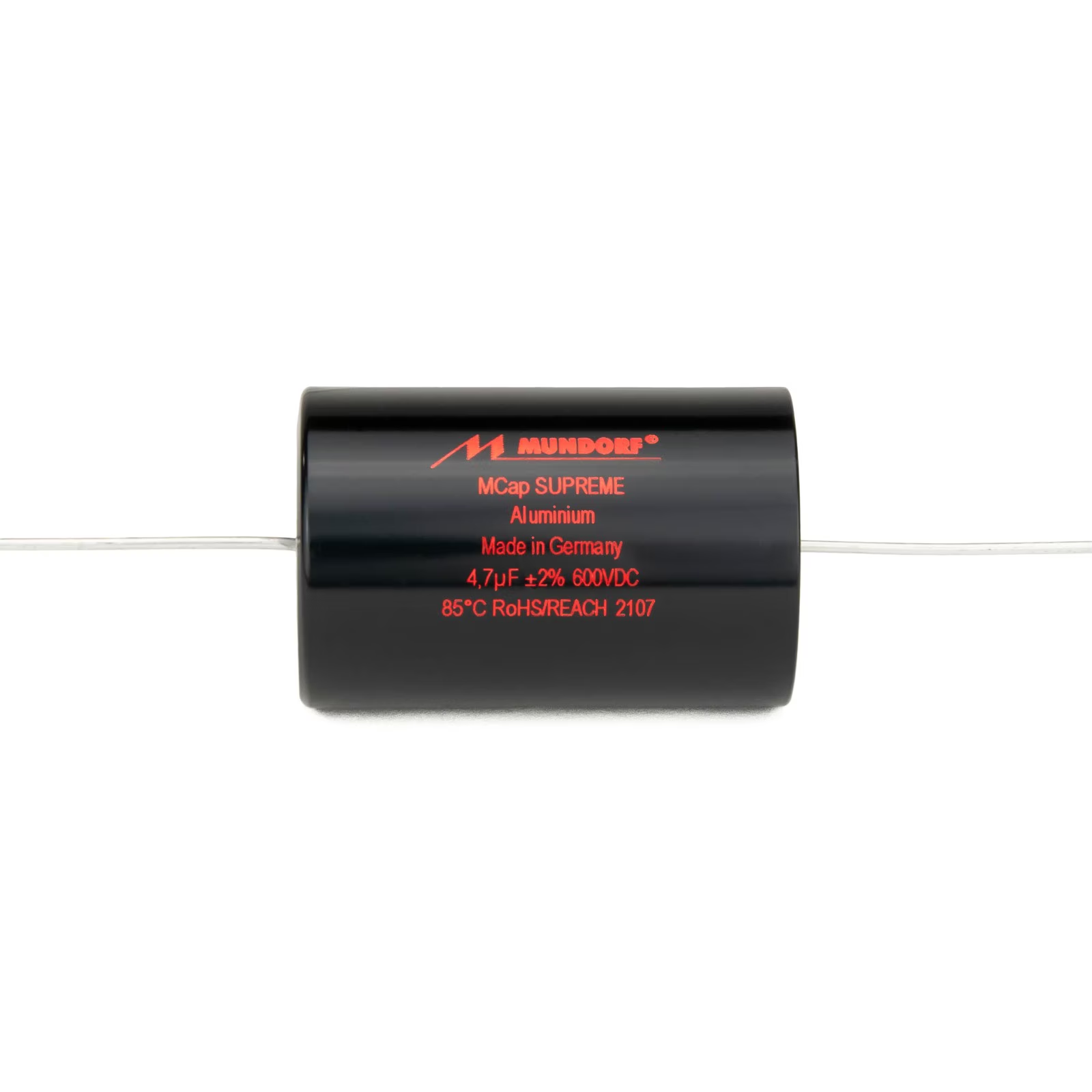
MCap SUPREME SilverGold Oil
The MCap Supreme SilverGold Oil combines the best of three worlds: the high-precision Supreme construction, a silver-gold metallization with the finest gold content, and vacuum oil impregnation for maximum sonic purity and stability.
Technologies
Gold stabilizes interfaces, smooths out microspectrum, adds color to silver.
Silver – Gold Metallization (Ag – Au)
The Silver-Gold Metallization combines the maximum conductivity of silver with the interfacial stability of gold. Silver provides precise, finely resolved signal routing with very low noise; gold stabilizes grain boundaries, slows down diffusion and smooths the microspectrum — particularly with small signals and over a long period of time.
Tonal effects
- Finer texture and more stable reproduction of the smallest details (overtones, spatial fractions, fading processes)
- Richer, differentiated timbres with a clear outline — colorful but ordered
- Quieter, more “mature” overall impression: less nervousness, high long-term suitability
- Noticeably more heart, rhythm and joy of playing with insight and precision
Oil penetrates every pore, stabilizes the wrap, reduces macro-microphony.
Vacuum Oil Impregnation
Vacuum oil impregnation involves displacing air from the coil and drawing a special oil — whose dielectric and hydromechanical properties optimize the desired acoustic characteristics of the coil structure — into every pore under a vacuum. The oil wets film and paper surfaces, stabilizes the wrap from the inside and dampens extensive movements — macro microphony is reduced deep in the wrap structure. In this way, the capacitor remains mechanically quiet even with high pulses and dynamics and does not falsify the music signal through its own movements.
Tonal effects
- Reverb decays, fading processes and quiet room information are more prominent because the wrap inside is calmed down
- Even with high dynamics, the sound remains calm and orderly; loud passages do not drown out the quieter details
- Transients (blowing noises, string strokes, cymbal impulses) come precisely, completely and without sharpness
- Overall impression: relaxed, controlled and at the same time exceptionally detailed
Serial double winding increases mass, lowers inductance, provides silence and precision.
The Supreme Wrapping Technology
A trump card in the world of Macro-Microphony and electrotechnical parameters
The Supreme wrapping technology sets up two coils with double target capacity and connects them in series internally. This increases mass and internal damping, distributes field forces across two structures and thus reduces macro microphonies very effectively. At the same time, the residual inductance drops to around a quarter of a comparable single coil — fast transients and impulses are transmitted cleanly and in a controlled manner.
Tonal effects
- Superior peace of mind even with very large amounts of energy — the condenser remains mechanically “silent”
- Attack, transients and rhythmic subtleties come quickly, precisely and without procrastination
- Microstructures (overtone trajectories, quiet space, fine movements) are clearly audible without having a clinical effect
- Large, relaxed stage with high fine-detail resolution — like a very good concert hall seat
Reduces electrode resistance, reduces hot spots, keeps parameters stable under load.
Reinforced Metallization
Reinforced metallization means a deliberately thicker metal layer on the insulation film. As a result, the resistance of the electrode tracks drops significantly, conductivity increases, voltage drops and local heating are reduced, and field gradients are flattened. The capacitor remains stable under pulses and high current peaks because the electrode does not become a limiting factor: energy is available more quickly and in a more controlled manner, capacity and losses remain more constant even under load, and signal-related modulations in the metal grid are reduced. The result is superior, powerful and clean transmission behavior — even if it becomes dynamic.
Tonal effects
- controlled, powerful and clear even at peak levels
- Bass and drum impulses with more authority and drawing
- more stable sound without electrode-side “flickering”
- more peace and order in complex, dynamic passages

Lowers field forces, calms the winding, reduces resonances and sonic restlessness.
Film Thickness of the Dielectric
A larger film thickness lowers the field strength in the dielectric and thus reduces the field-related mechanical forces on electrodes and film. The coil becomes mechanically quieter and less susceptible to resonance, and macro microphones are significantly reduced — but at the expense of size and capacity per volume. Film thickness is therefore a conscious key parameter for specifically reconciling physical stability and sound sovereignty with other design requirements, such as size or capacity requirements.
Tonal Effects
- larger, more relaxed playback without tonal nervousness
- better audibility for complex music
- Clarity without aggressiveness; precision instead of resonance-related sharpness
- quieter background and more stable order in the sound image
Fixes the wrap, dampens resonances, prevents signal-related oscillation.
Encapsulation in a housing with visco-elastic sealing compound
Encapsulation in a housing with visco-elastic sealing compound means: The capacitor wrap is mechanically calmed and permanently fixed in the fixed housing — not only against external vibrations, but also against stimulation from the music signal itself. This is because alternating current generates field forces that can set the winding in motion; this is precisely what causes macro-microphonic feedback when the capacitor winding resonates. The encapsulation prevents this feedback from building up: coupled energy is absorbed by the viscoelastic layer, resonances are widely dispersed and their amplitude is reduced – resonance peaks are effectively eliminated.
Tonal effects
- Stable, relaxed stage even at high levels — the capacitor remains “silent”
- Clear location: Voices and instruments retain their shape and position
- Less housing noise and structure-borne noise — the sound appears sorted and focused
- More audibility: quiet room information and fine details are retained even when dynamic
We are happy to advise you
Whether ideal components, technical know-how or individual solutions. Let us find the best solution for your application together!
For industrial customers
Order free samples
Would you like to test our products in yours? As a business customer, you can request free samples and see the quality and design for yourself.
NEWSLETTER
News and tips straight to your inbox. Subscribe to our newsletter and choose which topics matter to you.

Aluminum metallization (100% aluminum instead of zinc-aluminum mixture)
Pure aluminum metallization replaces the zinc-aluminum mixture commonly used in industry with a homogeneous metal structure. This reduces interface effects at the grain boundaries , stabilizes the conductivity across the electrode surface and results in a significantly quieter noise spectrum. For example, the basic design of an MCap is audibly different from typical industrial capacitors.
Tonal Effects
- Darker, quieter background — subtle artifacts recede
- Clearer, clearer stage without rough-metallic side effects
- Quiet, well-defined overall sound — a real introduction to audiophile quality
Silver – Gold Metallization (Ag – Au)
The Silver-Gold Metallization combines the maximum conductivity of silver with the interfacial stability of gold. Silver provides precise, finely resolved signal routing with very low noise; gold stabilizes grain boundaries, slows down diffusion and smooths the microspectrum — particularly with small signals and over a long period of time.
Tonal effects
- Finer texture and more stable reproduction of the smallest details (overtones, spatial fractions, fading processes)
- Richer, differentiated timbres with a clear outline — colorful but ordered
- Quieter, more “mature” overall impression: less nervousness, high long-term suitability
- Noticeably more heart, rhythm and joy of playing with insight and precision
Vacuum Oil Impregnation
Vacuum oil impregnation involves displacing air from the coil and drawing a special oil — whose dielectric and hydromechanical properties optimize the desired acoustic characteristics of the coil structure — into every pore under a vacuum. The oil wets film and paper surfaces, stabilizes the wrap from the inside and dampens extensive movements — macro microphony is reduced deep in the wrap structure. In this way, the capacitor remains mechanically quiet even with high pulses and dynamics and does not falsify the music signal through its own movements.
Tonal effects
- Reverb decays, fading processes and quiet room information are more prominent because the wrap inside is calmed down
- Even with high dynamics, the sound remains calm and orderly; loud passages do not drown out the quieter details
- Transients (blowing noises, string strokes, cymbal impulses) come precisely, completely and without sharpness
- Overall impression: relaxed, controlled and at the same time exceptionally detailed
Silver Metallization (Ag)
Silver metallization uses maximum conductivity and long free path lengths for electrons — fewer active microcontacts, less 1/f noise. Larger particle sizes and lower interference voltages at the grain boundaries result in particularly quiet micro-microphonic behavior, which transmits the smallest levels and high frequencies very finely and stably.
Tonal effects
- More insight: Details, overtones and room information are more clearly visible
- More stable stage and more precise positioning, especially in the tweeter/super tweeter
- Vocal, string and cymbal textures look finer and more complete
- Transients come faster without looking sharp or strained
- Embedded in a calm construction, the result is a transparent resolution with a calm, orderly background
The Supreme Wrapping Technology
A trump card in the world of Macro-Microphony and electrotechnical parameters
The Supreme wrapping technology sets up two coils with double target capacity and connects them in series internally. This increases mass and internal damping, distributes field forces across two structures and thus reduces macro microphonies very effectively. At the same time, the residual inductance drops to around a quarter of a comparable single coil — fast transients and impulses are transmitted cleanly and in a controlled manner.
Tonal effects
- Superior peace of mind even with very large amounts of energy — the condenser remains mechanically “silent”
- Attack, transients and rhythmic subtleties come quickly, precisely and without procrastination
- Microstructures (overtone trajectories, quiet space, fine movements) are clearly audible without having a clinical effect
- Large, relaxed stage with high fine-detail resolution — like a very good concert hall seat

Aluminum metallization (100% aluminum instead of zinc-aluminum mixture)
Pure aluminum metallization replaces the zinc-aluminum mixture commonly used in industry with a homogeneous metal structure. This reduces interface effects at the grain boundaries , stabilizes the conductivity across the electrode surface and results in a significantly quieter noise spectrum. For example, the basic design of an MCap is audibly different from typical industrial capacitors.
Tonal Effects
- Darker, quieter background — subtle artifacts recede
- Clearer, clearer stage without rough-metallic side effects
- Quiet, well-defined overall sound — a real introduction to audiophile quality
Silver – Gold Metallization (Ag – Au)
The Silver-Gold Metallization combines the maximum conductivity of silver with the interfacial stability of gold. Silver provides precise, finely resolved signal routing with very low noise; gold stabilizes grain boundaries, slows down diffusion and smooths the microspectrum — particularly with small signals and over a long period of time.
Tonal effects
- Finer texture and more stable reproduction of the smallest details (overtones, spatial fractions, fading processes)
- Richer, differentiated timbres with a clear outline — colorful but ordered
- Quieter, more “mature” overall impression: less nervousness, high long-term suitability
- Noticeably more heart, rhythm and joy of playing with insight and precision
Vacuum Oil Impregnation
Vacuum oil impregnation involves displacing air from the coil and drawing a special oil — whose dielectric and hydromechanical properties optimize the desired acoustic characteristics of the coil structure — into every pore under a vacuum. The oil wets film and paper surfaces, stabilizes the wrap from the inside and dampens extensive movements — macro microphony is reduced deep in the wrap structure. In this way, the capacitor remains mechanically quiet even with high pulses and dynamics and does not falsify the music signal through its own movements.
Tonal effects
- Reverb decays, fading processes and quiet room information are more prominent because the wrap inside is calmed down
- Even with high dynamics, the sound remains calm and orderly; loud passages do not drown out the quieter details
- Transients (blowing noises, string strokes, cymbal impulses) come precisely, completely and without sharpness
- Overall impression: relaxed, controlled and at the same time exceptionally detailed
Silver Metallization (Ag)
Silver metallization uses maximum conductivity and long free path lengths for electrons — fewer active microcontacts, less 1/f noise. Larger particle sizes and lower interference voltages at the grain boundaries result in particularly quiet micro-microphonic behavior, which transmits the smallest levels and high frequencies very finely and stably.
Tonal effects
- More insight: Details, overtones and room information are more clearly visible
- More stable stage and more precise positioning, especially in the tweeter/super tweeter
- Vocal, string and cymbal textures look finer and more complete
- Transients come faster without looking sharp or strained
- Embedded in a calm construction, the result is a transparent resolution with a calm, orderly background
The Supreme Wrapping Technology
A trump card in the world of Macro-Microphony and electrotechnical parameters
The Supreme wrapping technology sets up two coils with double target capacity and connects them in series internally. This increases mass and internal damping, distributes field forces across two structures and thus reduces macro microphonies very effectively. At the same time, the residual inductance drops to around a quarter of a comparable single coil — fast transients and impulses are transmitted cleanly and in a controlled manner.
Tonal effects
- Superior peace of mind even with very large amounts of energy — the condenser remains mechanically “silent”
- Attack, transients and rhythmic subtleties come quickly, precisely and without procrastination
- Microstructures (overtone trajectories, quiet space, fine movements) are clearly audible without having a clinical effect
- Large, relaxed stage with high fine-detail resolution — like a very good concert hall seat

Aluminum metallization (100% aluminum instead of zinc-aluminum mixture)
Pure aluminum metallization replaces the zinc-aluminum mixture commonly used in industry with a homogeneous metal structure. This reduces interface effects at the grain boundaries , stabilizes the conductivity across the electrode surface and results in a significantly quieter noise spectrum. For example, the basic design of an MCap is audibly different from typical industrial capacitors.
Tonal Effects
- Darker, quieter background — subtle artifacts recede
- Clearer, clearer stage without rough-metallic side effects
- Quiet, well-defined overall sound — a real introduction to audiophile quality
Silver – Gold Metallization (Ag – Au)
The Silver-Gold Metallization combines the maximum conductivity of silver with the interfacial stability of gold. Silver provides precise, finely resolved signal routing with very low noise; gold stabilizes grain boundaries, slows down diffusion and smooths the microspectrum — particularly with small signals and over a long period of time.
Tonal effects
- Finer texture and more stable reproduction of the smallest details (overtones, spatial fractions, fading processes)
- Richer, differentiated timbres with a clear outline — colorful but ordered
- Quieter, more “mature” overall impression: less nervousness, high long-term suitability
- Noticeably more heart, rhythm and joy of playing with insight and precision
Vacuum Oil Impregnation
Vacuum oil impregnation involves displacing air from the coil and drawing a special oil — whose dielectric and hydromechanical properties optimize the desired acoustic characteristics of the coil structure — into every pore under a vacuum. The oil wets film and paper surfaces, stabilizes the wrap from the inside and dampens extensive movements — macro microphony is reduced deep in the wrap structure. In this way, the capacitor remains mechanically quiet even with high pulses and dynamics and does not falsify the music signal through its own movements.
Tonal effects
- Reverb decays, fading processes and quiet room information are more prominent because the wrap inside is calmed down
- Even with high dynamics, the sound remains calm and orderly; loud passages do not drown out the quieter details
- Transients (blowing noises, string strokes, cymbal impulses) come precisely, completely and without sharpness
- Overall impression: relaxed, controlled and at the same time exceptionally detailed
Silver Metallization (Ag)
Silver metallization uses maximum conductivity and long free path lengths for electrons — fewer active microcontacts, less 1/f noise. Larger particle sizes and lower interference voltages at the grain boundaries result in particularly quiet micro-microphonic behavior, which transmits the smallest levels and high frequencies very finely and stably.
Tonal effects
- More insight: Details, overtones and room information are more clearly visible
- More stable stage and more precise positioning, especially in the tweeter/super tweeter
- Vocal, string and cymbal textures look finer and more complete
- Transients come faster without looking sharp or strained
- Embedded in a calm construction, the result is a transparent resolution with a calm, orderly background
The Supreme Wrapping Technology
A trump card in the world of Macro-Microphony and electrotechnical parameters
The Supreme wrapping technology sets up two coils with double target capacity and connects them in series internally. This increases mass and internal damping, distributes field forces across two structures and thus reduces macro microphonies very effectively. At the same time, the residual inductance drops to around a quarter of a comparable single coil — fast transients and impulses are transmitted cleanly and in a controlled manner.
Tonal effects
- Superior peace of mind even with very large amounts of energy — the condenser remains mechanically “silent”
- Attack, transients and rhythmic subtleties come quickly, precisely and without procrastination
- Microstructures (overtone trajectories, quiet space, fine movements) are clearly audible without having a clinical effect
- Large, relaxed stage with high fine-detail resolution — like a very good concert hall seat

Aluminum metallization (100% aluminum instead of zinc-aluminum mixture)
Pure aluminum metallization replaces the zinc-aluminum mixture commonly used in industry with a homogeneous metal structure. This reduces interface effects at the grain boundaries , stabilizes the conductivity across the electrode surface and results in a significantly quieter noise spectrum. For example, the basic design of an MCap is audibly different from typical industrial capacitors.
Tonal Effects
- Darker, quieter background — subtle artifacts recede
- Clearer, clearer stage without rough-metallic side effects
- Quiet, well-defined overall sound — a real introduction to audiophile quality
Silver – Gold Metallization (Ag – Au)
The Silver-Gold Metallization combines the maximum conductivity of silver with the interfacial stability of gold. Silver provides precise, finely resolved signal routing with very low noise; gold stabilizes grain boundaries, slows down diffusion and smooths the microspectrum — particularly with small signals and over a long period of time.
Tonal effects
- Finer texture and more stable reproduction of the smallest details (overtones, spatial fractions, fading processes)
- Richer, differentiated timbres with a clear outline — colorful but ordered
- Quieter, more “mature” overall impression: less nervousness, high long-term suitability
- Noticeably more heart, rhythm and joy of playing with insight and precision
Vacuum Oil Impregnation
Vacuum oil impregnation involves displacing air from the coil and drawing a special oil — whose dielectric and hydromechanical properties optimize the desired acoustic characteristics of the coil structure — into every pore under a vacuum. The oil wets film and paper surfaces, stabilizes the wrap from the inside and dampens extensive movements — macro microphony is reduced deep in the wrap structure. In this way, the capacitor remains mechanically quiet even with high pulses and dynamics and does not falsify the music signal through its own movements.
Tonal effects
- Reverb decays, fading processes and quiet room information are more prominent because the wrap inside is calmed down
- Even with high dynamics, the sound remains calm and orderly; loud passages do not drown out the quieter details
- Transients (blowing noises, string strokes, cymbal impulses) come precisely, completely and without sharpness
- Overall impression: relaxed, controlled and at the same time exceptionally detailed
Silver Metallization (Ag)
Silver metallization uses maximum conductivity and long free path lengths for electrons — fewer active microcontacts, less 1/f noise. Larger particle sizes and lower interference voltages at the grain boundaries result in particularly quiet micro-microphonic behavior, which transmits the smallest levels and high frequencies very finely and stably.
Tonal effects
- More insight: Details, overtones and room information are more clearly visible
- More stable stage and more precise positioning, especially in the tweeter/super tweeter
- Vocal, string and cymbal textures look finer and more complete
- Transients come faster without looking sharp or strained
- Embedded in a calm construction, the result is a transparent resolution with a calm, orderly background
The Supreme Wrapping Technology
A trump card in the world of Macro-Microphony and electrotechnical parameters
The Supreme wrapping technology sets up two coils with double target capacity and connects them in series internally. This increases mass and internal damping, distributes field forces across two structures and thus reduces macro microphonies very effectively. At the same time, the residual inductance drops to around a quarter of a comparable single coil — fast transients and impulses are transmitted cleanly and in a controlled manner.
Tonal effects
- Superior peace of mind even with very large amounts of energy — the condenser remains mechanically “silent”
- Attack, transients and rhythmic subtleties come quickly, precisely and without procrastination
- Microstructures (overtone trajectories, quiet space, fine movements) are clearly audible without having a clinical effect
- Large, relaxed stage with high fine-detail resolution — like a very good concert hall seat

Aluminum metallization (100% aluminum instead of zinc-aluminum mixture)
Pure aluminum metallization replaces the zinc-aluminum mixture commonly used in industry with a homogeneous metal structure. This reduces interface effects at the grain boundaries , stabilizes the conductivity across the electrode surface and results in a significantly quieter noise spectrum. For example, the basic design of an MCap is audibly different from typical industrial capacitors.
Tonal Effects
- Darker, quieter background — subtle artifacts recede
- Clearer, clearer stage without rough-metallic side effects
- Quiet, well-defined overall sound — a real introduction to audiophile quality
Silver – Gold Metallization (Ag – Au)
The Silver-Gold Metallization combines the maximum conductivity of silver with the interfacial stability of gold. Silver provides precise, finely resolved signal routing with very low noise; gold stabilizes grain boundaries, slows down diffusion and smooths the microspectrum — particularly with small signals and over a long period of time.
Tonal effects
- Finer texture and more stable reproduction of the smallest details (overtones, spatial fractions, fading processes)
- Richer, differentiated timbres with a clear outline — colorful but ordered
- Quieter, more “mature” overall impression: less nervousness, high long-term suitability
- Noticeably more heart, rhythm and joy of playing with insight and precision
Vacuum Oil Impregnation
Vacuum oil impregnation involves displacing air from the coil and drawing a special oil — whose dielectric and hydromechanical properties optimize the desired acoustic characteristics of the coil structure — into every pore under a vacuum. The oil wets film and paper surfaces, stabilizes the wrap from the inside and dampens extensive movements — macro microphony is reduced deep in the wrap structure. In this way, the capacitor remains mechanically quiet even with high pulses and dynamics and does not falsify the music signal through its own movements.
Tonal effects
- Reverb decays, fading processes and quiet room information are more prominent because the wrap inside is calmed down
- Even with high dynamics, the sound remains calm and orderly; loud passages do not drown out the quieter details
- Transients (blowing noises, string strokes, cymbal impulses) come precisely, completely and without sharpness
- Overall impression: relaxed, controlled and at the same time exceptionally detailed
Silver Metallization (Ag)
Silver metallization uses maximum conductivity and long free path lengths for electrons — fewer active microcontacts, less 1/f noise. Larger particle sizes and lower interference voltages at the grain boundaries result in particularly quiet micro-microphonic behavior, which transmits the smallest levels and high frequencies very finely and stably.
Tonal effects
- More insight: Details, overtones and room information are more clearly visible
- More stable stage and more precise positioning, especially in the tweeter/super tweeter
- Vocal, string and cymbal textures look finer and more complete
- Transients come faster without looking sharp or strained
- Embedded in a calm construction, the result is a transparent resolution with a calm, orderly background
The Supreme Wrapping Technology
A trump card in the world of Macro-Microphony and electrotechnical parameters
The Supreme wrapping technology sets up two coils with double target capacity and connects them in series internally. This increases mass and internal damping, distributes field forces across two structures and thus reduces macro microphonies very effectively. At the same time, the residual inductance drops to around a quarter of a comparable single coil — fast transients and impulses are transmitted cleanly and in a controlled manner.
Tonal effects
- Superior peace of mind even with very large amounts of energy — the condenser remains mechanically “silent”
- Attack, transients and rhythmic subtleties come quickly, precisely and without procrastination
- Microstructures (overtone trajectories, quiet space, fine movements) are clearly audible without having a clinical effect
- Large, relaxed stage with high fine-detail resolution — like a very good concert hall seat

Aluminum metallization (100% aluminum instead of zinc-aluminum mixture)
Pure aluminum metallization replaces the zinc-aluminum mixture commonly used in industry with a homogeneous metal structure. This reduces interface effects at the grain boundaries , stabilizes the conductivity across the electrode surface and results in a significantly quieter noise spectrum. For example, the basic design of an MCap is audibly different from typical industrial capacitors.
Tonal Effects
- Darker, quieter background — subtle artifacts recede
- Clearer, clearer stage without rough-metallic side effects
- Quiet, well-defined overall sound — a real introduction to audiophile quality
Silver – Gold Metallization (Ag – Au)
The Silver-Gold Metallization combines the maximum conductivity of silver with the interfacial stability of gold. Silver provides precise, finely resolved signal routing with very low noise; gold stabilizes grain boundaries, slows down diffusion and smooths the microspectrum — particularly with small signals and over a long period of time.
Tonal effects
- Finer texture and more stable reproduction of the smallest details (overtones, spatial fractions, fading processes)
- Richer, differentiated timbres with a clear outline — colorful but ordered
- Quieter, more “mature” overall impression: less nervousness, high long-term suitability
- Noticeably more heart, rhythm and joy of playing with insight and precision
Vacuum Oil Impregnation
Vacuum oil impregnation involves displacing air from the coil and drawing a special oil — whose dielectric and hydromechanical properties optimize the desired acoustic characteristics of the coil structure — into every pore under a vacuum. The oil wets film and paper surfaces, stabilizes the wrap from the inside and dampens extensive movements — macro microphony is reduced deep in the wrap structure. In this way, the capacitor remains mechanically quiet even with high pulses and dynamics and does not falsify the music signal through its own movements.
Tonal effects
- Reverb decays, fading processes and quiet room information are more prominent because the wrap inside is calmed down
- Even with high dynamics, the sound remains calm and orderly; loud passages do not drown out the quieter details
- Transients (blowing noises, string strokes, cymbal impulses) come precisely, completely and without sharpness
- Overall impression: relaxed, controlled and at the same time exceptionally detailed
Silver Metallization (Ag)
Silver metallization uses maximum conductivity and long free path lengths for electrons — fewer active microcontacts, less 1/f noise. Larger particle sizes and lower interference voltages at the grain boundaries result in particularly quiet micro-microphonic behavior, which transmits the smallest levels and high frequencies very finely and stably.
Tonal effects
- More insight: Details, overtones and room information are more clearly visible
- More stable stage and more precise positioning, especially in the tweeter/super tweeter
- Vocal, string and cymbal textures look finer and more complete
- Transients come faster without looking sharp or strained
- Embedded in a calm construction, the result is a transparent resolution with a calm, orderly background
The Supreme Wrapping Technology
A trump card in the world of Macro-Microphony and electrotechnical parameters
The Supreme wrapping technology sets up two coils with double target capacity and connects them in series internally. This increases mass and internal damping, distributes field forces across two structures and thus reduces macro microphonies very effectively. At the same time, the residual inductance drops to around a quarter of a comparable single coil — fast transients and impulses are transmitted cleanly and in a controlled manner.
Tonal effects
- Superior peace of mind even with very large amounts of energy — the condenser remains mechanically “silent”
- Attack, transients and rhythmic subtleties come quickly, precisely and without procrastination
- Microstructures (overtone trajectories, quiet space, fine movements) are clearly audible without having a clinical effect
- Large, relaxed stage with high fine-detail resolution — like a very good concert hall seat

Aluminum metallization (100% aluminum instead of zinc-aluminum mixture)
Pure aluminum metallization replaces the zinc-aluminum mixture commonly used in industry with a homogeneous metal structure. This reduces interface effects at the grain boundaries , stabilizes the conductivity across the electrode surface and results in a significantly quieter noise spectrum. For example, the basic design of an MCap is audibly different from typical industrial capacitors.
Tonal Effects
- Darker, quieter background — subtle artifacts recede
- Clearer, clearer stage without rough-metallic side effects
- Quiet, well-defined overall sound — a real introduction to audiophile quality
Silver – Gold Metallization (Ag – Au)
The Silver-Gold Metallization combines the maximum conductivity of silver with the interfacial stability of gold. Silver provides precise, finely resolved signal routing with very low noise; gold stabilizes grain boundaries, slows down diffusion and smooths the microspectrum — particularly with small signals and over a long period of time.
Tonal effects
- Finer texture and more stable reproduction of the smallest details (overtones, spatial fractions, fading processes)
- Richer, differentiated timbres with a clear outline — colorful but ordered
- Quieter, more “mature” overall impression: less nervousness, high long-term suitability
- Noticeably more heart, rhythm and joy of playing with insight and precision
Vacuum Oil Impregnation
Vacuum oil impregnation involves displacing air from the coil and drawing a special oil — whose dielectric and hydromechanical properties optimize the desired acoustic characteristics of the coil structure — into every pore under a vacuum. The oil wets film and paper surfaces, stabilizes the wrap from the inside and dampens extensive movements — macro microphony is reduced deep in the wrap structure. In this way, the capacitor remains mechanically quiet even with high pulses and dynamics and does not falsify the music signal through its own movements.
Tonal effects
- Reverb decays, fading processes and quiet room information are more prominent because the wrap inside is calmed down
- Even with high dynamics, the sound remains calm and orderly; loud passages do not drown out the quieter details
- Transients (blowing noises, string strokes, cymbal impulses) come precisely, completely and without sharpness
- Overall impression: relaxed, controlled and at the same time exceptionally detailed
Silver Metallization (Ag)
Silver metallization uses maximum conductivity and long free path lengths for electrons — fewer active microcontacts, less 1/f noise. Larger particle sizes and lower interference voltages at the grain boundaries result in particularly quiet micro-microphonic behavior, which transmits the smallest levels and high frequencies very finely and stably.
Tonal effects
- More insight: Details, overtones and room information are more clearly visible
- More stable stage and more precise positioning, especially in the tweeter/super tweeter
- Vocal, string and cymbal textures look finer and more complete
- Transients come faster without looking sharp or strained
- Embedded in a calm construction, the result is a transparent resolution with a calm, orderly background
The Supreme Wrapping Technology
A trump card in the world of Macro-Microphony and electrotechnical parameters
The Supreme wrapping technology sets up two coils with double target capacity and connects them in series internally. This increases mass and internal damping, distributes field forces across two structures and thus reduces macro microphonies very effectively. At the same time, the residual inductance drops to around a quarter of a comparable single coil — fast transients and impulses are transmitted cleanly and in a controlled manner.
Tonal effects
- Superior peace of mind even with very large amounts of energy — the condenser remains mechanically “silent”
- Attack, transients and rhythmic subtleties come quickly, precisely and without procrastination
- Microstructures (overtone trajectories, quiet space, fine movements) are clearly audible without having a clinical effect
- Large, relaxed stage with high fine-detail resolution — like a very good concert hall seat

Aluminum metallization (100% aluminum instead of zinc-aluminum mixture)
Pure aluminum metallization replaces the zinc-aluminum mixture commonly used in industry with a homogeneous metal structure. This reduces interface effects at the grain boundaries , stabilizes the conductivity across the electrode surface and results in a significantly quieter noise spectrum. For example, the basic design of an MCap is audibly different from typical industrial capacitors.
Tonal Effects
- Darker, quieter background — subtle artifacts recede
- Clearer, clearer stage without rough-metallic side effects
- Quiet, well-defined overall sound — a real introduction to audiophile quality
The Supreme Wrapping Technology
A trump card in the world of Macro-Microphony and electrotechnical parameters
The Supreme wrapping technology sets up two coils with double target capacity and connects them in series internally. This increases mass and internal damping, distributes field forces across two structures and thus reduces macro microphonies very effectively. At the same time, the residual inductance drops to around a quarter of a comparable single coil — fast transients and impulses are transmitted cleanly and in a controlled manner.
Tonal effects
- Superior peace of mind even with very large amounts of energy — the condenser remains mechanically “silent”
- Attack, transients and rhythmic subtleties come quickly, precisely and without procrastination
- Microstructures (overtone trajectories, quiet space, fine movements) are clearly audible without having a clinical effect
- Large, relaxed stage with high fine-detail resolution — like a very good concert hall seat
Reinforced Metallization
Reinforced metallization means a deliberately thicker metal layer on the insulation film. As a result, the resistance of the electrode tracks drops significantly, conductivity increases, voltage drops and local heating are reduced, and field gradients are flattened. The capacitor remains stable under pulses and high current peaks because the electrode does not become a limiting factor: energy is available more quickly and in a more controlled manner, capacity and losses remain more constant even under load, and signal-related modulations in the metal grid are reduced. The result is superior, powerful and clean transmission behavior — even if it becomes dynamic.
Tonal effects
- controlled, powerful and clear even at peak levels
- Bass and drum impulses with more authority and drawing
- more stable sound without electrode-side “flickering”
- more peace and order in complex, dynamic passages
Encapsulation in a housing with visco-elastic sealing compound
Encapsulation in a housing with visco-elastic sealing compound means: The capacitor wrap is mechanically calmed and permanently fixed in the fixed housing — not only against external vibrations, but also against stimulation from the music signal itself. This is because alternating current generates field forces that can set the winding in motion; this is precisely what causes macro-microphonic feedback when the capacitor winding resonates. The encapsulation prevents this feedback from building up: coupled energy is absorbed by the viscoelastic layer, resonances are widely dispersed and their amplitude is reduced – resonance peaks are effectively eliminated.
Tonal effects
- Stable, relaxed stage even at high levels — the capacitor remains “silent”
- Clear location: Voices and instruments retain their shape and position
- Less housing noise and structure-borne noise — the sound appears sorted and focused
- More audibility: quiet room information and fine details are retained even when dynamic
Tight Tolerances
Tight tolerances in capacitance, inductance, and resistance ensure that capacitors of one type are very close together in terms of their electrical properties. In crossovers, the left and right channels therefore work virtually identically: crossover frequencies, level ratios and phase positions match closely. This is the basis for stable, precise stereo imaging and reproducible results — in series production and also after service.
Tonal Effects
- precise, stable soundstage without drifting
- Coherent overall impression: left and right channels fuse into a single, seamless whole
- characteristic sound is reliably retained even after component replacement/repair
- More stable virtual center and clearer spatial layering

Aluminum metallization (100% aluminum instead of zinc-aluminum mixture)
Pure aluminum metallization replaces the zinc-aluminum mixture commonly used in industry with a homogeneous metal structure. This reduces interface effects at the grain boundaries , stabilizes the conductivity across the electrode surface and results in a significantly quieter noise spectrum. For example, the basic design of an MCap is audibly different from typical industrial capacitors.
Tonal Effects
- Darker, quieter background — subtle artifacts recede
- Clearer, clearer stage without rough-metallic side effects
- Quiet, well-defined overall sound — a real introduction to audiophile quality
The Supreme Wrapping Technology
A trump card in the world of Macro-Microphony and electrotechnical parameters
The Supreme wrapping technology sets up two coils with double target capacity and connects them in series internally. This increases mass and internal damping, distributes field forces across two structures and thus reduces macro microphonies very effectively. At the same time, the residual inductance drops to around a quarter of a comparable single coil — fast transients and impulses are transmitted cleanly and in a controlled manner.
Tonal effects
- Superior peace of mind even with very large amounts of energy — the condenser remains mechanically “silent”
- Attack, transients and rhythmic subtleties come quickly, precisely and without procrastination
- Microstructures (overtone trajectories, quiet space, fine movements) are clearly audible without having a clinical effect
- Large, relaxed stage with high fine-detail resolution — like a very good concert hall seat
Reinforced Metallization
Reinforced metallization means a deliberately thicker metal layer on the insulation film. As a result, the resistance of the electrode tracks drops significantly, conductivity increases, voltage drops and local heating are reduced, and field gradients are flattened. The capacitor remains stable under pulses and high current peaks because the electrode does not become a limiting factor: energy is available more quickly and in a more controlled manner, capacity and losses remain more constant even under load, and signal-related modulations in the metal grid are reduced. The result is superior, powerful and clean transmission behavior — even if it becomes dynamic.
Tonal effects
- controlled, powerful and clear even at peak levels
- Bass and drum impulses with more authority and drawing
- more stable sound without electrode-side “flickering”
- more peace and order in complex, dynamic passages
Encapsulation in a housing with visco-elastic sealing compound
Encapsulation in a housing with visco-elastic sealing compound means: The capacitor wrap is mechanically calmed and permanently fixed in the fixed housing — not only against external vibrations, but also against stimulation from the music signal itself. This is because alternating current generates field forces that can set the winding in motion; this is precisely what causes macro-microphonic feedback when the capacitor winding resonates. The encapsulation prevents this feedback from building up: coupled energy is absorbed by the viscoelastic layer, resonances are widely dispersed and their amplitude is reduced – resonance peaks are effectively eliminated.
Tonal effects
- Stable, relaxed stage even at high levels — the capacitor remains “silent”
- Clear location: Voices and instruments retain their shape and position
- Less housing noise and structure-borne noise — the sound appears sorted and focused
- More audibility: quiet room information and fine details are retained even when dynamic
Tight Tolerances
Tight tolerances in capacitance, inductance, and resistance ensure that capacitors of one type are very close together in terms of their electrical properties. In crossovers, the left and right channels therefore work virtually identically: crossover frequencies, level ratios and phase positions match closely. This is the basis for stable, precise stereo imaging and reproducible results — in series production and also after service.
Tonal Effects
- precise, stable soundstage without drifting
- Coherent overall impression: left and right channels fuse into a single, seamless whole
- characteristic sound is reliably retained even after component replacement/repair
- More stable virtual center and clearer spatial layering

Aluminum metallization (100% aluminum instead of zinc-aluminum mixture)
Pure aluminum metallization replaces the zinc-aluminum mixture commonly used in industry with a homogeneous metal structure. This reduces interface effects at the grain boundaries , stabilizes the conductivity across the electrode surface and results in a significantly quieter noise spectrum. For example, the basic design of an MCap is audibly different from typical industrial capacitors.
Tonal Effects
- Darker, quieter background — subtle artifacts recede
- Clearer, clearer stage without rough-metallic side effects
- Quiet, well-defined overall sound — a real introduction to audiophile quality
Silver – Gold Metallization (Ag – Au)
The Silver-Gold Metallization combines the maximum conductivity of silver with the interfacial stability of gold. Silver provides precise, finely resolved signal routing with very low noise; gold stabilizes grain boundaries, slows down diffusion and smooths the microspectrum — particularly with small signals and over a long period of time.
Tonal effects
- Finer texture and more stable reproduction of the smallest details (overtones, spatial fractions, fading processes)
- Richer, differentiated timbres with a clear outline — colorful but ordered
- Quieter, more “mature” overall impression: less nervousness, high long-term suitability
- Noticeably more heart, rhythm and joy of playing with insight and precision
Vacuum Oil Impregnation
Vacuum oil impregnation involves displacing air from the coil and drawing a special oil — whose dielectric and hydromechanical properties optimize the desired acoustic characteristics of the coil structure — into every pore under a vacuum. The oil wets film and paper surfaces, stabilizes the wrap from the inside and dampens extensive movements — macro microphony is reduced deep in the wrap structure. In this way, the capacitor remains mechanically quiet even with high pulses and dynamics and does not falsify the music signal through its own movements.
Tonal effects
- Reverb decays, fading processes and quiet room information are more prominent because the wrap inside is calmed down
- Even with high dynamics, the sound remains calm and orderly; loud passages do not drown out the quieter details
- Transients (blowing noises, string strokes, cymbal impulses) come precisely, completely and without sharpness
- Overall impression: relaxed, controlled and at the same time exceptionally detailed
Silver Metallization (Ag)
Silver metallization uses maximum conductivity and long free path lengths for electrons — fewer active microcontacts, less 1/f noise. Larger particle sizes and lower interference voltages at the grain boundaries result in particularly quiet micro-microphonic behavior, which transmits the smallest levels and high frequencies very finely and stably.
Tonal effects
- More insight: Details, overtones and room information are more clearly visible
- More stable stage and more precise positioning, especially in the tweeter/super tweeter
- Vocal, string and cymbal textures look finer and more complete
- Transients come faster without looking sharp or strained
- Embedded in a calm construction, the result is a transparent resolution with a calm, orderly background
The Supreme Wrapping Technology
A trump card in the world of Macro-Microphony and electrotechnical parameters
The Supreme wrapping technology sets up two coils with double target capacity and connects them in series internally. This increases mass and internal damping, distributes field forces across two structures and thus reduces macro microphonies very effectively. At the same time, the residual inductance drops to around a quarter of a comparable single coil — fast transients and impulses are transmitted cleanly and in a controlled manner.
Tonal effects
- Superior peace of mind even with very large amounts of energy — the condenser remains mechanically “silent”
- Attack, transients and rhythmic subtleties come quickly, precisely and without procrastination
- Microstructures (overtone trajectories, quiet space, fine movements) are clearly audible without having a clinical effect
- Large, relaxed stage with high fine-detail resolution — like a very good concert hall seat

Aluminum metallization (100% aluminum instead of zinc-aluminum mixture)
Pure aluminum metallization replaces the zinc-aluminum mixture commonly used in industry with a homogeneous metal structure. This reduces interface effects at the grain boundaries , stabilizes the conductivity across the electrode surface and results in a significantly quieter noise spectrum. For example, the basic design of an MCap is audibly different from typical industrial capacitors.
Tonal Effects
- Darker, quieter background — subtle artifacts recede
- Clearer, clearer stage without rough-metallic side effects
- Quiet, well-defined overall sound — a real introduction to audiophile quality
The Supreme Wrapping Technology
A trump card in the world of Macro-Microphony and electrotechnical parameters
The Supreme wrapping technology sets up two coils with double target capacity and connects them in series internally. This increases mass and internal damping, distributes field forces across two structures and thus reduces macro microphonies very effectively. At the same time, the residual inductance drops to around a quarter of a comparable single coil — fast transients and impulses are transmitted cleanly and in a controlled manner.
Tonal effects
- Superior peace of mind even with very large amounts of energy — the condenser remains mechanically “silent”
- Attack, transients and rhythmic subtleties come quickly, precisely and without procrastination
- Microstructures (overtone trajectories, quiet space, fine movements) are clearly audible without having a clinical effect
- Large, relaxed stage with high fine-detail resolution — like a very good concert hall seat
Reinforced Metallization
Reinforced metallization means a deliberately thicker metal layer on the insulation film. As a result, the resistance of the electrode tracks drops significantly, conductivity increases, voltage drops and local heating are reduced, and field gradients are flattened. The capacitor remains stable under pulses and high current peaks because the electrode does not become a limiting factor: energy is available more quickly and in a more controlled manner, capacity and losses remain more constant even under load, and signal-related modulations in the metal grid are reduced. The result is superior, powerful and clean transmission behavior — even if it becomes dynamic.
Tonal effects
- controlled, powerful and clear even at peak levels
- Bass and drum impulses with more authority and drawing
- more stable sound without electrode-side “flickering”
- more peace and order in complex, dynamic passages
Encapsulation in a housing with visco-elastic sealing compound
Encapsulation in a housing with visco-elastic sealing compound means: The capacitor wrap is mechanically calmed and permanently fixed in the fixed housing — not only against external vibrations, but also against stimulation from the music signal itself. This is because alternating current generates field forces that can set the winding in motion; this is precisely what causes macro-microphonic feedback when the capacitor winding resonates. The encapsulation prevents this feedback from building up: coupled energy is absorbed by the viscoelastic layer, resonances are widely dispersed and their amplitude is reduced – resonance peaks are effectively eliminated.
Tonal effects
- Stable, relaxed stage even at high levels — the capacitor remains “silent”
- Clear location: Voices and instruments retain their shape and position
- Less housing noise and structure-borne noise — the sound appears sorted and focused
- More audibility: quiet room information and fine details are retained even when dynamic
Tight Tolerances
Tight tolerances in capacitance, inductance, and resistance ensure that capacitors of one type are very close together in terms of their electrical properties. In crossovers, the left and right channels therefore work virtually identically: crossover frequencies, level ratios and phase positions match closely. This is the basis for stable, precise stereo imaging and reproducible results — in series production and also after service.
Tonal Effects
- precise, stable soundstage without drifting
- Coherent overall impression: left and right channels fuse into a single, seamless whole
- characteristic sound is reliably retained even after component replacement/repair
- More stable virtual center and clearer spatial layering

Aluminum metallization (100% aluminum instead of zinc-aluminum mixture)
Pure aluminum metallization replaces the zinc-aluminum mixture commonly used in industry with a homogeneous metal structure. This reduces interface effects at the grain boundaries , stabilizes the conductivity across the electrode surface and results in a significantly quieter noise spectrum. For example, the basic design of an MCap is audibly different from typical industrial capacitors.
Tonal Effects
- Darker, quieter background — subtle artifacts recede
- Clearer, clearer stage without rough-metallic side effects
- Quiet, well-defined overall sound — a real introduction to audiophile quality
The Supreme Wrapping Technology
A trump card in the world of Macro-Microphony and electrotechnical parameters
The Supreme wrapping technology sets up two coils with double target capacity and connects them in series internally. This increases mass and internal damping, distributes field forces across two structures and thus reduces macro microphonies very effectively. At the same time, the residual inductance drops to around a quarter of a comparable single coil — fast transients and impulses are transmitted cleanly and in a controlled manner.
Tonal effects
- Superior peace of mind even with very large amounts of energy — the condenser remains mechanically “silent”
- Attack, transients and rhythmic subtleties come quickly, precisely and without procrastination
- Microstructures (overtone trajectories, quiet space, fine movements) are clearly audible without having a clinical effect
- Large, relaxed stage with high fine-detail resolution — like a very good concert hall seat
Reinforced Metallization
Reinforced metallization means a deliberately thicker metal layer on the insulation film. As a result, the resistance of the electrode tracks drops significantly, conductivity increases, voltage drops and local heating are reduced, and field gradients are flattened. The capacitor remains stable under pulses and high current peaks because the electrode does not become a limiting factor: energy is available more quickly and in a more controlled manner, capacity and losses remain more constant even under load, and signal-related modulations in the metal grid are reduced. The result is superior, powerful and clean transmission behavior — even if it becomes dynamic.
Tonal effects
- controlled, powerful and clear even at peak levels
- Bass and drum impulses with more authority and drawing
- more stable sound without electrode-side “flickering”
- more peace and order in complex, dynamic passages
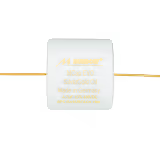
Encapsulation in a housing with visco-elastic sealing compound
Encapsulation in a housing with visco-elastic sealing compound means: The capacitor wrap is mechanically calmed and permanently fixed in the fixed housing — not only against external vibrations, but also against stimulation from the music signal itself. This is because alternating current generates field forces that can set the winding in motion; this is precisely what causes macro-microphonic feedback when the capacitor winding resonates. The encapsulation prevents this feedback from building up: coupled energy is absorbed by the viscoelastic layer, resonances are widely dispersed and their amplitude is reduced – resonance peaks are effectively eliminated.
Tonal effects
- Stable, relaxed stage even at high levels — the capacitor remains “silent”
- Clear location: Voices and instruments retain their shape and position
- Less housing noise and structure-borne noise — the sound appears sorted and focused
- More audibility: quiet room information and fine details are retained even when dynamic
Tight Tolerances
Tight tolerances in capacitance, inductance, and resistance ensure that capacitors of one type are very close together in terms of their electrical properties. In crossovers, the left and right channels therefore work virtually identically: crossover frequencies, level ratios and phase positions match closely. This is the basis for stable, precise stereo imaging and reproducible results — in series production and also after service.
Tonal Effects
- precise, stable soundstage without drifting
- Coherent overall impression: left and right channels fuse into a single, seamless whole
- characteristic sound is reliably retained even after component replacement/repair
- More stable virtual center and clearer spatial layering

Aluminum metallization (100% aluminum instead of zinc-aluminum mixture)
Pure aluminum metallization replaces the zinc-aluminum mixture commonly used in industry with a homogeneous metal structure. This reduces interface effects at the grain boundaries , stabilizes the conductivity across the electrode surface and results in a significantly quieter noise spectrum. For example, the basic design of an MCap is audibly different from typical industrial capacitors.
Tonal Effects
- Darker, quieter background — subtle artifacts recede
- Clearer, clearer stage without rough-metallic side effects
- Quiet, well-defined overall sound — a real introduction to audiophile quality
Silver – Gold Metallization (Ag – Au)
The Silver-Gold Metallization combines the maximum conductivity of silver with the interfacial stability of gold. Silver provides precise, finely resolved signal routing with very low noise; gold stabilizes grain boundaries, slows down diffusion and smooths the microspectrum — particularly with small signals and over a long period of time.
Tonal effects
- Finer texture and more stable reproduction of the smallest details (overtones, spatial fractions, fading processes)
- Richer, differentiated timbres with a clear outline — colorful but ordered
- Quieter, more “mature” overall impression: less nervousness, high long-term suitability
- Noticeably more heart, rhythm and joy of playing with insight and precision
Vacuum Oil Impregnation
Vacuum oil impregnation involves displacing air from the coil and drawing a special oil — whose dielectric and hydromechanical properties optimize the desired acoustic characteristics of the coil structure — into every pore under a vacuum. The oil wets film and paper surfaces, stabilizes the wrap from the inside and dampens extensive movements — macro microphony is reduced deep in the wrap structure. In this way, the capacitor remains mechanically quiet even with high pulses and dynamics and does not falsify the music signal through its own movements.
Tonal effects
- Reverb decays, fading processes and quiet room information are more prominent because the wrap inside is calmed down
- Even with high dynamics, the sound remains calm and orderly; loud passages do not drown out the quieter details
- Transients (blowing noises, string strokes, cymbal impulses) come precisely, completely and without sharpness
- Overall impression: relaxed, controlled and at the same time exceptionally detailed
Silver Metallization (Ag)
Silver metallization uses maximum conductivity and long free path lengths for electrons — fewer active microcontacts, less 1/f noise. Larger particle sizes and lower interference voltages at the grain boundaries result in particularly quiet micro-microphonic behavior, which transmits the smallest levels and high frequencies very finely and stably.
Tonal effects
- More insight: Details, overtones and room information are more clearly visible
- More stable stage and more precise positioning, especially in the tweeter/super tweeter
- Vocal, string and cymbal textures look finer and more complete
- Transients come faster without looking sharp or strained
- Embedded in a calm construction, the result is a transparent resolution with a calm, orderly background
The Supreme Wrapping Technology
A trump card in the world of Macro-Microphony and electrotechnical parameters
The Supreme wrapping technology sets up two coils with double target capacity and connects them in series internally. This increases mass and internal damping, distributes field forces across two structures and thus reduces macro microphonies very effectively. At the same time, the residual inductance drops to around a quarter of a comparable single coil — fast transients and impulses are transmitted cleanly and in a controlled manner.
Tonal effects
- Superior peace of mind even with very large amounts of energy — the condenser remains mechanically “silent”
- Attack, transients and rhythmic subtleties come quickly, precisely and without procrastination
- Microstructures (overtone trajectories, quiet space, fine movements) are clearly audible without having a clinical effect
- Large, relaxed stage with high fine-detail resolution — like a very good concert hall seat

Aluminum metallization (100% aluminum instead of zinc-aluminum mixture)
Pure aluminum metallization replaces the zinc-aluminum mixture commonly used in industry with a homogeneous metal structure. This reduces interface effects at the grain boundaries , stabilizes the conductivity across the electrode surface and results in a significantly quieter noise spectrum. For example, the basic design of an MCap is audibly different from typical industrial capacitors.
Tonal Effects
- Darker, quieter background — subtle artifacts recede
- Clearer, clearer stage without rough-metallic side effects
- Quiet, well-defined overall sound — a real introduction to audiophile quality
Silver – Gold Metallization (Ag – Au)
The Silver-Gold Metallization combines the maximum conductivity of silver with the interfacial stability of gold. Silver provides precise, finely resolved signal routing with very low noise; gold stabilizes grain boundaries, slows down diffusion and smooths the microspectrum — particularly with small signals and over a long period of time.
Tonal effects
- Finer texture and more stable reproduction of the smallest details (overtones, spatial fractions, fading processes)
- Richer, differentiated timbres with a clear outline — colorful but ordered
- Quieter, more “mature” overall impression: less nervousness, high long-term suitability
- Noticeably more heart, rhythm and joy of playing with insight and precision
Vacuum Oil Impregnation
Vacuum oil impregnation involves displacing air from the coil and drawing a special oil — whose dielectric and hydromechanical properties optimize the desired acoustic characteristics of the coil structure — into every pore under a vacuum. The oil wets film and paper surfaces, stabilizes the wrap from the inside and dampens extensive movements — macro microphony is reduced deep in the wrap structure. In this way, the capacitor remains mechanically quiet even with high pulses and dynamics and does not falsify the music signal through its own movements.
Tonal effects
- Reverb decays, fading processes and quiet room information are more prominent because the wrap inside is calmed down
- Even with high dynamics, the sound remains calm and orderly; loud passages do not drown out the quieter details
- Transients (blowing noises, string strokes, cymbal impulses) come precisely, completely and without sharpness
- Overall impression: relaxed, controlled and at the same time exceptionally detailed
Silver Metallization (Ag)
Silver metallization uses maximum conductivity and long free path lengths for electrons — fewer active microcontacts, less 1/f noise. Larger particle sizes and lower interference voltages at the grain boundaries result in particularly quiet micro-microphonic behavior, which transmits the smallest levels and high frequencies very finely and stably.
Tonal effects
- More insight: Details, overtones and room information are more clearly visible
- More stable stage and more precise positioning, especially in the tweeter/super tweeter
- Vocal, string and cymbal textures look finer and more complete
- Transients come faster without looking sharp or strained
- Embedded in a calm construction, the result is a transparent resolution with a calm, orderly background
The Supreme Wrapping Technology
A trump card in the world of Macro-Microphony and electrotechnical parameters
The Supreme wrapping technology sets up two coils with double target capacity and connects them in series internally. This increases mass and internal damping, distributes field forces across two structures and thus reduces macro microphonies very effectively. At the same time, the residual inductance drops to around a quarter of a comparable single coil — fast transients and impulses are transmitted cleanly and in a controlled manner.
Tonal effects
- Superior peace of mind even with very large amounts of energy — the condenser remains mechanically “silent”
- Attack, transients and rhythmic subtleties come quickly, precisely and without procrastination
- Microstructures (overtone trajectories, quiet space, fine movements) are clearly audible without having a clinical effect
- Large, relaxed stage with high fine-detail resolution — like a very good concert hall seat

Aluminum metallization (100% aluminum instead of zinc-aluminum mixture)
Pure aluminum metallization replaces the zinc-aluminum mixture commonly used in industry with a homogeneous metal structure. This reduces interface effects at the grain boundaries , stabilizes the conductivity across the electrode surface and results in a significantly quieter noise spectrum. For example, the basic design of an MCap is audibly different from typical industrial capacitors.
Tonal Effects
- Darker, quieter background — subtle artifacts recede
- Clearer, clearer stage without rough-metallic side effects
- Quiet, well-defined overall sound — a real introduction to audiophile quality
The Supreme Wrapping Technology
A trump card in the world of Macro-Microphony and electrotechnical parameters
The Supreme wrapping technology sets up two coils with double target capacity and connects them in series internally. This increases mass and internal damping, distributes field forces across two structures and thus reduces macro microphonies very effectively. At the same time, the residual inductance drops to around a quarter of a comparable single coil — fast transients and impulses are transmitted cleanly and in a controlled manner.
Tonal effects
- Superior peace of mind even with very large amounts of energy — the condenser remains mechanically “silent”
- Attack, transients and rhythmic subtleties come quickly, precisely and without procrastination
- Microstructures (overtone trajectories, quiet space, fine movements) are clearly audible without having a clinical effect
- Large, relaxed stage with high fine-detail resolution — like a very good concert hall seat
Reinforced Metallization
Reinforced metallization means a deliberately thicker metal layer on the insulation film. As a result, the resistance of the electrode tracks drops significantly, conductivity increases, voltage drops and local heating are reduced, and field gradients are flattened. The capacitor remains stable under pulses and high current peaks because the electrode does not become a limiting factor: energy is available more quickly and in a more controlled manner, capacity and losses remain more constant even under load, and signal-related modulations in the metal grid are reduced. The result is superior, powerful and clean transmission behavior — even if it becomes dynamic.
Tonal effects
- controlled, powerful and clear even at peak levels
- Bass and drum impulses with more authority and drawing
- more stable sound without electrode-side “flickering”
- more peace and order in complex, dynamic passages
Encapsulation in a housing with visco-elastic sealing compound
Encapsulation in a housing with visco-elastic sealing compound means: The capacitor wrap is mechanically calmed and permanently fixed in the fixed housing — not only against external vibrations, but also against stimulation from the music signal itself. This is because alternating current generates field forces that can set the winding in motion; this is precisely what causes macro-microphonic feedback when the capacitor winding resonates. The encapsulation prevents this feedback from building up: coupled energy is absorbed by the viscoelastic layer, resonances are widely dispersed and their amplitude is reduced – resonance peaks are effectively eliminated.
Tonal effects
- Stable, relaxed stage even at high levels — the capacitor remains “silent”
- Clear location: Voices and instruments retain their shape and position
- Less housing noise and structure-borne noise — the sound appears sorted and focused
- More audibility: quiet room information and fine details are retained even when dynamic
Tight Tolerances
Tight tolerances in capacitance, inductance, and resistance ensure that capacitors of one type are very close together in terms of their electrical properties. In crossovers, the left and right channels therefore work virtually identically: crossover frequencies, level ratios and phase positions match closely. This is the basis for stable, precise stereo imaging and reproducible results — in series production and also after service.
Tonal Effects
- precise, stable soundstage without drifting
- Coherent overall impression: left and right channels fuse into a single, seamless whole
- characteristic sound is reliably retained even after component replacement/repair
- More stable virtual center and clearer spatial layering