


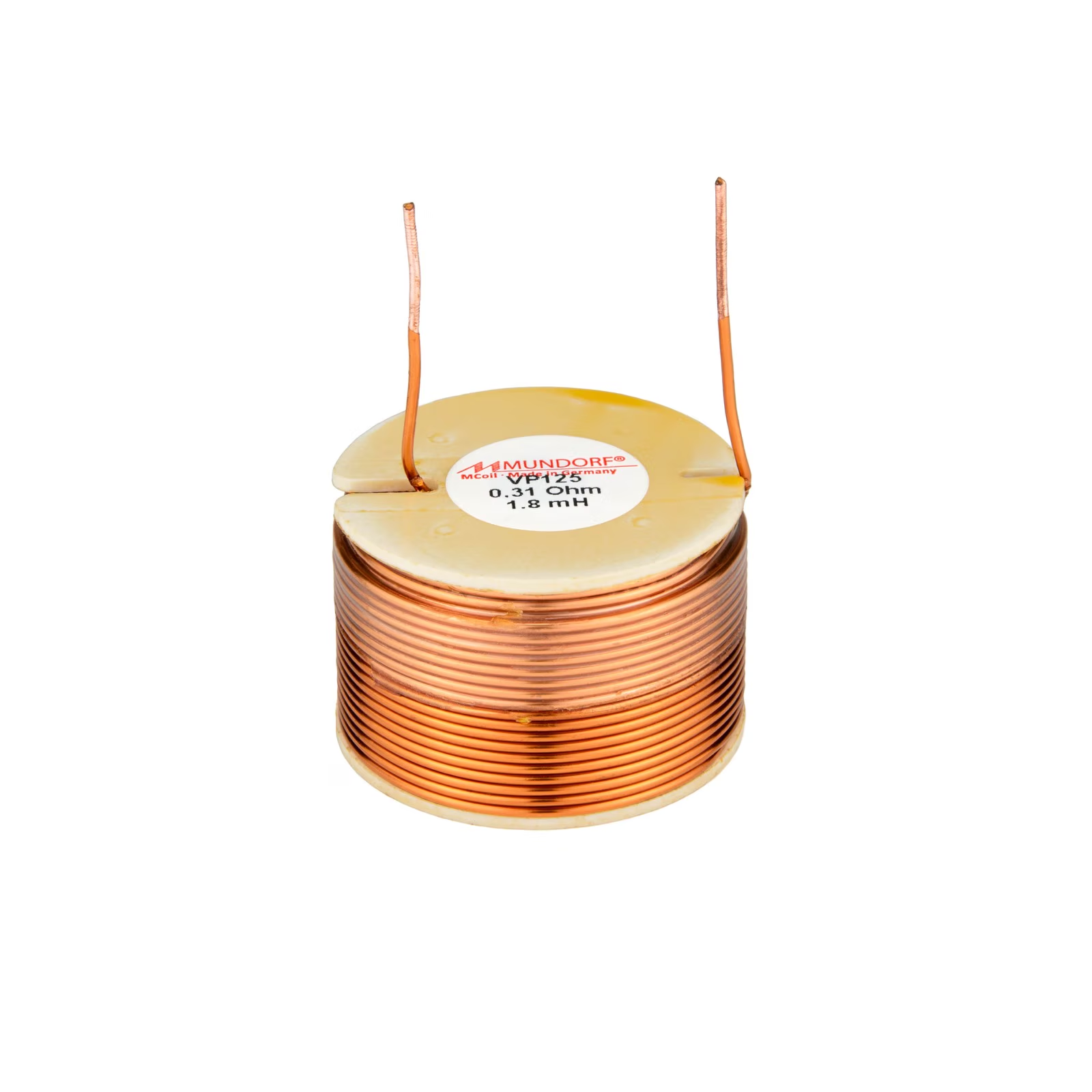
VP125
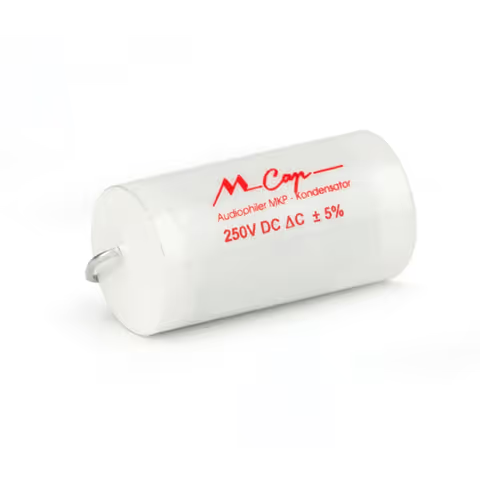
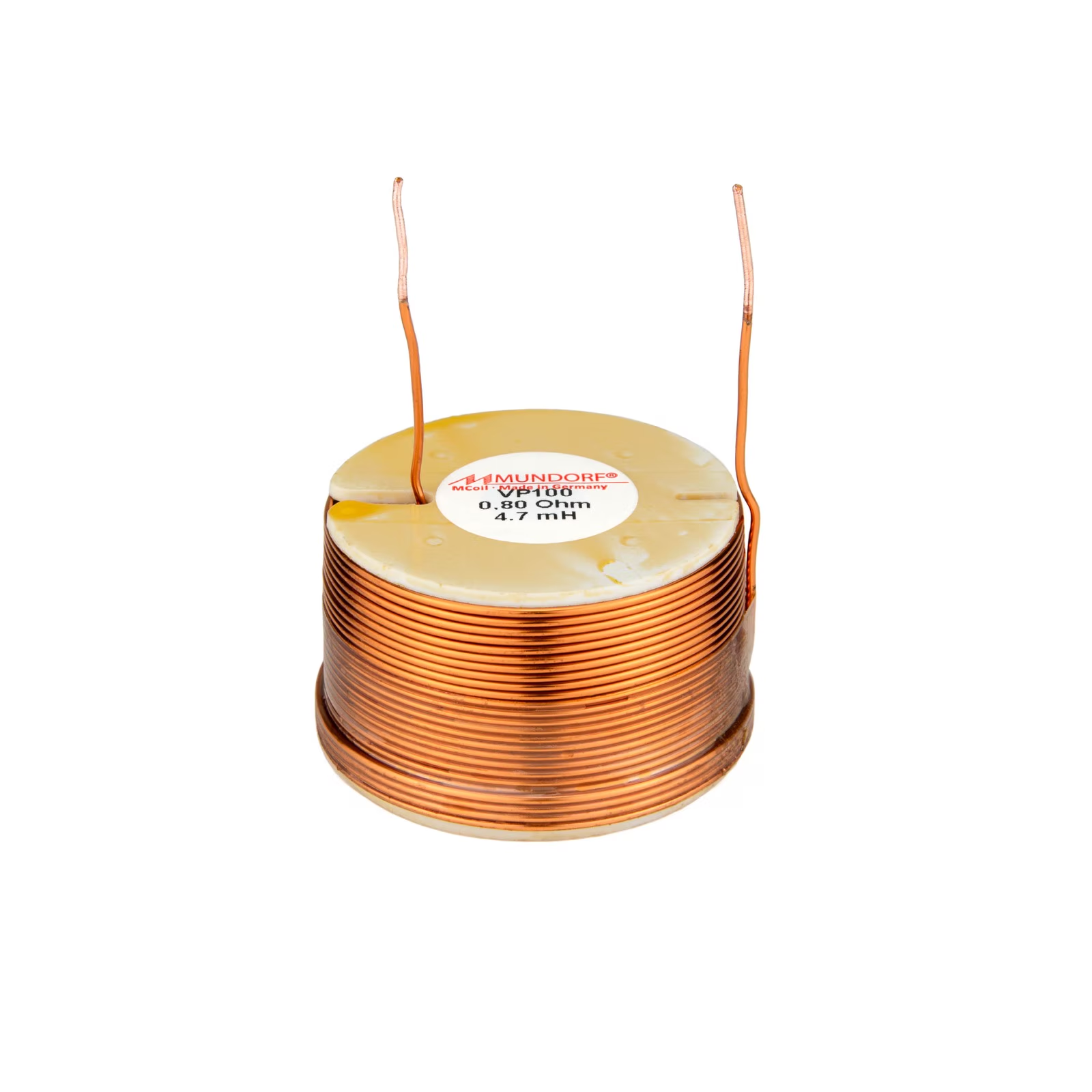
Aronit tubular-core coil, constructed with a P-core and baked varnish wire for high power handling and significantly reduced Macro-Microphony. The magnetically open circuit ensures late-onset, soft saturation as well as high current and dynamic reserves.
We are happy to advise you
Whether ideal components, technical know-how or individual solutions. Let us find the best solution for your application together!
For industrial customers
Order free samples
Would you like to test our products in yours? As a business customer, you can request free samples and see the quality and design for yourself.
NEWSLETTER
News and tips straight to your inbox. Subscribe to our newsletter and choose which topics matter to you.

OFC Copper
- Purity: at least 99.995% Cu, often 99.999% (4N) or higher
- Feature: almost oxygen-free (typically <10 ppm)
- Result: more stable grain boundaries, less oxide formation, more uniform electron flow
Tight Tolerances
Tight tolerances in capacitance, inductance, and resistance ensure that capacitors of one type are very close together in terms of their electrical properties. In crossovers, the left and right channels therefore work virtually identically: crossover frequencies, level ratios and phase positions match closely. This is the basis for stable, precise stereo imaging and reproducible results — in series production and also after service.
Tonal Effects
- precise, stable soundstage without drifting
- Coherent overall impression: left and right channels fuse into a single, seamless whole
- characteristic sound is reliably retained even after component replacement/repair
- More stable virtual center and clearer spatial layering

OFC Copper
- Purity: at least 99.995% Cu, often 99.999% (4N) or higher
- Feature: almost oxygen-free (typically <10 ppm)
- Result: more stable grain boundaries, less oxide formation, more uniform electron flow
Tight Tolerances
Tight tolerances in capacitance, inductance, and resistance ensure that capacitors of one type are very close together in terms of their electrical properties. In crossovers, the left and right channels therefore work virtually identically: crossover frequencies, level ratios and phase positions match closely. This is the basis for stable, precise stereo imaging and reproducible results — in series production and also after service.
Tonal Effects
- precise, stable soundstage without drifting
- Coherent overall impression: left and right channels fuse into a single, seamless whole
- characteristic sound is reliably retained even after component replacement/repair
- More stable virtual center and clearer spatial layering
OFC Copper
- Purity: at least 99.995% Cu, often 99.999% (4N) or higher
- Feature: almost oxygen-free (typically <10 ppm)
- Result: more stable grain boundaries, less oxide formation, more uniform electron flow
Tight Tolerances
Tight tolerances in capacitance, inductance, and resistance ensure that capacitors of one type are very close together in terms of their electrical properties. In crossovers, the left and right channels therefore work virtually identically: crossover frequencies, level ratios and phase positions match closely. This is the basis for stable, precise stereo imaging and reproducible results — in series production and also after service.
Tonal Effects
- precise, stable soundstage without drifting
- Coherent overall impression: left and right channels fuse into a single, seamless whole
- characteristic sound is reliably retained even after component replacement/repair
- More stable virtual center and clearer spatial layering
OFC Copper
- Purity: at least 99.995% Cu, often 99.999% (4N) or higher
- Feature: almost oxygen-free (typically <10 ppm)
- Result: more stable grain boundaries, less oxide formation, more uniform electron flow
Tight Tolerances
Tight tolerances in capacitance, inductance, and resistance ensure that capacitors of one type are very close together in terms of their electrical properties. In crossovers, the left and right channels therefore work virtually identically: crossover frequencies, level ratios and phase positions match closely. This is the basis for stable, precise stereo imaging and reproducible results — in series production and also after service.
Tonal Effects
- precise, stable soundstage without drifting
- Coherent overall impression: left and right channels fuse into a single, seamless whole
- characteristic sound is reliably retained even after component replacement/repair
- More stable virtual center and clearer spatial layering
OFC Copper
- Purity: at least 99.995% Cu, often 99.999% (4N) or higher
- Feature: almost oxygen-free (typically <10 ppm)
- Result: more stable grain boundaries, less oxide formation, more uniform electron flow
Tight Tolerances
Tight tolerances in capacitance, inductance, and resistance ensure that capacitors of one type are very close together in terms of their electrical properties. In crossovers, the left and right channels therefore work virtually identically: crossover frequencies, level ratios and phase positions match closely. This is the basis for stable, precise stereo imaging and reproducible results — in series production and also after service.
Tonal Effects
- precise, stable soundstage without drifting
- Coherent overall impression: left and right channels fuse into a single, seamless whole
- characteristic sound is reliably retained even after component replacement/repair
- More stable virtual center and clearer spatial layering

OFC Copper
- Purity: at least 99.995% Cu, often 99.999% (4N) or higher
- Feature: almost oxygen-free (typically <10 ppm)
- Result: more stable grain boundaries, less oxide formation, more uniform electron flow
Tight Tolerances
Tight tolerances in capacitance, inductance, and resistance ensure that capacitors of one type are very close together in terms of their electrical properties. In crossovers, the left and right channels therefore work virtually identically: crossover frequencies, level ratios and phase positions match closely. This is the basis for stable, precise stereo imaging and reproducible results — in series production and also after service.
Tonal Effects
- precise, stable soundstage without drifting
- Coherent overall impression: left and right channels fuse into a single, seamless whole
- characteristic sound is reliably retained even after component replacement/repair
- More stable virtual center and clearer spatial layering

OFC Copper
- Purity: at least 99.995% Cu, often 99.999% (4N) or higher
- Feature: almost oxygen-free (typically <10 ppm)
- Result: more stable grain boundaries, less oxide formation, more uniform electron flow
Tight Tolerances
Tight tolerances in capacitance, inductance, and resistance ensure that capacitors of one type are very close together in terms of their electrical properties. In crossovers, the left and right channels therefore work virtually identically: crossover frequencies, level ratios and phase positions match closely. This is the basis for stable, precise stereo imaging and reproducible results — in series production and also after service.
Tonal Effects
- precise, stable soundstage without drifting
- Coherent overall impression: left and right channels fuse into a single, seamless whole
- characteristic sound is reliably retained even after component replacement/repair
- More stable virtual center and clearer spatial layering
OFC Copper
- Purity: at least 99.995% Cu, often 99.999% (4N) or higher
- Feature: almost oxygen-free (typically <10 ppm)
- Result: more stable grain boundaries, less oxide formation, more uniform electron flow
Tight Tolerances
Tight tolerances in capacitance, inductance, and resistance ensure that capacitors of one type are very close together in terms of their electrical properties. In crossovers, the left and right channels therefore work virtually identically: crossover frequencies, level ratios and phase positions match closely. This is the basis for stable, precise stereo imaging and reproducible results — in series production and also after service.
Tonal Effects
- precise, stable soundstage without drifting
- Coherent overall impression: left and right channels fuse into a single, seamless whole
- characteristic sound is reliably retained even after component replacement/repair
- More stable virtual center and clearer spatial layering

OFC Copper
- Purity: at least 99.995% Cu, often 99.999% (4N) or higher
- Feature: almost oxygen-free (typically <10 ppm)
- Result: more stable grain boundaries, less oxide formation, more uniform electron flow
Tight Tolerances
Tight tolerances in capacitance, inductance, and resistance ensure that capacitors of one type are very close together in terms of their electrical properties. In crossovers, the left and right channels therefore work virtually identically: crossover frequencies, level ratios and phase positions match closely. This is the basis for stable, precise stereo imaging and reproducible results — in series production and also after service.
Tonal Effects
- precise, stable soundstage without drifting
- Coherent overall impression: left and right channels fuse into a single, seamless whole
- characteristic sound is reliably retained even after component replacement/repair
- More stable virtual center and clearer spatial layering

OFC Copper
- Purity: at least 99.995% Cu, often 99.999% (4N) or higher
- Feature: almost oxygen-free (typically <10 ppm)
- Result: more stable grain boundaries, less oxide formation, more uniform electron flow
Tight Tolerances
Tight tolerances in capacitance, inductance, and resistance ensure that capacitors of one type are very close together in terms of their electrical properties. In crossovers, the left and right channels therefore work virtually identically: crossover frequencies, level ratios and phase positions match closely. This is the basis for stable, precise stereo imaging and reproducible results — in series production and also after service.
Tonal Effects
- precise, stable soundstage without drifting
- Coherent overall impression: left and right channels fuse into a single, seamless whole
- characteristic sound is reliably retained even after component replacement/repair
- More stable virtual center and clearer spatial layering

OFC Copper
- Purity: at least 99.995% Cu, often 99.999% (4N) or higher
- Feature: almost oxygen-free (typically <10 ppm)
- Result: more stable grain boundaries, less oxide formation, more uniform electron flow
Tight Tolerances
Tight tolerances in capacitance, inductance, and resistance ensure that capacitors of one type are very close together in terms of their electrical properties. In crossovers, the left and right channels therefore work virtually identically: crossover frequencies, level ratios and phase positions match closely. This is the basis for stable, precise stereo imaging and reproducible results — in series production and also after service.
Tonal Effects
- precise, stable soundstage without drifting
- Coherent overall impression: left and right channels fuse into a single, seamless whole
- characteristic sound is reliably retained even after component replacement/repair
- More stable virtual center and clearer spatial layering

OFC Copper
- Purity: at least 99.995% Cu, often 99.999% (4N) or higher
- Feature: almost oxygen-free (typically <10 ppm)
- Result: more stable grain boundaries, less oxide formation, more uniform electron flow
Tight Tolerances
Tight tolerances in capacitance, inductance, and resistance ensure that capacitors of one type are very close together in terms of their electrical properties. In crossovers, the left and right channels therefore work virtually identically: crossover frequencies, level ratios and phase positions match closely. This is the basis for stable, precise stereo imaging and reproducible results — in series production and also after service.
Tonal Effects
- precise, stable soundstage without drifting
- Coherent overall impression: left and right channels fuse into a single, seamless whole
- characteristic sound is reliably retained even after component replacement/repair
- More stable virtual center and clearer spatial layering

OFC Copper
- Purity: at least 99.995% Cu, often 99.999% (4N) or higher
- Feature: almost oxygen-free (typically <10 ppm)
- Result: more stable grain boundaries, less oxide formation, more uniform electron flow
Tight Tolerances
Tight tolerances in capacitance, inductance, and resistance ensure that capacitors of one type are very close together in terms of their electrical properties. In crossovers, the left and right channels therefore work virtually identically: crossover frequencies, level ratios and phase positions match closely. This is the basis for stable, precise stereo imaging and reproducible results — in series production and also after service.
Tonal Effects
- precise, stable soundstage without drifting
- Coherent overall impression: left and right channels fuse into a single, seamless whole
- characteristic sound is reliably retained even after component replacement/repair
- More stable virtual center and clearer spatial layering

OFC Copper
- Purity: at least 99.995% Cu, often 99.999% (4N) or higher
- Feature: almost oxygen-free (typically <10 ppm)
- Result: more stable grain boundaries, less oxide formation, more uniform electron flow
Tight Tolerances
Tight tolerances in capacitance, inductance, and resistance ensure that capacitors of one type are very close together in terms of their electrical properties. In crossovers, the left and right channels therefore work virtually identically: crossover frequencies, level ratios and phase positions match closely. This is the basis for stable, precise stereo imaging and reproducible results — in series production and also after service.
Tonal Effects
- precise, stable soundstage without drifting
- Coherent overall impression: left and right channels fuse into a single, seamless whole
- characteristic sound is reliably retained even after component replacement/repair
- More stable virtual center and clearer spatial layering

OFC Copper
- Purity: at least 99.995% Cu, often 99.999% (4N) or higher
- Feature: almost oxygen-free (typically <10 ppm)
- Result: more stable grain boundaries, less oxide formation, more uniform electron flow
Tight Tolerances
Tight tolerances in capacitance, inductance, and resistance ensure that capacitors of one type are very close together in terms of their electrical properties. In crossovers, the left and right channels therefore work virtually identically: crossover frequencies, level ratios and phase positions match closely. This is the basis for stable, precise stereo imaging and reproducible results — in series production and also after service.
Tonal Effects
- precise, stable soundstage without drifting
- Coherent overall impression: left and right channels fuse into a single, seamless whole
- characteristic sound is reliably retained even after component replacement/repair
- More stable virtual center and clearer spatial layering

OFC Copper
- Purity: at least 99.995% Cu, often 99.999% (4N) or higher
- Feature: almost oxygen-free (typically <10 ppm)
- Result: more stable grain boundaries, less oxide formation, more uniform electron flow
Tight Tolerances
Tight tolerances in capacitance, inductance, and resistance ensure that capacitors of one type are very close together in terms of their electrical properties. In crossovers, the left and right channels therefore work virtually identically: crossover frequencies, level ratios and phase positions match closely. This is the basis for stable, precise stereo imaging and reproducible results — in series production and also after service.
Tonal Effects
- precise, stable soundstage without drifting
- Coherent overall impression: left and right channels fuse into a single, seamless whole
- characteristic sound is reliably retained even after component replacement/repair
- More stable virtual center and clearer spatial layering

OFC Copper
- Purity: at least 99.995% Cu, often 99.999% (4N) or higher
- Feature: almost oxygen-free (typically <10 ppm)
- Result: more stable grain boundaries, less oxide formation, more uniform electron flow
Tight Tolerances
Tight tolerances in capacitance, inductance, and resistance ensure that capacitors of one type are very close together in terms of their electrical properties. In crossovers, the left and right channels therefore work virtually identically: crossover frequencies, level ratios and phase positions match closely. This is the basis for stable, precise stereo imaging and reproducible results — in series production and also after service.
Tonal Effects
- precise, stable soundstage without drifting
- Coherent overall impression: left and right channels fuse into a single, seamless whole
- characteristic sound is reliably retained even after component replacement/repair
- More stable virtual center and clearer spatial layering