
Product Finder
Use our product finder to filter for components based on key specifications. This ensures you get the best results tailored to your individual requirements.
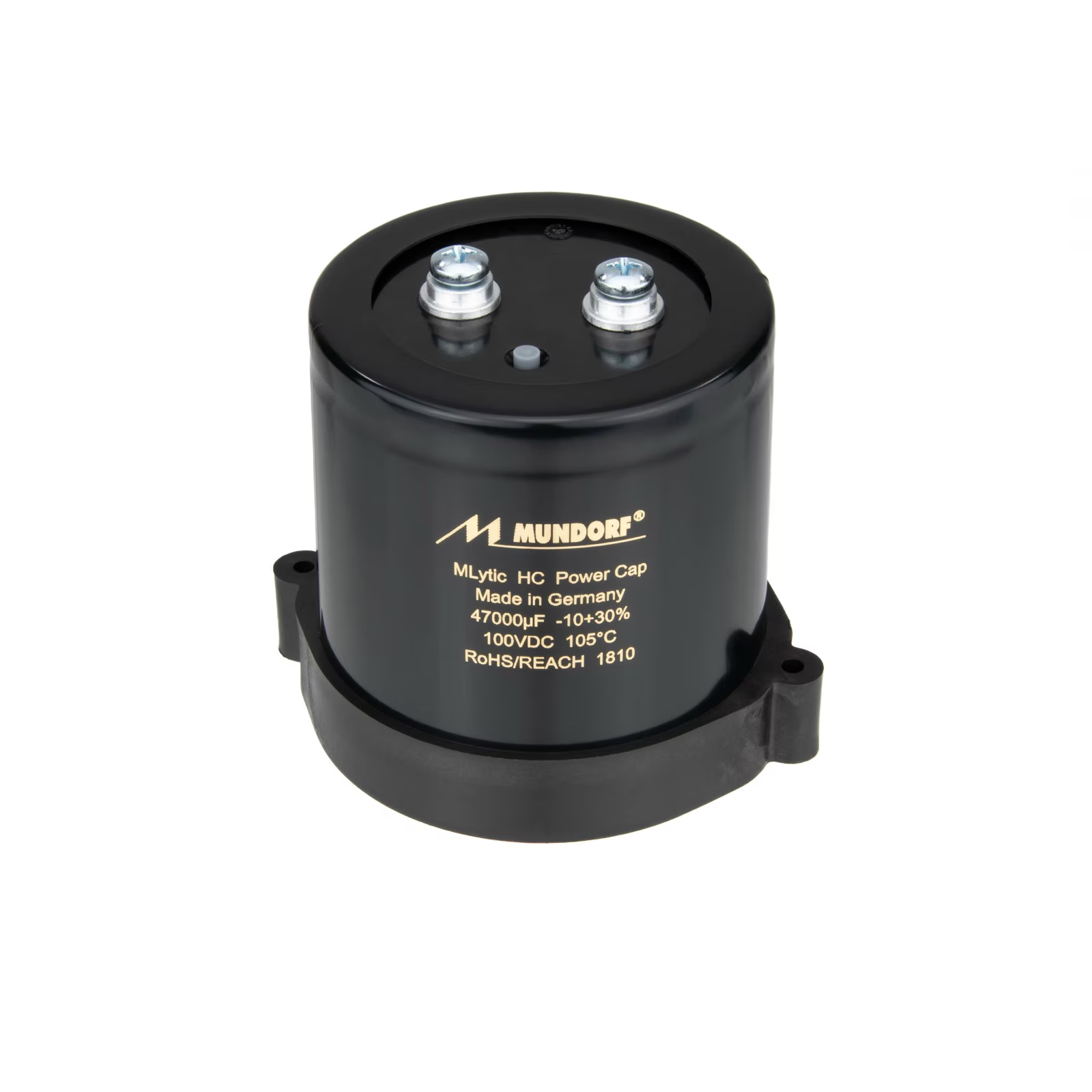
MLHC100
MLytic HC delivers extreme peak currents – fast, stable, and without compression.
Elastic Bonding
Adhesive pads for snap-in capacitors
Self-adhesive mounting pads for snap-in capacitors are inserted under the capacitor between the capacitor base and the circuit board and provide a relieving, vibration-dampening support. They are precisely tailored in diameter to the respective capacitor geometry, do not protrude and facilitate clean, safe installation.
Capacitor mounting clamps
Capacitor mounting clamps hold the capacitor in a form-fitting manner: It is placed in the clamp and securely fixed in the clamp with a screw. The clamp itself is then attached to the circuit board with screws and thus ensures stable, low-vibration assembly, even with larger components.
Manila Hemp Paper
Tight, controlled winding structures are a key requirement for reducing macro-microphonic effects in the electrolytic capacitor. The high-quality Manila hemp paper does more than just electrically separate the films: It acts as a damping separator in the wrap. Its fiber-elastic structure reduces vibrational energy and shock impulses instead of being felt as “pumps” in the supply. Forces from current pulses and mechanical stimuli are distributed more evenly so that the coil remains smoother. The result is a more stable energy output — particularly under load and with dynamic music.
Acoustic effects
- quieter background with high dynamics
- more control in bass during peak loads
- Fewer “pumps” of the supply under pulse load
- more stable overall impression at higher levels
Laser welded connections
Laser welding the connections of power supply capacitors offers considerable advantages over riveted connections widely used in industry.
Rivetted connections can be very reliable, but remain mechanical press connections whose contact surface and contact pressure can vary minimally due to temperature changes and long-term loads. Laser-welded connections, on the other hand, create a continuous metallurgically connection: The current path becomes more defined, contact resistance decreases, and remains constant even over extended periods of time. This directly improves core electrical data — in particular lower ESR, better current distribution in the coil and higher load capacity for ripple and pulse currents. In addition, it has a macro-microphone stabilizing effect because the internal contact point is mechanically “fixed” and works less under load pulses. As a result, energy is available faster and more evenly at the amplifier stage — without interruptions and without additional modulations.
Tonal effects
- more control during load jumps, less compression at high levels
- More stable bass due to lower supply drops
- quieter overall impression with complex music (less contact modulation)
- more consistent sound over the lifetime due to stable contact points
Maximum Contact between the Coils
The number of contacts or connection lugs between the connection (screw or solder connection) and the coil has a considerable influence on the electrical characteristics of a power supply capacitor. With each additional, sensibly placed contact, ESR and ESL decrease because the current can couple in and out of the coil via several parallel paths. At the same time, eddy current-related losses in the electrode film are reduced because the film is divided into smaller segments in terms of current and no large circulating currents occur. For industrial types, the number of contacts is therefore usually a compromise between electrical performance and economic production. With our top-end capacitors, we are consistently shifting this compromise towards maximum technically feasible contacting.
Tonal effects
- Faster energy flow in case of load jumps, less supply slump
- more control and “punch” in the bass due to lower impedance
- cleaner transients, less reverberation due to lower inductance
- more stable overall impression with high levels and complex music
Non-Magnetic Connections
Non-magnetic connections minimize micro-microphone modulations in the current path. In a power supply capacitor, the current flows not only through the coil, but also through the connecting wires and contact points — and this is exactly where ferromagnetic materials can produce undesired effects. Non-magnetic connection materials avoid magnetization and hysteresis in the conductor and thus reduce current-synchronous, very fine impedance modulations. This is a micro-microphonic measure in the actual power path: The connection is closer to the ideal conductor, without “magnetic interference.” In addition, there is additional electrotechnical benefit because non-magnetic, highly conductive materials often lower and stabilize contact and transition resistances. As a result, energy is available more evenly at the amplifier stage — and the sound remains quieter and more controlled.
Tonal effects
- quieter background and less “grit” with complex music
- more stable transients because the current path is less finely modulated
- clearer contours and cleaner room images at high levels
- more consistent sound quality due to more stable contact and conduction conditions
MLHC80
MLytic HC delivers extreme peak currents – fast, stable, and without compression.
Elastic Bonding
Adhesive pads for snap-in capacitors
Self-adhesive mounting pads for snap-in capacitors are inserted under the capacitor between the capacitor base and the circuit board and provide a relieving, vibration-dampening support. They are precisely tailored in diameter to the respective capacitor geometry, do not protrude and facilitate clean, safe installation.
Capacitor mounting clamps
Capacitor mounting clamps hold the capacitor in a form-fitting manner: It is placed in the clamp and securely fixed in the clamp with a screw. The clamp itself is then attached to the circuit board with screws and thus ensures stable, low-vibration assembly, even with larger components.
Manila Hemp Paper
Tight, controlled winding structures are a key requirement for reducing macro-microphonic effects in the electrolytic capacitor. The high-quality Manila hemp paper does more than just electrically separate the films: It acts as a damping separator in the wrap. Its fiber-elastic structure reduces vibrational energy and shock impulses instead of being felt as “pumps” in the supply. Forces from current pulses and mechanical stimuli are distributed more evenly so that the coil remains smoother. The result is a more stable energy output — particularly under load and with dynamic music.
Acoustic effects
- quieter background with high dynamics
- more control in bass during peak loads
- Fewer “pumps” of the supply under pulse load
- more stable overall impression at higher levels
Laser welded connections
Laser welding the connections of power supply capacitors offers considerable advantages over riveted connections widely used in industry.
Rivetted connections can be very reliable, but remain mechanical press connections whose contact surface and contact pressure can vary minimally due to temperature changes and long-term loads. Laser-welded connections, on the other hand, create a continuous metallurgically connection: The current path becomes more defined, contact resistance decreases, and remains constant even over extended periods of time. This directly improves core electrical data — in particular lower ESR, better current distribution in the coil and higher load capacity for ripple and pulse currents. In addition, it has a macro-microphone stabilizing effect because the internal contact point is mechanically “fixed” and works less under load pulses. As a result, energy is available faster and more evenly at the amplifier stage — without interruptions and without additional modulations.
Tonal effects
- more control during load jumps, less compression at high levels
- More stable bass due to lower supply drops
- quieter overall impression with complex music (less contact modulation)
- more consistent sound over the lifetime due to stable contact points
Maximum Contact between the Coils
The number of contacts or connection lugs between the connection (screw or solder connection) and the coil has a considerable influence on the electrical characteristics of a power supply capacitor. With each additional, sensibly placed contact, ESR and ESL decrease because the current can couple in and out of the coil via several parallel paths. At the same time, eddy current-related losses in the electrode film are reduced because the film is divided into smaller segments in terms of current and no large circulating currents occur. For industrial types, the number of contacts is therefore usually a compromise between electrical performance and economic production. With our top-end capacitors, we are consistently shifting this compromise towards maximum technically feasible contacting.
Tonal effects
- Faster energy flow in case of load jumps, less supply slump
- more control and “punch” in the bass due to lower impedance
- cleaner transients, less reverberation due to lower inductance
- more stable overall impression with high levels and complex music
Non-Magnetic Connections
Non-magnetic connections minimize micro-microphone modulations in the current path. In a power supply capacitor, the current flows not only through the coil, but also through the connecting wires and contact points — and this is exactly where ferromagnetic materials can produce undesired effects. Non-magnetic connection materials avoid magnetization and hysteresis in the conductor and thus reduce current-synchronous, very fine impedance modulations. This is a micro-microphonic measure in the actual power path: The connection is closer to the ideal conductor, without “magnetic interference.” In addition, there is additional electrotechnical benefit because non-magnetic, highly conductive materials often lower and stabilize contact and transition resistances. As a result, energy is available more evenly at the amplifier stage — and the sound remains quieter and more controlled.
Tonal effects
- quieter background and less “grit” with complex music
- more stable transients because the current path is less finely modulated
- clearer contours and cleaner room images at high levels
- more consistent sound quality due to more stable contact and conduction conditions