
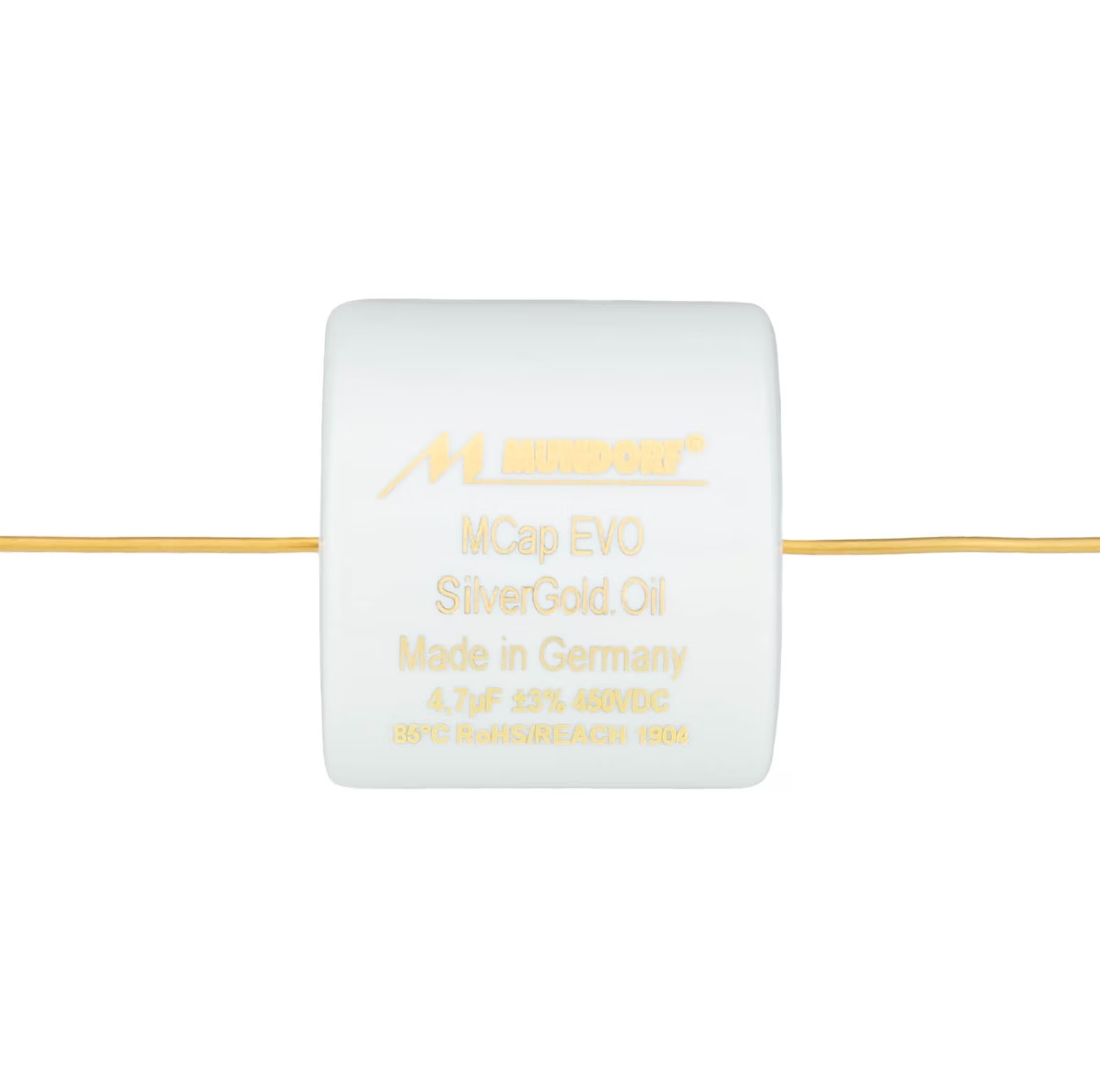
MESGO-47T3.350
The MCap Evo SilverGold Oil strikes a harmonious balance between structure and emotion. Built upon the precisely engineered Evo foundation – characterized by a clear rhythmic structure and the finest impulses – the silver/gold metallization ensures exceptional transparency, fine texture, and a precise, three-dimensional soundstage. The gold content contributes warmth, rich timbres, lively rhythm, and a sense of musical joy, strengthening the emotional connection to the music. Voices and instruments appear present and colorful, the soundstage feels deep and alive – you are literally drawn into the music.
Technologies
Reduces charge carrier dispersion at grain boundaries in the metal, reduces sound roughness, calms the noise spectrum.
Aluminum metallization (100% aluminum instead of zinc-aluminum mixture)
Pure aluminum metallization replaces the zinc-aluminum mixture commonly used in industry with a homogeneous metal structure. This reduces interface effects at the grain boundaries , stabilizes the conductivity across the electrode surface and results in a significantly quieter noise spectrum. For example, the basic design of an MCap is audibly different from typical industrial capacitors.
Tonal Effects
- Darker, quieter background — subtle artifacts recede
- Clearer, clearer stage without rough-metallic side effects
- Quiet, well-defined overall sound — a real introduction to audiophile quality
Gold stabilizes interfaces, smooths out microspectrum, adds color to silver.
Silver – Gold Metallization (Ag – Au)
The Silver-Gold Metallization combines the maximum conductivity of silver with the interfacial stability of gold. Silver provides precise, finely resolved signal routing with very low noise; gold stabilizes grain boundaries, slows down diffusion and smooths the microspectrum — particularly with small signals and over a long period of time.
Tonal effects
- Finer texture and more stable reproduction of the smallest details (overtones, spatial fractions, fading processes)
- Richer, differentiated timbres with a clear outline — colorful but ordered
- Quieter, more “mature” overall impression: less nervousness, high long-term suitability
- Noticeably more heart, rhythm and joy of playing with insight and precision
Oil penetrates every pore, stabilizes the wrap, reduces macro-microphony.
Vacuum Oil Impregnation
Vacuum oil impregnation involves displacing air from the coil and drawing a special oil — whose dielectric and hydromechanical properties optimize the desired acoustic characteristics of the coil structure — into every pore under a vacuum. The oil wets film and paper surfaces, stabilizes the wrap from the inside and dampens extensive movements — macro microphony is reduced deep in the wrap structure. In this way, the capacitor remains mechanically quiet even with high pulses and dynamics and does not falsify the music signal through its own movements.
Tonal effects
- Reverb decays, fading processes and quiet room information are more prominent because the wrap inside is calmed down
- Even with high dynamics, the sound remains calm and orderly; loud passages do not drown out the quieter details
- Transients (blowing noises, string strokes, cymbal impulses) come precisely, completely and without sharpness
- Overall impression: relaxed, controlled and at the same time exceptionally detailed
Lowers ESL and ESR, significantly improves timing, focus and audibility.
Evo Winding Geometry
The Evo winding geometry uses many narrow turns of the electrode foils, with end-face contacts, instead of a few wide layers. As a result, current paths are shortened and the power distribution over the entire winding surface is significantly more homogeneous. This not only significantly lowers the equivalent series inductance (ESL), but also the equivalent series resistance (ESR) — the capacitor processes transients faster, in a more controlled manner and at the same time remains mechanically more stable and less susceptible to mechanical resonances. The result is a precise, focused and stress-free listening experience that remains organized even with complex music.
Tonal effects
- more precise transients and clear rhythmic structure
- More stable center, clearer localisation and a more focused soundstage
- better transparency in dense, complex music
- more control and sovereignty even at higher levels
- stress-free precision without nervousness
- clean microdetails without temporal smearing
Soothes the wrap, reduces macro microphones, increases silence and location precision.
Optimized Winding Tension plus Stabilization
Optimized winding tension and additional stabilization mechanically calm the wrap and significantly reduce macro-microphone effects — for a quieter background, a more stable stage and clean transients, even with dynamic music and higher levels.
Tonal effects
- more peace and order in the sound image
- More precise positioning and a more stable stage
- clearer microdetails without smudging
Reduces electrode resistance, reduces hot spots, keeps parameters stable under load.
Reinforced Metallization
Reinforced metallization means a deliberately thicker metal layer on the insulation film. As a result, the resistance of the electrode tracks drops significantly, conductivity increases, voltage drops and local heating are reduced, and field gradients are flattened. The capacitor remains stable under pulses and high current peaks because the electrode does not become a limiting factor: energy is available more quickly and in a more controlled manner, capacity and losses remain more constant even under load, and signal-related modulations in the metal grid are reduced. The result is superior, powerful and clean transmission behavior — even if it becomes dynamic.
Tonal effects
- controlled, powerful and clear even at peak levels
- Bass and drum impulses with more authority and drawing
- more stable sound without electrode-side “flickering”
- more peace and order in complex, dynamic passages
Fixes the wrap, dampens resonances, prevents signal-related oscillation.
Encapsulation in a housing with visco-elastic sealing compound
Encapsulation in a housing with visco-elastic sealing compound means: The capacitor wrap is mechanically calmed and permanently fixed in the fixed housing — not only against external vibrations, but also against stimulation from the music signal itself. This is because alternating current generates field forces that can set the winding in motion; this is precisely what causes macro-microphonic feedback when the capacitor winding resonates. The encapsulation prevents this feedback from building up: coupled energy is absorbed by the viscoelastic layer, resonances are widely dispersed and their amplitude is reduced – resonance peaks are effectively eliminated.
Tonal effects
- Stable, relaxed stage even at high levels — the capacitor remains “silent”
- Clear location: Voices and instruments retain their shape and position
- Less housing noise and structure-borne noise — the sound appears sorted and focused
- More audibility: quiet room information and fine details are retained even when dynamic
Make sure that the left and right channels work identically, important for stable stage and positioning.
Tight Tolerances
Tight tolerances in capacitance, inductance, and resistance ensure that capacitors of one type are very close together in terms of their electrical properties. In crossovers, the left and right channels therefore work virtually identically: crossover frequencies, level ratios and phase positions match closely. This is the basis for stable, precise stereo imaging and reproducible results — in series production and also after service.
Tonal Effects
- precise, stable soundstage without drifting
- Coherent overall impression: left and right channels fuse into a single, seamless whole
- characteristic sound is reliably retained even after component replacement/repair
- More stable virtual center and clearer spatial layering
Similar configurations
1 VARIANTS
We are happy to advise you
Whether ideal components, technical know-how or individual solutions. Let us find the best solution for your application together!
For industrial customers
Order free samples
Would you like to test our products in yours? As a business customer, you can request free samples and see the quality and design for yourself.
NEWSLETTER
News and tips straight to your inbox. Subscribe to our newsletter and choose which topics matter to you.
Our services for manufacturers and partners
From selecting products from our range to developing custom solutions – we support you through every phase of your project.
Product consulting
Would you like to test our products yourself? As a business customer, you can request free samples to experience our quality and design firsthand.
Project consulting & custom solutions
We create custom designs outside of our standard range, perfectly tailored to your project in terms of dimensions, specifications, and combinations. Available for orders of a commercially viable quantity.

Aluminum metallization (100% aluminum instead of zinc-aluminum mixture)
Pure aluminum metallization replaces the zinc-aluminum mixture commonly used in industry with a homogeneous metal structure. This reduces interface effects at the grain boundaries , stabilizes the conductivity across the electrode surface and results in a significantly quieter noise spectrum. For example, the basic design of an MCap is audibly different from typical industrial capacitors.
Tonal Effects
- Darker, quieter background — subtle artifacts recede
- Clearer, clearer stage without rough-metallic side effects
- Quiet, well-defined overall sound — a real introduction to audiophile quality
Silver – Gold Metallization (Ag – Au)
The Silver-Gold Metallization combines the maximum conductivity of silver with the interfacial stability of gold. Silver provides precise, finely resolved signal routing with very low noise; gold stabilizes grain boundaries, slows down diffusion and smooths the microspectrum — particularly with small signals and over a long period of time.
Tonal effects
- Finer texture and more stable reproduction of the smallest details (overtones, spatial fractions, fading processes)
- Richer, differentiated timbres with a clear outline — colorful but ordered
- Quieter, more “mature” overall impression: less nervousness, high long-term suitability
- Noticeably more heart, rhythm and joy of playing with insight and precision
Vacuum Oil Impregnation
Vacuum oil impregnation involves displacing air from the coil and drawing a special oil — whose dielectric and hydromechanical properties optimize the desired acoustic characteristics of the coil structure — into every pore under a vacuum. The oil wets film and paper surfaces, stabilizes the wrap from the inside and dampens extensive movements — macro microphony is reduced deep in the wrap structure. In this way, the capacitor remains mechanically quiet even with high pulses and dynamics and does not falsify the music signal through its own movements.
Tonal effects
- Reverb decays, fading processes and quiet room information are more prominent because the wrap inside is calmed down
- Even with high dynamics, the sound remains calm and orderly; loud passages do not drown out the quieter details
- Transients (blowing noises, string strokes, cymbal impulses) come precisely, completely and without sharpness
- Overall impression: relaxed, controlled and at the same time exceptionally detailed
Evo Winding Geometry
The Evo winding geometry uses many narrow turns of the electrode foils, with end-face contacts, instead of a few wide layers. As a result, current paths are shortened and the power distribution over the entire winding surface is significantly more homogeneous. This not only significantly lowers the equivalent series inductance (ESL), but also the equivalent series resistance (ESR) — the capacitor processes transients faster, in a more controlled manner and at the same time remains mechanically more stable and less susceptible to mechanical resonances. The result is a precise, focused and stress-free listening experience that remains organized even with complex music.
Tonal effects
- more precise transients and clear rhythmic structure
- More stable center, clearer localisation and a more focused soundstage
- better transparency in dense, complex music
- more control and sovereignty even at higher levels
- stress-free precision without nervousness
- clean microdetails without temporal smearing
Optimized Winding Tension plus Stabilization
Optimized winding tension and additional stabilization mechanically calm the wrap and significantly reduce macro-microphone effects — for a quieter background, a more stable stage and clean transients, even with dynamic music and higher levels.
Tonal effects
- more peace and order in the sound image
- More precise positioning and a more stable stage
- clearer microdetails without smudging

Aluminum metallization (100% aluminum instead of zinc-aluminum mixture)
Pure aluminum metallization replaces the zinc-aluminum mixture commonly used in industry with a homogeneous metal structure. This reduces interface effects at the grain boundaries , stabilizes the conductivity across the electrode surface and results in a significantly quieter noise spectrum. For example, the basic design of an MCap is audibly different from typical industrial capacitors.
Tonal Effects
- Darker, quieter background — subtle artifacts recede
- Clearer, clearer stage without rough-metallic side effects
- Quiet, well-defined overall sound — a real introduction to audiophile quality
Silver – Gold Metallization (Ag – Au)
The Silver-Gold Metallization combines the maximum conductivity of silver with the interfacial stability of gold. Silver provides precise, finely resolved signal routing with very low noise; gold stabilizes grain boundaries, slows down diffusion and smooths the microspectrum — particularly with small signals and over a long period of time.
Tonal effects
- Finer texture and more stable reproduction of the smallest details (overtones, spatial fractions, fading processes)
- Richer, differentiated timbres with a clear outline — colorful but ordered
- Quieter, more “mature” overall impression: less nervousness, high long-term suitability
- Noticeably more heart, rhythm and joy of playing with insight and precision
Vacuum Oil Impregnation
Vacuum oil impregnation involves displacing air from the coil and drawing a special oil — whose dielectric and hydromechanical properties optimize the desired acoustic characteristics of the coil structure — into every pore under a vacuum. The oil wets film and paper surfaces, stabilizes the wrap from the inside and dampens extensive movements — macro microphony is reduced deep in the wrap structure. In this way, the capacitor remains mechanically quiet even with high pulses and dynamics and does not falsify the music signal through its own movements.
Tonal effects
- Reverb decays, fading processes and quiet room information are more prominent because the wrap inside is calmed down
- Even with high dynamics, the sound remains calm and orderly; loud passages do not drown out the quieter details
- Transients (blowing noises, string strokes, cymbal impulses) come precisely, completely and without sharpness
- Overall impression: relaxed, controlled and at the same time exceptionally detailed
Evo Winding Geometry
The Evo winding geometry uses many narrow turns of the electrode foils, with end-face contacts, instead of a few wide layers. As a result, current paths are shortened and the power distribution over the entire winding surface is significantly more homogeneous. This not only significantly lowers the equivalent series inductance (ESL), but also the equivalent series resistance (ESR) — the capacitor processes transients faster, in a more controlled manner and at the same time remains mechanically more stable and less susceptible to mechanical resonances. The result is a precise, focused and stress-free listening experience that remains organized even with complex music.
Tonal effects
- more precise transients and clear rhythmic structure
- More stable center, clearer localisation and a more focused soundstage
- better transparency in dense, complex music
- more control and sovereignty even at higher levels
- stress-free precision without nervousness
- clean microdetails without temporal smearing
Optimized Winding Tension plus Stabilization
Optimized winding tension and additional stabilization mechanically calm the wrap and significantly reduce macro-microphone effects — for a quieter background, a more stable stage and clean transients, even with dynamic music and higher levels.
Tonal effects
- more peace and order in the sound image
- More precise positioning and a more stable stage
- clearer microdetails without smudging

Aluminum metallization (100% aluminum instead of zinc-aluminum mixture)
Pure aluminum metallization replaces the zinc-aluminum mixture commonly used in industry with a homogeneous metal structure. This reduces interface effects at the grain boundaries , stabilizes the conductivity across the electrode surface and results in a significantly quieter noise spectrum. For example, the basic design of an MCap is audibly different from typical industrial capacitors.
Tonal Effects
- Darker, quieter background — subtle artifacts recede
- Clearer, clearer stage without rough-metallic side effects
- Quiet, well-defined overall sound — a real introduction to audiophile quality
Silver – Gold Metallization (Ag – Au)
The Silver-Gold Metallization combines the maximum conductivity of silver with the interfacial stability of gold. Silver provides precise, finely resolved signal routing with very low noise; gold stabilizes grain boundaries, slows down diffusion and smooths the microspectrum — particularly with small signals and over a long period of time.
Tonal effects
- Finer texture and more stable reproduction of the smallest details (overtones, spatial fractions, fading processes)
- Richer, differentiated timbres with a clear outline — colorful but ordered
- Quieter, more “mature” overall impression: less nervousness, high long-term suitability
- Noticeably more heart, rhythm and joy of playing with insight and precision
Vacuum Oil Impregnation
Vacuum oil impregnation involves displacing air from the coil and drawing a special oil — whose dielectric and hydromechanical properties optimize the desired acoustic characteristics of the coil structure — into every pore under a vacuum. The oil wets film and paper surfaces, stabilizes the wrap from the inside and dampens extensive movements — macro microphony is reduced deep in the wrap structure. In this way, the capacitor remains mechanically quiet even with high pulses and dynamics and does not falsify the music signal through its own movements.
Tonal effects
- Reverb decays, fading processes and quiet room information are more prominent because the wrap inside is calmed down
- Even with high dynamics, the sound remains calm and orderly; loud passages do not drown out the quieter details
- Transients (blowing noises, string strokes, cymbal impulses) come precisely, completely and without sharpness
- Overall impression: relaxed, controlled and at the same time exceptionally detailed
Evo Winding Geometry
The Evo winding geometry uses many narrow turns of the electrode foils, with end-face contacts, instead of a few wide layers. As a result, current paths are shortened and the power distribution over the entire winding surface is significantly more homogeneous. This not only significantly lowers the equivalent series inductance (ESL), but also the equivalent series resistance (ESR) — the capacitor processes transients faster, in a more controlled manner and at the same time remains mechanically more stable and less susceptible to mechanical resonances. The result is a precise, focused and stress-free listening experience that remains organized even with complex music.
Tonal effects
- more precise transients and clear rhythmic structure
- More stable center, clearer localisation and a more focused soundstage
- better transparency in dense, complex music
- more control and sovereignty even at higher levels
- stress-free precision without nervousness
- clean microdetails without temporal smearing
Optimized Winding Tension plus Stabilization
Optimized winding tension and additional stabilization mechanically calm the wrap and significantly reduce macro-microphone effects — for a quieter background, a more stable stage and clean transients, even with dynamic music and higher levels.
Tonal effects
- more peace and order in the sound image
- More precise positioning and a more stable stage
- clearer microdetails without smudging

Aluminum metallization (100% aluminum instead of zinc-aluminum mixture)
Pure aluminum metallization replaces the zinc-aluminum mixture commonly used in industry with a homogeneous metal structure. This reduces interface effects at the grain boundaries , stabilizes the conductivity across the electrode surface and results in a significantly quieter noise spectrum. For example, the basic design of an MCap is audibly different from typical industrial capacitors.
Tonal Effects
- Darker, quieter background — subtle artifacts recede
- Clearer, clearer stage without rough-metallic side effects
- Quiet, well-defined overall sound — a real introduction to audiophile quality
Silver – Gold Metallization (Ag – Au)
The Silver-Gold Metallization combines the maximum conductivity of silver with the interfacial stability of gold. Silver provides precise, finely resolved signal routing with very low noise; gold stabilizes grain boundaries, slows down diffusion and smooths the microspectrum — particularly with small signals and over a long period of time.
Tonal effects
- Finer texture and more stable reproduction of the smallest details (overtones, spatial fractions, fading processes)
- Richer, differentiated timbres with a clear outline — colorful but ordered
- Quieter, more “mature” overall impression: less nervousness, high long-term suitability
- Noticeably more heart, rhythm and joy of playing with insight and precision
Vacuum Oil Impregnation
Vacuum oil impregnation involves displacing air from the coil and drawing a special oil — whose dielectric and hydromechanical properties optimize the desired acoustic characteristics of the coil structure — into every pore under a vacuum. The oil wets film and paper surfaces, stabilizes the wrap from the inside and dampens extensive movements — macro microphony is reduced deep in the wrap structure. In this way, the capacitor remains mechanically quiet even with high pulses and dynamics and does not falsify the music signal through its own movements.
Tonal effects
- Reverb decays, fading processes and quiet room information are more prominent because the wrap inside is calmed down
- Even with high dynamics, the sound remains calm and orderly; loud passages do not drown out the quieter details
- Transients (blowing noises, string strokes, cymbal impulses) come precisely, completely and without sharpness
- Overall impression: relaxed, controlled and at the same time exceptionally detailed
Evo Winding Geometry
The Evo winding geometry uses many narrow turns of the electrode foils, with end-face contacts, instead of a few wide layers. As a result, current paths are shortened and the power distribution over the entire winding surface is significantly more homogeneous. This not only significantly lowers the equivalent series inductance (ESL), but also the equivalent series resistance (ESR) — the capacitor processes transients faster, in a more controlled manner and at the same time remains mechanically more stable and less susceptible to mechanical resonances. The result is a precise, focused and stress-free listening experience that remains organized even with complex music.
Tonal effects
- more precise transients and clear rhythmic structure
- More stable center, clearer localisation and a more focused soundstage
- better transparency in dense, complex music
- more control and sovereignty even at higher levels
- stress-free precision without nervousness
- clean microdetails without temporal smearing
Optimized Winding Tension plus Stabilization
Optimized winding tension and additional stabilization mechanically calm the wrap and significantly reduce macro-microphone effects — for a quieter background, a more stable stage and clean transients, even with dynamic music and higher levels.
Tonal effects
- more peace and order in the sound image
- More precise positioning and a more stable stage
- clearer microdetails without smudging

Aluminum metallization (100% aluminum instead of zinc-aluminum mixture)
Pure aluminum metallization replaces the zinc-aluminum mixture commonly used in industry with a homogeneous metal structure. This reduces interface effects at the grain boundaries , stabilizes the conductivity across the electrode surface and results in a significantly quieter noise spectrum. For example, the basic design of an MCap is audibly different from typical industrial capacitors.
Tonal Effects
- Darker, quieter background — subtle artifacts recede
- Clearer, clearer stage without rough-metallic side effects
- Quiet, well-defined overall sound — a real introduction to audiophile quality
Silver – Gold Metallization (Ag – Au)
The Silver-Gold Metallization combines the maximum conductivity of silver with the interfacial stability of gold. Silver provides precise, finely resolved signal routing with very low noise; gold stabilizes grain boundaries, slows down diffusion and smooths the microspectrum — particularly with small signals and over a long period of time.
Tonal effects
- Finer texture and more stable reproduction of the smallest details (overtones, spatial fractions, fading processes)
- Richer, differentiated timbres with a clear outline — colorful but ordered
- Quieter, more “mature” overall impression: less nervousness, high long-term suitability
- Noticeably more heart, rhythm and joy of playing with insight and precision
Vacuum Oil Impregnation
Vacuum oil impregnation involves displacing air from the coil and drawing a special oil — whose dielectric and hydromechanical properties optimize the desired acoustic characteristics of the coil structure — into every pore under a vacuum. The oil wets film and paper surfaces, stabilizes the wrap from the inside and dampens extensive movements — macro microphony is reduced deep in the wrap structure. In this way, the capacitor remains mechanically quiet even with high pulses and dynamics and does not falsify the music signal through its own movements.
Tonal effects
- Reverb decays, fading processes and quiet room information are more prominent because the wrap inside is calmed down
- Even with high dynamics, the sound remains calm and orderly; loud passages do not drown out the quieter details
- Transients (blowing noises, string strokes, cymbal impulses) come precisely, completely and without sharpness
- Overall impression: relaxed, controlled and at the same time exceptionally detailed
Evo Winding Geometry
The Evo winding geometry uses many narrow turns of the electrode foils, with end-face contacts, instead of a few wide layers. As a result, current paths are shortened and the power distribution over the entire winding surface is significantly more homogeneous. This not only significantly lowers the equivalent series inductance (ESL), but also the equivalent series resistance (ESR) — the capacitor processes transients faster, in a more controlled manner and at the same time remains mechanically more stable and less susceptible to mechanical resonances. The result is a precise, focused and stress-free listening experience that remains organized even with complex music.
Tonal effects
- more precise transients and clear rhythmic structure
- More stable center, clearer localisation and a more focused soundstage
- better transparency in dense, complex music
- more control and sovereignty even at higher levels
- stress-free precision without nervousness
- clean microdetails without temporal smearing
Optimized Winding Tension plus Stabilization
Optimized winding tension and additional stabilization mechanically calm the wrap and significantly reduce macro-microphone effects — for a quieter background, a more stable stage and clean transients, even with dynamic music and higher levels.
Tonal effects
- more peace and order in the sound image
- More precise positioning and a more stable stage
- clearer microdetails without smudging

Aluminum metallization (100% aluminum instead of zinc-aluminum mixture)
Pure aluminum metallization replaces the zinc-aluminum mixture commonly used in industry with a homogeneous metal structure. This reduces interface effects at the grain boundaries , stabilizes the conductivity across the electrode surface and results in a significantly quieter noise spectrum. For example, the basic design of an MCap is audibly different from typical industrial capacitors.
Tonal Effects
- Darker, quieter background — subtle artifacts recede
- Clearer, clearer stage without rough-metallic side effects
- Quiet, well-defined overall sound — a real introduction to audiophile quality
Silver – Gold Metallization (Ag – Au)
The Silver-Gold Metallization combines the maximum conductivity of silver with the interfacial stability of gold. Silver provides precise, finely resolved signal routing with very low noise; gold stabilizes grain boundaries, slows down diffusion and smooths the microspectrum — particularly with small signals and over a long period of time.
Tonal effects
- Finer texture and more stable reproduction of the smallest details (overtones, spatial fractions, fading processes)
- Richer, differentiated timbres with a clear outline — colorful but ordered
- Quieter, more “mature” overall impression: less nervousness, high long-term suitability
- Noticeably more heart, rhythm and joy of playing with insight and precision
Vacuum Oil Impregnation
Vacuum oil impregnation involves displacing air from the coil and drawing a special oil — whose dielectric and hydromechanical properties optimize the desired acoustic characteristics of the coil structure — into every pore under a vacuum. The oil wets film and paper surfaces, stabilizes the wrap from the inside and dampens extensive movements — macro microphony is reduced deep in the wrap structure. In this way, the capacitor remains mechanically quiet even with high pulses and dynamics and does not falsify the music signal through its own movements.
Tonal effects
- Reverb decays, fading processes and quiet room information are more prominent because the wrap inside is calmed down
- Even with high dynamics, the sound remains calm and orderly; loud passages do not drown out the quieter details
- Transients (blowing noises, string strokes, cymbal impulses) come precisely, completely and without sharpness
- Overall impression: relaxed, controlled and at the same time exceptionally detailed
Evo Winding Geometry
The Evo winding geometry uses many narrow turns of the electrode foils, with end-face contacts, instead of a few wide layers. As a result, current paths are shortened and the power distribution over the entire winding surface is significantly more homogeneous. This not only significantly lowers the equivalent series inductance (ESL), but also the equivalent series resistance (ESR) — the capacitor processes transients faster, in a more controlled manner and at the same time remains mechanically more stable and less susceptible to mechanical resonances. The result is a precise, focused and stress-free listening experience that remains organized even with complex music.
Tonal effects
- more precise transients and clear rhythmic structure
- More stable center, clearer localisation and a more focused soundstage
- better transparency in dense, complex music
- more control and sovereignty even at higher levels
- stress-free precision without nervousness
- clean microdetails without temporal smearing
Optimized Winding Tension plus Stabilization
Optimized winding tension and additional stabilization mechanically calm the wrap and significantly reduce macro-microphone effects — for a quieter background, a more stable stage and clean transients, even with dynamic music and higher levels.
Tonal effects
- more peace and order in the sound image
- More precise positioning and a more stable stage
- clearer microdetails without smudging

Aluminum metallization (100% aluminum instead of zinc-aluminum mixture)
Pure aluminum metallization replaces the zinc-aluminum mixture commonly used in industry with a homogeneous metal structure. This reduces interface effects at the grain boundaries , stabilizes the conductivity across the electrode surface and results in a significantly quieter noise spectrum. For example, the basic design of an MCap is audibly different from typical industrial capacitors.
Tonal Effects
- Darker, quieter background — subtle artifacts recede
- Clearer, clearer stage without rough-metallic side effects
- Quiet, well-defined overall sound — a real introduction to audiophile quality
Silver – Gold Metallization (Ag – Au)
The Silver-Gold Metallization combines the maximum conductivity of silver with the interfacial stability of gold. Silver provides precise, finely resolved signal routing with very low noise; gold stabilizes grain boundaries, slows down diffusion and smooths the microspectrum — particularly with small signals and over a long period of time.
Tonal effects
- Finer texture and more stable reproduction of the smallest details (overtones, spatial fractions, fading processes)
- Richer, differentiated timbres with a clear outline — colorful but ordered
- Quieter, more “mature” overall impression: less nervousness, high long-term suitability
- Noticeably more heart, rhythm and joy of playing with insight and precision
Vacuum Oil Impregnation
Vacuum oil impregnation involves displacing air from the coil and drawing a special oil — whose dielectric and hydromechanical properties optimize the desired acoustic characteristics of the coil structure — into every pore under a vacuum. The oil wets film and paper surfaces, stabilizes the wrap from the inside and dampens extensive movements — macro microphony is reduced deep in the wrap structure. In this way, the capacitor remains mechanically quiet even with high pulses and dynamics and does not falsify the music signal through its own movements.
Tonal effects
- Reverb decays, fading processes and quiet room information are more prominent because the wrap inside is calmed down
- Even with high dynamics, the sound remains calm and orderly; loud passages do not drown out the quieter details
- Transients (blowing noises, string strokes, cymbal impulses) come precisely, completely and without sharpness
- Overall impression: relaxed, controlled and at the same time exceptionally detailed
Evo Winding Geometry
The Evo winding geometry uses many narrow turns of the electrode foils, with end-face contacts, instead of a few wide layers. As a result, current paths are shortened and the power distribution over the entire winding surface is significantly more homogeneous. This not only significantly lowers the equivalent series inductance (ESL), but also the equivalent series resistance (ESR) — the capacitor processes transients faster, in a more controlled manner and at the same time remains mechanically more stable and less susceptible to mechanical resonances. The result is a precise, focused and stress-free listening experience that remains organized even with complex music.
Tonal effects
- more precise transients and clear rhythmic structure
- More stable center, clearer localisation and a more focused soundstage
- better transparency in dense, complex music
- more control and sovereignty even at higher levels
- stress-free precision without nervousness
- clean microdetails without temporal smearing
Optimized Winding Tension plus Stabilization
Optimized winding tension and additional stabilization mechanically calm the wrap and significantly reduce macro-microphone effects — for a quieter background, a more stable stage and clean transients, even with dynamic music and higher levels.
Tonal effects
- more peace and order in the sound image
- More precise positioning and a more stable stage
- clearer microdetails without smudging

Aluminum metallization (100% aluminum instead of zinc-aluminum mixture)
Pure aluminum metallization replaces the zinc-aluminum mixture commonly used in industry with a homogeneous metal structure. This reduces interface effects at the grain boundaries , stabilizes the conductivity across the electrode surface and results in a significantly quieter noise spectrum. For example, the basic design of an MCap is audibly different from typical industrial capacitors.
Tonal Effects
- Darker, quieter background — subtle artifacts recede
- Clearer, clearer stage without rough-metallic side effects
- Quiet, well-defined overall sound — a real introduction to audiophile quality
Silver – Gold Metallization (Ag – Au)
The Silver-Gold Metallization combines the maximum conductivity of silver with the interfacial stability of gold. Silver provides precise, finely resolved signal routing with very low noise; gold stabilizes grain boundaries, slows down diffusion and smooths the microspectrum — particularly with small signals and over a long period of time.
Tonal effects
- Finer texture and more stable reproduction of the smallest details (overtones, spatial fractions, fading processes)
- Richer, differentiated timbres with a clear outline — colorful but ordered
- Quieter, more “mature” overall impression: less nervousness, high long-term suitability
- Noticeably more heart, rhythm and joy of playing with insight and precision
Vacuum Oil Impregnation
Vacuum oil impregnation involves displacing air from the coil and drawing a special oil — whose dielectric and hydromechanical properties optimize the desired acoustic characteristics of the coil structure — into every pore under a vacuum. The oil wets film and paper surfaces, stabilizes the wrap from the inside and dampens extensive movements — macro microphony is reduced deep in the wrap structure. In this way, the capacitor remains mechanically quiet even with high pulses and dynamics and does not falsify the music signal through its own movements.
Tonal effects
- Reverb decays, fading processes and quiet room information are more prominent because the wrap inside is calmed down
- Even with high dynamics, the sound remains calm and orderly; loud passages do not drown out the quieter details
- Transients (blowing noises, string strokes, cymbal impulses) come precisely, completely and without sharpness
- Overall impression: relaxed, controlled and at the same time exceptionally detailed
Evo Winding Geometry
The Evo winding geometry uses many narrow turns of the electrode foils, with end-face contacts, instead of a few wide layers. As a result, current paths are shortened and the power distribution over the entire winding surface is significantly more homogeneous. This not only significantly lowers the equivalent series inductance (ESL), but also the equivalent series resistance (ESR) — the capacitor processes transients faster, in a more controlled manner and at the same time remains mechanically more stable and less susceptible to mechanical resonances. The result is a precise, focused and stress-free listening experience that remains organized even with complex music.
Tonal effects
- more precise transients and clear rhythmic structure
- More stable center, clearer localisation and a more focused soundstage
- better transparency in dense, complex music
- more control and sovereignty even at higher levels
- stress-free precision without nervousness
- clean microdetails without temporal smearing
Optimized Winding Tension plus Stabilization
Optimized winding tension and additional stabilization mechanically calm the wrap and significantly reduce macro-microphone effects — for a quieter background, a more stable stage and clean transients, even with dynamic music and higher levels.
Tonal effects
- more peace and order in the sound image
- More precise positioning and a more stable stage
- clearer microdetails without smudging

Aluminum metallization (100% aluminum instead of zinc-aluminum mixture)
Pure aluminum metallization replaces the zinc-aluminum mixture commonly used in industry with a homogeneous metal structure. This reduces interface effects at the grain boundaries , stabilizes the conductivity across the electrode surface and results in a significantly quieter noise spectrum. For example, the basic design of an MCap is audibly different from typical industrial capacitors.
Tonal Effects
- Darker, quieter background — subtle artifacts recede
- Clearer, clearer stage without rough-metallic side effects
- Quiet, well-defined overall sound — a real introduction to audiophile quality
Silver – Gold Metallization (Ag – Au)
The Silver-Gold Metallization combines the maximum conductivity of silver with the interfacial stability of gold. Silver provides precise, finely resolved signal routing with very low noise; gold stabilizes grain boundaries, slows down diffusion and smooths the microspectrum — particularly with small signals and over a long period of time.
Tonal effects
- Finer texture and more stable reproduction of the smallest details (overtones, spatial fractions, fading processes)
- Richer, differentiated timbres with a clear outline — colorful but ordered
- Quieter, more “mature” overall impression: less nervousness, high long-term suitability
- Noticeably more heart, rhythm and joy of playing with insight and precision
Vacuum Oil Impregnation
Vacuum oil impregnation involves displacing air from the coil and drawing a special oil — whose dielectric and hydromechanical properties optimize the desired acoustic characteristics of the coil structure — into every pore under a vacuum. The oil wets film and paper surfaces, stabilizes the wrap from the inside and dampens extensive movements — macro microphony is reduced deep in the wrap structure. In this way, the capacitor remains mechanically quiet even with high pulses and dynamics and does not falsify the music signal through its own movements.
Tonal effects
- Reverb decays, fading processes and quiet room information are more prominent because the wrap inside is calmed down
- Even with high dynamics, the sound remains calm and orderly; loud passages do not drown out the quieter details
- Transients (blowing noises, string strokes, cymbal impulses) come precisely, completely and without sharpness
- Overall impression: relaxed, controlled and at the same time exceptionally detailed
Evo Winding Geometry
The Evo winding geometry uses many narrow turns of the electrode foils, with end-face contacts, instead of a few wide layers. As a result, current paths are shortened and the power distribution over the entire winding surface is significantly more homogeneous. This not only significantly lowers the equivalent series inductance (ESL), but also the equivalent series resistance (ESR) — the capacitor processes transients faster, in a more controlled manner and at the same time remains mechanically more stable and less susceptible to mechanical resonances. The result is a precise, focused and stress-free listening experience that remains organized even with complex music.
Tonal effects
- more precise transients and clear rhythmic structure
- More stable center, clearer localisation and a more focused soundstage
- better transparency in dense, complex music
- more control and sovereignty even at higher levels
- stress-free precision without nervousness
- clean microdetails without temporal smearing
Optimized Winding Tension plus Stabilization
Optimized winding tension and additional stabilization mechanically calm the wrap and significantly reduce macro-microphone effects — for a quieter background, a more stable stage and clean transients, even with dynamic music and higher levels.
Tonal effects
- more peace and order in the sound image
- More precise positioning and a more stable stage
- clearer microdetails without smudging

Aluminum metallization (100% aluminum instead of zinc-aluminum mixture)
Pure aluminum metallization replaces the zinc-aluminum mixture commonly used in industry with a homogeneous metal structure. This reduces interface effects at the grain boundaries , stabilizes the conductivity across the electrode surface and results in a significantly quieter noise spectrum. For example, the basic design of an MCap is audibly different from typical industrial capacitors.
Tonal Effects
- Darker, quieter background — subtle artifacts recede
- Clearer, clearer stage without rough-metallic side effects
- Quiet, well-defined overall sound — a real introduction to audiophile quality
Silver – Gold Metallization (Ag – Au)
The Silver-Gold Metallization combines the maximum conductivity of silver with the interfacial stability of gold. Silver provides precise, finely resolved signal routing with very low noise; gold stabilizes grain boundaries, slows down diffusion and smooths the microspectrum — particularly with small signals and over a long period of time.
Tonal effects
- Finer texture and more stable reproduction of the smallest details (overtones, spatial fractions, fading processes)
- Richer, differentiated timbres with a clear outline — colorful but ordered
- Quieter, more “mature” overall impression: less nervousness, high long-term suitability
- Noticeably more heart, rhythm and joy of playing with insight and precision
Vacuum Oil Impregnation
Vacuum oil impregnation involves displacing air from the coil and drawing a special oil — whose dielectric and hydromechanical properties optimize the desired acoustic characteristics of the coil structure — into every pore under a vacuum. The oil wets film and paper surfaces, stabilizes the wrap from the inside and dampens extensive movements — macro microphony is reduced deep in the wrap structure. In this way, the capacitor remains mechanically quiet even with high pulses and dynamics and does not falsify the music signal through its own movements.
Tonal effects
- Reverb decays, fading processes and quiet room information are more prominent because the wrap inside is calmed down
- Even with high dynamics, the sound remains calm and orderly; loud passages do not drown out the quieter details
- Transients (blowing noises, string strokes, cymbal impulses) come precisely, completely and without sharpness
- Overall impression: relaxed, controlled and at the same time exceptionally detailed
Evo Winding Geometry
The Evo winding geometry uses many narrow turns of the electrode foils, with end-face contacts, instead of a few wide layers. As a result, current paths are shortened and the power distribution over the entire winding surface is significantly more homogeneous. This not only significantly lowers the equivalent series inductance (ESL), but also the equivalent series resistance (ESR) — the capacitor processes transients faster, in a more controlled manner and at the same time remains mechanically more stable and less susceptible to mechanical resonances. The result is a precise, focused and stress-free listening experience that remains organized even with complex music.
Tonal effects
- more precise transients and clear rhythmic structure
- More stable center, clearer localisation and a more focused soundstage
- better transparency in dense, complex music
- more control and sovereignty even at higher levels
- stress-free precision without nervousness
- clean microdetails without temporal smearing
Optimized Winding Tension plus Stabilization
Optimized winding tension and additional stabilization mechanically calm the wrap and significantly reduce macro-microphone effects — for a quieter background, a more stable stage and clean transients, even with dynamic music and higher levels.
Tonal effects
- more peace and order in the sound image
- More precise positioning and a more stable stage
- clearer microdetails without smudging

Aluminum metallization (100% aluminum instead of zinc-aluminum mixture)
Pure aluminum metallization replaces the zinc-aluminum mixture commonly used in industry with a homogeneous metal structure. This reduces interface effects at the grain boundaries , stabilizes the conductivity across the electrode surface and results in a significantly quieter noise spectrum. For example, the basic design of an MCap is audibly different from typical industrial capacitors.
Tonal Effects
- Darker, quieter background — subtle artifacts recede
- Clearer, clearer stage without rough-metallic side effects
- Quiet, well-defined overall sound — a real introduction to audiophile quality
Silver – Gold Metallization (Ag – Au)
The Silver-Gold Metallization combines the maximum conductivity of silver with the interfacial stability of gold. Silver provides precise, finely resolved signal routing with very low noise; gold stabilizes grain boundaries, slows down diffusion and smooths the microspectrum — particularly with small signals and over a long period of time.
Tonal effects
- Finer texture and more stable reproduction of the smallest details (overtones, spatial fractions, fading processes)
- Richer, differentiated timbres with a clear outline — colorful but ordered
- Quieter, more “mature” overall impression: less nervousness, high long-term suitability
- Noticeably more heart, rhythm and joy of playing with insight and precision
Vacuum Oil Impregnation
Vacuum oil impregnation involves displacing air from the coil and drawing a special oil — whose dielectric and hydromechanical properties optimize the desired acoustic characteristics of the coil structure — into every pore under a vacuum. The oil wets film and paper surfaces, stabilizes the wrap from the inside and dampens extensive movements — macro microphony is reduced deep in the wrap structure. In this way, the capacitor remains mechanically quiet even with high pulses and dynamics and does not falsify the music signal through its own movements.
Tonal effects
- Reverb decays, fading processes and quiet room information are more prominent because the wrap inside is calmed down
- Even with high dynamics, the sound remains calm and orderly; loud passages do not drown out the quieter details
- Transients (blowing noises, string strokes, cymbal impulses) come precisely, completely and without sharpness
- Overall impression: relaxed, controlled and at the same time exceptionally detailed
Evo Winding Geometry
The Evo winding geometry uses many narrow turns of the electrode foils, with end-face contacts, instead of a few wide layers. As a result, current paths are shortened and the power distribution over the entire winding surface is significantly more homogeneous. This not only significantly lowers the equivalent series inductance (ESL), but also the equivalent series resistance (ESR) — the capacitor processes transients faster, in a more controlled manner and at the same time remains mechanically more stable and less susceptible to mechanical resonances. The result is a precise, focused and stress-free listening experience that remains organized even with complex music.
Tonal effects
- more precise transients and clear rhythmic structure
- More stable center, clearer localisation and a more focused soundstage
- better transparency in dense, complex music
- more control and sovereignty even at higher levels
- stress-free precision without nervousness
- clean microdetails without temporal smearing
Optimized Winding Tension plus Stabilization
Optimized winding tension and additional stabilization mechanically calm the wrap and significantly reduce macro-microphone effects — for a quieter background, a more stable stage and clean transients, even with dynamic music and higher levels.
Tonal effects
- more peace and order in the sound image
- More precise positioning and a more stable stage
- clearer microdetails without smudging

Aluminum metallization (100% aluminum instead of zinc-aluminum mixture)
Pure aluminum metallization replaces the zinc-aluminum mixture commonly used in industry with a homogeneous metal structure. This reduces interface effects at the grain boundaries , stabilizes the conductivity across the electrode surface and results in a significantly quieter noise spectrum. For example, the basic design of an MCap is audibly different from typical industrial capacitors.
Tonal Effects
- Darker, quieter background — subtle artifacts recede
- Clearer, clearer stage without rough-metallic side effects
- Quiet, well-defined overall sound — a real introduction to audiophile quality
Silver – Gold Metallization (Ag – Au)
The Silver-Gold Metallization combines the maximum conductivity of silver with the interfacial stability of gold. Silver provides precise, finely resolved signal routing with very low noise; gold stabilizes grain boundaries, slows down diffusion and smooths the microspectrum — particularly with small signals and over a long period of time.
Tonal effects
- Finer texture and more stable reproduction of the smallest details (overtones, spatial fractions, fading processes)
- Richer, differentiated timbres with a clear outline — colorful but ordered
- Quieter, more “mature” overall impression: less nervousness, high long-term suitability
- Noticeably more heart, rhythm and joy of playing with insight and precision
Vacuum Oil Impregnation
Vacuum oil impregnation involves displacing air from the coil and drawing a special oil — whose dielectric and hydromechanical properties optimize the desired acoustic characteristics of the coil structure — into every pore under a vacuum. The oil wets film and paper surfaces, stabilizes the wrap from the inside and dampens extensive movements — macro microphony is reduced deep in the wrap structure. In this way, the capacitor remains mechanically quiet even with high pulses and dynamics and does not falsify the music signal through its own movements.
Tonal effects
- Reverb decays, fading processes and quiet room information are more prominent because the wrap inside is calmed down
- Even with high dynamics, the sound remains calm and orderly; loud passages do not drown out the quieter details
- Transients (blowing noises, string strokes, cymbal impulses) come precisely, completely and without sharpness
- Overall impression: relaxed, controlled and at the same time exceptionally detailed
Evo Winding Geometry
The Evo winding geometry uses many narrow turns of the electrode foils, with end-face contacts, instead of a few wide layers. As a result, current paths are shortened and the power distribution over the entire winding surface is significantly more homogeneous. This not only significantly lowers the equivalent series inductance (ESL), but also the equivalent series resistance (ESR) — the capacitor processes transients faster, in a more controlled manner and at the same time remains mechanically more stable and less susceptible to mechanical resonances. The result is a precise, focused and stress-free listening experience that remains organized even with complex music.
Tonal effects
- more precise transients and clear rhythmic structure
- More stable center, clearer localisation and a more focused soundstage
- better transparency in dense, complex music
- more control and sovereignty even at higher levels
- stress-free precision without nervousness
- clean microdetails without temporal smearing
Optimized Winding Tension plus Stabilization
Optimized winding tension and additional stabilization mechanically calm the wrap and significantly reduce macro-microphone effects — for a quieter background, a more stable stage and clean transients, even with dynamic music and higher levels.
Tonal effects
- more peace and order in the sound image
- More precise positioning and a more stable stage
- clearer microdetails without smudging

Aluminum metallization (100% aluminum instead of zinc-aluminum mixture)
Pure aluminum metallization replaces the zinc-aluminum mixture commonly used in industry with a homogeneous metal structure. This reduces interface effects at the grain boundaries , stabilizes the conductivity across the electrode surface and results in a significantly quieter noise spectrum. For example, the basic design of an MCap is audibly different from typical industrial capacitors.
Tonal Effects
- Darker, quieter background — subtle artifacts recede
- Clearer, clearer stage without rough-metallic side effects
- Quiet, well-defined overall sound — a real introduction to audiophile quality
Silver – Gold Metallization (Ag – Au)
The Silver-Gold Metallization combines the maximum conductivity of silver with the interfacial stability of gold. Silver provides precise, finely resolved signal routing with very low noise; gold stabilizes grain boundaries, slows down diffusion and smooths the microspectrum — particularly with small signals and over a long period of time.
Tonal effects
- Finer texture and more stable reproduction of the smallest details (overtones, spatial fractions, fading processes)
- Richer, differentiated timbres with a clear outline — colorful but ordered
- Quieter, more “mature” overall impression: less nervousness, high long-term suitability
- Noticeably more heart, rhythm and joy of playing with insight and precision
Vacuum Oil Impregnation
Vacuum oil impregnation involves displacing air from the coil and drawing a special oil — whose dielectric and hydromechanical properties optimize the desired acoustic characteristics of the coil structure — into every pore under a vacuum. The oil wets film and paper surfaces, stabilizes the wrap from the inside and dampens extensive movements — macro microphony is reduced deep in the wrap structure. In this way, the capacitor remains mechanically quiet even with high pulses and dynamics and does not falsify the music signal through its own movements.
Tonal effects
- Reverb decays, fading processes and quiet room information are more prominent because the wrap inside is calmed down
- Even with high dynamics, the sound remains calm and orderly; loud passages do not drown out the quieter details
- Transients (blowing noises, string strokes, cymbal impulses) come precisely, completely and without sharpness
- Overall impression: relaxed, controlled and at the same time exceptionally detailed
Evo Winding Geometry
The Evo winding geometry uses many narrow turns of the electrode foils, with end-face contacts, instead of a few wide layers. As a result, current paths are shortened and the power distribution over the entire winding surface is significantly more homogeneous. This not only significantly lowers the equivalent series inductance (ESL), but also the equivalent series resistance (ESR) — the capacitor processes transients faster, in a more controlled manner and at the same time remains mechanically more stable and less susceptible to mechanical resonances. The result is a precise, focused and stress-free listening experience that remains organized even with complex music.
Tonal effects
- more precise transients and clear rhythmic structure
- More stable center, clearer localisation and a more focused soundstage
- better transparency in dense, complex music
- more control and sovereignty even at higher levels
- stress-free precision without nervousness
- clean microdetails without temporal smearing
Optimized Winding Tension plus Stabilization
Optimized winding tension and additional stabilization mechanically calm the wrap and significantly reduce macro-microphone effects — for a quieter background, a more stable stage and clean transients, even with dynamic music and higher levels.
Tonal effects
- more peace and order in the sound image
- More precise positioning and a more stable stage
- clearer microdetails without smudging

Aluminum metallization (100% aluminum instead of zinc-aluminum mixture)
Pure aluminum metallization replaces the zinc-aluminum mixture commonly used in industry with a homogeneous metal structure. This reduces interface effects at the grain boundaries , stabilizes the conductivity across the electrode surface and results in a significantly quieter noise spectrum. For example, the basic design of an MCap is audibly different from typical industrial capacitors.
Tonal Effects
- Darker, quieter background — subtle artifacts recede
- Clearer, clearer stage without rough-metallic side effects
- Quiet, well-defined overall sound — a real introduction to audiophile quality
Silver – Gold Metallization (Ag – Au)
The Silver-Gold Metallization combines the maximum conductivity of silver with the interfacial stability of gold. Silver provides precise, finely resolved signal routing with very low noise; gold stabilizes grain boundaries, slows down diffusion and smooths the microspectrum — particularly with small signals and over a long period of time.
Tonal effects
- Finer texture and more stable reproduction of the smallest details (overtones, spatial fractions, fading processes)
- Richer, differentiated timbres with a clear outline — colorful but ordered
- Quieter, more “mature” overall impression: less nervousness, high long-term suitability
- Noticeably more heart, rhythm and joy of playing with insight and precision
Vacuum Oil Impregnation
Vacuum oil impregnation involves displacing air from the coil and drawing a special oil — whose dielectric and hydromechanical properties optimize the desired acoustic characteristics of the coil structure — into every pore under a vacuum. The oil wets film and paper surfaces, stabilizes the wrap from the inside and dampens extensive movements — macro microphony is reduced deep in the wrap structure. In this way, the capacitor remains mechanically quiet even with high pulses and dynamics and does not falsify the music signal through its own movements.
Tonal effects
- Reverb decays, fading processes and quiet room information are more prominent because the wrap inside is calmed down
- Even with high dynamics, the sound remains calm and orderly; loud passages do not drown out the quieter details
- Transients (blowing noises, string strokes, cymbal impulses) come precisely, completely and without sharpness
- Overall impression: relaxed, controlled and at the same time exceptionally detailed
Evo Winding Geometry
The Evo winding geometry uses many narrow turns of the electrode foils, with end-face contacts, instead of a few wide layers. As a result, current paths are shortened and the power distribution over the entire winding surface is significantly more homogeneous. This not only significantly lowers the equivalent series inductance (ESL), but also the equivalent series resistance (ESR) — the capacitor processes transients faster, in a more controlled manner and at the same time remains mechanically more stable and less susceptible to mechanical resonances. The result is a precise, focused and stress-free listening experience that remains organized even with complex music.
Tonal effects
- more precise transients and clear rhythmic structure
- More stable center, clearer localisation and a more focused soundstage
- better transparency in dense, complex music
- more control and sovereignty even at higher levels
- stress-free precision without nervousness
- clean microdetails without temporal smearing
Optimized Winding Tension plus Stabilization
Optimized winding tension and additional stabilization mechanically calm the wrap and significantly reduce macro-microphone effects — for a quieter background, a more stable stage and clean transients, even with dynamic music and higher levels.
Tonal effects
- more peace and order in the sound image
- More precise positioning and a more stable stage
- clearer microdetails without smudging

Aluminum metallization (100% aluminum instead of zinc-aluminum mixture)
Pure aluminum metallization replaces the zinc-aluminum mixture commonly used in industry with a homogeneous metal structure. This reduces interface effects at the grain boundaries , stabilizes the conductivity across the electrode surface and results in a significantly quieter noise spectrum. For example, the basic design of an MCap is audibly different from typical industrial capacitors.
Tonal Effects
- Darker, quieter background — subtle artifacts recede
- Clearer, clearer stage without rough-metallic side effects
- Quiet, well-defined overall sound — a real introduction to audiophile quality
Silver – Gold Metallization (Ag – Au)
The Silver-Gold Metallization combines the maximum conductivity of silver with the interfacial stability of gold. Silver provides precise, finely resolved signal routing with very low noise; gold stabilizes grain boundaries, slows down diffusion and smooths the microspectrum — particularly with small signals and over a long period of time.
Tonal effects
- Finer texture and more stable reproduction of the smallest details (overtones, spatial fractions, fading processes)
- Richer, differentiated timbres with a clear outline — colorful but ordered
- Quieter, more “mature” overall impression: less nervousness, high long-term suitability
- Noticeably more heart, rhythm and joy of playing with insight and precision
Vacuum Oil Impregnation
Vacuum oil impregnation involves displacing air from the coil and drawing a special oil — whose dielectric and hydromechanical properties optimize the desired acoustic characteristics of the coil structure — into every pore under a vacuum. The oil wets film and paper surfaces, stabilizes the wrap from the inside and dampens extensive movements — macro microphony is reduced deep in the wrap structure. In this way, the capacitor remains mechanically quiet even with high pulses and dynamics and does not falsify the music signal through its own movements.
Tonal effects
- Reverb decays, fading processes and quiet room information are more prominent because the wrap inside is calmed down
- Even with high dynamics, the sound remains calm and orderly; loud passages do not drown out the quieter details
- Transients (blowing noises, string strokes, cymbal impulses) come precisely, completely and without sharpness
- Overall impression: relaxed, controlled and at the same time exceptionally detailed
Evo Winding Geometry
The Evo winding geometry uses many narrow turns of the electrode foils, with end-face contacts, instead of a few wide layers. As a result, current paths are shortened and the power distribution over the entire winding surface is significantly more homogeneous. This not only significantly lowers the equivalent series inductance (ESL), but also the equivalent series resistance (ESR) — the capacitor processes transients faster, in a more controlled manner and at the same time remains mechanically more stable and less susceptible to mechanical resonances. The result is a precise, focused and stress-free listening experience that remains organized even with complex music.
Tonal effects
- more precise transients and clear rhythmic structure
- More stable center, clearer localisation and a more focused soundstage
- better transparency in dense, complex music
- more control and sovereignty even at higher levels
- stress-free precision without nervousness
- clean microdetails without temporal smearing
Optimized Winding Tension plus Stabilization
Optimized winding tension and additional stabilization mechanically calm the wrap and significantly reduce macro-microphone effects — for a quieter background, a more stable stage and clean transients, even with dynamic music and higher levels.
Tonal effects
- more peace and order in the sound image
- More precise positioning and a more stable stage
- clearer microdetails without smudging

Aluminum metallization (100% aluminum instead of zinc-aluminum mixture)
Pure aluminum metallization replaces the zinc-aluminum mixture commonly used in industry with a homogeneous metal structure. This reduces interface effects at the grain boundaries , stabilizes the conductivity across the electrode surface and results in a significantly quieter noise spectrum. For example, the basic design of an MCap is audibly different from typical industrial capacitors.
Tonal Effects
- Darker, quieter background — subtle artifacts recede
- Clearer, clearer stage without rough-metallic side effects
- Quiet, well-defined overall sound — a real introduction to audiophile quality
Silver – Gold Metallization (Ag – Au)
The Silver-Gold Metallization combines the maximum conductivity of silver with the interfacial stability of gold. Silver provides precise, finely resolved signal routing with very low noise; gold stabilizes grain boundaries, slows down diffusion and smooths the microspectrum — particularly with small signals and over a long period of time.
Tonal effects
- Finer texture and more stable reproduction of the smallest details (overtones, spatial fractions, fading processes)
- Richer, differentiated timbres with a clear outline — colorful but ordered
- Quieter, more “mature” overall impression: less nervousness, high long-term suitability
- Noticeably more heart, rhythm and joy of playing with insight and precision
Vacuum Oil Impregnation
Vacuum oil impregnation involves displacing air from the coil and drawing a special oil — whose dielectric and hydromechanical properties optimize the desired acoustic characteristics of the coil structure — into every pore under a vacuum. The oil wets film and paper surfaces, stabilizes the wrap from the inside and dampens extensive movements — macro microphony is reduced deep in the wrap structure. In this way, the capacitor remains mechanically quiet even with high pulses and dynamics and does not falsify the music signal through its own movements.
Tonal effects
- Reverb decays, fading processes and quiet room information are more prominent because the wrap inside is calmed down
- Even with high dynamics, the sound remains calm and orderly; loud passages do not drown out the quieter details
- Transients (blowing noises, string strokes, cymbal impulses) come precisely, completely and without sharpness
- Overall impression: relaxed, controlled and at the same time exceptionally detailed
Evo Winding Geometry
The Evo winding geometry uses many narrow turns of the electrode foils, with end-face contacts, instead of a few wide layers. As a result, current paths are shortened and the power distribution over the entire winding surface is significantly more homogeneous. This not only significantly lowers the equivalent series inductance (ESL), but also the equivalent series resistance (ESR) — the capacitor processes transients faster, in a more controlled manner and at the same time remains mechanically more stable and less susceptible to mechanical resonances. The result is a precise, focused and stress-free listening experience that remains organized even with complex music.
Tonal effects
- more precise transients and clear rhythmic structure
- More stable center, clearer localisation and a more focused soundstage
- better transparency in dense, complex music
- more control and sovereignty even at higher levels
- stress-free precision without nervousness
- clean microdetails without temporal smearing
Optimized Winding Tension plus Stabilization
Optimized winding tension and additional stabilization mechanically calm the wrap and significantly reduce macro-microphone effects — for a quieter background, a more stable stage and clean transients, even with dynamic music and higher levels.
Tonal effects
- more peace and order in the sound image
- More precise positioning and a more stable stage
- clearer microdetails without smudging

Aluminum metallization (100% aluminum instead of zinc-aluminum mixture)
Pure aluminum metallization replaces the zinc-aluminum mixture commonly used in industry with a homogeneous metal structure. This reduces interface effects at the grain boundaries , stabilizes the conductivity across the electrode surface and results in a significantly quieter noise spectrum. For example, the basic design of an MCap is audibly different from typical industrial capacitors.
Tonal Effects
- Darker, quieter background — subtle artifacts recede
- Clearer, clearer stage without rough-metallic side effects
- Quiet, well-defined overall sound — a real introduction to audiophile quality
Silver – Gold Metallization (Ag – Au)
The Silver-Gold Metallization combines the maximum conductivity of silver with the interfacial stability of gold. Silver provides precise, finely resolved signal routing with very low noise; gold stabilizes grain boundaries, slows down diffusion and smooths the microspectrum — particularly with small signals and over a long period of time.
Tonal effects
- Finer texture and more stable reproduction of the smallest details (overtones, spatial fractions, fading processes)
- Richer, differentiated timbres with a clear outline — colorful but ordered
- Quieter, more “mature” overall impression: less nervousness, high long-term suitability
- Noticeably more heart, rhythm and joy of playing with insight and precision
Vacuum Oil Impregnation
Vacuum oil impregnation involves displacing air from the coil and drawing a special oil — whose dielectric and hydromechanical properties optimize the desired acoustic characteristics of the coil structure — into every pore under a vacuum. The oil wets film and paper surfaces, stabilizes the wrap from the inside and dampens extensive movements — macro microphony is reduced deep in the wrap structure. In this way, the capacitor remains mechanically quiet even with high pulses and dynamics and does not falsify the music signal through its own movements.
Tonal effects
- Reverb decays, fading processes and quiet room information are more prominent because the wrap inside is calmed down
- Even with high dynamics, the sound remains calm and orderly; loud passages do not drown out the quieter details
- Transients (blowing noises, string strokes, cymbal impulses) come precisely, completely and without sharpness
- Overall impression: relaxed, controlled and at the same time exceptionally detailed
Evo Winding Geometry
The Evo winding geometry uses many narrow turns of the electrode foils, with end-face contacts, instead of a few wide layers. As a result, current paths are shortened and the power distribution over the entire winding surface is significantly more homogeneous. This not only significantly lowers the equivalent series inductance (ESL), but also the equivalent series resistance (ESR) — the capacitor processes transients faster, in a more controlled manner and at the same time remains mechanically more stable and less susceptible to mechanical resonances. The result is a precise, focused and stress-free listening experience that remains organized even with complex music.
Tonal effects
- more precise transients and clear rhythmic structure
- More stable center, clearer localisation and a more focused soundstage
- better transparency in dense, complex music
- more control and sovereignty even at higher levels
- stress-free precision without nervousness
- clean microdetails without temporal smearing
Optimized Winding Tension plus Stabilization
Optimized winding tension and additional stabilization mechanically calm the wrap and significantly reduce macro-microphone effects — for a quieter background, a more stable stage and clean transients, even with dynamic music and higher levels.
Tonal effects
- more peace and order in the sound image
- More precise positioning and a more stable stage
- clearer microdetails without smudging

Aluminum metallization (100% aluminum instead of zinc-aluminum mixture)
Pure aluminum metallization replaces the zinc-aluminum mixture commonly used in industry with a homogeneous metal structure. This reduces interface effects at the grain boundaries , stabilizes the conductivity across the electrode surface and results in a significantly quieter noise spectrum. For example, the basic design of an MCap is audibly different from typical industrial capacitors.
Tonal Effects
- Darker, quieter background — subtle artifacts recede
- Clearer, clearer stage without rough-metallic side effects
- Quiet, well-defined overall sound — a real introduction to audiophile quality
Silver – Gold Metallization (Ag – Au)
The Silver-Gold Metallization combines the maximum conductivity of silver with the interfacial stability of gold. Silver provides precise, finely resolved signal routing with very low noise; gold stabilizes grain boundaries, slows down diffusion and smooths the microspectrum — particularly with small signals and over a long period of time.
Tonal effects
- Finer texture and more stable reproduction of the smallest details (overtones, spatial fractions, fading processes)
- Richer, differentiated timbres with a clear outline — colorful but ordered
- Quieter, more “mature” overall impression: less nervousness, high long-term suitability
- Noticeably more heart, rhythm and joy of playing with insight and precision
Vacuum Oil Impregnation
Vacuum oil impregnation involves displacing air from the coil and drawing a special oil — whose dielectric and hydromechanical properties optimize the desired acoustic characteristics of the coil structure — into every pore under a vacuum. The oil wets film and paper surfaces, stabilizes the wrap from the inside and dampens extensive movements — macro microphony is reduced deep in the wrap structure. In this way, the capacitor remains mechanically quiet even with high pulses and dynamics and does not falsify the music signal through its own movements.
Tonal effects
- Reverb decays, fading processes and quiet room information are more prominent because the wrap inside is calmed down
- Even with high dynamics, the sound remains calm and orderly; loud passages do not drown out the quieter details
- Transients (blowing noises, string strokes, cymbal impulses) come precisely, completely and without sharpness
- Overall impression: relaxed, controlled and at the same time exceptionally detailed
Evo Winding Geometry
The Evo winding geometry uses many narrow turns of the electrode foils, with end-face contacts, instead of a few wide layers. As a result, current paths are shortened and the power distribution over the entire winding surface is significantly more homogeneous. This not only significantly lowers the equivalent series inductance (ESL), but also the equivalent series resistance (ESR) — the capacitor processes transients faster, in a more controlled manner and at the same time remains mechanically more stable and less susceptible to mechanical resonances. The result is a precise, focused and stress-free listening experience that remains organized even with complex music.
Tonal effects
- more precise transients and clear rhythmic structure
- More stable center, clearer localisation and a more focused soundstage
- better transparency in dense, complex music
- more control and sovereignty even at higher levels
- stress-free precision without nervousness
- clean microdetails without temporal smearing
Optimized Winding Tension plus Stabilization
Optimized winding tension and additional stabilization mechanically calm the wrap and significantly reduce macro-microphone effects — for a quieter background, a more stable stage and clean transients, even with dynamic music and higher levels.
Tonal effects
- more peace and order in the sound image
- More precise positioning and a more stable stage
- clearer microdetails without smudging

Aluminum metallization (100% aluminum instead of zinc-aluminum mixture)
Pure aluminum metallization replaces the zinc-aluminum mixture commonly used in industry with a homogeneous metal structure. This reduces interface effects at the grain boundaries , stabilizes the conductivity across the electrode surface and results in a significantly quieter noise spectrum. For example, the basic design of an MCap is audibly different from typical industrial capacitors.
Tonal Effects
- Darker, quieter background — subtle artifacts recede
- Clearer, clearer stage without rough-metallic side effects
- Quiet, well-defined overall sound — a real introduction to audiophile quality
Silver – Gold Metallization (Ag – Au)
The Silver-Gold Metallization combines the maximum conductivity of silver with the interfacial stability of gold. Silver provides precise, finely resolved signal routing with very low noise; gold stabilizes grain boundaries, slows down diffusion and smooths the microspectrum — particularly with small signals and over a long period of time.
Tonal effects
- Finer texture and more stable reproduction of the smallest details (overtones, spatial fractions, fading processes)
- Richer, differentiated timbres with a clear outline — colorful but ordered
- Quieter, more “mature” overall impression: less nervousness, high long-term suitability
- Noticeably more heart, rhythm and joy of playing with insight and precision
Vacuum Oil Impregnation
Vacuum oil impregnation involves displacing air from the coil and drawing a special oil — whose dielectric and hydromechanical properties optimize the desired acoustic characteristics of the coil structure — into every pore under a vacuum. The oil wets film and paper surfaces, stabilizes the wrap from the inside and dampens extensive movements — macro microphony is reduced deep in the wrap structure. In this way, the capacitor remains mechanically quiet even with high pulses and dynamics and does not falsify the music signal through its own movements.
Tonal effects
- Reverb decays, fading processes and quiet room information are more prominent because the wrap inside is calmed down
- Even with high dynamics, the sound remains calm and orderly; loud passages do not drown out the quieter details
- Transients (blowing noises, string strokes, cymbal impulses) come precisely, completely and without sharpness
- Overall impression: relaxed, controlled and at the same time exceptionally detailed
Evo Winding Geometry
The Evo winding geometry uses many narrow turns of the electrode foils, with end-face contacts, instead of a few wide layers. As a result, current paths are shortened and the power distribution over the entire winding surface is significantly more homogeneous. This not only significantly lowers the equivalent series inductance (ESL), but also the equivalent series resistance (ESR) — the capacitor processes transients faster, in a more controlled manner and at the same time remains mechanically more stable and less susceptible to mechanical resonances. The result is a precise, focused and stress-free listening experience that remains organized even with complex music.
Tonal effects
- more precise transients and clear rhythmic structure
- More stable center, clearer localisation and a more focused soundstage
- better transparency in dense, complex music
- more control and sovereignty even at higher levels
- stress-free precision without nervousness
- clean microdetails without temporal smearing
Optimized Winding Tension plus Stabilization
Optimized winding tension and additional stabilization mechanically calm the wrap and significantly reduce macro-microphone effects — for a quieter background, a more stable stage and clean transients, even with dynamic music and higher levels.
Tonal effects
- more peace and order in the sound image
- More precise positioning and a more stable stage
- clearer microdetails without smudging

Aluminum metallization (100% aluminum instead of zinc-aluminum mixture)
Pure aluminum metallization replaces the zinc-aluminum mixture commonly used in industry with a homogeneous metal structure. This reduces interface effects at the grain boundaries , stabilizes the conductivity across the electrode surface and results in a significantly quieter noise spectrum. For example, the basic design of an MCap is audibly different from typical industrial capacitors.
Tonal Effects
- Darker, quieter background — subtle artifacts recede
- Clearer, clearer stage without rough-metallic side effects
- Quiet, well-defined overall sound — a real introduction to audiophile quality
Silver – Gold Metallization (Ag – Au)
The Silver-Gold Metallization combines the maximum conductivity of silver with the interfacial stability of gold. Silver provides precise, finely resolved signal routing with very low noise; gold stabilizes grain boundaries, slows down diffusion and smooths the microspectrum — particularly with small signals and over a long period of time.
Tonal effects
- Finer texture and more stable reproduction of the smallest details (overtones, spatial fractions, fading processes)
- Richer, differentiated timbres with a clear outline — colorful but ordered
- Quieter, more “mature” overall impression: less nervousness, high long-term suitability
- Noticeably more heart, rhythm and joy of playing with insight and precision
Vacuum Oil Impregnation
Vacuum oil impregnation involves displacing air from the coil and drawing a special oil — whose dielectric and hydromechanical properties optimize the desired acoustic characteristics of the coil structure — into every pore under a vacuum. The oil wets film and paper surfaces, stabilizes the wrap from the inside and dampens extensive movements — macro microphony is reduced deep in the wrap structure. In this way, the capacitor remains mechanically quiet even with high pulses and dynamics and does not falsify the music signal through its own movements.
Tonal effects
- Reverb decays, fading processes and quiet room information are more prominent because the wrap inside is calmed down
- Even with high dynamics, the sound remains calm and orderly; loud passages do not drown out the quieter details
- Transients (blowing noises, string strokes, cymbal impulses) come precisely, completely and without sharpness
- Overall impression: relaxed, controlled and at the same time exceptionally detailed
Evo Winding Geometry
The Evo winding geometry uses many narrow turns of the electrode foils, with end-face contacts, instead of a few wide layers. As a result, current paths are shortened and the power distribution over the entire winding surface is significantly more homogeneous. This not only significantly lowers the equivalent series inductance (ESL), but also the equivalent series resistance (ESR) — the capacitor processes transients faster, in a more controlled manner and at the same time remains mechanically more stable and less susceptible to mechanical resonances. The result is a precise, focused and stress-free listening experience that remains organized even with complex music.
Tonal effects
- more precise transients and clear rhythmic structure
- More stable center, clearer localisation and a more focused soundstage
- better transparency in dense, complex music
- more control and sovereignty even at higher levels
- stress-free precision without nervousness
- clean microdetails without temporal smearing
Optimized Winding Tension plus Stabilization
Optimized winding tension and additional stabilization mechanically calm the wrap and significantly reduce macro-microphone effects — for a quieter background, a more stable stage and clean transients, even with dynamic music and higher levels.
Tonal effects
- more peace and order in the sound image
- More precise positioning and a more stable stage
- clearer microdetails without smudging

Aluminum metallization (100% aluminum instead of zinc-aluminum mixture)
Pure aluminum metallization replaces the zinc-aluminum mixture commonly used in industry with a homogeneous metal structure. This reduces interface effects at the grain boundaries , stabilizes the conductivity across the electrode surface and results in a significantly quieter noise spectrum. For example, the basic design of an MCap is audibly different from typical industrial capacitors.
Tonal Effects
- Darker, quieter background — subtle artifacts recede
- Clearer, clearer stage without rough-metallic side effects
- Quiet, well-defined overall sound — a real introduction to audiophile quality
Silver – Gold Metallization (Ag – Au)
The Silver-Gold Metallization combines the maximum conductivity of silver with the interfacial stability of gold. Silver provides precise, finely resolved signal routing with very low noise; gold stabilizes grain boundaries, slows down diffusion and smooths the microspectrum — particularly with small signals and over a long period of time.
Tonal effects
- Finer texture and more stable reproduction of the smallest details (overtones, spatial fractions, fading processes)
- Richer, differentiated timbres with a clear outline — colorful but ordered
- Quieter, more “mature” overall impression: less nervousness, high long-term suitability
- Noticeably more heart, rhythm and joy of playing with insight and precision
Vacuum Oil Impregnation
Vacuum oil impregnation involves displacing air from the coil and drawing a special oil — whose dielectric and hydromechanical properties optimize the desired acoustic characteristics of the coil structure — into every pore under a vacuum. The oil wets film and paper surfaces, stabilizes the wrap from the inside and dampens extensive movements — macro microphony is reduced deep in the wrap structure. In this way, the capacitor remains mechanically quiet even with high pulses and dynamics and does not falsify the music signal through its own movements.
Tonal effects
- Reverb decays, fading processes and quiet room information are more prominent because the wrap inside is calmed down
- Even with high dynamics, the sound remains calm and orderly; loud passages do not drown out the quieter details
- Transients (blowing noises, string strokes, cymbal impulses) come precisely, completely and without sharpness
- Overall impression: relaxed, controlled and at the same time exceptionally detailed
Evo Winding Geometry
The Evo winding geometry uses many narrow turns of the electrode foils, with end-face contacts, instead of a few wide layers. As a result, current paths are shortened and the power distribution over the entire winding surface is significantly more homogeneous. This not only significantly lowers the equivalent series inductance (ESL), but also the equivalent series resistance (ESR) — the capacitor processes transients faster, in a more controlled manner and at the same time remains mechanically more stable and less susceptible to mechanical resonances. The result is a precise, focused and stress-free listening experience that remains organized even with complex music.
Tonal effects
- more precise transients and clear rhythmic structure
- More stable center, clearer localisation and a more focused soundstage
- better transparency in dense, complex music
- more control and sovereignty even at higher levels
- stress-free precision without nervousness
- clean microdetails without temporal smearing
Optimized Winding Tension plus Stabilization
Optimized winding tension and additional stabilization mechanically calm the wrap and significantly reduce macro-microphone effects — for a quieter background, a more stable stage and clean transients, even with dynamic music and higher levels.
Tonal effects
- more peace and order in the sound image
- More precise positioning and a more stable stage
- clearer microdetails without smudging

Aluminum metallization (100% aluminum instead of zinc-aluminum mixture)
Pure aluminum metallization replaces the zinc-aluminum mixture commonly used in industry with a homogeneous metal structure. This reduces interface effects at the grain boundaries , stabilizes the conductivity across the electrode surface and results in a significantly quieter noise spectrum. For example, the basic design of an MCap is audibly different from typical industrial capacitors.
Tonal Effects
- Darker, quieter background — subtle artifacts recede
- Clearer, clearer stage without rough-metallic side effects
- Quiet, well-defined overall sound — a real introduction to audiophile quality
Silver – Gold Metallization (Ag – Au)
The Silver-Gold Metallization combines the maximum conductivity of silver with the interfacial stability of gold. Silver provides precise, finely resolved signal routing with very low noise; gold stabilizes grain boundaries, slows down diffusion and smooths the microspectrum — particularly with small signals and over a long period of time.
Tonal effects
- Finer texture and more stable reproduction of the smallest details (overtones, spatial fractions, fading processes)
- Richer, differentiated timbres with a clear outline — colorful but ordered
- Quieter, more “mature” overall impression: less nervousness, high long-term suitability
- Noticeably more heart, rhythm and joy of playing with insight and precision
Vacuum Oil Impregnation
Vacuum oil impregnation involves displacing air from the coil and drawing a special oil — whose dielectric and hydromechanical properties optimize the desired acoustic characteristics of the coil structure — into every pore under a vacuum. The oil wets film and paper surfaces, stabilizes the wrap from the inside and dampens extensive movements — macro microphony is reduced deep in the wrap structure. In this way, the capacitor remains mechanically quiet even with high pulses and dynamics and does not falsify the music signal through its own movements.
Tonal effects
- Reverb decays, fading processes and quiet room information are more prominent because the wrap inside is calmed down
- Even with high dynamics, the sound remains calm and orderly; loud passages do not drown out the quieter details
- Transients (blowing noises, string strokes, cymbal impulses) come precisely, completely and without sharpness
- Overall impression: relaxed, controlled and at the same time exceptionally detailed
Evo Winding Geometry
The Evo winding geometry uses many narrow turns of the electrode foils, with end-face contacts, instead of a few wide layers. As a result, current paths are shortened and the power distribution over the entire winding surface is significantly more homogeneous. This not only significantly lowers the equivalent series inductance (ESL), but also the equivalent series resistance (ESR) — the capacitor processes transients faster, in a more controlled manner and at the same time remains mechanically more stable and less susceptible to mechanical resonances. The result is a precise, focused and stress-free listening experience that remains organized even with complex music.
Tonal effects
- more precise transients and clear rhythmic structure
- More stable center, clearer localisation and a more focused soundstage
- better transparency in dense, complex music
- more control and sovereignty even at higher levels
- stress-free precision without nervousness
- clean microdetails without temporal smearing
Optimized Winding Tension plus Stabilization
Optimized winding tension and additional stabilization mechanically calm the wrap and significantly reduce macro-microphone effects — for a quieter background, a more stable stage and clean transients, even with dynamic music and higher levels.
Tonal effects
- more peace and order in the sound image
- More precise positioning and a more stable stage
- clearer microdetails without smudging

Aluminum metallization (100% aluminum instead of zinc-aluminum mixture)
Pure aluminum metallization replaces the zinc-aluminum mixture commonly used in industry with a homogeneous metal structure. This reduces interface effects at the grain boundaries , stabilizes the conductivity across the electrode surface and results in a significantly quieter noise spectrum. For example, the basic design of an MCap is audibly different from typical industrial capacitors.
Tonal Effects
- Darker, quieter background — subtle artifacts recede
- Clearer, clearer stage without rough-metallic side effects
- Quiet, well-defined overall sound — a real introduction to audiophile quality
Silver – Gold Metallization (Ag – Au)
The Silver-Gold Metallization combines the maximum conductivity of silver with the interfacial stability of gold. Silver provides precise, finely resolved signal routing with very low noise; gold stabilizes grain boundaries, slows down diffusion and smooths the microspectrum — particularly with small signals and over a long period of time.
Tonal effects
- Finer texture and more stable reproduction of the smallest details (overtones, spatial fractions, fading processes)
- Richer, differentiated timbres with a clear outline — colorful but ordered
- Quieter, more “mature” overall impression: less nervousness, high long-term suitability
- Noticeably more heart, rhythm and joy of playing with insight and precision
Vacuum Oil Impregnation
Vacuum oil impregnation involves displacing air from the coil and drawing a special oil — whose dielectric and hydromechanical properties optimize the desired acoustic characteristics of the coil structure — into every pore under a vacuum. The oil wets film and paper surfaces, stabilizes the wrap from the inside and dampens extensive movements — macro microphony is reduced deep in the wrap structure. In this way, the capacitor remains mechanically quiet even with high pulses and dynamics and does not falsify the music signal through its own movements.
Tonal effects
- Reverb decays, fading processes and quiet room information are more prominent because the wrap inside is calmed down
- Even with high dynamics, the sound remains calm and orderly; loud passages do not drown out the quieter details
- Transients (blowing noises, string strokes, cymbal impulses) come precisely, completely and without sharpness
- Overall impression: relaxed, controlled and at the same time exceptionally detailed
Evo Winding Geometry
The Evo winding geometry uses many narrow turns of the electrode foils, with end-face contacts, instead of a few wide layers. As a result, current paths are shortened and the power distribution over the entire winding surface is significantly more homogeneous. This not only significantly lowers the equivalent series inductance (ESL), but also the equivalent series resistance (ESR) — the capacitor processes transients faster, in a more controlled manner and at the same time remains mechanically more stable and less susceptible to mechanical resonances. The result is a precise, focused and stress-free listening experience that remains organized even with complex music.
Tonal effects
- more precise transients and clear rhythmic structure
- More stable center, clearer localisation and a more focused soundstage
- better transparency in dense, complex music
- more control and sovereignty even at higher levels
- stress-free precision without nervousness
- clean microdetails without temporal smearing
Optimized Winding Tension plus Stabilization
Optimized winding tension and additional stabilization mechanically calm the wrap and significantly reduce macro-microphone effects — for a quieter background, a more stable stage and clean transients, even with dynamic music and higher levels.
Tonal effects
- more peace and order in the sound image
- More precise positioning and a more stable stage
- clearer microdetails without smudging

Aluminum metallization (100% aluminum instead of zinc-aluminum mixture)
Pure aluminum metallization replaces the zinc-aluminum mixture commonly used in industry with a homogeneous metal structure. This reduces interface effects at the grain boundaries , stabilizes the conductivity across the electrode surface and results in a significantly quieter noise spectrum. For example, the basic design of an MCap is audibly different from typical industrial capacitors.
Tonal Effects
- Darker, quieter background — subtle artifacts recede
- Clearer, clearer stage without rough-metallic side effects
- Quiet, well-defined overall sound — a real introduction to audiophile quality
Silver – Gold Metallization (Ag – Au)
The Silver-Gold Metallization combines the maximum conductivity of silver with the interfacial stability of gold. Silver provides precise, finely resolved signal routing with very low noise; gold stabilizes grain boundaries, slows down diffusion and smooths the microspectrum — particularly with small signals and over a long period of time.
Tonal effects
- Finer texture and more stable reproduction of the smallest details (overtones, spatial fractions, fading processes)
- Richer, differentiated timbres with a clear outline — colorful but ordered
- Quieter, more “mature” overall impression: less nervousness, high long-term suitability
- Noticeably more heart, rhythm and joy of playing with insight and precision
Vacuum Oil Impregnation
Vacuum oil impregnation involves displacing air from the coil and drawing a special oil — whose dielectric and hydromechanical properties optimize the desired acoustic characteristics of the coil structure — into every pore under a vacuum. The oil wets film and paper surfaces, stabilizes the wrap from the inside and dampens extensive movements — macro microphony is reduced deep in the wrap structure. In this way, the capacitor remains mechanically quiet even with high pulses and dynamics and does not falsify the music signal through its own movements.
Tonal effects
- Reverb decays, fading processes and quiet room information are more prominent because the wrap inside is calmed down
- Even with high dynamics, the sound remains calm and orderly; loud passages do not drown out the quieter details
- Transients (blowing noises, string strokes, cymbal impulses) come precisely, completely and without sharpness
- Overall impression: relaxed, controlled and at the same time exceptionally detailed
Evo Winding Geometry
The Evo winding geometry uses many narrow turns of the electrode foils, with end-face contacts, instead of a few wide layers. As a result, current paths are shortened and the power distribution over the entire winding surface is significantly more homogeneous. This not only significantly lowers the equivalent series inductance (ESL), but also the equivalent series resistance (ESR) — the capacitor processes transients faster, in a more controlled manner and at the same time remains mechanically more stable and less susceptible to mechanical resonances. The result is a precise, focused and stress-free listening experience that remains organized even with complex music.
Tonal effects
- more precise transients and clear rhythmic structure
- More stable center, clearer localisation and a more focused soundstage
- better transparency in dense, complex music
- more control and sovereignty even at higher levels
- stress-free precision without nervousness
- clean microdetails without temporal smearing
Optimized Winding Tension plus Stabilization
Optimized winding tension and additional stabilization mechanically calm the wrap and significantly reduce macro-microphone effects — for a quieter background, a more stable stage and clean transients, even with dynamic music and higher levels.
Tonal effects
- more peace and order in the sound image
- More precise positioning and a more stable stage
- clearer microdetails without smudging

Aluminum metallization (100% aluminum instead of zinc-aluminum mixture)
Pure aluminum metallization replaces the zinc-aluminum mixture commonly used in industry with a homogeneous metal structure. This reduces interface effects at the grain boundaries , stabilizes the conductivity across the electrode surface and results in a significantly quieter noise spectrum. For example, the basic design of an MCap is audibly different from typical industrial capacitors.
Tonal Effects
- Darker, quieter background — subtle artifacts recede
- Clearer, clearer stage without rough-metallic side effects
- Quiet, well-defined overall sound — a real introduction to audiophile quality
Silver – Gold Metallization (Ag – Au)
The Silver-Gold Metallization combines the maximum conductivity of silver with the interfacial stability of gold. Silver provides precise, finely resolved signal routing with very low noise; gold stabilizes grain boundaries, slows down diffusion and smooths the microspectrum — particularly with small signals and over a long period of time.
Tonal effects
- Finer texture and more stable reproduction of the smallest details (overtones, spatial fractions, fading processes)
- Richer, differentiated timbres with a clear outline — colorful but ordered
- Quieter, more “mature” overall impression: less nervousness, high long-term suitability
- Noticeably more heart, rhythm and joy of playing with insight and precision
Vacuum Oil Impregnation
Vacuum oil impregnation involves displacing air from the coil and drawing a special oil — whose dielectric and hydromechanical properties optimize the desired acoustic characteristics of the coil structure — into every pore under a vacuum. The oil wets film and paper surfaces, stabilizes the wrap from the inside and dampens extensive movements — macro microphony is reduced deep in the wrap structure. In this way, the capacitor remains mechanically quiet even with high pulses and dynamics and does not falsify the music signal through its own movements.
Tonal effects
- Reverb decays, fading processes and quiet room information are more prominent because the wrap inside is calmed down
- Even with high dynamics, the sound remains calm and orderly; loud passages do not drown out the quieter details
- Transients (blowing noises, string strokes, cymbal impulses) come precisely, completely and without sharpness
- Overall impression: relaxed, controlled and at the same time exceptionally detailed
Evo Winding Geometry
The Evo winding geometry uses many narrow turns of the electrode foils, with end-face contacts, instead of a few wide layers. As a result, current paths are shortened and the power distribution over the entire winding surface is significantly more homogeneous. This not only significantly lowers the equivalent series inductance (ESL), but also the equivalent series resistance (ESR) — the capacitor processes transients faster, in a more controlled manner and at the same time remains mechanically more stable and less susceptible to mechanical resonances. The result is a precise, focused and stress-free listening experience that remains organized even with complex music.
Tonal effects
- more precise transients and clear rhythmic structure
- More stable center, clearer localisation and a more focused soundstage
- better transparency in dense, complex music
- more control and sovereignty even at higher levels
- stress-free precision without nervousness
- clean microdetails without temporal smearing
Optimized Winding Tension plus Stabilization
Optimized winding tension and additional stabilization mechanically calm the wrap and significantly reduce macro-microphone effects — for a quieter background, a more stable stage and clean transients, even with dynamic music and higher levels.
Tonal effects
- more peace and order in the sound image
- More precise positioning and a more stable stage
- clearer microdetails without smudging

Aluminum metallization (100% aluminum instead of zinc-aluminum mixture)
Pure aluminum metallization replaces the zinc-aluminum mixture commonly used in industry with a homogeneous metal structure. This reduces interface effects at the grain boundaries , stabilizes the conductivity across the electrode surface and results in a significantly quieter noise spectrum. For example, the basic design of an MCap is audibly different from typical industrial capacitors.
Tonal Effects
- Darker, quieter background — subtle artifacts recede
- Clearer, clearer stage without rough-metallic side effects
- Quiet, well-defined overall sound — a real introduction to audiophile quality
Silver – Gold Metallization (Ag – Au)
The Silver-Gold Metallization combines the maximum conductivity of silver with the interfacial stability of gold. Silver provides precise, finely resolved signal routing with very low noise; gold stabilizes grain boundaries, slows down diffusion and smooths the microspectrum — particularly with small signals and over a long period of time.
Tonal effects
- Finer texture and more stable reproduction of the smallest details (overtones, spatial fractions, fading processes)
- Richer, differentiated timbres with a clear outline — colorful but ordered
- Quieter, more “mature” overall impression: less nervousness, high long-term suitability
- Noticeably more heart, rhythm and joy of playing with insight and precision
Vacuum Oil Impregnation
Vacuum oil impregnation involves displacing air from the coil and drawing a special oil — whose dielectric and hydromechanical properties optimize the desired acoustic characteristics of the coil structure — into every pore under a vacuum. The oil wets film and paper surfaces, stabilizes the wrap from the inside and dampens extensive movements — macro microphony is reduced deep in the wrap structure. In this way, the capacitor remains mechanically quiet even with high pulses and dynamics and does not falsify the music signal through its own movements.
Tonal effects
- Reverb decays, fading processes and quiet room information are more prominent because the wrap inside is calmed down
- Even with high dynamics, the sound remains calm and orderly; loud passages do not drown out the quieter details
- Transients (blowing noises, string strokes, cymbal impulses) come precisely, completely and without sharpness
- Overall impression: relaxed, controlled and at the same time exceptionally detailed
Evo Winding Geometry
The Evo winding geometry uses many narrow turns of the electrode foils, with end-face contacts, instead of a few wide layers. As a result, current paths are shortened and the power distribution over the entire winding surface is significantly more homogeneous. This not only significantly lowers the equivalent series inductance (ESL), but also the equivalent series resistance (ESR) — the capacitor processes transients faster, in a more controlled manner and at the same time remains mechanically more stable and less susceptible to mechanical resonances. The result is a precise, focused and stress-free listening experience that remains organized even with complex music.
Tonal effects
- more precise transients and clear rhythmic structure
- More stable center, clearer localisation and a more focused soundstage
- better transparency in dense, complex music
- more control and sovereignty even at higher levels
- stress-free precision without nervousness
- clean microdetails without temporal smearing
Optimized Winding Tension plus Stabilization
Optimized winding tension and additional stabilization mechanically calm the wrap and significantly reduce macro-microphone effects — for a quieter background, a more stable stage and clean transients, even with dynamic music and higher levels.
Tonal effects
- more peace and order in the sound image
- More precise positioning and a more stable stage
- clearer microdetails without smudging

Aluminum metallization (100% aluminum instead of zinc-aluminum mixture)
Pure aluminum metallization replaces the zinc-aluminum mixture commonly used in industry with a homogeneous metal structure. This reduces interface effects at the grain boundaries , stabilizes the conductivity across the electrode surface and results in a significantly quieter noise spectrum. For example, the basic design of an MCap is audibly different from typical industrial capacitors.
Tonal Effects
- Darker, quieter background — subtle artifacts recede
- Clearer, clearer stage without rough-metallic side effects
- Quiet, well-defined overall sound — a real introduction to audiophile quality
Silver – Gold Metallization (Ag – Au)
The Silver-Gold Metallization combines the maximum conductivity of silver with the interfacial stability of gold. Silver provides precise, finely resolved signal routing with very low noise; gold stabilizes grain boundaries, slows down diffusion and smooths the microspectrum — particularly with small signals and over a long period of time.
Tonal effects
- Finer texture and more stable reproduction of the smallest details (overtones, spatial fractions, fading processes)
- Richer, differentiated timbres with a clear outline — colorful but ordered
- Quieter, more “mature” overall impression: less nervousness, high long-term suitability
- Noticeably more heart, rhythm and joy of playing with insight and precision
Vacuum Oil Impregnation
Vacuum oil impregnation involves displacing air from the coil and drawing a special oil — whose dielectric and hydromechanical properties optimize the desired acoustic characteristics of the coil structure — into every pore under a vacuum. The oil wets film and paper surfaces, stabilizes the wrap from the inside and dampens extensive movements — macro microphony is reduced deep in the wrap structure. In this way, the capacitor remains mechanically quiet even with high pulses and dynamics and does not falsify the music signal through its own movements.
Tonal effects
- Reverb decays, fading processes and quiet room information are more prominent because the wrap inside is calmed down
- Even with high dynamics, the sound remains calm and orderly; loud passages do not drown out the quieter details
- Transients (blowing noises, string strokes, cymbal impulses) come precisely, completely and without sharpness
- Overall impression: relaxed, controlled and at the same time exceptionally detailed
Evo Winding Geometry
The Evo winding geometry uses many narrow turns of the electrode foils, with end-face contacts, instead of a few wide layers. As a result, current paths are shortened and the power distribution over the entire winding surface is significantly more homogeneous. This not only significantly lowers the equivalent series inductance (ESL), but also the equivalent series resistance (ESR) — the capacitor processes transients faster, in a more controlled manner and at the same time remains mechanically more stable and less susceptible to mechanical resonances. The result is a precise, focused and stress-free listening experience that remains organized even with complex music.
Tonal effects
- more precise transients and clear rhythmic structure
- More stable center, clearer localisation and a more focused soundstage
- better transparency in dense, complex music
- more control and sovereignty even at higher levels
- stress-free precision without nervousness
- clean microdetails without temporal smearing
Optimized Winding Tension plus Stabilization
Optimized winding tension and additional stabilization mechanically calm the wrap and significantly reduce macro-microphone effects — for a quieter background, a more stable stage and clean transients, even with dynamic music and higher levels.
Tonal effects
- more peace and order in the sound image
- More precise positioning and a more stable stage
- clearer microdetails without smudging

Aluminum metallization (100% aluminum instead of zinc-aluminum mixture)
Pure aluminum metallization replaces the zinc-aluminum mixture commonly used in industry with a homogeneous metal structure. This reduces interface effects at the grain boundaries , stabilizes the conductivity across the electrode surface and results in a significantly quieter noise spectrum. For example, the basic design of an MCap is audibly different from typical industrial capacitors.
Tonal Effects
- Darker, quieter background — subtle artifacts recede
- Clearer, clearer stage without rough-metallic side effects
- Quiet, well-defined overall sound — a real introduction to audiophile quality
Silver – Gold Metallization (Ag – Au)
The Silver-Gold Metallization combines the maximum conductivity of silver with the interfacial stability of gold. Silver provides precise, finely resolved signal routing with very low noise; gold stabilizes grain boundaries, slows down diffusion and smooths the microspectrum — particularly with small signals and over a long period of time.
Tonal effects
- Finer texture and more stable reproduction of the smallest details (overtones, spatial fractions, fading processes)
- Richer, differentiated timbres with a clear outline — colorful but ordered
- Quieter, more “mature” overall impression: less nervousness, high long-term suitability
- Noticeably more heart, rhythm and joy of playing with insight and precision
Vacuum Oil Impregnation
Vacuum oil impregnation involves displacing air from the coil and drawing a special oil — whose dielectric and hydromechanical properties optimize the desired acoustic characteristics of the coil structure — into every pore under a vacuum. The oil wets film and paper surfaces, stabilizes the wrap from the inside and dampens extensive movements — macro microphony is reduced deep in the wrap structure. In this way, the capacitor remains mechanically quiet even with high pulses and dynamics and does not falsify the music signal through its own movements.
Tonal effects
- Reverb decays, fading processes and quiet room information are more prominent because the wrap inside is calmed down
- Even with high dynamics, the sound remains calm and orderly; loud passages do not drown out the quieter details
- Transients (blowing noises, string strokes, cymbal impulses) come precisely, completely and without sharpness
- Overall impression: relaxed, controlled and at the same time exceptionally detailed
Evo Winding Geometry
The Evo winding geometry uses many narrow turns of the electrode foils, with end-face contacts, instead of a few wide layers. As a result, current paths are shortened and the power distribution over the entire winding surface is significantly more homogeneous. This not only significantly lowers the equivalent series inductance (ESL), but also the equivalent series resistance (ESR) — the capacitor processes transients faster, in a more controlled manner and at the same time remains mechanically more stable and less susceptible to mechanical resonances. The result is a precise, focused and stress-free listening experience that remains organized even with complex music.
Tonal effects
- more precise transients and clear rhythmic structure
- More stable center, clearer localisation and a more focused soundstage
- better transparency in dense, complex music
- more control and sovereignty even at higher levels
- stress-free precision without nervousness
- clean microdetails without temporal smearing
Optimized Winding Tension plus Stabilization
Optimized winding tension and additional stabilization mechanically calm the wrap and significantly reduce macro-microphone effects — for a quieter background, a more stable stage and clean transients, even with dynamic music and higher levels.
Tonal effects
- more peace and order in the sound image
- More precise positioning and a more stable stage
- clearer microdetails without smudging

Aluminum metallization (100% aluminum instead of zinc-aluminum mixture)
Pure aluminum metallization replaces the zinc-aluminum mixture commonly used in industry with a homogeneous metal structure. This reduces interface effects at the grain boundaries , stabilizes the conductivity across the electrode surface and results in a significantly quieter noise spectrum. For example, the basic design of an MCap is audibly different from typical industrial capacitors.
Tonal Effects
- Darker, quieter background — subtle artifacts recede
- Clearer, clearer stage without rough-metallic side effects
- Quiet, well-defined overall sound — a real introduction to audiophile quality
Silver – Gold Metallization (Ag – Au)
The Silver-Gold Metallization combines the maximum conductivity of silver with the interfacial stability of gold. Silver provides precise, finely resolved signal routing with very low noise; gold stabilizes grain boundaries, slows down diffusion and smooths the microspectrum — particularly with small signals and over a long period of time.
Tonal effects
- Finer texture and more stable reproduction of the smallest details (overtones, spatial fractions, fading processes)
- Richer, differentiated timbres with a clear outline — colorful but ordered
- Quieter, more “mature” overall impression: less nervousness, high long-term suitability
- Noticeably more heart, rhythm and joy of playing with insight and precision
Vacuum Oil Impregnation
Vacuum oil impregnation involves displacing air from the coil and drawing a special oil — whose dielectric and hydromechanical properties optimize the desired acoustic characteristics of the coil structure — into every pore under a vacuum. The oil wets film and paper surfaces, stabilizes the wrap from the inside and dampens extensive movements — macro microphony is reduced deep in the wrap structure. In this way, the capacitor remains mechanically quiet even with high pulses and dynamics and does not falsify the music signal through its own movements.
Tonal effects
- Reverb decays, fading processes and quiet room information are more prominent because the wrap inside is calmed down
- Even with high dynamics, the sound remains calm and orderly; loud passages do not drown out the quieter details
- Transients (blowing noises, string strokes, cymbal impulses) come precisely, completely and without sharpness
- Overall impression: relaxed, controlled and at the same time exceptionally detailed
Evo Winding Geometry
The Evo winding geometry uses many narrow turns of the electrode foils, with end-face contacts, instead of a few wide layers. As a result, current paths are shortened and the power distribution over the entire winding surface is significantly more homogeneous. This not only significantly lowers the equivalent series inductance (ESL), but also the equivalent series resistance (ESR) — the capacitor processes transients faster, in a more controlled manner and at the same time remains mechanically more stable and less susceptible to mechanical resonances. The result is a precise, focused and stress-free listening experience that remains organized even with complex music.
Tonal effects
- more precise transients and clear rhythmic structure
- More stable center, clearer localisation and a more focused soundstage
- better transparency in dense, complex music
- more control and sovereignty even at higher levels
- stress-free precision without nervousness
- clean microdetails without temporal smearing
Optimized Winding Tension plus Stabilization
Optimized winding tension and additional stabilization mechanically calm the wrap and significantly reduce macro-microphone effects — for a quieter background, a more stable stage and clean transients, even with dynamic music and higher levels.
Tonal effects
- more peace and order in the sound image
- More precise positioning and a more stable stage
- clearer microdetails without smudging

Aluminum metallization (100% aluminum instead of zinc-aluminum mixture)
Pure aluminum metallization replaces the zinc-aluminum mixture commonly used in industry with a homogeneous metal structure. This reduces interface effects at the grain boundaries , stabilizes the conductivity across the electrode surface and results in a significantly quieter noise spectrum. For example, the basic design of an MCap is audibly different from typical industrial capacitors.
Tonal Effects
- Darker, quieter background — subtle artifacts recede
- Clearer, clearer stage without rough-metallic side effects
- Quiet, well-defined overall sound — a real introduction to audiophile quality
Silver – Gold Metallization (Ag – Au)
The Silver-Gold Metallization combines the maximum conductivity of silver with the interfacial stability of gold. Silver provides precise, finely resolved signal routing with very low noise; gold stabilizes grain boundaries, slows down diffusion and smooths the microspectrum — particularly with small signals and over a long period of time.
Tonal effects
- Finer texture and more stable reproduction of the smallest details (overtones, spatial fractions, fading processes)
- Richer, differentiated timbres with a clear outline — colorful but ordered
- Quieter, more “mature” overall impression: less nervousness, high long-term suitability
- Noticeably more heart, rhythm and joy of playing with insight and precision
Vacuum Oil Impregnation
Vacuum oil impregnation involves displacing air from the coil and drawing a special oil — whose dielectric and hydromechanical properties optimize the desired acoustic characteristics of the coil structure — into every pore under a vacuum. The oil wets film and paper surfaces, stabilizes the wrap from the inside and dampens extensive movements — macro microphony is reduced deep in the wrap structure. In this way, the capacitor remains mechanically quiet even with high pulses and dynamics and does not falsify the music signal through its own movements.
Tonal effects
- Reverb decays, fading processes and quiet room information are more prominent because the wrap inside is calmed down
- Even with high dynamics, the sound remains calm and orderly; loud passages do not drown out the quieter details
- Transients (blowing noises, string strokes, cymbal impulses) come precisely, completely and without sharpness
- Overall impression: relaxed, controlled and at the same time exceptionally detailed
Evo Winding Geometry
The Evo winding geometry uses many narrow turns of the electrode foils, with end-face contacts, instead of a few wide layers. As a result, current paths are shortened and the power distribution over the entire winding surface is significantly more homogeneous. This not only significantly lowers the equivalent series inductance (ESL), but also the equivalent series resistance (ESR) — the capacitor processes transients faster, in a more controlled manner and at the same time remains mechanically more stable and less susceptible to mechanical resonances. The result is a precise, focused and stress-free listening experience that remains organized even with complex music.
Tonal effects
- more precise transients and clear rhythmic structure
- More stable center, clearer localisation and a more focused soundstage
- better transparency in dense, complex music
- more control and sovereignty even at higher levels
- stress-free precision without nervousness
- clean microdetails without temporal smearing
Optimized Winding Tension plus Stabilization
Optimized winding tension and additional stabilization mechanically calm the wrap and significantly reduce macro-microphone effects — for a quieter background, a more stable stage and clean transients, even with dynamic music and higher levels.
Tonal effects
- more peace and order in the sound image
- More precise positioning and a more stable stage
- clearer microdetails without smudging

Aluminum metallization (100% aluminum instead of zinc-aluminum mixture)
Pure aluminum metallization replaces the zinc-aluminum mixture commonly used in industry with a homogeneous metal structure. This reduces interface effects at the grain boundaries , stabilizes the conductivity across the electrode surface and results in a significantly quieter noise spectrum. For example, the basic design of an MCap is audibly different from typical industrial capacitors.
Tonal Effects
- Darker, quieter background — subtle artifacts recede
- Clearer, clearer stage without rough-metallic side effects
- Quiet, well-defined overall sound — a real introduction to audiophile quality
Silver – Gold Metallization (Ag – Au)
The Silver-Gold Metallization combines the maximum conductivity of silver with the interfacial stability of gold. Silver provides precise, finely resolved signal routing with very low noise; gold stabilizes grain boundaries, slows down diffusion and smooths the microspectrum — particularly with small signals and over a long period of time.
Tonal effects
- Finer texture and more stable reproduction of the smallest details (overtones, spatial fractions, fading processes)
- Richer, differentiated timbres with a clear outline — colorful but ordered
- Quieter, more “mature” overall impression: less nervousness, high long-term suitability
- Noticeably more heart, rhythm and joy of playing with insight and precision
Vacuum Oil Impregnation
Vacuum oil impregnation involves displacing air from the coil and drawing a special oil — whose dielectric and hydromechanical properties optimize the desired acoustic characteristics of the coil structure — into every pore under a vacuum. The oil wets film and paper surfaces, stabilizes the wrap from the inside and dampens extensive movements — macro microphony is reduced deep in the wrap structure. In this way, the capacitor remains mechanically quiet even with high pulses and dynamics and does not falsify the music signal through its own movements.
Tonal effects
- Reverb decays, fading processes and quiet room information are more prominent because the wrap inside is calmed down
- Even with high dynamics, the sound remains calm and orderly; loud passages do not drown out the quieter details
- Transients (blowing noises, string strokes, cymbal impulses) come precisely, completely and without sharpness
- Overall impression: relaxed, controlled and at the same time exceptionally detailed
Evo Winding Geometry
The Evo winding geometry uses many narrow turns of the electrode foils, with end-face contacts, instead of a few wide layers. As a result, current paths are shortened and the power distribution over the entire winding surface is significantly more homogeneous. This not only significantly lowers the equivalent series inductance (ESL), but also the equivalent series resistance (ESR) — the capacitor processes transients faster, in a more controlled manner and at the same time remains mechanically more stable and less susceptible to mechanical resonances. The result is a precise, focused and stress-free listening experience that remains organized even with complex music.
Tonal effects
- more precise transients and clear rhythmic structure
- More stable center, clearer localisation and a more focused soundstage
- better transparency in dense, complex music
- more control and sovereignty even at higher levels
- stress-free precision without nervousness
- clean microdetails without temporal smearing
Optimized Winding Tension plus Stabilization
Optimized winding tension and additional stabilization mechanically calm the wrap and significantly reduce macro-microphone effects — for a quieter background, a more stable stage and clean transients, even with dynamic music and higher levels.
Tonal effects
- more peace and order in the sound image
- More precise positioning and a more stable stage
- clearer microdetails without smudging

Aluminum metallization (100% aluminum instead of zinc-aluminum mixture)
Pure aluminum metallization replaces the zinc-aluminum mixture commonly used in industry with a homogeneous metal structure. This reduces interface effects at the grain boundaries , stabilizes the conductivity across the electrode surface and results in a significantly quieter noise spectrum. For example, the basic design of an MCap is audibly different from typical industrial capacitors.
Tonal Effects
- Darker, quieter background — subtle artifacts recede
- Clearer, clearer stage without rough-metallic side effects
- Quiet, well-defined overall sound — a real introduction to audiophile quality
Silver – Gold Metallization (Ag – Au)
The Silver-Gold Metallization combines the maximum conductivity of silver with the interfacial stability of gold. Silver provides precise, finely resolved signal routing with very low noise; gold stabilizes grain boundaries, slows down diffusion and smooths the microspectrum — particularly with small signals and over a long period of time.
Tonal effects
- Finer texture and more stable reproduction of the smallest details (overtones, spatial fractions, fading processes)
- Richer, differentiated timbres with a clear outline — colorful but ordered
- Quieter, more “mature” overall impression: less nervousness, high long-term suitability
- Noticeably more heart, rhythm and joy of playing with insight and precision
Vacuum Oil Impregnation
Vacuum oil impregnation involves displacing air from the coil and drawing a special oil — whose dielectric and hydromechanical properties optimize the desired acoustic characteristics of the coil structure — into every pore under a vacuum. The oil wets film and paper surfaces, stabilizes the wrap from the inside and dampens extensive movements — macro microphony is reduced deep in the wrap structure. In this way, the capacitor remains mechanically quiet even with high pulses and dynamics and does not falsify the music signal through its own movements.
Tonal effects
- Reverb decays, fading processes and quiet room information are more prominent because the wrap inside is calmed down
- Even with high dynamics, the sound remains calm and orderly; loud passages do not drown out the quieter details
- Transients (blowing noises, string strokes, cymbal impulses) come precisely, completely and without sharpness
- Overall impression: relaxed, controlled and at the same time exceptionally detailed
Evo Winding Geometry
The Evo winding geometry uses many narrow turns of the electrode foils, with end-face contacts, instead of a few wide layers. As a result, current paths are shortened and the power distribution over the entire winding surface is significantly more homogeneous. This not only significantly lowers the equivalent series inductance (ESL), but also the equivalent series resistance (ESR) — the capacitor processes transients faster, in a more controlled manner and at the same time remains mechanically more stable and less susceptible to mechanical resonances. The result is a precise, focused and stress-free listening experience that remains organized even with complex music.
Tonal effects
- more precise transients and clear rhythmic structure
- More stable center, clearer localisation and a more focused soundstage
- better transparency in dense, complex music
- more control and sovereignty even at higher levels
- stress-free precision without nervousness
- clean microdetails without temporal smearing
Optimized Winding Tension plus Stabilization
Optimized winding tension and additional stabilization mechanically calm the wrap and significantly reduce macro-microphone effects — for a quieter background, a more stable stage and clean transients, even with dynamic music and higher levels.
Tonal effects
- more peace and order in the sound image
- More precise positioning and a more stable stage
- clearer microdetails without smudging

Aluminum metallization (100% aluminum instead of zinc-aluminum mixture)
Pure aluminum metallization replaces the zinc-aluminum mixture commonly used in industry with a homogeneous metal structure. This reduces interface effects at the grain boundaries , stabilizes the conductivity across the electrode surface and results in a significantly quieter noise spectrum. For example, the basic design of an MCap is audibly different from typical industrial capacitors.
Tonal Effects
- Darker, quieter background — subtle artifacts recede
- Clearer, clearer stage without rough-metallic side effects
- Quiet, well-defined overall sound — a real introduction to audiophile quality
Silver – Gold Metallization (Ag – Au)
The Silver-Gold Metallization combines the maximum conductivity of silver with the interfacial stability of gold. Silver provides precise, finely resolved signal routing with very low noise; gold stabilizes grain boundaries, slows down diffusion and smooths the microspectrum — particularly with small signals and over a long period of time.
Tonal effects
- Finer texture and more stable reproduction of the smallest details (overtones, spatial fractions, fading processes)
- Richer, differentiated timbres with a clear outline — colorful but ordered
- Quieter, more “mature” overall impression: less nervousness, high long-term suitability
- Noticeably more heart, rhythm and joy of playing with insight and precision
Vacuum Oil Impregnation
Vacuum oil impregnation involves displacing air from the coil and drawing a special oil — whose dielectric and hydromechanical properties optimize the desired acoustic characteristics of the coil structure — into every pore under a vacuum. The oil wets film and paper surfaces, stabilizes the wrap from the inside and dampens extensive movements — macro microphony is reduced deep in the wrap structure. In this way, the capacitor remains mechanically quiet even with high pulses and dynamics and does not falsify the music signal through its own movements.
Tonal effects
- Reverb decays, fading processes and quiet room information are more prominent because the wrap inside is calmed down
- Even with high dynamics, the sound remains calm and orderly; loud passages do not drown out the quieter details
- Transients (blowing noises, string strokes, cymbal impulses) come precisely, completely and without sharpness
- Overall impression: relaxed, controlled and at the same time exceptionally detailed
Evo Winding Geometry
The Evo winding geometry uses many narrow turns of the electrode foils, with end-face contacts, instead of a few wide layers. As a result, current paths are shortened and the power distribution over the entire winding surface is significantly more homogeneous. This not only significantly lowers the equivalent series inductance (ESL), but also the equivalent series resistance (ESR) — the capacitor processes transients faster, in a more controlled manner and at the same time remains mechanically more stable and less susceptible to mechanical resonances. The result is a precise, focused and stress-free listening experience that remains organized even with complex music.
Tonal effects
- more precise transients and clear rhythmic structure
- More stable center, clearer localisation and a more focused soundstage
- better transparency in dense, complex music
- more control and sovereignty even at higher levels
- stress-free precision without nervousness
- clean microdetails without temporal smearing
Optimized Winding Tension plus Stabilization
Optimized winding tension and additional stabilization mechanically calm the wrap and significantly reduce macro-microphone effects — for a quieter background, a more stable stage and clean transients, even with dynamic music and higher levels.
Tonal effects
- more peace and order in the sound image
- More precise positioning and a more stable stage
- clearer microdetails without smudging

Aluminum metallization (100% aluminum instead of zinc-aluminum mixture)
Pure aluminum metallization replaces the zinc-aluminum mixture commonly used in industry with a homogeneous metal structure. This reduces interface effects at the grain boundaries , stabilizes the conductivity across the electrode surface and results in a significantly quieter noise spectrum. For example, the basic design of an MCap is audibly different from typical industrial capacitors.
Tonal Effects
- Darker, quieter background — subtle artifacts recede
- Clearer, clearer stage without rough-metallic side effects
- Quiet, well-defined overall sound — a real introduction to audiophile quality
Silver – Gold Metallization (Ag – Au)
The Silver-Gold Metallization combines the maximum conductivity of silver with the interfacial stability of gold. Silver provides precise, finely resolved signal routing with very low noise; gold stabilizes grain boundaries, slows down diffusion and smooths the microspectrum — particularly with small signals and over a long period of time.
Tonal effects
- Finer texture and more stable reproduction of the smallest details (overtones, spatial fractions, fading processes)
- Richer, differentiated timbres with a clear outline — colorful but ordered
- Quieter, more “mature” overall impression: less nervousness, high long-term suitability
- Noticeably more heart, rhythm and joy of playing with insight and precision
Vacuum Oil Impregnation
Vacuum oil impregnation involves displacing air from the coil and drawing a special oil — whose dielectric and hydromechanical properties optimize the desired acoustic characteristics of the coil structure — into every pore under a vacuum. The oil wets film and paper surfaces, stabilizes the wrap from the inside and dampens extensive movements — macro microphony is reduced deep in the wrap structure. In this way, the capacitor remains mechanically quiet even with high pulses and dynamics and does not falsify the music signal through its own movements.
Tonal effects
- Reverb decays, fading processes and quiet room information are more prominent because the wrap inside is calmed down
- Even with high dynamics, the sound remains calm and orderly; loud passages do not drown out the quieter details
- Transients (blowing noises, string strokes, cymbal impulses) come precisely, completely and without sharpness
- Overall impression: relaxed, controlled and at the same time exceptionally detailed
Evo Winding Geometry
The Evo winding geometry uses many narrow turns of the electrode foils, with end-face contacts, instead of a few wide layers. As a result, current paths are shortened and the power distribution over the entire winding surface is significantly more homogeneous. This not only significantly lowers the equivalent series inductance (ESL), but also the equivalent series resistance (ESR) — the capacitor processes transients faster, in a more controlled manner and at the same time remains mechanically more stable and less susceptible to mechanical resonances. The result is a precise, focused and stress-free listening experience that remains organized even with complex music.
Tonal effects
- more precise transients and clear rhythmic structure
- More stable center, clearer localisation and a more focused soundstage
- better transparency in dense, complex music
- more control and sovereignty even at higher levels
- stress-free precision without nervousness
- clean microdetails without temporal smearing
Optimized Winding Tension plus Stabilization
Optimized winding tension and additional stabilization mechanically calm the wrap and significantly reduce macro-microphone effects — for a quieter background, a more stable stage and clean transients, even with dynamic music and higher levels.
Tonal effects
- more peace and order in the sound image
- More precise positioning and a more stable stage
- clearer microdetails without smudging

Aluminum metallization (100% aluminum instead of zinc-aluminum mixture)
Pure aluminum metallization replaces the zinc-aluminum mixture commonly used in industry with a homogeneous metal structure. This reduces interface effects at the grain boundaries , stabilizes the conductivity across the electrode surface and results in a significantly quieter noise spectrum. For example, the basic design of an MCap is audibly different from typical industrial capacitors.
Tonal Effects
- Darker, quieter background — subtle artifacts recede
- Clearer, clearer stage without rough-metallic side effects
- Quiet, well-defined overall sound — a real introduction to audiophile quality
Silver – Gold Metallization (Ag – Au)
The Silver-Gold Metallization combines the maximum conductivity of silver with the interfacial stability of gold. Silver provides precise, finely resolved signal routing with very low noise; gold stabilizes grain boundaries, slows down diffusion and smooths the microspectrum — particularly with small signals and over a long period of time.
Tonal effects
- Finer texture and more stable reproduction of the smallest details (overtones, spatial fractions, fading processes)
- Richer, differentiated timbres with a clear outline — colorful but ordered
- Quieter, more “mature” overall impression: less nervousness, high long-term suitability
- Noticeably more heart, rhythm and joy of playing with insight and precision
Vacuum Oil Impregnation
Vacuum oil impregnation involves displacing air from the coil and drawing a special oil — whose dielectric and hydromechanical properties optimize the desired acoustic characteristics of the coil structure — into every pore under a vacuum. The oil wets film and paper surfaces, stabilizes the wrap from the inside and dampens extensive movements — macro microphony is reduced deep in the wrap structure. In this way, the capacitor remains mechanically quiet even with high pulses and dynamics and does not falsify the music signal through its own movements.
Tonal effects
- Reverb decays, fading processes and quiet room information are more prominent because the wrap inside is calmed down
- Even with high dynamics, the sound remains calm and orderly; loud passages do not drown out the quieter details
- Transients (blowing noises, string strokes, cymbal impulses) come precisely, completely and without sharpness
- Overall impression: relaxed, controlled and at the same time exceptionally detailed
Evo Winding Geometry
The Evo winding geometry uses many narrow turns of the electrode foils, with end-face contacts, instead of a few wide layers. As a result, current paths are shortened and the power distribution over the entire winding surface is significantly more homogeneous. This not only significantly lowers the equivalent series inductance (ESL), but also the equivalent series resistance (ESR) — the capacitor processes transients faster, in a more controlled manner and at the same time remains mechanically more stable and less susceptible to mechanical resonances. The result is a precise, focused and stress-free listening experience that remains organized even with complex music.
Tonal effects
- more precise transients and clear rhythmic structure
- More stable center, clearer localisation and a more focused soundstage
- better transparency in dense, complex music
- more control and sovereignty even at higher levels
- stress-free precision without nervousness
- clean microdetails without temporal smearing
Optimized Winding Tension plus Stabilization
Optimized winding tension and additional stabilization mechanically calm the wrap and significantly reduce macro-microphone effects — for a quieter background, a more stable stage and clean transients, even with dynamic music and higher levels.
Tonal effects
- more peace and order in the sound image
- More precise positioning and a more stable stage
- clearer microdetails without smudging

Aluminum metallization (100% aluminum instead of zinc-aluminum mixture)
Pure aluminum metallization replaces the zinc-aluminum mixture commonly used in industry with a homogeneous metal structure. This reduces interface effects at the grain boundaries , stabilizes the conductivity across the electrode surface and results in a significantly quieter noise spectrum. For example, the basic design of an MCap is audibly different from typical industrial capacitors.
Tonal Effects
- Darker, quieter background — subtle artifacts recede
- Clearer, clearer stage without rough-metallic side effects
- Quiet, well-defined overall sound — a real introduction to audiophile quality
Silver – Gold Metallization (Ag – Au)
The Silver-Gold Metallization combines the maximum conductivity of silver with the interfacial stability of gold. Silver provides precise, finely resolved signal routing with very low noise; gold stabilizes grain boundaries, slows down diffusion and smooths the microspectrum — particularly with small signals and over a long period of time.
Tonal effects
- Finer texture and more stable reproduction of the smallest details (overtones, spatial fractions, fading processes)
- Richer, differentiated timbres with a clear outline — colorful but ordered
- Quieter, more “mature” overall impression: less nervousness, high long-term suitability
- Noticeably more heart, rhythm and joy of playing with insight and precision
Vacuum Oil Impregnation
Vacuum oil impregnation involves displacing air from the coil and drawing a special oil — whose dielectric and hydromechanical properties optimize the desired acoustic characteristics of the coil structure — into every pore under a vacuum. The oil wets film and paper surfaces, stabilizes the wrap from the inside and dampens extensive movements — macro microphony is reduced deep in the wrap structure. In this way, the capacitor remains mechanically quiet even with high pulses and dynamics and does not falsify the music signal through its own movements.
Tonal effects
- Reverb decays, fading processes and quiet room information are more prominent because the wrap inside is calmed down
- Even with high dynamics, the sound remains calm and orderly; loud passages do not drown out the quieter details
- Transients (blowing noises, string strokes, cymbal impulses) come precisely, completely and without sharpness
- Overall impression: relaxed, controlled and at the same time exceptionally detailed
Evo Winding Geometry
The Evo winding geometry uses many narrow turns of the electrode foils, with end-face contacts, instead of a few wide layers. As a result, current paths are shortened and the power distribution over the entire winding surface is significantly more homogeneous. This not only significantly lowers the equivalent series inductance (ESL), but also the equivalent series resistance (ESR) — the capacitor processes transients faster, in a more controlled manner and at the same time remains mechanically more stable and less susceptible to mechanical resonances. The result is a precise, focused and stress-free listening experience that remains organized even with complex music.
Tonal effects
- more precise transients and clear rhythmic structure
- More stable center, clearer localisation and a more focused soundstage
- better transparency in dense, complex music
- more control and sovereignty even at higher levels
- stress-free precision without nervousness
- clean microdetails without temporal smearing
Optimized Winding Tension plus Stabilization
Optimized winding tension and additional stabilization mechanically calm the wrap and significantly reduce macro-microphone effects — for a quieter background, a more stable stage and clean transients, even with dynamic music and higher levels.
Tonal effects
- more peace and order in the sound image
- More precise positioning and a more stable stage
- clearer microdetails without smudging

Aluminum metallization (100% aluminum instead of zinc-aluminum mixture)
Pure aluminum metallization replaces the zinc-aluminum mixture commonly used in industry with a homogeneous metal structure. This reduces interface effects at the grain boundaries , stabilizes the conductivity across the electrode surface and results in a significantly quieter noise spectrum. For example, the basic design of an MCap is audibly different from typical industrial capacitors.
Tonal Effects
- Darker, quieter background — subtle artifacts recede
- Clearer, clearer stage without rough-metallic side effects
- Quiet, well-defined overall sound — a real introduction to audiophile quality
Silver – Gold Metallization (Ag – Au)
The Silver-Gold Metallization combines the maximum conductivity of silver with the interfacial stability of gold. Silver provides precise, finely resolved signal routing with very low noise; gold stabilizes grain boundaries, slows down diffusion and smooths the microspectrum — particularly with small signals and over a long period of time.
Tonal effects
- Finer texture and more stable reproduction of the smallest details (overtones, spatial fractions, fading processes)
- Richer, differentiated timbres with a clear outline — colorful but ordered
- Quieter, more “mature” overall impression: less nervousness, high long-term suitability
- Noticeably more heart, rhythm and joy of playing with insight and precision
Vacuum Oil Impregnation
Vacuum oil impregnation involves displacing air from the coil and drawing a special oil — whose dielectric and hydromechanical properties optimize the desired acoustic characteristics of the coil structure — into every pore under a vacuum. The oil wets film and paper surfaces, stabilizes the wrap from the inside and dampens extensive movements — macro microphony is reduced deep in the wrap structure. In this way, the capacitor remains mechanically quiet even with high pulses and dynamics and does not falsify the music signal through its own movements.
Tonal effects
- Reverb decays, fading processes and quiet room information are more prominent because the wrap inside is calmed down
- Even with high dynamics, the sound remains calm and orderly; loud passages do not drown out the quieter details
- Transients (blowing noises, string strokes, cymbal impulses) come precisely, completely and without sharpness
- Overall impression: relaxed, controlled and at the same time exceptionally detailed
Evo Winding Geometry
The Evo winding geometry uses many narrow turns of the electrode foils, with end-face contacts, instead of a few wide layers. As a result, current paths are shortened and the power distribution over the entire winding surface is significantly more homogeneous. This not only significantly lowers the equivalent series inductance (ESL), but also the equivalent series resistance (ESR) — the capacitor processes transients faster, in a more controlled manner and at the same time remains mechanically more stable and less susceptible to mechanical resonances. The result is a precise, focused and stress-free listening experience that remains organized even with complex music.
Tonal effects
- more precise transients and clear rhythmic structure
- More stable center, clearer localisation and a more focused soundstage
- better transparency in dense, complex music
- more control and sovereignty even at higher levels
- stress-free precision without nervousness
- clean microdetails without temporal smearing
Optimized Winding Tension plus Stabilization
Optimized winding tension and additional stabilization mechanically calm the wrap and significantly reduce macro-microphone effects — for a quieter background, a more stable stage and clean transients, even with dynamic music and higher levels.
Tonal effects
- more peace and order in the sound image
- More precise positioning and a more stable stage
- clearer microdetails without smudging

Aluminum metallization (100% aluminum instead of zinc-aluminum mixture)
Pure aluminum metallization replaces the zinc-aluminum mixture commonly used in industry with a homogeneous metal structure. This reduces interface effects at the grain boundaries , stabilizes the conductivity across the electrode surface and results in a significantly quieter noise spectrum. For example, the basic design of an MCap is audibly different from typical industrial capacitors.
Tonal Effects
- Darker, quieter background — subtle artifacts recede
- Clearer, clearer stage without rough-metallic side effects
- Quiet, well-defined overall sound — a real introduction to audiophile quality
Silver – Gold Metallization (Ag – Au)
The Silver-Gold Metallization combines the maximum conductivity of silver with the interfacial stability of gold. Silver provides precise, finely resolved signal routing with very low noise; gold stabilizes grain boundaries, slows down diffusion and smooths the microspectrum — particularly with small signals and over a long period of time.
Tonal effects
- Finer texture and more stable reproduction of the smallest details (overtones, spatial fractions, fading processes)
- Richer, differentiated timbres with a clear outline — colorful but ordered
- Quieter, more “mature” overall impression: less nervousness, high long-term suitability
- Noticeably more heart, rhythm and joy of playing with insight and precision
Vacuum Oil Impregnation
Vacuum oil impregnation involves displacing air from the coil and drawing a special oil — whose dielectric and hydromechanical properties optimize the desired acoustic characteristics of the coil structure — into every pore under a vacuum. The oil wets film and paper surfaces, stabilizes the wrap from the inside and dampens extensive movements — macro microphony is reduced deep in the wrap structure. In this way, the capacitor remains mechanically quiet even with high pulses and dynamics and does not falsify the music signal through its own movements.
Tonal effects
- Reverb decays, fading processes and quiet room information are more prominent because the wrap inside is calmed down
- Even with high dynamics, the sound remains calm and orderly; loud passages do not drown out the quieter details
- Transients (blowing noises, string strokes, cymbal impulses) come precisely, completely and without sharpness
- Overall impression: relaxed, controlled and at the same time exceptionally detailed
Evo Winding Geometry
The Evo winding geometry uses many narrow turns of the electrode foils, with end-face contacts, instead of a few wide layers. As a result, current paths are shortened and the power distribution over the entire winding surface is significantly more homogeneous. This not only significantly lowers the equivalent series inductance (ESL), but also the equivalent series resistance (ESR) — the capacitor processes transients faster, in a more controlled manner and at the same time remains mechanically more stable and less susceptible to mechanical resonances. The result is a precise, focused and stress-free listening experience that remains organized even with complex music.
Tonal effects
- more precise transients and clear rhythmic structure
- More stable center, clearer localisation and a more focused soundstage
- better transparency in dense, complex music
- more control and sovereignty even at higher levels
- stress-free precision without nervousness
- clean microdetails without temporal smearing
Optimized Winding Tension plus Stabilization
Optimized winding tension and additional stabilization mechanically calm the wrap and significantly reduce macro-microphone effects — for a quieter background, a more stable stage and clean transients, even with dynamic music and higher levels.
Tonal effects
- more peace and order in the sound image
- More precise positioning and a more stable stage
- clearer microdetails without smudging

Aluminum metallization (100% aluminum instead of zinc-aluminum mixture)
Pure aluminum metallization replaces the zinc-aluminum mixture commonly used in industry with a homogeneous metal structure. This reduces interface effects at the grain boundaries , stabilizes the conductivity across the electrode surface and results in a significantly quieter noise spectrum. For example, the basic design of an MCap is audibly different from typical industrial capacitors.
Tonal Effects
- Darker, quieter background — subtle artifacts recede
- Clearer, clearer stage without rough-metallic side effects
- Quiet, well-defined overall sound — a real introduction to audiophile quality
Silver – Gold Metallization (Ag – Au)
The Silver-Gold Metallization combines the maximum conductivity of silver with the interfacial stability of gold. Silver provides precise, finely resolved signal routing with very low noise; gold stabilizes grain boundaries, slows down diffusion and smooths the microspectrum — particularly with small signals and over a long period of time.
Tonal effects
- Finer texture and more stable reproduction of the smallest details (overtones, spatial fractions, fading processes)
- Richer, differentiated timbres with a clear outline — colorful but ordered
- Quieter, more “mature” overall impression: less nervousness, high long-term suitability
- Noticeably more heart, rhythm and joy of playing with insight and precision
Vacuum Oil Impregnation
Vacuum oil impregnation involves displacing air from the coil and drawing a special oil — whose dielectric and hydromechanical properties optimize the desired acoustic characteristics of the coil structure — into every pore under a vacuum. The oil wets film and paper surfaces, stabilizes the wrap from the inside and dampens extensive movements — macro microphony is reduced deep in the wrap structure. In this way, the capacitor remains mechanically quiet even with high pulses and dynamics and does not falsify the music signal through its own movements.
Tonal effects
- Reverb decays, fading processes and quiet room information are more prominent because the wrap inside is calmed down
- Even with high dynamics, the sound remains calm and orderly; loud passages do not drown out the quieter details
- Transients (blowing noises, string strokes, cymbal impulses) come precisely, completely and without sharpness
- Overall impression: relaxed, controlled and at the same time exceptionally detailed
Evo Winding Geometry
The Evo winding geometry uses many narrow turns of the electrode foils, with end-face contacts, instead of a few wide layers. As a result, current paths are shortened and the power distribution over the entire winding surface is significantly more homogeneous. This not only significantly lowers the equivalent series inductance (ESL), but also the equivalent series resistance (ESR) — the capacitor processes transients faster, in a more controlled manner and at the same time remains mechanically more stable and less susceptible to mechanical resonances. The result is a precise, focused and stress-free listening experience that remains organized even with complex music.
Tonal effects
- more precise transients and clear rhythmic structure
- More stable center, clearer localisation and a more focused soundstage
- better transparency in dense, complex music
- more control and sovereignty even at higher levels
- stress-free precision without nervousness
- clean microdetails without temporal smearing
Optimized Winding Tension plus Stabilization
Optimized winding tension and additional stabilization mechanically calm the wrap and significantly reduce macro-microphone effects — for a quieter background, a more stable stage and clean transients, even with dynamic music and higher levels.
Tonal effects
- more peace and order in the sound image
- More precise positioning and a more stable stage
- clearer microdetails without smudging

Aluminum metallization (100% aluminum instead of zinc-aluminum mixture)
Pure aluminum metallization replaces the zinc-aluminum mixture commonly used in industry with a homogeneous metal structure. This reduces interface effects at the grain boundaries , stabilizes the conductivity across the electrode surface and results in a significantly quieter noise spectrum. For example, the basic design of an MCap is audibly different from typical industrial capacitors.
Tonal Effects
- Darker, quieter background — subtle artifacts recede
- Clearer, clearer stage without rough-metallic side effects
- Quiet, well-defined overall sound — a real introduction to audiophile quality
Silver – Gold Metallization (Ag – Au)
The Silver-Gold Metallization combines the maximum conductivity of silver with the interfacial stability of gold. Silver provides precise, finely resolved signal routing with very low noise; gold stabilizes grain boundaries, slows down diffusion and smooths the microspectrum — particularly with small signals and over a long period of time.
Tonal effects
- Finer texture and more stable reproduction of the smallest details (overtones, spatial fractions, fading processes)
- Richer, differentiated timbres with a clear outline — colorful but ordered
- Quieter, more “mature” overall impression: less nervousness, high long-term suitability
- Noticeably more heart, rhythm and joy of playing with insight and precision
Vacuum Oil Impregnation
Vacuum oil impregnation involves displacing air from the coil and drawing a special oil — whose dielectric and hydromechanical properties optimize the desired acoustic characteristics of the coil structure — into every pore under a vacuum. The oil wets film and paper surfaces, stabilizes the wrap from the inside and dampens extensive movements — macro microphony is reduced deep in the wrap structure. In this way, the capacitor remains mechanically quiet even with high pulses and dynamics and does not falsify the music signal through its own movements.
Tonal effects
- Reverb decays, fading processes and quiet room information are more prominent because the wrap inside is calmed down
- Even with high dynamics, the sound remains calm and orderly; loud passages do not drown out the quieter details
- Transients (blowing noises, string strokes, cymbal impulses) come precisely, completely and without sharpness
- Overall impression: relaxed, controlled and at the same time exceptionally detailed
Evo Winding Geometry
The Evo winding geometry uses many narrow turns of the electrode foils, with end-face contacts, instead of a few wide layers. As a result, current paths are shortened and the power distribution over the entire winding surface is significantly more homogeneous. This not only significantly lowers the equivalent series inductance (ESL), but also the equivalent series resistance (ESR) — the capacitor processes transients faster, in a more controlled manner and at the same time remains mechanically more stable and less susceptible to mechanical resonances. The result is a precise, focused and stress-free listening experience that remains organized even with complex music.
Tonal effects
- more precise transients and clear rhythmic structure
- More stable center, clearer localisation and a more focused soundstage
- better transparency in dense, complex music
- more control and sovereignty even at higher levels
- stress-free precision without nervousness
- clean microdetails without temporal smearing
Optimized Winding Tension plus Stabilization
Optimized winding tension and additional stabilization mechanically calm the wrap and significantly reduce macro-microphone effects — for a quieter background, a more stable stage and clean transients, even with dynamic music and higher levels.
Tonal effects
- more peace and order in the sound image
- More precise positioning and a more stable stage
- clearer microdetails without smudging

Aluminum metallization (100% aluminum instead of zinc-aluminum mixture)
Pure aluminum metallization replaces the zinc-aluminum mixture commonly used in industry with a homogeneous metal structure. This reduces interface effects at the grain boundaries , stabilizes the conductivity across the electrode surface and results in a significantly quieter noise spectrum. For example, the basic design of an MCap is audibly different from typical industrial capacitors.
Tonal Effects
- Darker, quieter background — subtle artifacts recede
- Clearer, clearer stage without rough-metallic side effects
- Quiet, well-defined overall sound — a real introduction to audiophile quality
Silver – Gold Metallization (Ag – Au)
The Silver-Gold Metallization combines the maximum conductivity of silver with the interfacial stability of gold. Silver provides precise, finely resolved signal routing with very low noise; gold stabilizes grain boundaries, slows down diffusion and smooths the microspectrum — particularly with small signals and over a long period of time.
Tonal effects
- Finer texture and more stable reproduction of the smallest details (overtones, spatial fractions, fading processes)
- Richer, differentiated timbres with a clear outline — colorful but ordered
- Quieter, more “mature” overall impression: less nervousness, high long-term suitability
- Noticeably more heart, rhythm and joy of playing with insight and precision
Vacuum Oil Impregnation
Vacuum oil impregnation involves displacing air from the coil and drawing a special oil — whose dielectric and hydromechanical properties optimize the desired acoustic characteristics of the coil structure — into every pore under a vacuum. The oil wets film and paper surfaces, stabilizes the wrap from the inside and dampens extensive movements — macro microphony is reduced deep in the wrap structure. In this way, the capacitor remains mechanically quiet even with high pulses and dynamics and does not falsify the music signal through its own movements.
Tonal effects
- Reverb decays, fading processes and quiet room information are more prominent because the wrap inside is calmed down
- Even with high dynamics, the sound remains calm and orderly; loud passages do not drown out the quieter details
- Transients (blowing noises, string strokes, cymbal impulses) come precisely, completely and without sharpness
- Overall impression: relaxed, controlled and at the same time exceptionally detailed
Evo Winding Geometry
The Evo winding geometry uses many narrow turns of the electrode foils, with end-face contacts, instead of a few wide layers. As a result, current paths are shortened and the power distribution over the entire winding surface is significantly more homogeneous. This not only significantly lowers the equivalent series inductance (ESL), but also the equivalent series resistance (ESR) — the capacitor processes transients faster, in a more controlled manner and at the same time remains mechanically more stable and less susceptible to mechanical resonances. The result is a precise, focused and stress-free listening experience that remains organized even with complex music.
Tonal effects
- more precise transients and clear rhythmic structure
- More stable center, clearer localisation and a more focused soundstage
- better transparency in dense, complex music
- more control and sovereignty even at higher levels
- stress-free precision without nervousness
- clean microdetails without temporal smearing
Optimized Winding Tension plus Stabilization
Optimized winding tension and additional stabilization mechanically calm the wrap and significantly reduce macro-microphone effects — for a quieter background, a more stable stage and clean transients, even with dynamic music and higher levels.
Tonal effects
- more peace and order in the sound image
- More precise positioning and a more stable stage
- clearer microdetails without smudging

Aluminum metallization (100% aluminum instead of zinc-aluminum mixture)
Pure aluminum metallization replaces the zinc-aluminum mixture commonly used in industry with a homogeneous metal structure. This reduces interface effects at the grain boundaries , stabilizes the conductivity across the electrode surface and results in a significantly quieter noise spectrum. For example, the basic design of an MCap is audibly different from typical industrial capacitors.
Tonal Effects
- Darker, quieter background — subtle artifacts recede
- Clearer, clearer stage without rough-metallic side effects
- Quiet, well-defined overall sound — a real introduction to audiophile quality
Silver – Gold Metallization (Ag – Au)
The Silver-Gold Metallization combines the maximum conductivity of silver with the interfacial stability of gold. Silver provides precise, finely resolved signal routing with very low noise; gold stabilizes grain boundaries, slows down diffusion and smooths the microspectrum — particularly with small signals and over a long period of time.
Tonal effects
- Finer texture and more stable reproduction of the smallest details (overtones, spatial fractions, fading processes)
- Richer, differentiated timbres with a clear outline — colorful but ordered
- Quieter, more “mature” overall impression: less nervousness, high long-term suitability
- Noticeably more heart, rhythm and joy of playing with insight and precision
Vacuum Oil Impregnation
Vacuum oil impregnation involves displacing air from the coil and drawing a special oil — whose dielectric and hydromechanical properties optimize the desired acoustic characteristics of the coil structure — into every pore under a vacuum. The oil wets film and paper surfaces, stabilizes the wrap from the inside and dampens extensive movements — macro microphony is reduced deep in the wrap structure. In this way, the capacitor remains mechanically quiet even with high pulses and dynamics and does not falsify the music signal through its own movements.
Tonal effects
- Reverb decays, fading processes and quiet room information are more prominent because the wrap inside is calmed down
- Even with high dynamics, the sound remains calm and orderly; loud passages do not drown out the quieter details
- Transients (blowing noises, string strokes, cymbal impulses) come precisely, completely and without sharpness
- Overall impression: relaxed, controlled and at the same time exceptionally detailed
Evo Winding Geometry
The Evo winding geometry uses many narrow turns of the electrode foils, with end-face contacts, instead of a few wide layers. As a result, current paths are shortened and the power distribution over the entire winding surface is significantly more homogeneous. This not only significantly lowers the equivalent series inductance (ESL), but also the equivalent series resistance (ESR) — the capacitor processes transients faster, in a more controlled manner and at the same time remains mechanically more stable and less susceptible to mechanical resonances. The result is a precise, focused and stress-free listening experience that remains organized even with complex music.
Tonal effects
- more precise transients and clear rhythmic structure
- More stable center, clearer localisation and a more focused soundstage
- better transparency in dense, complex music
- more control and sovereignty even at higher levels
- stress-free precision without nervousness
- clean microdetails without temporal smearing
Optimized Winding Tension plus Stabilization
Optimized winding tension and additional stabilization mechanically calm the wrap and significantly reduce macro-microphone effects — for a quieter background, a more stable stage and clean transients, even with dynamic music and higher levels.
Tonal effects
- more peace and order in the sound image
- More precise positioning and a more stable stage
- clearer microdetails without smudging

Aluminum metallization (100% aluminum instead of zinc-aluminum mixture)
Pure aluminum metallization replaces the zinc-aluminum mixture commonly used in industry with a homogeneous metal structure. This reduces interface effects at the grain boundaries , stabilizes the conductivity across the electrode surface and results in a significantly quieter noise spectrum. For example, the basic design of an MCap is audibly different from typical industrial capacitors.
Tonal Effects
- Darker, quieter background — subtle artifacts recede
- Clearer, clearer stage without rough-metallic side effects
- Quiet, well-defined overall sound — a real introduction to audiophile quality
Silver – Gold Metallization (Ag – Au)
The Silver-Gold Metallization combines the maximum conductivity of silver with the interfacial stability of gold. Silver provides precise, finely resolved signal routing with very low noise; gold stabilizes grain boundaries, slows down diffusion and smooths the microspectrum — particularly with small signals and over a long period of time.
Tonal effects
- Finer texture and more stable reproduction of the smallest details (overtones, spatial fractions, fading processes)
- Richer, differentiated timbres with a clear outline — colorful but ordered
- Quieter, more “mature” overall impression: less nervousness, high long-term suitability
- Noticeably more heart, rhythm and joy of playing with insight and precision
Vacuum Oil Impregnation
Vacuum oil impregnation involves displacing air from the coil and drawing a special oil — whose dielectric and hydromechanical properties optimize the desired acoustic characteristics of the coil structure — into every pore under a vacuum. The oil wets film and paper surfaces, stabilizes the wrap from the inside and dampens extensive movements — macro microphony is reduced deep in the wrap structure. In this way, the capacitor remains mechanically quiet even with high pulses and dynamics and does not falsify the music signal through its own movements.
Tonal effects
- Reverb decays, fading processes and quiet room information are more prominent because the wrap inside is calmed down
- Even with high dynamics, the sound remains calm and orderly; loud passages do not drown out the quieter details
- Transients (blowing noises, string strokes, cymbal impulses) come precisely, completely and without sharpness
- Overall impression: relaxed, controlled and at the same time exceptionally detailed
Evo Winding Geometry
The Evo winding geometry uses many narrow turns of the electrode foils, with end-face contacts, instead of a few wide layers. As a result, current paths are shortened and the power distribution over the entire winding surface is significantly more homogeneous. This not only significantly lowers the equivalent series inductance (ESL), but also the equivalent series resistance (ESR) — the capacitor processes transients faster, in a more controlled manner and at the same time remains mechanically more stable and less susceptible to mechanical resonances. The result is a precise, focused and stress-free listening experience that remains organized even with complex music.
Tonal effects
- more precise transients and clear rhythmic structure
- More stable center, clearer localisation and a more focused soundstage
- better transparency in dense, complex music
- more control and sovereignty even at higher levels
- stress-free precision without nervousness
- clean microdetails without temporal smearing
Optimized Winding Tension plus Stabilization
Optimized winding tension and additional stabilization mechanically calm the wrap and significantly reduce macro-microphone effects — for a quieter background, a more stable stage and clean transients, even with dynamic music and higher levels.
Tonal effects
- more peace and order in the sound image
- More precise positioning and a more stable stage
- clearer microdetails without smudging

Aluminum metallization (100% aluminum instead of zinc-aluminum mixture)
Pure aluminum metallization replaces the zinc-aluminum mixture commonly used in industry with a homogeneous metal structure. This reduces interface effects at the grain boundaries , stabilizes the conductivity across the electrode surface and results in a significantly quieter noise spectrum. For example, the basic design of an MCap is audibly different from typical industrial capacitors.
Tonal Effects
- Darker, quieter background — subtle artifacts recede
- Clearer, clearer stage without rough-metallic side effects
- Quiet, well-defined overall sound — a real introduction to audiophile quality
Silver – Gold Metallization (Ag – Au)
The Silver-Gold Metallization combines the maximum conductivity of silver with the interfacial stability of gold. Silver provides precise, finely resolved signal routing with very low noise; gold stabilizes grain boundaries, slows down diffusion and smooths the microspectrum — particularly with small signals and over a long period of time.
Tonal effects
- Finer texture and more stable reproduction of the smallest details (overtones, spatial fractions, fading processes)
- Richer, differentiated timbres with a clear outline — colorful but ordered
- Quieter, more “mature” overall impression: less nervousness, high long-term suitability
- Noticeably more heart, rhythm and joy of playing with insight and precision
Vacuum Oil Impregnation
Vacuum oil impregnation involves displacing air from the coil and drawing a special oil — whose dielectric and hydromechanical properties optimize the desired acoustic characteristics of the coil structure — into every pore under a vacuum. The oil wets film and paper surfaces, stabilizes the wrap from the inside and dampens extensive movements — macro microphony is reduced deep in the wrap structure. In this way, the capacitor remains mechanically quiet even with high pulses and dynamics and does not falsify the music signal through its own movements.
Tonal effects
- Reverb decays, fading processes and quiet room information are more prominent because the wrap inside is calmed down
- Even with high dynamics, the sound remains calm and orderly; loud passages do not drown out the quieter details
- Transients (blowing noises, string strokes, cymbal impulses) come precisely, completely and without sharpness
- Overall impression: relaxed, controlled and at the same time exceptionally detailed
Evo Winding Geometry
The Evo winding geometry uses many narrow turns of the electrode foils, with end-face contacts, instead of a few wide layers. As a result, current paths are shortened and the power distribution over the entire winding surface is significantly more homogeneous. This not only significantly lowers the equivalent series inductance (ESL), but also the equivalent series resistance (ESR) — the capacitor processes transients faster, in a more controlled manner and at the same time remains mechanically more stable and less susceptible to mechanical resonances. The result is a precise, focused and stress-free listening experience that remains organized even with complex music.
Tonal effects
- more precise transients and clear rhythmic structure
- More stable center, clearer localisation and a more focused soundstage
- better transparency in dense, complex music
- more control and sovereignty even at higher levels
- stress-free precision without nervousness
- clean microdetails without temporal smearing
Optimized Winding Tension plus Stabilization
Optimized winding tension and additional stabilization mechanically calm the wrap and significantly reduce macro-microphone effects — for a quieter background, a more stable stage and clean transients, even with dynamic music and higher levels.
Tonal effects
- more peace and order in the sound image
- More precise positioning and a more stable stage
- clearer microdetails without smudging

Aluminum metallization (100% aluminum instead of zinc-aluminum mixture)
Pure aluminum metallization replaces the zinc-aluminum mixture commonly used in industry with a homogeneous metal structure. This reduces interface effects at the grain boundaries , stabilizes the conductivity across the electrode surface and results in a significantly quieter noise spectrum. For example, the basic design of an MCap is audibly different from typical industrial capacitors.
Tonal Effects
- Darker, quieter background — subtle artifacts recede
- Clearer, clearer stage without rough-metallic side effects
- Quiet, well-defined overall sound — a real introduction to audiophile quality
Silver – Gold Metallization (Ag – Au)
The Silver-Gold Metallization combines the maximum conductivity of silver with the interfacial stability of gold. Silver provides precise, finely resolved signal routing with very low noise; gold stabilizes grain boundaries, slows down diffusion and smooths the microspectrum — particularly with small signals and over a long period of time.
Tonal effects
- Finer texture and more stable reproduction of the smallest details (overtones, spatial fractions, fading processes)
- Richer, differentiated timbres with a clear outline — colorful but ordered
- Quieter, more “mature” overall impression: less nervousness, high long-term suitability
- Noticeably more heart, rhythm and joy of playing with insight and precision
Vacuum Oil Impregnation
Vacuum oil impregnation involves displacing air from the coil and drawing a special oil — whose dielectric and hydromechanical properties optimize the desired acoustic characteristics of the coil structure — into every pore under a vacuum. The oil wets film and paper surfaces, stabilizes the wrap from the inside and dampens extensive movements — macro microphony is reduced deep in the wrap structure. In this way, the capacitor remains mechanically quiet even with high pulses and dynamics and does not falsify the music signal through its own movements.
Tonal effects
- Reverb decays, fading processes and quiet room information are more prominent because the wrap inside is calmed down
- Even with high dynamics, the sound remains calm and orderly; loud passages do not drown out the quieter details
- Transients (blowing noises, string strokes, cymbal impulses) come precisely, completely and without sharpness
- Overall impression: relaxed, controlled and at the same time exceptionally detailed
Evo Winding Geometry
The Evo winding geometry uses many narrow turns of the electrode foils, with end-face contacts, instead of a few wide layers. As a result, current paths are shortened and the power distribution over the entire winding surface is significantly more homogeneous. This not only significantly lowers the equivalent series inductance (ESL), but also the equivalent series resistance (ESR) — the capacitor processes transients faster, in a more controlled manner and at the same time remains mechanically more stable and less susceptible to mechanical resonances. The result is a precise, focused and stress-free listening experience that remains organized even with complex music.
Tonal effects
- more precise transients and clear rhythmic structure
- More stable center, clearer localisation and a more focused soundstage
- better transparency in dense, complex music
- more control and sovereignty even at higher levels
- stress-free precision without nervousness
- clean microdetails without temporal smearing
Optimized Winding Tension plus Stabilization
Optimized winding tension and additional stabilization mechanically calm the wrap and significantly reduce macro-microphone effects — for a quieter background, a more stable stage and clean transients, even with dynamic music and higher levels.
Tonal effects
- more peace and order in the sound image
- More precise positioning and a more stable stage
- clearer microdetails without smudging

Aluminum metallization (100% aluminum instead of zinc-aluminum mixture)
Pure aluminum metallization replaces the zinc-aluminum mixture commonly used in industry with a homogeneous metal structure. This reduces interface effects at the grain boundaries , stabilizes the conductivity across the electrode surface and results in a significantly quieter noise spectrum. For example, the basic design of an MCap is audibly different from typical industrial capacitors.
Tonal Effects
- Darker, quieter background — subtle artifacts recede
- Clearer, clearer stage without rough-metallic side effects
- Quiet, well-defined overall sound — a real introduction to audiophile quality
Silver – Gold Metallization (Ag – Au)
The Silver-Gold Metallization combines the maximum conductivity of silver with the interfacial stability of gold. Silver provides precise, finely resolved signal routing with very low noise; gold stabilizes grain boundaries, slows down diffusion and smooths the microspectrum — particularly with small signals and over a long period of time.
Tonal effects
- Finer texture and more stable reproduction of the smallest details (overtones, spatial fractions, fading processes)
- Richer, differentiated timbres with a clear outline — colorful but ordered
- Quieter, more “mature” overall impression: less nervousness, high long-term suitability
- Noticeably more heart, rhythm and joy of playing with insight and precision
Vacuum Oil Impregnation
Vacuum oil impregnation involves displacing air from the coil and drawing a special oil — whose dielectric and hydromechanical properties optimize the desired acoustic characteristics of the coil structure — into every pore under a vacuum. The oil wets film and paper surfaces, stabilizes the wrap from the inside and dampens extensive movements — macro microphony is reduced deep in the wrap structure. In this way, the capacitor remains mechanically quiet even with high pulses and dynamics and does not falsify the music signal through its own movements.
Tonal effects
- Reverb decays, fading processes and quiet room information are more prominent because the wrap inside is calmed down
- Even with high dynamics, the sound remains calm and orderly; loud passages do not drown out the quieter details
- Transients (blowing noises, string strokes, cymbal impulses) come precisely, completely and without sharpness
- Overall impression: relaxed, controlled and at the same time exceptionally detailed
Evo Winding Geometry
The Evo winding geometry uses many narrow turns of the electrode foils, with end-face contacts, instead of a few wide layers. As a result, current paths are shortened and the power distribution over the entire winding surface is significantly more homogeneous. This not only significantly lowers the equivalent series inductance (ESL), but also the equivalent series resistance (ESR) — the capacitor processes transients faster, in a more controlled manner and at the same time remains mechanically more stable and less susceptible to mechanical resonances. The result is a precise, focused and stress-free listening experience that remains organized even with complex music.
Tonal effects
- more precise transients and clear rhythmic structure
- More stable center, clearer localisation and a more focused soundstage
- better transparency in dense, complex music
- more control and sovereignty even at higher levels
- stress-free precision without nervousness
- clean microdetails without temporal smearing
Optimized Winding Tension plus Stabilization
Optimized winding tension and additional stabilization mechanically calm the wrap and significantly reduce macro-microphone effects — for a quieter background, a more stable stage and clean transients, even with dynamic music and higher levels.
Tonal effects
- more peace and order in the sound image
- More precise positioning and a more stable stage
- clearer microdetails without smudging

Aluminum metallization (100% aluminum instead of zinc-aluminum mixture)
Pure aluminum metallization replaces the zinc-aluminum mixture commonly used in industry with a homogeneous metal structure. This reduces interface effects at the grain boundaries , stabilizes the conductivity across the electrode surface and results in a significantly quieter noise spectrum. For example, the basic design of an MCap is audibly different from typical industrial capacitors.
Tonal Effects
- Darker, quieter background — subtle artifacts recede
- Clearer, clearer stage without rough-metallic side effects
- Quiet, well-defined overall sound — a real introduction to audiophile quality
Silver – Gold Metallization (Ag – Au)
The Silver-Gold Metallization combines the maximum conductivity of silver with the interfacial stability of gold. Silver provides precise, finely resolved signal routing with very low noise; gold stabilizes grain boundaries, slows down diffusion and smooths the microspectrum — particularly with small signals and over a long period of time.
Tonal effects
- Finer texture and more stable reproduction of the smallest details (overtones, spatial fractions, fading processes)
- Richer, differentiated timbres with a clear outline — colorful but ordered
- Quieter, more “mature” overall impression: less nervousness, high long-term suitability
- Noticeably more heart, rhythm and joy of playing with insight and precision
Vacuum Oil Impregnation
Vacuum oil impregnation involves displacing air from the coil and drawing a special oil — whose dielectric and hydromechanical properties optimize the desired acoustic characteristics of the coil structure — into every pore under a vacuum. The oil wets film and paper surfaces, stabilizes the wrap from the inside and dampens extensive movements — macro microphony is reduced deep in the wrap structure. In this way, the capacitor remains mechanically quiet even with high pulses and dynamics and does not falsify the music signal through its own movements.
Tonal effects
- Reverb decays, fading processes and quiet room information are more prominent because the wrap inside is calmed down
- Even with high dynamics, the sound remains calm and orderly; loud passages do not drown out the quieter details
- Transients (blowing noises, string strokes, cymbal impulses) come precisely, completely and without sharpness
- Overall impression: relaxed, controlled and at the same time exceptionally detailed
Evo Winding Geometry
The Evo winding geometry uses many narrow turns of the electrode foils, with end-face contacts, instead of a few wide layers. As a result, current paths are shortened and the power distribution over the entire winding surface is significantly more homogeneous. This not only significantly lowers the equivalent series inductance (ESL), but also the equivalent series resistance (ESR) — the capacitor processes transients faster, in a more controlled manner and at the same time remains mechanically more stable and less susceptible to mechanical resonances. The result is a precise, focused and stress-free listening experience that remains organized even with complex music.
Tonal effects
- more precise transients and clear rhythmic structure
- More stable center, clearer localisation and a more focused soundstage
- better transparency in dense, complex music
- more control and sovereignty even at higher levels
- stress-free precision without nervousness
- clean microdetails without temporal smearing
Optimized Winding Tension plus Stabilization
Optimized winding tension and additional stabilization mechanically calm the wrap and significantly reduce macro-microphone effects — for a quieter background, a more stable stage and clean transients, even with dynamic music and higher levels.
Tonal effects
- more peace and order in the sound image
- More precise positioning and a more stable stage
- clearer microdetails without smudging

Aluminum metallization (100% aluminum instead of zinc-aluminum mixture)
Pure aluminum metallization replaces the zinc-aluminum mixture commonly used in industry with a homogeneous metal structure. This reduces interface effects at the grain boundaries , stabilizes the conductivity across the electrode surface and results in a significantly quieter noise spectrum. For example, the basic design of an MCap is audibly different from typical industrial capacitors.
Tonal Effects
- Darker, quieter background — subtle artifacts recede
- Clearer, clearer stage without rough-metallic side effects
- Quiet, well-defined overall sound — a real introduction to audiophile quality
Silver – Gold Metallization (Ag – Au)
The Silver-Gold Metallization combines the maximum conductivity of silver with the interfacial stability of gold. Silver provides precise, finely resolved signal routing with very low noise; gold stabilizes grain boundaries, slows down diffusion and smooths the microspectrum — particularly with small signals and over a long period of time.
Tonal effects
- Finer texture and more stable reproduction of the smallest details (overtones, spatial fractions, fading processes)
- Richer, differentiated timbres with a clear outline — colorful but ordered
- Quieter, more “mature” overall impression: less nervousness, high long-term suitability
- Noticeably more heart, rhythm and joy of playing with insight and precision
Vacuum Oil Impregnation
Vacuum oil impregnation involves displacing air from the coil and drawing a special oil — whose dielectric and hydromechanical properties optimize the desired acoustic characteristics of the coil structure — into every pore under a vacuum. The oil wets film and paper surfaces, stabilizes the wrap from the inside and dampens extensive movements — macro microphony is reduced deep in the wrap structure. In this way, the capacitor remains mechanically quiet even with high pulses and dynamics and does not falsify the music signal through its own movements.
Tonal effects
- Reverb decays, fading processes and quiet room information are more prominent because the wrap inside is calmed down
- Even with high dynamics, the sound remains calm and orderly; loud passages do not drown out the quieter details
- Transients (blowing noises, string strokes, cymbal impulses) come precisely, completely and without sharpness
- Overall impression: relaxed, controlled and at the same time exceptionally detailed
Evo Winding Geometry
The Evo winding geometry uses many narrow turns of the electrode foils, with end-face contacts, instead of a few wide layers. As a result, current paths are shortened and the power distribution over the entire winding surface is significantly more homogeneous. This not only significantly lowers the equivalent series inductance (ESL), but also the equivalent series resistance (ESR) — the capacitor processes transients faster, in a more controlled manner and at the same time remains mechanically more stable and less susceptible to mechanical resonances. The result is a precise, focused and stress-free listening experience that remains organized even with complex music.
Tonal effects
- more precise transients and clear rhythmic structure
- More stable center, clearer localisation and a more focused soundstage
- better transparency in dense, complex music
- more control and sovereignty even at higher levels
- stress-free precision without nervousness
- clean microdetails without temporal smearing
Optimized Winding Tension plus Stabilization
Optimized winding tension and additional stabilization mechanically calm the wrap and significantly reduce macro-microphone effects — for a quieter background, a more stable stage and clean transients, even with dynamic music and higher levels.
Tonal effects
- more peace and order in the sound image
- More precise positioning and a more stable stage
- clearer microdetails without smudging

Aluminum metallization (100% aluminum instead of zinc-aluminum mixture)
Pure aluminum metallization replaces the zinc-aluminum mixture commonly used in industry with a homogeneous metal structure. This reduces interface effects at the grain boundaries , stabilizes the conductivity across the electrode surface and results in a significantly quieter noise spectrum. For example, the basic design of an MCap is audibly different from typical industrial capacitors.
Tonal Effects
- Darker, quieter background — subtle artifacts recede
- Clearer, clearer stage without rough-metallic side effects
- Quiet, well-defined overall sound — a real introduction to audiophile quality
Silver – Gold Metallization (Ag – Au)
The Silver-Gold Metallization combines the maximum conductivity of silver with the interfacial stability of gold. Silver provides precise, finely resolved signal routing with very low noise; gold stabilizes grain boundaries, slows down diffusion and smooths the microspectrum — particularly with small signals and over a long period of time.
Tonal effects
- Finer texture and more stable reproduction of the smallest details (overtones, spatial fractions, fading processes)
- Richer, differentiated timbres with a clear outline — colorful but ordered
- Quieter, more “mature” overall impression: less nervousness, high long-term suitability
- Noticeably more heart, rhythm and joy of playing with insight and precision
Vacuum Oil Impregnation
Vacuum oil impregnation involves displacing air from the coil and drawing a special oil — whose dielectric and hydromechanical properties optimize the desired acoustic characteristics of the coil structure — into every pore under a vacuum. The oil wets film and paper surfaces, stabilizes the wrap from the inside and dampens extensive movements — macro microphony is reduced deep in the wrap structure. In this way, the capacitor remains mechanically quiet even with high pulses and dynamics and does not falsify the music signal through its own movements.
Tonal effects
- Reverb decays, fading processes and quiet room information are more prominent because the wrap inside is calmed down
- Even with high dynamics, the sound remains calm and orderly; loud passages do not drown out the quieter details
- Transients (blowing noises, string strokes, cymbal impulses) come precisely, completely and without sharpness
- Overall impression: relaxed, controlled and at the same time exceptionally detailed
Evo Winding Geometry
The Evo winding geometry uses many narrow turns of the electrode foils, with end-face contacts, instead of a few wide layers. As a result, current paths are shortened and the power distribution over the entire winding surface is significantly more homogeneous. This not only significantly lowers the equivalent series inductance (ESL), but also the equivalent series resistance (ESR) — the capacitor processes transients faster, in a more controlled manner and at the same time remains mechanically more stable and less susceptible to mechanical resonances. The result is a precise, focused and stress-free listening experience that remains organized even with complex music.
Tonal effects
- more precise transients and clear rhythmic structure
- More stable center, clearer localisation and a more focused soundstage
- better transparency in dense, complex music
- more control and sovereignty even at higher levels
- stress-free precision without nervousness
- clean microdetails without temporal smearing
Optimized Winding Tension plus Stabilization
Optimized winding tension and additional stabilization mechanically calm the wrap and significantly reduce macro-microphone effects — for a quieter background, a more stable stage and clean transients, even with dynamic music and higher levels.
Tonal effects
- more peace and order in the sound image
- More precise positioning and a more stable stage
- clearer microdetails without smudging

Aluminum metallization (100% aluminum instead of zinc-aluminum mixture)
Pure aluminum metallization replaces the zinc-aluminum mixture commonly used in industry with a homogeneous metal structure. This reduces interface effects at the grain boundaries , stabilizes the conductivity across the electrode surface and results in a significantly quieter noise spectrum. For example, the basic design of an MCap is audibly different from typical industrial capacitors.
Tonal Effects
- Darker, quieter background — subtle artifacts recede
- Clearer, clearer stage without rough-metallic side effects
- Quiet, well-defined overall sound — a real introduction to audiophile quality
Silver – Gold Metallization (Ag – Au)
The Silver-Gold Metallization combines the maximum conductivity of silver with the interfacial stability of gold. Silver provides precise, finely resolved signal routing with very low noise; gold stabilizes grain boundaries, slows down diffusion and smooths the microspectrum — particularly with small signals and over a long period of time.
Tonal effects
- Finer texture and more stable reproduction of the smallest details (overtones, spatial fractions, fading processes)
- Richer, differentiated timbres with a clear outline — colorful but ordered
- Quieter, more “mature” overall impression: less nervousness, high long-term suitability
- Noticeably more heart, rhythm and joy of playing with insight and precision
Vacuum Oil Impregnation
Vacuum oil impregnation involves displacing air from the coil and drawing a special oil — whose dielectric and hydromechanical properties optimize the desired acoustic characteristics of the coil structure — into every pore under a vacuum. The oil wets film and paper surfaces, stabilizes the wrap from the inside and dampens extensive movements — macro microphony is reduced deep in the wrap structure. In this way, the capacitor remains mechanically quiet even with high pulses and dynamics and does not falsify the music signal through its own movements.
Tonal effects
- Reverb decays, fading processes and quiet room information are more prominent because the wrap inside is calmed down
- Even with high dynamics, the sound remains calm and orderly; loud passages do not drown out the quieter details
- Transients (blowing noises, string strokes, cymbal impulses) come precisely, completely and without sharpness
- Overall impression: relaxed, controlled and at the same time exceptionally detailed
Evo Winding Geometry
The Evo winding geometry uses many narrow turns of the electrode foils, with end-face contacts, instead of a few wide layers. As a result, current paths are shortened and the power distribution over the entire winding surface is significantly more homogeneous. This not only significantly lowers the equivalent series inductance (ESL), but also the equivalent series resistance (ESR) — the capacitor processes transients faster, in a more controlled manner and at the same time remains mechanically more stable and less susceptible to mechanical resonances. The result is a precise, focused and stress-free listening experience that remains organized even with complex music.
Tonal effects
- more precise transients and clear rhythmic structure
- More stable center, clearer localisation and a more focused soundstage
- better transparency in dense, complex music
- more control and sovereignty even at higher levels
- stress-free precision without nervousness
- clean microdetails without temporal smearing
Optimized Winding Tension plus Stabilization
Optimized winding tension and additional stabilization mechanically calm the wrap and significantly reduce macro-microphone effects — for a quieter background, a more stable stage and clean transients, even with dynamic music and higher levels.
Tonal effects
- more peace and order in the sound image
- More precise positioning and a more stable stage
- clearer microdetails without smudging

Aluminum metallization (100% aluminum instead of zinc-aluminum mixture)
Pure aluminum metallization replaces the zinc-aluminum mixture commonly used in industry with a homogeneous metal structure. This reduces interface effects at the grain boundaries , stabilizes the conductivity across the electrode surface and results in a significantly quieter noise spectrum. For example, the basic design of an MCap is audibly different from typical industrial capacitors.
Tonal Effects
- Darker, quieter background — subtle artifacts recede
- Clearer, clearer stage without rough-metallic side effects
- Quiet, well-defined overall sound — a real introduction to audiophile quality
Silver – Gold Metallization (Ag – Au)
The Silver-Gold Metallization combines the maximum conductivity of silver with the interfacial stability of gold. Silver provides precise, finely resolved signal routing with very low noise; gold stabilizes grain boundaries, slows down diffusion and smooths the microspectrum — particularly with small signals and over a long period of time.
Tonal effects
- Finer texture and more stable reproduction of the smallest details (overtones, spatial fractions, fading processes)
- Richer, differentiated timbres with a clear outline — colorful but ordered
- Quieter, more “mature” overall impression: less nervousness, high long-term suitability
- Noticeably more heart, rhythm and joy of playing with insight and precision
Vacuum Oil Impregnation
Vacuum oil impregnation involves displacing air from the coil and drawing a special oil — whose dielectric and hydromechanical properties optimize the desired acoustic characteristics of the coil structure — into every pore under a vacuum. The oil wets film and paper surfaces, stabilizes the wrap from the inside and dampens extensive movements — macro microphony is reduced deep in the wrap structure. In this way, the capacitor remains mechanically quiet even with high pulses and dynamics and does not falsify the music signal through its own movements.
Tonal effects
- Reverb decays, fading processes and quiet room information are more prominent because the wrap inside is calmed down
- Even with high dynamics, the sound remains calm and orderly; loud passages do not drown out the quieter details
- Transients (blowing noises, string strokes, cymbal impulses) come precisely, completely and without sharpness
- Overall impression: relaxed, controlled and at the same time exceptionally detailed
Evo Winding Geometry
The Evo winding geometry uses many narrow turns of the electrode foils, with end-face contacts, instead of a few wide layers. As a result, current paths are shortened and the power distribution over the entire winding surface is significantly more homogeneous. This not only significantly lowers the equivalent series inductance (ESL), but also the equivalent series resistance (ESR) — the capacitor processes transients faster, in a more controlled manner and at the same time remains mechanically more stable and less susceptible to mechanical resonances. The result is a precise, focused and stress-free listening experience that remains organized even with complex music.
Tonal effects
- more precise transients and clear rhythmic structure
- More stable center, clearer localisation and a more focused soundstage
- better transparency in dense, complex music
- more control and sovereignty even at higher levels
- stress-free precision without nervousness
- clean microdetails without temporal smearing
Optimized Winding Tension plus Stabilization
Optimized winding tension and additional stabilization mechanically calm the wrap and significantly reduce macro-microphone effects — for a quieter background, a more stable stage and clean transients, even with dynamic music and higher levels.
Tonal effects
- more peace and order in the sound image
- More precise positioning and a more stable stage
- clearer microdetails without smudging

Aluminum metallization (100% aluminum instead of zinc-aluminum mixture)
Pure aluminum metallization replaces the zinc-aluminum mixture commonly used in industry with a homogeneous metal structure. This reduces interface effects at the grain boundaries , stabilizes the conductivity across the electrode surface and results in a significantly quieter noise spectrum. For example, the basic design of an MCap is audibly different from typical industrial capacitors.
Tonal Effects
- Darker, quieter background — subtle artifacts recede
- Clearer, clearer stage without rough-metallic side effects
- Quiet, well-defined overall sound — a real introduction to audiophile quality
Silver – Gold Metallization (Ag – Au)
The Silver-Gold Metallization combines the maximum conductivity of silver with the interfacial stability of gold. Silver provides precise, finely resolved signal routing with very low noise; gold stabilizes grain boundaries, slows down diffusion and smooths the microspectrum — particularly with small signals and over a long period of time.
Tonal effects
- Finer texture and more stable reproduction of the smallest details (overtones, spatial fractions, fading processes)
- Richer, differentiated timbres with a clear outline — colorful but ordered
- Quieter, more “mature” overall impression: less nervousness, high long-term suitability
- Noticeably more heart, rhythm and joy of playing with insight and precision
Vacuum Oil Impregnation
Vacuum oil impregnation involves displacing air from the coil and drawing a special oil — whose dielectric and hydromechanical properties optimize the desired acoustic characteristics of the coil structure — into every pore under a vacuum. The oil wets film and paper surfaces, stabilizes the wrap from the inside and dampens extensive movements — macro microphony is reduced deep in the wrap structure. In this way, the capacitor remains mechanically quiet even with high pulses and dynamics and does not falsify the music signal through its own movements.
Tonal effects
- Reverb decays, fading processes and quiet room information are more prominent because the wrap inside is calmed down
- Even with high dynamics, the sound remains calm and orderly; loud passages do not drown out the quieter details
- Transients (blowing noises, string strokes, cymbal impulses) come precisely, completely and without sharpness
- Overall impression: relaxed, controlled and at the same time exceptionally detailed
Evo Winding Geometry
The Evo winding geometry uses many narrow turns of the electrode foils, with end-face contacts, instead of a few wide layers. As a result, current paths are shortened and the power distribution over the entire winding surface is significantly more homogeneous. This not only significantly lowers the equivalent series inductance (ESL), but also the equivalent series resistance (ESR) — the capacitor processes transients faster, in a more controlled manner and at the same time remains mechanically more stable and less susceptible to mechanical resonances. The result is a precise, focused and stress-free listening experience that remains organized even with complex music.
Tonal effects
- more precise transients and clear rhythmic structure
- More stable center, clearer localisation and a more focused soundstage
- better transparency in dense, complex music
- more control and sovereignty even at higher levels
- stress-free precision without nervousness
- clean microdetails without temporal smearing
Optimized Winding Tension plus Stabilization
Optimized winding tension and additional stabilization mechanically calm the wrap and significantly reduce macro-microphone effects — for a quieter background, a more stable stage and clean transients, even with dynamic music and higher levels.
Tonal effects
- more peace and order in the sound image
- More precise positioning and a more stable stage
- clearer microdetails without smudging

Aluminum metallization (100% aluminum instead of zinc-aluminum mixture)
Pure aluminum metallization replaces the zinc-aluminum mixture commonly used in industry with a homogeneous metal structure. This reduces interface effects at the grain boundaries , stabilizes the conductivity across the electrode surface and results in a significantly quieter noise spectrum. For example, the basic design of an MCap is audibly different from typical industrial capacitors.
Tonal Effects
- Darker, quieter background — subtle artifacts recede
- Clearer, clearer stage without rough-metallic side effects
- Quiet, well-defined overall sound — a real introduction to audiophile quality
Silver – Gold Metallization (Ag – Au)
The Silver-Gold Metallization combines the maximum conductivity of silver with the interfacial stability of gold. Silver provides precise, finely resolved signal routing with very low noise; gold stabilizes grain boundaries, slows down diffusion and smooths the microspectrum — particularly with small signals and over a long period of time.
Tonal effects
- Finer texture and more stable reproduction of the smallest details (overtones, spatial fractions, fading processes)
- Richer, differentiated timbres with a clear outline — colorful but ordered
- Quieter, more “mature” overall impression: less nervousness, high long-term suitability
- Noticeably more heart, rhythm and joy of playing with insight and precision
Vacuum Oil Impregnation
Vacuum oil impregnation involves displacing air from the coil and drawing a special oil — whose dielectric and hydromechanical properties optimize the desired acoustic characteristics of the coil structure — into every pore under a vacuum. The oil wets film and paper surfaces, stabilizes the wrap from the inside and dampens extensive movements — macro microphony is reduced deep in the wrap structure. In this way, the capacitor remains mechanically quiet even with high pulses and dynamics and does not falsify the music signal through its own movements.
Tonal effects
- Reverb decays, fading processes and quiet room information are more prominent because the wrap inside is calmed down
- Even with high dynamics, the sound remains calm and orderly; loud passages do not drown out the quieter details
- Transients (blowing noises, string strokes, cymbal impulses) come precisely, completely and without sharpness
- Overall impression: relaxed, controlled and at the same time exceptionally detailed
Evo Winding Geometry
The Evo winding geometry uses many narrow turns of the electrode foils, with end-face contacts, instead of a few wide layers. As a result, current paths are shortened and the power distribution over the entire winding surface is significantly more homogeneous. This not only significantly lowers the equivalent series inductance (ESL), but also the equivalent series resistance (ESR) — the capacitor processes transients faster, in a more controlled manner and at the same time remains mechanically more stable and less susceptible to mechanical resonances. The result is a precise, focused and stress-free listening experience that remains organized even with complex music.
Tonal effects
- more precise transients and clear rhythmic structure
- More stable center, clearer localisation and a more focused soundstage
- better transparency in dense, complex music
- more control and sovereignty even at higher levels
- stress-free precision without nervousness
- clean microdetails without temporal smearing
Optimized Winding Tension plus Stabilization
Optimized winding tension and additional stabilization mechanically calm the wrap and significantly reduce macro-microphone effects — for a quieter background, a more stable stage and clean transients, even with dynamic music and higher levels.
Tonal effects
- more peace and order in the sound image
- More precise positioning and a more stable stage
- clearer microdetails without smudging

Aluminum metallization (100% aluminum instead of zinc-aluminum mixture)
Pure aluminum metallization replaces the zinc-aluminum mixture commonly used in industry with a homogeneous metal structure. This reduces interface effects at the grain boundaries , stabilizes the conductivity across the electrode surface and results in a significantly quieter noise spectrum. For example, the basic design of an MCap is audibly different from typical industrial capacitors.
Tonal Effects
- Darker, quieter background — subtle artifacts recede
- Clearer, clearer stage without rough-metallic side effects
- Quiet, well-defined overall sound — a real introduction to audiophile quality
Silver – Gold Metallization (Ag – Au)
The Silver-Gold Metallization combines the maximum conductivity of silver with the interfacial stability of gold. Silver provides precise, finely resolved signal routing with very low noise; gold stabilizes grain boundaries, slows down diffusion and smooths the microspectrum — particularly with small signals and over a long period of time.
Tonal effects
- Finer texture and more stable reproduction of the smallest details (overtones, spatial fractions, fading processes)
- Richer, differentiated timbres with a clear outline — colorful but ordered
- Quieter, more “mature” overall impression: less nervousness, high long-term suitability
- Noticeably more heart, rhythm and joy of playing with insight and precision
Vacuum Oil Impregnation
Vacuum oil impregnation involves displacing air from the coil and drawing a special oil — whose dielectric and hydromechanical properties optimize the desired acoustic characteristics of the coil structure — into every pore under a vacuum. The oil wets film and paper surfaces, stabilizes the wrap from the inside and dampens extensive movements — macro microphony is reduced deep in the wrap structure. In this way, the capacitor remains mechanically quiet even with high pulses and dynamics and does not falsify the music signal through its own movements.
Tonal effects
- Reverb decays, fading processes and quiet room information are more prominent because the wrap inside is calmed down
- Even with high dynamics, the sound remains calm and orderly; loud passages do not drown out the quieter details
- Transients (blowing noises, string strokes, cymbal impulses) come precisely, completely and without sharpness
- Overall impression: relaxed, controlled and at the same time exceptionally detailed
Evo Winding Geometry
The Evo winding geometry uses many narrow turns of the electrode foils, with end-face contacts, instead of a few wide layers. As a result, current paths are shortened and the power distribution over the entire winding surface is significantly more homogeneous. This not only significantly lowers the equivalent series inductance (ESL), but also the equivalent series resistance (ESR) — the capacitor processes transients faster, in a more controlled manner and at the same time remains mechanically more stable and less susceptible to mechanical resonances. The result is a precise, focused and stress-free listening experience that remains organized even with complex music.
Tonal effects
- more precise transients and clear rhythmic structure
- More stable center, clearer localisation and a more focused soundstage
- better transparency in dense, complex music
- more control and sovereignty even at higher levels
- stress-free precision without nervousness
- clean microdetails without temporal smearing
Optimized Winding Tension plus Stabilization
Optimized winding tension and additional stabilization mechanically calm the wrap and significantly reduce macro-microphone effects — for a quieter background, a more stable stage and clean transients, even with dynamic music and higher levels.
Tonal effects
- more peace and order in the sound image
- More precise positioning and a more stable stage
- clearer microdetails without smudging

Aluminum metallization (100% aluminum instead of zinc-aluminum mixture)
Pure aluminum metallization replaces the zinc-aluminum mixture commonly used in industry with a homogeneous metal structure. This reduces interface effects at the grain boundaries , stabilizes the conductivity across the electrode surface and results in a significantly quieter noise spectrum. For example, the basic design of an MCap is audibly different from typical industrial capacitors.
Tonal Effects
- Darker, quieter background — subtle artifacts recede
- Clearer, clearer stage without rough-metallic side effects
- Quiet, well-defined overall sound — a real introduction to audiophile quality
Silver – Gold Metallization (Ag – Au)
The Silver-Gold Metallization combines the maximum conductivity of silver with the interfacial stability of gold. Silver provides precise, finely resolved signal routing with very low noise; gold stabilizes grain boundaries, slows down diffusion and smooths the microspectrum — particularly with small signals and over a long period of time.
Tonal effects
- Finer texture and more stable reproduction of the smallest details (overtones, spatial fractions, fading processes)
- Richer, differentiated timbres with a clear outline — colorful but ordered
- Quieter, more “mature” overall impression: less nervousness, high long-term suitability
- Noticeably more heart, rhythm and joy of playing with insight and precision
Vacuum Oil Impregnation
Vacuum oil impregnation involves displacing air from the coil and drawing a special oil — whose dielectric and hydromechanical properties optimize the desired acoustic characteristics of the coil structure — into every pore under a vacuum. The oil wets film and paper surfaces, stabilizes the wrap from the inside and dampens extensive movements — macro microphony is reduced deep in the wrap structure. In this way, the capacitor remains mechanically quiet even with high pulses and dynamics and does not falsify the music signal through its own movements.
Tonal effects
- Reverb decays, fading processes and quiet room information are more prominent because the wrap inside is calmed down
- Even with high dynamics, the sound remains calm and orderly; loud passages do not drown out the quieter details
- Transients (blowing noises, string strokes, cymbal impulses) come precisely, completely and without sharpness
- Overall impression: relaxed, controlled and at the same time exceptionally detailed
Evo Winding Geometry
The Evo winding geometry uses many narrow turns of the electrode foils, with end-face contacts, instead of a few wide layers. As a result, current paths are shortened and the power distribution over the entire winding surface is significantly more homogeneous. This not only significantly lowers the equivalent series inductance (ESL), but also the equivalent series resistance (ESR) — the capacitor processes transients faster, in a more controlled manner and at the same time remains mechanically more stable and less susceptible to mechanical resonances. The result is a precise, focused and stress-free listening experience that remains organized even with complex music.
Tonal effects
- more precise transients and clear rhythmic structure
- More stable center, clearer localisation and a more focused soundstage
- better transparency in dense, complex music
- more control and sovereignty even at higher levels
- stress-free precision without nervousness
- clean microdetails without temporal smearing
Optimized Winding Tension plus Stabilization
Optimized winding tension and additional stabilization mechanically calm the wrap and significantly reduce macro-microphone effects — for a quieter background, a more stable stage and clean transients, even with dynamic music and higher levels.
Tonal effects
- more peace and order in the sound image
- More precise positioning and a more stable stage
- clearer microdetails without smudging

Aluminum metallization (100% aluminum instead of zinc-aluminum mixture)
Pure aluminum metallization replaces the zinc-aluminum mixture commonly used in industry with a homogeneous metal structure. This reduces interface effects at the grain boundaries , stabilizes the conductivity across the electrode surface and results in a significantly quieter noise spectrum. For example, the basic design of an MCap is audibly different from typical industrial capacitors.
Tonal Effects
- Darker, quieter background — subtle artifacts recede
- Clearer, clearer stage without rough-metallic side effects
- Quiet, well-defined overall sound — a real introduction to audiophile quality
Silver – Gold Metallization (Ag – Au)
The Silver-Gold Metallization combines the maximum conductivity of silver with the interfacial stability of gold. Silver provides precise, finely resolved signal routing with very low noise; gold stabilizes grain boundaries, slows down diffusion and smooths the microspectrum — particularly with small signals and over a long period of time.
Tonal effects
- Finer texture and more stable reproduction of the smallest details (overtones, spatial fractions, fading processes)
- Richer, differentiated timbres with a clear outline — colorful but ordered
- Quieter, more “mature” overall impression: less nervousness, high long-term suitability
- Noticeably more heart, rhythm and joy of playing with insight and precision
Vacuum Oil Impregnation
Vacuum oil impregnation involves displacing air from the coil and drawing a special oil — whose dielectric and hydromechanical properties optimize the desired acoustic characteristics of the coil structure — into every pore under a vacuum. The oil wets film and paper surfaces, stabilizes the wrap from the inside and dampens extensive movements — macro microphony is reduced deep in the wrap structure. In this way, the capacitor remains mechanically quiet even with high pulses and dynamics and does not falsify the music signal through its own movements.
Tonal effects
- Reverb decays, fading processes and quiet room information are more prominent because the wrap inside is calmed down
- Even with high dynamics, the sound remains calm and orderly; loud passages do not drown out the quieter details
- Transients (blowing noises, string strokes, cymbal impulses) come precisely, completely and without sharpness
- Overall impression: relaxed, controlled and at the same time exceptionally detailed
Evo Winding Geometry
The Evo winding geometry uses many narrow turns of the electrode foils, with end-face contacts, instead of a few wide layers. As a result, current paths are shortened and the power distribution over the entire winding surface is significantly more homogeneous. This not only significantly lowers the equivalent series inductance (ESL), but also the equivalent series resistance (ESR) — the capacitor processes transients faster, in a more controlled manner and at the same time remains mechanically more stable and less susceptible to mechanical resonances. The result is a precise, focused and stress-free listening experience that remains organized even with complex music.
Tonal effects
- more precise transients and clear rhythmic structure
- More stable center, clearer localisation and a more focused soundstage
- better transparency in dense, complex music
- more control and sovereignty even at higher levels
- stress-free precision without nervousness
- clean microdetails without temporal smearing
Optimized Winding Tension plus Stabilization
Optimized winding tension and additional stabilization mechanically calm the wrap and significantly reduce macro-microphone effects — for a quieter background, a more stable stage and clean transients, even with dynamic music and higher levels.
Tonal effects
- more peace and order in the sound image
- More precise positioning and a more stable stage
- clearer microdetails without smudging

Aluminum metallization (100% aluminum instead of zinc-aluminum mixture)
Pure aluminum metallization replaces the zinc-aluminum mixture commonly used in industry with a homogeneous metal structure. This reduces interface effects at the grain boundaries , stabilizes the conductivity across the electrode surface and results in a significantly quieter noise spectrum. For example, the basic design of an MCap is audibly different from typical industrial capacitors.
Tonal Effects
- Darker, quieter background — subtle artifacts recede
- Clearer, clearer stage without rough-metallic side effects
- Quiet, well-defined overall sound — a real introduction to audiophile quality
Silver – Gold Metallization (Ag – Au)
The Silver-Gold Metallization combines the maximum conductivity of silver with the interfacial stability of gold. Silver provides precise, finely resolved signal routing with very low noise; gold stabilizes grain boundaries, slows down diffusion and smooths the microspectrum — particularly with small signals and over a long period of time.
Tonal effects
- Finer texture and more stable reproduction of the smallest details (overtones, spatial fractions, fading processes)
- Richer, differentiated timbres with a clear outline — colorful but ordered
- Quieter, more “mature” overall impression: less nervousness, high long-term suitability
- Noticeably more heart, rhythm and joy of playing with insight and precision
Vacuum Oil Impregnation
Vacuum oil impregnation involves displacing air from the coil and drawing a special oil — whose dielectric and hydromechanical properties optimize the desired acoustic characteristics of the coil structure — into every pore under a vacuum. The oil wets film and paper surfaces, stabilizes the wrap from the inside and dampens extensive movements — macro microphony is reduced deep in the wrap structure. In this way, the capacitor remains mechanically quiet even with high pulses and dynamics and does not falsify the music signal through its own movements.
Tonal effects
- Reverb decays, fading processes and quiet room information are more prominent because the wrap inside is calmed down
- Even with high dynamics, the sound remains calm and orderly; loud passages do not drown out the quieter details
- Transients (blowing noises, string strokes, cymbal impulses) come precisely, completely and without sharpness
- Overall impression: relaxed, controlled and at the same time exceptionally detailed
Evo Winding Geometry
The Evo winding geometry uses many narrow turns of the electrode foils, with end-face contacts, instead of a few wide layers. As a result, current paths are shortened and the power distribution over the entire winding surface is significantly more homogeneous. This not only significantly lowers the equivalent series inductance (ESL), but also the equivalent series resistance (ESR) — the capacitor processes transients faster, in a more controlled manner and at the same time remains mechanically more stable and less susceptible to mechanical resonances. The result is a precise, focused and stress-free listening experience that remains organized even with complex music.
Tonal effects
- more precise transients and clear rhythmic structure
- More stable center, clearer localisation and a more focused soundstage
- better transparency in dense, complex music
- more control and sovereignty even at higher levels
- stress-free precision without nervousness
- clean microdetails without temporal smearing
Optimized Winding Tension plus Stabilization
Optimized winding tension and additional stabilization mechanically calm the wrap and significantly reduce macro-microphone effects — for a quieter background, a more stable stage and clean transients, even with dynamic music and higher levels.
Tonal effects
- more peace and order in the sound image
- More precise positioning and a more stable stage
- clearer microdetails without smudging

Aluminum metallization (100% aluminum instead of zinc-aluminum mixture)
Pure aluminum metallization replaces the zinc-aluminum mixture commonly used in industry with a homogeneous metal structure. This reduces interface effects at the grain boundaries , stabilizes the conductivity across the electrode surface and results in a significantly quieter noise spectrum. For example, the basic design of an MCap is audibly different from typical industrial capacitors.
Tonal Effects
- Darker, quieter background — subtle artifacts recede
- Clearer, clearer stage without rough-metallic side effects
- Quiet, well-defined overall sound — a real introduction to audiophile quality
Silver – Gold Metallization (Ag – Au)
The Silver-Gold Metallization combines the maximum conductivity of silver with the interfacial stability of gold. Silver provides precise, finely resolved signal routing with very low noise; gold stabilizes grain boundaries, slows down diffusion and smooths the microspectrum — particularly with small signals and over a long period of time.
Tonal effects
- Finer texture and more stable reproduction of the smallest details (overtones, spatial fractions, fading processes)
- Richer, differentiated timbres with a clear outline — colorful but ordered
- Quieter, more “mature” overall impression: less nervousness, high long-term suitability
- Noticeably more heart, rhythm and joy of playing with insight and precision
Vacuum Oil Impregnation
Vacuum oil impregnation involves displacing air from the coil and drawing a special oil — whose dielectric and hydromechanical properties optimize the desired acoustic characteristics of the coil structure — into every pore under a vacuum. The oil wets film and paper surfaces, stabilizes the wrap from the inside and dampens extensive movements — macro microphony is reduced deep in the wrap structure. In this way, the capacitor remains mechanically quiet even with high pulses and dynamics and does not falsify the music signal through its own movements.
Tonal effects
- Reverb decays, fading processes and quiet room information are more prominent because the wrap inside is calmed down
- Even with high dynamics, the sound remains calm and orderly; loud passages do not drown out the quieter details
- Transients (blowing noises, string strokes, cymbal impulses) come precisely, completely and without sharpness
- Overall impression: relaxed, controlled and at the same time exceptionally detailed
Evo Winding Geometry
The Evo winding geometry uses many narrow turns of the electrode foils, with end-face contacts, instead of a few wide layers. As a result, current paths are shortened and the power distribution over the entire winding surface is significantly more homogeneous. This not only significantly lowers the equivalent series inductance (ESL), but also the equivalent series resistance (ESR) — the capacitor processes transients faster, in a more controlled manner and at the same time remains mechanically more stable and less susceptible to mechanical resonances. The result is a precise, focused and stress-free listening experience that remains organized even with complex music.
Tonal effects
- more precise transients and clear rhythmic structure
- More stable center, clearer localisation and a more focused soundstage
- better transparency in dense, complex music
- more control and sovereignty even at higher levels
- stress-free precision without nervousness
- clean microdetails without temporal smearing
Optimized Winding Tension plus Stabilization
Optimized winding tension and additional stabilization mechanically calm the wrap and significantly reduce macro-microphone effects — for a quieter background, a more stable stage and clean transients, even with dynamic music and higher levels.
Tonal effects
- more peace and order in the sound image
- More precise positioning and a more stable stage
- clearer microdetails without smudging

Aluminum metallization (100% aluminum instead of zinc-aluminum mixture)
Pure aluminum metallization replaces the zinc-aluminum mixture commonly used in industry with a homogeneous metal structure. This reduces interface effects at the grain boundaries , stabilizes the conductivity across the electrode surface and results in a significantly quieter noise spectrum. For example, the basic design of an MCap is audibly different from typical industrial capacitors.
Tonal Effects
- Darker, quieter background — subtle artifacts recede
- Clearer, clearer stage without rough-metallic side effects
- Quiet, well-defined overall sound — a real introduction to audiophile quality
Silver – Gold Metallization (Ag – Au)
The Silver-Gold Metallization combines the maximum conductivity of silver with the interfacial stability of gold. Silver provides precise, finely resolved signal routing with very low noise; gold stabilizes grain boundaries, slows down diffusion and smooths the microspectrum — particularly with small signals and over a long period of time.
Tonal effects
- Finer texture and more stable reproduction of the smallest details (overtones, spatial fractions, fading processes)
- Richer, differentiated timbres with a clear outline — colorful but ordered
- Quieter, more “mature” overall impression: less nervousness, high long-term suitability
- Noticeably more heart, rhythm and joy of playing with insight and precision
Vacuum Oil Impregnation
Vacuum oil impregnation involves displacing air from the coil and drawing a special oil — whose dielectric and hydromechanical properties optimize the desired acoustic characteristics of the coil structure — into every pore under a vacuum. The oil wets film and paper surfaces, stabilizes the wrap from the inside and dampens extensive movements — macro microphony is reduced deep in the wrap structure. In this way, the capacitor remains mechanically quiet even with high pulses and dynamics and does not falsify the music signal through its own movements.
Tonal effects
- Reverb decays, fading processes and quiet room information are more prominent because the wrap inside is calmed down
- Even with high dynamics, the sound remains calm and orderly; loud passages do not drown out the quieter details
- Transients (blowing noises, string strokes, cymbal impulses) come precisely, completely and without sharpness
- Overall impression: relaxed, controlled and at the same time exceptionally detailed
Evo Winding Geometry
The Evo winding geometry uses many narrow turns of the electrode foils, with end-face contacts, instead of a few wide layers. As a result, current paths are shortened and the power distribution over the entire winding surface is significantly more homogeneous. This not only significantly lowers the equivalent series inductance (ESL), but also the equivalent series resistance (ESR) — the capacitor processes transients faster, in a more controlled manner and at the same time remains mechanically more stable and less susceptible to mechanical resonances. The result is a precise, focused and stress-free listening experience that remains organized even with complex music.
Tonal effects
- more precise transients and clear rhythmic structure
- More stable center, clearer localisation and a more focused soundstage
- better transparency in dense, complex music
- more control and sovereignty even at higher levels
- stress-free precision without nervousness
- clean microdetails without temporal smearing
Optimized Winding Tension plus Stabilization
Optimized winding tension and additional stabilization mechanically calm the wrap and significantly reduce macro-microphone effects — for a quieter background, a more stable stage and clean transients, even with dynamic music and higher levels.
Tonal effects
- more peace and order in the sound image
- More precise positioning and a more stable stage
- clearer microdetails without smudging

Aluminum metallization (100% aluminum instead of zinc-aluminum mixture)
Pure aluminum metallization replaces the zinc-aluminum mixture commonly used in industry with a homogeneous metal structure. This reduces interface effects at the grain boundaries , stabilizes the conductivity across the electrode surface and results in a significantly quieter noise spectrum. For example, the basic design of an MCap is audibly different from typical industrial capacitors.
Tonal Effects
- Darker, quieter background — subtle artifacts recede
- Clearer, clearer stage without rough-metallic side effects
- Quiet, well-defined overall sound — a real introduction to audiophile quality
Silver – Gold Metallization (Ag – Au)
The Silver-Gold Metallization combines the maximum conductivity of silver with the interfacial stability of gold. Silver provides precise, finely resolved signal routing with very low noise; gold stabilizes grain boundaries, slows down diffusion and smooths the microspectrum — particularly with small signals and over a long period of time.
Tonal effects
- Finer texture and more stable reproduction of the smallest details (overtones, spatial fractions, fading processes)
- Richer, differentiated timbres with a clear outline — colorful but ordered
- Quieter, more “mature” overall impression: less nervousness, high long-term suitability
- Noticeably more heart, rhythm and joy of playing with insight and precision
Vacuum Oil Impregnation
Vacuum oil impregnation involves displacing air from the coil and drawing a special oil — whose dielectric and hydromechanical properties optimize the desired acoustic characteristics of the coil structure — into every pore under a vacuum. The oil wets film and paper surfaces, stabilizes the wrap from the inside and dampens extensive movements — macro microphony is reduced deep in the wrap structure. In this way, the capacitor remains mechanically quiet even with high pulses and dynamics and does not falsify the music signal through its own movements.
Tonal effects
- Reverb decays, fading processes and quiet room information are more prominent because the wrap inside is calmed down
- Even with high dynamics, the sound remains calm and orderly; loud passages do not drown out the quieter details
- Transients (blowing noises, string strokes, cymbal impulses) come precisely, completely and without sharpness
- Overall impression: relaxed, controlled and at the same time exceptionally detailed
Evo Winding Geometry
The Evo winding geometry uses many narrow turns of the electrode foils, with end-face contacts, instead of a few wide layers. As a result, current paths are shortened and the power distribution over the entire winding surface is significantly more homogeneous. This not only significantly lowers the equivalent series inductance (ESL), but also the equivalent series resistance (ESR) — the capacitor processes transients faster, in a more controlled manner and at the same time remains mechanically more stable and less susceptible to mechanical resonances. The result is a precise, focused and stress-free listening experience that remains organized even with complex music.
Tonal effects
- more precise transients and clear rhythmic structure
- More stable center, clearer localisation and a more focused soundstage
- better transparency in dense, complex music
- more control and sovereignty even at higher levels
- stress-free precision without nervousness
- clean microdetails without temporal smearing
Optimized Winding Tension plus Stabilization
Optimized winding tension and additional stabilization mechanically calm the wrap and significantly reduce macro-microphone effects — for a quieter background, a more stable stage and clean transients, even with dynamic music and higher levels.
Tonal effects
- more peace and order in the sound image
- More precise positioning and a more stable stage
- clearer microdetails without smudging

Aluminum metallization (100% aluminum instead of zinc-aluminum mixture)
Pure aluminum metallization replaces the zinc-aluminum mixture commonly used in industry with a homogeneous metal structure. This reduces interface effects at the grain boundaries , stabilizes the conductivity across the electrode surface and results in a significantly quieter noise spectrum. For example, the basic design of an MCap is audibly different from typical industrial capacitors.
Tonal Effects
- Darker, quieter background — subtle artifacts recede
- Clearer, clearer stage without rough-metallic side effects
- Quiet, well-defined overall sound — a real introduction to audiophile quality
Silver – Gold Metallization (Ag – Au)
The Silver-Gold Metallization combines the maximum conductivity of silver with the interfacial stability of gold. Silver provides precise, finely resolved signal routing with very low noise; gold stabilizes grain boundaries, slows down diffusion and smooths the microspectrum — particularly with small signals and over a long period of time.
Tonal effects
- Finer texture and more stable reproduction of the smallest details (overtones, spatial fractions, fading processes)
- Richer, differentiated timbres with a clear outline — colorful but ordered
- Quieter, more “mature” overall impression: less nervousness, high long-term suitability
- Noticeably more heart, rhythm and joy of playing with insight and precision
Vacuum Oil Impregnation
Vacuum oil impregnation involves displacing air from the coil and drawing a special oil — whose dielectric and hydromechanical properties optimize the desired acoustic characteristics of the coil structure — into every pore under a vacuum. The oil wets film and paper surfaces, stabilizes the wrap from the inside and dampens extensive movements — macro microphony is reduced deep in the wrap structure. In this way, the capacitor remains mechanically quiet even with high pulses and dynamics and does not falsify the music signal through its own movements.
Tonal effects
- Reverb decays, fading processes and quiet room information are more prominent because the wrap inside is calmed down
- Even with high dynamics, the sound remains calm and orderly; loud passages do not drown out the quieter details
- Transients (blowing noises, string strokes, cymbal impulses) come precisely, completely and without sharpness
- Overall impression: relaxed, controlled and at the same time exceptionally detailed
Evo Winding Geometry
The Evo winding geometry uses many narrow turns of the electrode foils, with end-face contacts, instead of a few wide layers. As a result, current paths are shortened and the power distribution over the entire winding surface is significantly more homogeneous. This not only significantly lowers the equivalent series inductance (ESL), but also the equivalent series resistance (ESR) — the capacitor processes transients faster, in a more controlled manner and at the same time remains mechanically more stable and less susceptible to mechanical resonances. The result is a precise, focused and stress-free listening experience that remains organized even with complex music.
Tonal effects
- more precise transients and clear rhythmic structure
- More stable center, clearer localisation and a more focused soundstage
- better transparency in dense, complex music
- more control and sovereignty even at higher levels
- stress-free precision without nervousness
- clean microdetails without temporal smearing
Optimized Winding Tension plus Stabilization
Optimized winding tension and additional stabilization mechanically calm the wrap and significantly reduce macro-microphone effects — for a quieter background, a more stable stage and clean transients, even with dynamic music and higher levels.
Tonal effects
- more peace and order in the sound image
- More precise positioning and a more stable stage
- clearer microdetails without smudging

Aluminum metallization (100% aluminum instead of zinc-aluminum mixture)
Pure aluminum metallization replaces the zinc-aluminum mixture commonly used in industry with a homogeneous metal structure. This reduces interface effects at the grain boundaries , stabilizes the conductivity across the electrode surface and results in a significantly quieter noise spectrum. For example, the basic design of an MCap is audibly different from typical industrial capacitors.
Tonal Effects
- Darker, quieter background — subtle artifacts recede
- Clearer, clearer stage without rough-metallic side effects
- Quiet, well-defined overall sound — a real introduction to audiophile quality
Silver – Gold Metallization (Ag – Au)
The Silver-Gold Metallization combines the maximum conductivity of silver with the interfacial stability of gold. Silver provides precise, finely resolved signal routing with very low noise; gold stabilizes grain boundaries, slows down diffusion and smooths the microspectrum — particularly with small signals and over a long period of time.
Tonal effects
- Finer texture and more stable reproduction of the smallest details (overtones, spatial fractions, fading processes)
- Richer, differentiated timbres with a clear outline — colorful but ordered
- Quieter, more “mature” overall impression: less nervousness, high long-term suitability
- Noticeably more heart, rhythm and joy of playing with insight and precision
Vacuum Oil Impregnation
Vacuum oil impregnation involves displacing air from the coil and drawing a special oil — whose dielectric and hydromechanical properties optimize the desired acoustic characteristics of the coil structure — into every pore under a vacuum. The oil wets film and paper surfaces, stabilizes the wrap from the inside and dampens extensive movements — macro microphony is reduced deep in the wrap structure. In this way, the capacitor remains mechanically quiet even with high pulses and dynamics and does not falsify the music signal through its own movements.
Tonal effects
- Reverb decays, fading processes and quiet room information are more prominent because the wrap inside is calmed down
- Even with high dynamics, the sound remains calm and orderly; loud passages do not drown out the quieter details
- Transients (blowing noises, string strokes, cymbal impulses) come precisely, completely and without sharpness
- Overall impression: relaxed, controlled and at the same time exceptionally detailed
Evo Winding Geometry
The Evo winding geometry uses many narrow turns of the electrode foils, with end-face contacts, instead of a few wide layers. As a result, current paths are shortened and the power distribution over the entire winding surface is significantly more homogeneous. This not only significantly lowers the equivalent series inductance (ESL), but also the equivalent series resistance (ESR) — the capacitor processes transients faster, in a more controlled manner and at the same time remains mechanically more stable and less susceptible to mechanical resonances. The result is a precise, focused and stress-free listening experience that remains organized even with complex music.
Tonal effects
- more precise transients and clear rhythmic structure
- More stable center, clearer localisation and a more focused soundstage
- better transparency in dense, complex music
- more control and sovereignty even at higher levels
- stress-free precision without nervousness
- clean microdetails without temporal smearing
Optimized Winding Tension plus Stabilization
Optimized winding tension and additional stabilization mechanically calm the wrap and significantly reduce macro-microphone effects — for a quieter background, a more stable stage and clean transients, even with dynamic music and higher levels.
Tonal effects
- more peace and order in the sound image
- More precise positioning and a more stable stage
- clearer microdetails without smudging

Aluminum metallization (100% aluminum instead of zinc-aluminum mixture)
Pure aluminum metallization replaces the zinc-aluminum mixture commonly used in industry with a homogeneous metal structure. This reduces interface effects at the grain boundaries , stabilizes the conductivity across the electrode surface and results in a significantly quieter noise spectrum. For example, the basic design of an MCap is audibly different from typical industrial capacitors.
Tonal Effects
- Darker, quieter background — subtle artifacts recede
- Clearer, clearer stage without rough-metallic side effects
- Quiet, well-defined overall sound — a real introduction to audiophile quality
Silver – Gold Metallization (Ag – Au)
The Silver-Gold Metallization combines the maximum conductivity of silver with the interfacial stability of gold. Silver provides precise, finely resolved signal routing with very low noise; gold stabilizes grain boundaries, slows down diffusion and smooths the microspectrum — particularly with small signals and over a long period of time.
Tonal effects
- Finer texture and more stable reproduction of the smallest details (overtones, spatial fractions, fading processes)
- Richer, differentiated timbres with a clear outline — colorful but ordered
- Quieter, more “mature” overall impression: less nervousness, high long-term suitability
- Noticeably more heart, rhythm and joy of playing with insight and precision
Vacuum Oil Impregnation
Vacuum oil impregnation involves displacing air from the coil and drawing a special oil — whose dielectric and hydromechanical properties optimize the desired acoustic characteristics of the coil structure — into every pore under a vacuum. The oil wets film and paper surfaces, stabilizes the wrap from the inside and dampens extensive movements — macro microphony is reduced deep in the wrap structure. In this way, the capacitor remains mechanically quiet even with high pulses and dynamics and does not falsify the music signal through its own movements.
Tonal effects
- Reverb decays, fading processes and quiet room information are more prominent because the wrap inside is calmed down
- Even with high dynamics, the sound remains calm and orderly; loud passages do not drown out the quieter details
- Transients (blowing noises, string strokes, cymbal impulses) come precisely, completely and without sharpness
- Overall impression: relaxed, controlled and at the same time exceptionally detailed
Evo Winding Geometry
The Evo winding geometry uses many narrow turns of the electrode foils, with end-face contacts, instead of a few wide layers. As a result, current paths are shortened and the power distribution over the entire winding surface is significantly more homogeneous. This not only significantly lowers the equivalent series inductance (ESL), but also the equivalent series resistance (ESR) — the capacitor processes transients faster, in a more controlled manner and at the same time remains mechanically more stable and less susceptible to mechanical resonances. The result is a precise, focused and stress-free listening experience that remains organized even with complex music.
Tonal effects
- more precise transients and clear rhythmic structure
- More stable center, clearer localisation and a more focused soundstage
- better transparency in dense, complex music
- more control and sovereignty even at higher levels
- stress-free precision without nervousness
- clean microdetails without temporal smearing
Optimized Winding Tension plus Stabilization
Optimized winding tension and additional stabilization mechanically calm the wrap and significantly reduce macro-microphone effects — for a quieter background, a more stable stage and clean transients, even with dynamic music and higher levels.
Tonal effects
- more peace and order in the sound image
- More precise positioning and a more stable stage
- clearer microdetails without smudging

Aluminum metallization (100% aluminum instead of zinc-aluminum mixture)
Pure aluminum metallization replaces the zinc-aluminum mixture commonly used in industry with a homogeneous metal structure. This reduces interface effects at the grain boundaries , stabilizes the conductivity across the electrode surface and results in a significantly quieter noise spectrum. For example, the basic design of an MCap is audibly different from typical industrial capacitors.
Tonal Effects
- Darker, quieter background — subtle artifacts recede
- Clearer, clearer stage without rough-metallic side effects
- Quiet, well-defined overall sound — a real introduction to audiophile quality
Silver – Gold Metallization (Ag – Au)
The Silver-Gold Metallization combines the maximum conductivity of silver with the interfacial stability of gold. Silver provides precise, finely resolved signal routing with very low noise; gold stabilizes grain boundaries, slows down diffusion and smooths the microspectrum — particularly with small signals and over a long period of time.
Tonal effects
- Finer texture and more stable reproduction of the smallest details (overtones, spatial fractions, fading processes)
- Richer, differentiated timbres with a clear outline — colorful but ordered
- Quieter, more “mature” overall impression: less nervousness, high long-term suitability
- Noticeably more heart, rhythm and joy of playing with insight and precision
Vacuum Oil Impregnation
Vacuum oil impregnation involves displacing air from the coil and drawing a special oil — whose dielectric and hydromechanical properties optimize the desired acoustic characteristics of the coil structure — into every pore under a vacuum. The oil wets film and paper surfaces, stabilizes the wrap from the inside and dampens extensive movements — macro microphony is reduced deep in the wrap structure. In this way, the capacitor remains mechanically quiet even with high pulses and dynamics and does not falsify the music signal through its own movements.
Tonal effects
- Reverb decays, fading processes and quiet room information are more prominent because the wrap inside is calmed down
- Even with high dynamics, the sound remains calm and orderly; loud passages do not drown out the quieter details
- Transients (blowing noises, string strokes, cymbal impulses) come precisely, completely and without sharpness
- Overall impression: relaxed, controlled and at the same time exceptionally detailed
Evo Winding Geometry
The Evo winding geometry uses many narrow turns of the electrode foils, with end-face contacts, instead of a few wide layers. As a result, current paths are shortened and the power distribution over the entire winding surface is significantly more homogeneous. This not only significantly lowers the equivalent series inductance (ESL), but also the equivalent series resistance (ESR) — the capacitor processes transients faster, in a more controlled manner and at the same time remains mechanically more stable and less susceptible to mechanical resonances. The result is a precise, focused and stress-free listening experience that remains organized even with complex music.
Tonal effects
- more precise transients and clear rhythmic structure
- More stable center, clearer localisation and a more focused soundstage
- better transparency in dense, complex music
- more control and sovereignty even at higher levels
- stress-free precision without nervousness
- clean microdetails without temporal smearing
Optimized Winding Tension plus Stabilization
Optimized winding tension and additional stabilization mechanically calm the wrap and significantly reduce macro-microphone effects — for a quieter background, a more stable stage and clean transients, even with dynamic music and higher levels.
Tonal effects
- more peace and order in the sound image
- More precise positioning and a more stable stage
- clearer microdetails without smudging

Aluminum metallization (100% aluminum instead of zinc-aluminum mixture)
Pure aluminum metallization replaces the zinc-aluminum mixture commonly used in industry with a homogeneous metal structure. This reduces interface effects at the grain boundaries , stabilizes the conductivity across the electrode surface and results in a significantly quieter noise spectrum. For example, the basic design of an MCap is audibly different from typical industrial capacitors.
Tonal Effects
- Darker, quieter background — subtle artifacts recede
- Clearer, clearer stage without rough-metallic side effects
- Quiet, well-defined overall sound — a real introduction to audiophile quality
Silver – Gold Metallization (Ag – Au)
The Silver-Gold Metallization combines the maximum conductivity of silver with the interfacial stability of gold. Silver provides precise, finely resolved signal routing with very low noise; gold stabilizes grain boundaries, slows down diffusion and smooths the microspectrum — particularly with small signals and over a long period of time.
Tonal effects
- Finer texture and more stable reproduction of the smallest details (overtones, spatial fractions, fading processes)
- Richer, differentiated timbres with a clear outline — colorful but ordered
- Quieter, more “mature” overall impression: less nervousness, high long-term suitability
- Noticeably more heart, rhythm and joy of playing with insight and precision
Vacuum Oil Impregnation
Vacuum oil impregnation involves displacing air from the coil and drawing a special oil — whose dielectric and hydromechanical properties optimize the desired acoustic characteristics of the coil structure — into every pore under a vacuum. The oil wets film and paper surfaces, stabilizes the wrap from the inside and dampens extensive movements — macro microphony is reduced deep in the wrap structure. In this way, the capacitor remains mechanically quiet even with high pulses and dynamics and does not falsify the music signal through its own movements.
Tonal effects
- Reverb decays, fading processes and quiet room information are more prominent because the wrap inside is calmed down
- Even with high dynamics, the sound remains calm and orderly; loud passages do not drown out the quieter details
- Transients (blowing noises, string strokes, cymbal impulses) come precisely, completely and without sharpness
- Overall impression: relaxed, controlled and at the same time exceptionally detailed
Evo Winding Geometry
The Evo winding geometry uses many narrow turns of the electrode foils, with end-face contacts, instead of a few wide layers. As a result, current paths are shortened and the power distribution over the entire winding surface is significantly more homogeneous. This not only significantly lowers the equivalent series inductance (ESL), but also the equivalent series resistance (ESR) — the capacitor processes transients faster, in a more controlled manner and at the same time remains mechanically more stable and less susceptible to mechanical resonances. The result is a precise, focused and stress-free listening experience that remains organized even with complex music.
Tonal effects
- more precise transients and clear rhythmic structure
- More stable center, clearer localisation and a more focused soundstage
- better transparency in dense, complex music
- more control and sovereignty even at higher levels
- stress-free precision without nervousness
- clean microdetails without temporal smearing
Optimized Winding Tension plus Stabilization
Optimized winding tension and additional stabilization mechanically calm the wrap and significantly reduce macro-microphone effects — for a quieter background, a more stable stage and clean transients, even with dynamic music and higher levels.
Tonal effects
- more peace and order in the sound image
- More precise positioning and a more stable stage
- clearer microdetails without smudging

Aluminum metallization (100% aluminum instead of zinc-aluminum mixture)
Pure aluminum metallization replaces the zinc-aluminum mixture commonly used in industry with a homogeneous metal structure. This reduces interface effects at the grain boundaries , stabilizes the conductivity across the electrode surface and results in a significantly quieter noise spectrum. For example, the basic design of an MCap is audibly different from typical industrial capacitors.
Tonal Effects
- Darker, quieter background — subtle artifacts recede
- Clearer, clearer stage without rough-metallic side effects
- Quiet, well-defined overall sound — a real introduction to audiophile quality
Silver – Gold Metallization (Ag – Au)
The Silver-Gold Metallization combines the maximum conductivity of silver with the interfacial stability of gold. Silver provides precise, finely resolved signal routing with very low noise; gold stabilizes grain boundaries, slows down diffusion and smooths the microspectrum — particularly with small signals and over a long period of time.
Tonal effects
- Finer texture and more stable reproduction of the smallest details (overtones, spatial fractions, fading processes)
- Richer, differentiated timbres with a clear outline — colorful but ordered
- Quieter, more “mature” overall impression: less nervousness, high long-term suitability
- Noticeably more heart, rhythm and joy of playing with insight and precision
Vacuum Oil Impregnation
Vacuum oil impregnation involves displacing air from the coil and drawing a special oil — whose dielectric and hydromechanical properties optimize the desired acoustic characteristics of the coil structure — into every pore under a vacuum. The oil wets film and paper surfaces, stabilizes the wrap from the inside and dampens extensive movements — macro microphony is reduced deep in the wrap structure. In this way, the capacitor remains mechanically quiet even with high pulses and dynamics and does not falsify the music signal through its own movements.
Tonal effects
- Reverb decays, fading processes and quiet room information are more prominent because the wrap inside is calmed down
- Even with high dynamics, the sound remains calm and orderly; loud passages do not drown out the quieter details
- Transients (blowing noises, string strokes, cymbal impulses) come precisely, completely and without sharpness
- Overall impression: relaxed, controlled and at the same time exceptionally detailed
Evo Winding Geometry
The Evo winding geometry uses many narrow turns of the electrode foils, with end-face contacts, instead of a few wide layers. As a result, current paths are shortened and the power distribution over the entire winding surface is significantly more homogeneous. This not only significantly lowers the equivalent series inductance (ESL), but also the equivalent series resistance (ESR) — the capacitor processes transients faster, in a more controlled manner and at the same time remains mechanically more stable and less susceptible to mechanical resonances. The result is a precise, focused and stress-free listening experience that remains organized even with complex music.
Tonal effects
- more precise transients and clear rhythmic structure
- More stable center, clearer localisation and a more focused soundstage
- better transparency in dense, complex music
- more control and sovereignty even at higher levels
- stress-free precision without nervousness
- clean microdetails without temporal smearing
Optimized Winding Tension plus Stabilization
Optimized winding tension and additional stabilization mechanically calm the wrap and significantly reduce macro-microphone effects — for a quieter background, a more stable stage and clean transients, even with dynamic music and higher levels.
Tonal effects
- more peace and order in the sound image
- More precise positioning and a more stable stage
- clearer microdetails without smudging

Aluminum metallization (100% aluminum instead of zinc-aluminum mixture)
Pure aluminum metallization replaces the zinc-aluminum mixture commonly used in industry with a homogeneous metal structure. This reduces interface effects at the grain boundaries , stabilizes the conductivity across the electrode surface and results in a significantly quieter noise spectrum. For example, the basic design of an MCap is audibly different from typical industrial capacitors.
Tonal Effects
- Darker, quieter background — subtle artifacts recede
- Clearer, clearer stage without rough-metallic side effects
- Quiet, well-defined overall sound — a real introduction to audiophile quality
Silver – Gold Metallization (Ag – Au)
The Silver-Gold Metallization combines the maximum conductivity of silver with the interfacial stability of gold. Silver provides precise, finely resolved signal routing with very low noise; gold stabilizes grain boundaries, slows down diffusion and smooths the microspectrum — particularly with small signals and over a long period of time.
Tonal effects
- Finer texture and more stable reproduction of the smallest details (overtones, spatial fractions, fading processes)
- Richer, differentiated timbres with a clear outline — colorful but ordered
- Quieter, more “mature” overall impression: less nervousness, high long-term suitability
- Noticeably more heart, rhythm and joy of playing with insight and precision
Vacuum Oil Impregnation
Vacuum oil impregnation involves displacing air from the coil and drawing a special oil — whose dielectric and hydromechanical properties optimize the desired acoustic characteristics of the coil structure — into every pore under a vacuum. The oil wets film and paper surfaces, stabilizes the wrap from the inside and dampens extensive movements — macro microphony is reduced deep in the wrap structure. In this way, the capacitor remains mechanically quiet even with high pulses and dynamics and does not falsify the music signal through its own movements.
Tonal effects
- Reverb decays, fading processes and quiet room information are more prominent because the wrap inside is calmed down
- Even with high dynamics, the sound remains calm and orderly; loud passages do not drown out the quieter details
- Transients (blowing noises, string strokes, cymbal impulses) come precisely, completely and without sharpness
- Overall impression: relaxed, controlled and at the same time exceptionally detailed
Evo Winding Geometry
The Evo winding geometry uses many narrow turns of the electrode foils, with end-face contacts, instead of a few wide layers. As a result, current paths are shortened and the power distribution over the entire winding surface is significantly more homogeneous. This not only significantly lowers the equivalent series inductance (ESL), but also the equivalent series resistance (ESR) — the capacitor processes transients faster, in a more controlled manner and at the same time remains mechanically more stable and less susceptible to mechanical resonances. The result is a precise, focused and stress-free listening experience that remains organized even with complex music.
Tonal effects
- more precise transients and clear rhythmic structure
- More stable center, clearer localisation and a more focused soundstage
- better transparency in dense, complex music
- more control and sovereignty even at higher levels
- stress-free precision without nervousness
- clean microdetails without temporal smearing
Optimized Winding Tension plus Stabilization
Optimized winding tension and additional stabilization mechanically calm the wrap and significantly reduce macro-microphone effects — for a quieter background, a more stable stage and clean transients, even with dynamic music and higher levels.
Tonal effects
- more peace and order in the sound image
- More precise positioning and a more stable stage
- clearer microdetails without smudging

Aluminum metallization (100% aluminum instead of zinc-aluminum mixture)
Pure aluminum metallization replaces the zinc-aluminum mixture commonly used in industry with a homogeneous metal structure. This reduces interface effects at the grain boundaries , stabilizes the conductivity across the electrode surface and results in a significantly quieter noise spectrum. For example, the basic design of an MCap is audibly different from typical industrial capacitors.
Tonal Effects
- Darker, quieter background — subtle artifacts recede
- Clearer, clearer stage without rough-metallic side effects
- Quiet, well-defined overall sound — a real introduction to audiophile quality
Silver – Gold Metallization (Ag – Au)
The Silver-Gold Metallization combines the maximum conductivity of silver with the interfacial stability of gold. Silver provides precise, finely resolved signal routing with very low noise; gold stabilizes grain boundaries, slows down diffusion and smooths the microspectrum — particularly with small signals and over a long period of time.
Tonal effects
- Finer texture and more stable reproduction of the smallest details (overtones, spatial fractions, fading processes)
- Richer, differentiated timbres with a clear outline — colorful but ordered
- Quieter, more “mature” overall impression: less nervousness, high long-term suitability
- Noticeably more heart, rhythm and joy of playing with insight and precision
Vacuum Oil Impregnation
Vacuum oil impregnation involves displacing air from the coil and drawing a special oil — whose dielectric and hydromechanical properties optimize the desired acoustic characteristics of the coil structure — into every pore under a vacuum. The oil wets film and paper surfaces, stabilizes the wrap from the inside and dampens extensive movements — macro microphony is reduced deep in the wrap structure. In this way, the capacitor remains mechanically quiet even with high pulses and dynamics and does not falsify the music signal through its own movements.
Tonal effects
- Reverb decays, fading processes and quiet room information are more prominent because the wrap inside is calmed down
- Even with high dynamics, the sound remains calm and orderly; loud passages do not drown out the quieter details
- Transients (blowing noises, string strokes, cymbal impulses) come precisely, completely and without sharpness
- Overall impression: relaxed, controlled and at the same time exceptionally detailed
Evo Winding Geometry
The Evo winding geometry uses many narrow turns of the electrode foils, with end-face contacts, instead of a few wide layers. As a result, current paths are shortened and the power distribution over the entire winding surface is significantly more homogeneous. This not only significantly lowers the equivalent series inductance (ESL), but also the equivalent series resistance (ESR) — the capacitor processes transients faster, in a more controlled manner and at the same time remains mechanically more stable and less susceptible to mechanical resonances. The result is a precise, focused and stress-free listening experience that remains organized even with complex music.
Tonal effects
- more precise transients and clear rhythmic structure
- More stable center, clearer localisation and a more focused soundstage
- better transparency in dense, complex music
- more control and sovereignty even at higher levels
- stress-free precision without nervousness
- clean microdetails without temporal smearing
Optimized Winding Tension plus Stabilization
Optimized winding tension and additional stabilization mechanically calm the wrap and significantly reduce macro-microphone effects — for a quieter background, a more stable stage and clean transients, even with dynamic music and higher levels.
Tonal effects
- more peace and order in the sound image
- More precise positioning and a more stable stage
- clearer microdetails without smudging

Aluminum metallization (100% aluminum instead of zinc-aluminum mixture)
Pure aluminum metallization replaces the zinc-aluminum mixture commonly used in industry with a homogeneous metal structure. This reduces interface effects at the grain boundaries , stabilizes the conductivity across the electrode surface and results in a significantly quieter noise spectrum. For example, the basic design of an MCap is audibly different from typical industrial capacitors.
Tonal Effects
- Darker, quieter background — subtle artifacts recede
- Clearer, clearer stage without rough-metallic side effects
- Quiet, well-defined overall sound — a real introduction to audiophile quality
Silver – Gold Metallization (Ag – Au)
The Silver-Gold Metallization combines the maximum conductivity of silver with the interfacial stability of gold. Silver provides precise, finely resolved signal routing with very low noise; gold stabilizes grain boundaries, slows down diffusion and smooths the microspectrum — particularly with small signals and over a long period of time.
Tonal effects
- Finer texture and more stable reproduction of the smallest details (overtones, spatial fractions, fading processes)
- Richer, differentiated timbres with a clear outline — colorful but ordered
- Quieter, more “mature” overall impression: less nervousness, high long-term suitability
- Noticeably more heart, rhythm and joy of playing with insight and precision
Vacuum Oil Impregnation
Vacuum oil impregnation involves displacing air from the coil and drawing a special oil — whose dielectric and hydromechanical properties optimize the desired acoustic characteristics of the coil structure — into every pore under a vacuum. The oil wets film and paper surfaces, stabilizes the wrap from the inside and dampens extensive movements — macro microphony is reduced deep in the wrap structure. In this way, the capacitor remains mechanically quiet even with high pulses and dynamics and does not falsify the music signal through its own movements.
Tonal effects
- Reverb decays, fading processes and quiet room information are more prominent because the wrap inside is calmed down
- Even with high dynamics, the sound remains calm and orderly; loud passages do not drown out the quieter details
- Transients (blowing noises, string strokes, cymbal impulses) come precisely, completely and without sharpness
- Overall impression: relaxed, controlled and at the same time exceptionally detailed
Evo Winding Geometry
The Evo winding geometry uses many narrow turns of the electrode foils, with end-face contacts, instead of a few wide layers. As a result, current paths are shortened and the power distribution over the entire winding surface is significantly more homogeneous. This not only significantly lowers the equivalent series inductance (ESL), but also the equivalent series resistance (ESR) — the capacitor processes transients faster, in a more controlled manner and at the same time remains mechanically more stable and less susceptible to mechanical resonances. The result is a precise, focused and stress-free listening experience that remains organized even with complex music.
Tonal effects
- more precise transients and clear rhythmic structure
- More stable center, clearer localisation and a more focused soundstage
- better transparency in dense, complex music
- more control and sovereignty even at higher levels
- stress-free precision without nervousness
- clean microdetails without temporal smearing
Optimized Winding Tension plus Stabilization
Optimized winding tension and additional stabilization mechanically calm the wrap and significantly reduce macro-microphone effects — for a quieter background, a more stable stage and clean transients, even with dynamic music and higher levels.
Tonal effects
- more peace and order in the sound image
- More precise positioning and a more stable stage
- clearer microdetails without smudging

Aluminum metallization (100% aluminum instead of zinc-aluminum mixture)
Pure aluminum metallization replaces the zinc-aluminum mixture commonly used in industry with a homogeneous metal structure. This reduces interface effects at the grain boundaries , stabilizes the conductivity across the electrode surface and results in a significantly quieter noise spectrum. For example, the basic design of an MCap is audibly different from typical industrial capacitors.
Tonal Effects
- Darker, quieter background — subtle artifacts recede
- Clearer, clearer stage without rough-metallic side effects
- Quiet, well-defined overall sound — a real introduction to audiophile quality
Silver – Gold Metallization (Ag – Au)
The Silver-Gold Metallization combines the maximum conductivity of silver with the interfacial stability of gold. Silver provides precise, finely resolved signal routing with very low noise; gold stabilizes grain boundaries, slows down diffusion and smooths the microspectrum — particularly with small signals and over a long period of time.
Tonal effects
- Finer texture and more stable reproduction of the smallest details (overtones, spatial fractions, fading processes)
- Richer, differentiated timbres with a clear outline — colorful but ordered
- Quieter, more “mature” overall impression: less nervousness, high long-term suitability
- Noticeably more heart, rhythm and joy of playing with insight and precision
Vacuum Oil Impregnation
Vacuum oil impregnation involves displacing air from the coil and drawing a special oil — whose dielectric and hydromechanical properties optimize the desired acoustic characteristics of the coil structure — into every pore under a vacuum. The oil wets film and paper surfaces, stabilizes the wrap from the inside and dampens extensive movements — macro microphony is reduced deep in the wrap structure. In this way, the capacitor remains mechanically quiet even with high pulses and dynamics and does not falsify the music signal through its own movements.
Tonal effects
- Reverb decays, fading processes and quiet room information are more prominent because the wrap inside is calmed down
- Even with high dynamics, the sound remains calm and orderly; loud passages do not drown out the quieter details
- Transients (blowing noises, string strokes, cymbal impulses) come precisely, completely and without sharpness
- Overall impression: relaxed, controlled and at the same time exceptionally detailed
Evo Winding Geometry
The Evo winding geometry uses many narrow turns of the electrode foils, with end-face contacts, instead of a few wide layers. As a result, current paths are shortened and the power distribution over the entire winding surface is significantly more homogeneous. This not only significantly lowers the equivalent series inductance (ESL), but also the equivalent series resistance (ESR) — the capacitor processes transients faster, in a more controlled manner and at the same time remains mechanically more stable and less susceptible to mechanical resonances. The result is a precise, focused and stress-free listening experience that remains organized even with complex music.
Tonal effects
- more precise transients and clear rhythmic structure
- More stable center, clearer localisation and a more focused soundstage
- better transparency in dense, complex music
- more control and sovereignty even at higher levels
- stress-free precision without nervousness
- clean microdetails without temporal smearing
Optimized Winding Tension plus Stabilization
Optimized winding tension and additional stabilization mechanically calm the wrap and significantly reduce macro-microphone effects — for a quieter background, a more stable stage and clean transients, even with dynamic music and higher levels.
Tonal effects
- more peace and order in the sound image
- More precise positioning and a more stable stage
- clearer microdetails without smudging

Silver – Gold Metallization (Ag – Au)
The Silver-Gold Metallization combines the maximum conductivity of silver with the interfacial stability of gold. Silver provides precise, finely resolved signal routing with very low noise; gold stabilizes grain boundaries, slows down diffusion and smooths the microspectrum — particularly with small signals and over a long period of time.
Tonal effects
- Finer texture and more stable reproduction of the smallest details (overtones, spatial fractions, fading processes)
- Richer, differentiated timbres with a clear outline — colorful but ordered
- Quieter, more “mature” overall impression: less nervousness, high long-term suitability
- Noticeably more heart, rhythm and joy of playing with insight and precision
Vacuum Oil Impregnation
Vacuum oil impregnation involves displacing air from the coil and drawing a special oil — whose dielectric and hydromechanical properties optimize the desired acoustic characteristics of the coil structure — into every pore under a vacuum. The oil wets film and paper surfaces, stabilizes the wrap from the inside and dampens extensive movements — macro microphony is reduced deep in the wrap structure. In this way, the capacitor remains mechanically quiet even with high pulses and dynamics and does not falsify the music signal through its own movements.
Tonal effects
- Reverb decays, fading processes and quiet room information are more prominent because the wrap inside is calmed down
- Even with high dynamics, the sound remains calm and orderly; loud passages do not drown out the quieter details
- Transients (blowing noises, string strokes, cymbal impulses) come precisely, completely and without sharpness
- Overall impression: relaxed, controlled and at the same time exceptionally detailed
Evo Winding Geometry
The Evo winding geometry uses many narrow turns of the electrode foils, with end-face contacts, instead of a few wide layers. As a result, current paths are shortened and the power distribution over the entire winding surface is significantly more homogeneous. This not only significantly lowers the equivalent series inductance (ESL), but also the equivalent series resistance (ESR) — the capacitor processes transients faster, in a more controlled manner and at the same time remains mechanically more stable and less susceptible to mechanical resonances. The result is a precise, focused and stress-free listening experience that remains organized even with complex music.
Tonal effects
- more precise transients and clear rhythmic structure
- More stable center, clearer localisation and a more focused soundstage
- better transparency in dense, complex music
- more control and sovereignty even at higher levels
- stress-free precision without nervousness
- clean microdetails without temporal smearing
Reinforced Metallization
Reinforced metallization means a deliberately thicker metal layer on the insulation film. As a result, the resistance of the electrode tracks drops significantly, conductivity increases, voltage drops and local heating are reduced, and field gradients are flattened. The capacitor remains stable under pulses and high current peaks because the electrode does not become a limiting factor: energy is available more quickly and in a more controlled manner, capacity and losses remain more constant even under load, and signal-related modulations in the metal grid are reduced. The result is superior, powerful and clean transmission behavior — even if it becomes dynamic.
Tonal effects
- controlled, powerful and clear even at peak levels
- Bass and drum impulses with more authority and drawing
- more stable sound without electrode-side “flickering”
- more peace and order in complex, dynamic passages
Encapsulation in a housing with visco-elastic sealing compound
Encapsulation in a housing with visco-elastic sealing compound means: The capacitor wrap is mechanically calmed and permanently fixed in the fixed housing — not only against external vibrations, but also against stimulation from the music signal itself. This is because alternating current generates field forces that can set the winding in motion; this is precisely what causes macro-microphonic feedback when the capacitor winding resonates. The encapsulation prevents this feedback from building up: coupled energy is absorbed by the viscoelastic layer, resonances are widely dispersed and their amplitude is reduced – resonance peaks are effectively eliminated.
Tonal effects
- Stable, relaxed stage even at high levels — the capacitor remains “silent”
- Clear location: Voices and instruments retain their shape and position
- Less housing noise and structure-borne noise — the sound appears sorted and focused
- More audibility: quiet room information and fine details are retained even when dynamic

Aluminum metallization (100% aluminum instead of zinc-aluminum mixture)
Pure aluminum metallization replaces the zinc-aluminum mixture commonly used in industry with a homogeneous metal structure. This reduces interface effects at the grain boundaries , stabilizes the conductivity across the electrode surface and results in a significantly quieter noise spectrum. For example, the basic design of an MCap is audibly different from typical industrial capacitors.
Tonal Effects
- Darker, quieter background — subtle artifacts recede
- Clearer, clearer stage without rough-metallic side effects
- Quiet, well-defined overall sound — a real introduction to audiophile quality
Evo Winding Geometry
The Evo winding geometry uses many narrow turns of the electrode foils, with end-face contacts, instead of a few wide layers. As a result, current paths are shortened and the power distribution over the entire winding surface is significantly more homogeneous. This not only significantly lowers the equivalent series inductance (ESL), but also the equivalent series resistance (ESR) — the capacitor processes transients faster, in a more controlled manner and at the same time remains mechanically more stable and less susceptible to mechanical resonances. The result is a precise, focused and stress-free listening experience that remains organized even with complex music.
Tonal effects
- more precise transients and clear rhythmic structure
- More stable center, clearer localisation and a more focused soundstage
- better transparency in dense, complex music
- more control and sovereignty even at higher levels
- stress-free precision without nervousness
- clean microdetails without temporal smearing
Reinforced Metallization
Reinforced metallization means a deliberately thicker metal layer on the insulation film. As a result, the resistance of the electrode tracks drops significantly, conductivity increases, voltage drops and local heating are reduced, and field gradients are flattened. The capacitor remains stable under pulses and high current peaks because the electrode does not become a limiting factor: energy is available more quickly and in a more controlled manner, capacity and losses remain more constant even under load, and signal-related modulations in the metal grid are reduced. The result is superior, powerful and clean transmission behavior — even if it becomes dynamic.
Tonal effects
- controlled, powerful and clear even at peak levels
- Bass and drum impulses with more authority and drawing
- more stable sound without electrode-side “flickering”
- more peace and order in complex, dynamic passages
Encapsulation in a housing with visco-elastic sealing compound
Encapsulation in a housing with visco-elastic sealing compound means: The capacitor wrap is mechanically calmed and permanently fixed in the fixed housing — not only against external vibrations, but also against stimulation from the music signal itself. This is because alternating current generates field forces that can set the winding in motion; this is precisely what causes macro-microphonic feedback when the capacitor winding resonates. The encapsulation prevents this feedback from building up: coupled energy is absorbed by the viscoelastic layer, resonances are widely dispersed and their amplitude is reduced – resonance peaks are effectively eliminated.
Tonal effects
- Stable, relaxed stage even at high levels — the capacitor remains “silent”
- Clear location: Voices and instruments retain their shape and position
- Less housing noise and structure-borne noise — the sound appears sorted and focused
- More audibility: quiet room information and fine details are retained even when dynamic
Tight Tolerances
Tight tolerances in capacitance, inductance, and resistance ensure that capacitors of one type are very close together in terms of their electrical properties. In crossovers, the left and right channels therefore work virtually identically: crossover frequencies, level ratios and phase positions match closely. This is the basis for stable, precise stereo imaging and reproducible results — in series production and also after service.
Tonal Effects
- precise, stable soundstage without drifting
- Coherent overall impression: left and right channels fuse into a single, seamless whole
- characteristic sound is reliably retained even after component replacement/repair
- More stable virtual center and clearer spatial layering

Aluminum metallization (100% aluminum instead of zinc-aluminum mixture)
Pure aluminum metallization replaces the zinc-aluminum mixture commonly used in industry with a homogeneous metal structure. This reduces interface effects at the grain boundaries , stabilizes the conductivity across the electrode surface and results in a significantly quieter noise spectrum. For example, the basic design of an MCap is audibly different from typical industrial capacitors.
Tonal Effects
- Darker, quieter background — subtle artifacts recede
- Clearer, clearer stage without rough-metallic side effects
- Quiet, well-defined overall sound — a real introduction to audiophile quality
Silver – Gold Metallization (Ag – Au)
The Silver-Gold Metallization combines the maximum conductivity of silver with the interfacial stability of gold. Silver provides precise, finely resolved signal routing with very low noise; gold stabilizes grain boundaries, slows down diffusion and smooths the microspectrum — particularly with small signals and over a long period of time.
Tonal effects
- Finer texture and more stable reproduction of the smallest details (overtones, spatial fractions, fading processes)
- Richer, differentiated timbres with a clear outline — colorful but ordered
- Quieter, more “mature” overall impression: less nervousness, high long-term suitability
- Noticeably more heart, rhythm and joy of playing with insight and precision
Vacuum Oil Impregnation
Vacuum oil impregnation involves displacing air from the coil and drawing a special oil — whose dielectric and hydromechanical properties optimize the desired acoustic characteristics of the coil structure — into every pore under a vacuum. The oil wets film and paper surfaces, stabilizes the wrap from the inside and dampens extensive movements — macro microphony is reduced deep in the wrap structure. In this way, the capacitor remains mechanically quiet even with high pulses and dynamics and does not falsify the music signal through its own movements.
Tonal effects
- Reverb decays, fading processes and quiet room information are more prominent because the wrap inside is calmed down
- Even with high dynamics, the sound remains calm and orderly; loud passages do not drown out the quieter details
- Transients (blowing noises, string strokes, cymbal impulses) come precisely, completely and without sharpness
- Overall impression: relaxed, controlled and at the same time exceptionally detailed
Evo Winding Geometry
The Evo winding geometry uses many narrow turns of the electrode foils, with end-face contacts, instead of a few wide layers. As a result, current paths are shortened and the power distribution over the entire winding surface is significantly more homogeneous. This not only significantly lowers the equivalent series inductance (ESL), but also the equivalent series resistance (ESR) — the capacitor processes transients faster, in a more controlled manner and at the same time remains mechanically more stable and less susceptible to mechanical resonances. The result is a precise, focused and stress-free listening experience that remains organized even with complex music.
Tonal effects
- more precise transients and clear rhythmic structure
- More stable center, clearer localisation and a more focused soundstage
- better transparency in dense, complex music
- more control and sovereignty even at higher levels
- stress-free precision without nervousness
- clean microdetails without temporal smearing
Optimized Winding Tension plus Stabilization
Optimized winding tension and additional stabilization mechanically calm the wrap and significantly reduce macro-microphone effects — for a quieter background, a more stable stage and clean transients, even with dynamic music and higher levels.
Tonal effects
- more peace and order in the sound image
- More precise positioning and a more stable stage
- clearer microdetails without smudging

Aluminum metallization (100% aluminum instead of zinc-aluminum mixture)
Pure aluminum metallization replaces the zinc-aluminum mixture commonly used in industry with a homogeneous metal structure. This reduces interface effects at the grain boundaries , stabilizes the conductivity across the electrode surface and results in a significantly quieter noise spectrum. For example, the basic design of an MCap is audibly different from typical industrial capacitors.
Tonal Effects
- Darker, quieter background — subtle artifacts recede
- Clearer, clearer stage without rough-metallic side effects
- Quiet, well-defined overall sound — a real introduction to audiophile quality
Silver – Gold Metallization (Ag – Au)
The Silver-Gold Metallization combines the maximum conductivity of silver with the interfacial stability of gold. Silver provides precise, finely resolved signal routing with very low noise; gold stabilizes grain boundaries, slows down diffusion and smooths the microspectrum — particularly with small signals and over a long period of time.
Tonal effects
- Finer texture and more stable reproduction of the smallest details (overtones, spatial fractions, fading processes)
- Richer, differentiated timbres with a clear outline — colorful but ordered
- Quieter, more “mature” overall impression: less nervousness, high long-term suitability
- Noticeably more heart, rhythm and joy of playing with insight and precision
Vacuum Oil Impregnation
Vacuum oil impregnation involves displacing air from the coil and drawing a special oil — whose dielectric and hydromechanical properties optimize the desired acoustic characteristics of the coil structure — into every pore under a vacuum. The oil wets film and paper surfaces, stabilizes the wrap from the inside and dampens extensive movements — macro microphony is reduced deep in the wrap structure. In this way, the capacitor remains mechanically quiet even with high pulses and dynamics and does not falsify the music signal through its own movements.
Tonal effects
- Reverb decays, fading processes and quiet room information are more prominent because the wrap inside is calmed down
- Even with high dynamics, the sound remains calm and orderly; loud passages do not drown out the quieter details
- Transients (blowing noises, string strokes, cymbal impulses) come precisely, completely and without sharpness
- Overall impression: relaxed, controlled and at the same time exceptionally detailed
Evo Winding Geometry
The Evo winding geometry uses many narrow turns of the electrode foils, with end-face contacts, instead of a few wide layers. As a result, current paths are shortened and the power distribution over the entire winding surface is significantly more homogeneous. This not only significantly lowers the equivalent series inductance (ESL), but also the equivalent series resistance (ESR) — the capacitor processes transients faster, in a more controlled manner and at the same time remains mechanically more stable and less susceptible to mechanical resonances. The result is a precise, focused and stress-free listening experience that remains organized even with complex music.
Tonal effects
- more precise transients and clear rhythmic structure
- More stable center, clearer localisation and a more focused soundstage
- better transparency in dense, complex music
- more control and sovereignty even at higher levels
- stress-free precision without nervousness
- clean microdetails without temporal smearing
Optimized Winding Tension plus Stabilization
Optimized winding tension and additional stabilization mechanically calm the wrap and significantly reduce macro-microphone effects — for a quieter background, a more stable stage and clean transients, even with dynamic music and higher levels.
Tonal effects
- more peace and order in the sound image
- More precise positioning and a more stable stage
- clearer microdetails without smudging

Aluminum metallization (100% aluminum instead of zinc-aluminum mixture)
Pure aluminum metallization replaces the zinc-aluminum mixture commonly used in industry with a homogeneous metal structure. This reduces interface effects at the grain boundaries , stabilizes the conductivity across the electrode surface and results in a significantly quieter noise spectrum. For example, the basic design of an MCap is audibly different from typical industrial capacitors.
Tonal Effects
- Darker, quieter background — subtle artifacts recede
- Clearer, clearer stage without rough-metallic side effects
- Quiet, well-defined overall sound — a real introduction to audiophile quality
Silver – Gold Metallization (Ag – Au)
The Silver-Gold Metallization combines the maximum conductivity of silver with the interfacial stability of gold. Silver provides precise, finely resolved signal routing with very low noise; gold stabilizes grain boundaries, slows down diffusion and smooths the microspectrum — particularly with small signals and over a long period of time.
Tonal effects
- Finer texture and more stable reproduction of the smallest details (overtones, spatial fractions, fading processes)
- Richer, differentiated timbres with a clear outline — colorful but ordered
- Quieter, more “mature” overall impression: less nervousness, high long-term suitability
- Noticeably more heart, rhythm and joy of playing with insight and precision
Vacuum Oil Impregnation
Vacuum oil impregnation involves displacing air from the coil and drawing a special oil — whose dielectric and hydromechanical properties optimize the desired acoustic characteristics of the coil structure — into every pore under a vacuum. The oil wets film and paper surfaces, stabilizes the wrap from the inside and dampens extensive movements — macro microphony is reduced deep in the wrap structure. In this way, the capacitor remains mechanically quiet even with high pulses and dynamics and does not falsify the music signal through its own movements.
Tonal effects
- Reverb decays, fading processes and quiet room information are more prominent because the wrap inside is calmed down
- Even with high dynamics, the sound remains calm and orderly; loud passages do not drown out the quieter details
- Transients (blowing noises, string strokes, cymbal impulses) come precisely, completely and without sharpness
- Overall impression: relaxed, controlled and at the same time exceptionally detailed
Evo Winding Geometry
The Evo winding geometry uses many narrow turns of the electrode foils, with end-face contacts, instead of a few wide layers. As a result, current paths are shortened and the power distribution over the entire winding surface is significantly more homogeneous. This not only significantly lowers the equivalent series inductance (ESL), but also the equivalent series resistance (ESR) — the capacitor processes transients faster, in a more controlled manner and at the same time remains mechanically more stable and less susceptible to mechanical resonances. The result is a precise, focused and stress-free listening experience that remains organized even with complex music.
Tonal effects
- more precise transients and clear rhythmic structure
- More stable center, clearer localisation and a more focused soundstage
- better transparency in dense, complex music
- more control and sovereignty even at higher levels
- stress-free precision without nervousness
- clean microdetails without temporal smearing
Optimized Winding Tension plus Stabilization
Optimized winding tension and additional stabilization mechanically calm the wrap and significantly reduce macro-microphone effects — for a quieter background, a more stable stage and clean transients, even with dynamic music and higher levels.
Tonal effects
- more peace and order in the sound image
- More precise positioning and a more stable stage
- clearer microdetails without smudging

Aluminum metallization (100% aluminum instead of zinc-aluminum mixture)
Pure aluminum metallization replaces the zinc-aluminum mixture commonly used in industry with a homogeneous metal structure. This reduces interface effects at the grain boundaries , stabilizes the conductivity across the electrode surface and results in a significantly quieter noise spectrum. For example, the basic design of an MCap is audibly different from typical industrial capacitors.
Tonal Effects
- Darker, quieter background — subtle artifacts recede
- Clearer, clearer stage without rough-metallic side effects
- Quiet, well-defined overall sound — a real introduction to audiophile quality
Silver – Gold Metallization (Ag – Au)
The Silver-Gold Metallization combines the maximum conductivity of silver with the interfacial stability of gold. Silver provides precise, finely resolved signal routing with very low noise; gold stabilizes grain boundaries, slows down diffusion and smooths the microspectrum — particularly with small signals and over a long period of time.
Tonal effects
- Finer texture and more stable reproduction of the smallest details (overtones, spatial fractions, fading processes)
- Richer, differentiated timbres with a clear outline — colorful but ordered
- Quieter, more “mature” overall impression: less nervousness, high long-term suitability
- Noticeably more heart, rhythm and joy of playing with insight and precision
Vacuum Oil Impregnation
Vacuum oil impregnation involves displacing air from the coil and drawing a special oil — whose dielectric and hydromechanical properties optimize the desired acoustic characteristics of the coil structure — into every pore under a vacuum. The oil wets film and paper surfaces, stabilizes the wrap from the inside and dampens extensive movements — macro microphony is reduced deep in the wrap structure. In this way, the capacitor remains mechanically quiet even with high pulses and dynamics and does not falsify the music signal through its own movements.
Tonal effects
- Reverb decays, fading processes and quiet room information are more prominent because the wrap inside is calmed down
- Even with high dynamics, the sound remains calm and orderly; loud passages do not drown out the quieter details
- Transients (blowing noises, string strokes, cymbal impulses) come precisely, completely and without sharpness
- Overall impression: relaxed, controlled and at the same time exceptionally detailed
Evo Winding Geometry
The Evo winding geometry uses many narrow turns of the electrode foils, with end-face contacts, instead of a few wide layers. As a result, current paths are shortened and the power distribution over the entire winding surface is significantly more homogeneous. This not only significantly lowers the equivalent series inductance (ESL), but also the equivalent series resistance (ESR) — the capacitor processes transients faster, in a more controlled manner and at the same time remains mechanically more stable and less susceptible to mechanical resonances. The result is a precise, focused and stress-free listening experience that remains organized even with complex music.
Tonal effects
- more precise transients and clear rhythmic structure
- More stable center, clearer localisation and a more focused soundstage
- better transparency in dense, complex music
- more control and sovereignty even at higher levels
- stress-free precision without nervousness
- clean microdetails without temporal smearing
Optimized Winding Tension plus Stabilization
Optimized winding tension and additional stabilization mechanically calm the wrap and significantly reduce macro-microphone effects — for a quieter background, a more stable stage and clean transients, even with dynamic music and higher levels.
Tonal effects
- more peace and order in the sound image
- More precise positioning and a more stable stage
- clearer microdetails without smudging

Aluminum metallization (100% aluminum instead of zinc-aluminum mixture)
Pure aluminum metallization replaces the zinc-aluminum mixture commonly used in industry with a homogeneous metal structure. This reduces interface effects at the grain boundaries , stabilizes the conductivity across the electrode surface and results in a significantly quieter noise spectrum. For example, the basic design of an MCap is audibly different from typical industrial capacitors.
Tonal Effects
- Darker, quieter background — subtle artifacts recede
- Clearer, clearer stage without rough-metallic side effects
- Quiet, well-defined overall sound — a real introduction to audiophile quality
Silver – Gold Metallization (Ag – Au)
The Silver-Gold Metallization combines the maximum conductivity of silver with the interfacial stability of gold. Silver provides precise, finely resolved signal routing with very low noise; gold stabilizes grain boundaries, slows down diffusion and smooths the microspectrum — particularly with small signals and over a long period of time.
Tonal effects
- Finer texture and more stable reproduction of the smallest details (overtones, spatial fractions, fading processes)
- Richer, differentiated timbres with a clear outline — colorful but ordered
- Quieter, more “mature” overall impression: less nervousness, high long-term suitability
- Noticeably more heart, rhythm and joy of playing with insight and precision
Vacuum Oil Impregnation
Vacuum oil impregnation involves displacing air from the coil and drawing a special oil — whose dielectric and hydromechanical properties optimize the desired acoustic characteristics of the coil structure — into every pore under a vacuum. The oil wets film and paper surfaces, stabilizes the wrap from the inside and dampens extensive movements — macro microphony is reduced deep in the wrap structure. In this way, the capacitor remains mechanically quiet even with high pulses and dynamics and does not falsify the music signal through its own movements.
Tonal effects
- Reverb decays, fading processes and quiet room information are more prominent because the wrap inside is calmed down
- Even with high dynamics, the sound remains calm and orderly; loud passages do not drown out the quieter details
- Transients (blowing noises, string strokes, cymbal impulses) come precisely, completely and without sharpness
- Overall impression: relaxed, controlled and at the same time exceptionally detailed
Evo Winding Geometry
The Evo winding geometry uses many narrow turns of the electrode foils, with end-face contacts, instead of a few wide layers. As a result, current paths are shortened and the power distribution over the entire winding surface is significantly more homogeneous. This not only significantly lowers the equivalent series inductance (ESL), but also the equivalent series resistance (ESR) — the capacitor processes transients faster, in a more controlled manner and at the same time remains mechanically more stable and less susceptible to mechanical resonances. The result is a precise, focused and stress-free listening experience that remains organized even with complex music.
Tonal effects
- more precise transients and clear rhythmic structure
- More stable center, clearer localisation and a more focused soundstage
- better transparency in dense, complex music
- more control and sovereignty even at higher levels
- stress-free precision without nervousness
- clean microdetails without temporal smearing
Optimized Winding Tension plus Stabilization
Optimized winding tension and additional stabilization mechanically calm the wrap and significantly reduce macro-microphone effects — for a quieter background, a more stable stage and clean transients, even with dynamic music and higher levels.
Tonal effects
- more peace and order in the sound image
- More precise positioning and a more stable stage
- clearer microdetails without smudging

Aluminum metallization (100% aluminum instead of zinc-aluminum mixture)
Pure aluminum metallization replaces the zinc-aluminum mixture commonly used in industry with a homogeneous metal structure. This reduces interface effects at the grain boundaries , stabilizes the conductivity across the electrode surface and results in a significantly quieter noise spectrum. For example, the basic design of an MCap is audibly different from typical industrial capacitors.
Tonal Effects
- Darker, quieter background — subtle artifacts recede
- Clearer, clearer stage without rough-metallic side effects
- Quiet, well-defined overall sound — a real introduction to audiophile quality
Silver – Gold Metallization (Ag – Au)
The Silver-Gold Metallization combines the maximum conductivity of silver with the interfacial stability of gold. Silver provides precise, finely resolved signal routing with very low noise; gold stabilizes grain boundaries, slows down diffusion and smooths the microspectrum — particularly with small signals and over a long period of time.
Tonal effects
- Finer texture and more stable reproduction of the smallest details (overtones, spatial fractions, fading processes)
- Richer, differentiated timbres with a clear outline — colorful but ordered
- Quieter, more “mature” overall impression: less nervousness, high long-term suitability
- Noticeably more heart, rhythm and joy of playing with insight and precision
Vacuum Oil Impregnation
Vacuum oil impregnation involves displacing air from the coil and drawing a special oil — whose dielectric and hydromechanical properties optimize the desired acoustic characteristics of the coil structure — into every pore under a vacuum. The oil wets film and paper surfaces, stabilizes the wrap from the inside and dampens extensive movements — macro microphony is reduced deep in the wrap structure. In this way, the capacitor remains mechanically quiet even with high pulses and dynamics and does not falsify the music signal through its own movements.
Tonal effects
- Reverb decays, fading processes and quiet room information are more prominent because the wrap inside is calmed down
- Even with high dynamics, the sound remains calm and orderly; loud passages do not drown out the quieter details
- Transients (blowing noises, string strokes, cymbal impulses) come precisely, completely and without sharpness
- Overall impression: relaxed, controlled and at the same time exceptionally detailed
Evo Winding Geometry
The Evo winding geometry uses many narrow turns of the electrode foils, with end-face contacts, instead of a few wide layers. As a result, current paths are shortened and the power distribution over the entire winding surface is significantly more homogeneous. This not only significantly lowers the equivalent series inductance (ESL), but also the equivalent series resistance (ESR) — the capacitor processes transients faster, in a more controlled manner and at the same time remains mechanically more stable and less susceptible to mechanical resonances. The result is a precise, focused and stress-free listening experience that remains organized even with complex music.
Tonal effects
- more precise transients and clear rhythmic structure
- More stable center, clearer localisation and a more focused soundstage
- better transparency in dense, complex music
- more control and sovereignty even at higher levels
- stress-free precision without nervousness
- clean microdetails without temporal smearing
Optimized Winding Tension plus Stabilization
Optimized winding tension and additional stabilization mechanically calm the wrap and significantly reduce macro-microphone effects — for a quieter background, a more stable stage and clean transients, even with dynamic music and higher levels.
Tonal effects
- more peace and order in the sound image
- More precise positioning and a more stable stage
- clearer microdetails without smudging

Aluminum metallization (100% aluminum instead of zinc-aluminum mixture)
Pure aluminum metallization replaces the zinc-aluminum mixture commonly used in industry with a homogeneous metal structure. This reduces interface effects at the grain boundaries , stabilizes the conductivity across the electrode surface and results in a significantly quieter noise spectrum. For example, the basic design of an MCap is audibly different from typical industrial capacitors.
Tonal Effects
- Darker, quieter background — subtle artifacts recede
- Clearer, clearer stage without rough-metallic side effects
- Quiet, well-defined overall sound — a real introduction to audiophile quality
Silver – Gold Metallization (Ag – Au)
The Silver-Gold Metallization combines the maximum conductivity of silver with the interfacial stability of gold. Silver provides precise, finely resolved signal routing with very low noise; gold stabilizes grain boundaries, slows down diffusion and smooths the microspectrum — particularly with small signals and over a long period of time.
Tonal effects
- Finer texture and more stable reproduction of the smallest details (overtones, spatial fractions, fading processes)
- Richer, differentiated timbres with a clear outline — colorful but ordered
- Quieter, more “mature” overall impression: less nervousness, high long-term suitability
- Noticeably more heart, rhythm and joy of playing with insight and precision
Vacuum Oil Impregnation
Vacuum oil impregnation involves displacing air from the coil and drawing a special oil — whose dielectric and hydromechanical properties optimize the desired acoustic characteristics of the coil structure — into every pore under a vacuum. The oil wets film and paper surfaces, stabilizes the wrap from the inside and dampens extensive movements — macro microphony is reduced deep in the wrap structure. In this way, the capacitor remains mechanically quiet even with high pulses and dynamics and does not falsify the music signal through its own movements.
Tonal effects
- Reverb decays, fading processes and quiet room information are more prominent because the wrap inside is calmed down
- Even with high dynamics, the sound remains calm and orderly; loud passages do not drown out the quieter details
- Transients (blowing noises, string strokes, cymbal impulses) come precisely, completely and without sharpness
- Overall impression: relaxed, controlled and at the same time exceptionally detailed
Evo Winding Geometry
The Evo winding geometry uses many narrow turns of the electrode foils, with end-face contacts, instead of a few wide layers. As a result, current paths are shortened and the power distribution over the entire winding surface is significantly more homogeneous. This not only significantly lowers the equivalent series inductance (ESL), but also the equivalent series resistance (ESR) — the capacitor processes transients faster, in a more controlled manner and at the same time remains mechanically more stable and less susceptible to mechanical resonances. The result is a precise, focused and stress-free listening experience that remains organized even with complex music.
Tonal effects
- more precise transients and clear rhythmic structure
- More stable center, clearer localisation and a more focused soundstage
- better transparency in dense, complex music
- more control and sovereignty even at higher levels
- stress-free precision without nervousness
- clean microdetails without temporal smearing
Optimized Winding Tension plus Stabilization
Optimized winding tension and additional stabilization mechanically calm the wrap and significantly reduce macro-microphone effects — for a quieter background, a more stable stage and clean transients, even with dynamic music and higher levels.
Tonal effects
- more peace and order in the sound image
- More precise positioning and a more stable stage
- clearer microdetails without smudging

Aluminum metallization (100% aluminum instead of zinc-aluminum mixture)
Pure aluminum metallization replaces the zinc-aluminum mixture commonly used in industry with a homogeneous metal structure. This reduces interface effects at the grain boundaries , stabilizes the conductivity across the electrode surface and results in a significantly quieter noise spectrum. For example, the basic design of an MCap is audibly different from typical industrial capacitors.
Tonal Effects
- Darker, quieter background — subtle artifacts recede
- Clearer, clearer stage without rough-metallic side effects
- Quiet, well-defined overall sound — a real introduction to audiophile quality
Silver – Gold Metallization (Ag – Au)
The Silver-Gold Metallization combines the maximum conductivity of silver with the interfacial stability of gold. Silver provides precise, finely resolved signal routing with very low noise; gold stabilizes grain boundaries, slows down diffusion and smooths the microspectrum — particularly with small signals and over a long period of time.
Tonal effects
- Finer texture and more stable reproduction of the smallest details (overtones, spatial fractions, fading processes)
- Richer, differentiated timbres with a clear outline — colorful but ordered
- Quieter, more “mature” overall impression: less nervousness, high long-term suitability
- Noticeably more heart, rhythm and joy of playing with insight and precision
Vacuum Oil Impregnation
Vacuum oil impregnation involves displacing air from the coil and drawing a special oil — whose dielectric and hydromechanical properties optimize the desired acoustic characteristics of the coil structure — into every pore under a vacuum. The oil wets film and paper surfaces, stabilizes the wrap from the inside and dampens extensive movements — macro microphony is reduced deep in the wrap structure. In this way, the capacitor remains mechanically quiet even with high pulses and dynamics and does not falsify the music signal through its own movements.
Tonal effects
- Reverb decays, fading processes and quiet room information are more prominent because the wrap inside is calmed down
- Even with high dynamics, the sound remains calm and orderly; loud passages do not drown out the quieter details
- Transients (blowing noises, string strokes, cymbal impulses) come precisely, completely and without sharpness
- Overall impression: relaxed, controlled and at the same time exceptionally detailed
Evo Winding Geometry
The Evo winding geometry uses many narrow turns of the electrode foils, with end-face contacts, instead of a few wide layers. As a result, current paths are shortened and the power distribution over the entire winding surface is significantly more homogeneous. This not only significantly lowers the equivalent series inductance (ESL), but also the equivalent series resistance (ESR) — the capacitor processes transients faster, in a more controlled manner and at the same time remains mechanically more stable and less susceptible to mechanical resonances. The result is a precise, focused and stress-free listening experience that remains organized even with complex music.
Tonal effects
- more precise transients and clear rhythmic structure
- More stable center, clearer localisation and a more focused soundstage
- better transparency in dense, complex music
- more control and sovereignty even at higher levels
- stress-free precision without nervousness
- clean microdetails without temporal smearing
Optimized Winding Tension plus Stabilization
Optimized winding tension and additional stabilization mechanically calm the wrap and significantly reduce macro-microphone effects — for a quieter background, a more stable stage and clean transients, even with dynamic music and higher levels.
Tonal effects
- more peace and order in the sound image
- More precise positioning and a more stable stage
- clearer microdetails without smudging

Aluminum metallization (100% aluminum instead of zinc-aluminum mixture)
Pure aluminum metallization replaces the zinc-aluminum mixture commonly used in industry with a homogeneous metal structure. This reduces interface effects at the grain boundaries , stabilizes the conductivity across the electrode surface and results in a significantly quieter noise spectrum. For example, the basic design of an MCap is audibly different from typical industrial capacitors.
Tonal Effects
- Darker, quieter background — subtle artifacts recede
- Clearer, clearer stage without rough-metallic side effects
- Quiet, well-defined overall sound — a real introduction to audiophile quality
Silver – Gold Metallization (Ag – Au)
The Silver-Gold Metallization combines the maximum conductivity of silver with the interfacial stability of gold. Silver provides precise, finely resolved signal routing with very low noise; gold stabilizes grain boundaries, slows down diffusion and smooths the microspectrum — particularly with small signals and over a long period of time.
Tonal effects
- Finer texture and more stable reproduction of the smallest details (overtones, spatial fractions, fading processes)
- Richer, differentiated timbres with a clear outline — colorful but ordered
- Quieter, more “mature” overall impression: less nervousness, high long-term suitability
- Noticeably more heart, rhythm and joy of playing with insight and precision
Vacuum Oil Impregnation
Vacuum oil impregnation involves displacing air from the coil and drawing a special oil — whose dielectric and hydromechanical properties optimize the desired acoustic characteristics of the coil structure — into every pore under a vacuum. The oil wets film and paper surfaces, stabilizes the wrap from the inside and dampens extensive movements — macro microphony is reduced deep in the wrap structure. In this way, the capacitor remains mechanically quiet even with high pulses and dynamics and does not falsify the music signal through its own movements.
Tonal effects
- Reverb decays, fading processes and quiet room information are more prominent because the wrap inside is calmed down
- Even with high dynamics, the sound remains calm and orderly; loud passages do not drown out the quieter details
- Transients (blowing noises, string strokes, cymbal impulses) come precisely, completely and without sharpness
- Overall impression: relaxed, controlled and at the same time exceptionally detailed
Evo Winding Geometry
The Evo winding geometry uses many narrow turns of the electrode foils, with end-face contacts, instead of a few wide layers. As a result, current paths are shortened and the power distribution over the entire winding surface is significantly more homogeneous. This not only significantly lowers the equivalent series inductance (ESL), but also the equivalent series resistance (ESR) — the capacitor processes transients faster, in a more controlled manner and at the same time remains mechanically more stable and less susceptible to mechanical resonances. The result is a precise, focused and stress-free listening experience that remains organized even with complex music.
Tonal effects
- more precise transients and clear rhythmic structure
- More stable center, clearer localisation and a more focused soundstage
- better transparency in dense, complex music
- more control and sovereignty even at higher levels
- stress-free precision without nervousness
- clean microdetails without temporal smearing
Optimized Winding Tension plus Stabilization
Optimized winding tension and additional stabilization mechanically calm the wrap and significantly reduce macro-microphone effects — for a quieter background, a more stable stage and clean transients, even with dynamic music and higher levels.
Tonal effects
- more peace and order in the sound image
- More precise positioning and a more stable stage
- clearer microdetails without smudging

Aluminum metallization (100% aluminum instead of zinc-aluminum mixture)
Pure aluminum metallization replaces the zinc-aluminum mixture commonly used in industry with a homogeneous metal structure. This reduces interface effects at the grain boundaries , stabilizes the conductivity across the electrode surface and results in a significantly quieter noise spectrum. For example, the basic design of an MCap is audibly different from typical industrial capacitors.
Tonal Effects
- Darker, quieter background — subtle artifacts recede
- Clearer, clearer stage without rough-metallic side effects
- Quiet, well-defined overall sound — a real introduction to audiophile quality
Silver – Gold Metallization (Ag – Au)
The Silver-Gold Metallization combines the maximum conductivity of silver with the interfacial stability of gold. Silver provides precise, finely resolved signal routing with very low noise; gold stabilizes grain boundaries, slows down diffusion and smooths the microspectrum — particularly with small signals and over a long period of time.
Tonal effects
- Finer texture and more stable reproduction of the smallest details (overtones, spatial fractions, fading processes)
- Richer, differentiated timbres with a clear outline — colorful but ordered
- Quieter, more “mature” overall impression: less nervousness, high long-term suitability
- Noticeably more heart, rhythm and joy of playing with insight and precision
Vacuum Oil Impregnation
Vacuum oil impregnation involves displacing air from the coil and drawing a special oil — whose dielectric and hydromechanical properties optimize the desired acoustic characteristics of the coil structure — into every pore under a vacuum. The oil wets film and paper surfaces, stabilizes the wrap from the inside and dampens extensive movements — macro microphony is reduced deep in the wrap structure. In this way, the capacitor remains mechanically quiet even with high pulses and dynamics and does not falsify the music signal through its own movements.
Tonal effects
- Reverb decays, fading processes and quiet room information are more prominent because the wrap inside is calmed down
- Even with high dynamics, the sound remains calm and orderly; loud passages do not drown out the quieter details
- Transients (blowing noises, string strokes, cymbal impulses) come precisely, completely and without sharpness
- Overall impression: relaxed, controlled and at the same time exceptionally detailed
Evo Winding Geometry
The Evo winding geometry uses many narrow turns of the electrode foils, with end-face contacts, instead of a few wide layers. As a result, current paths are shortened and the power distribution over the entire winding surface is significantly more homogeneous. This not only significantly lowers the equivalent series inductance (ESL), but also the equivalent series resistance (ESR) — the capacitor processes transients faster, in a more controlled manner and at the same time remains mechanically more stable and less susceptible to mechanical resonances. The result is a precise, focused and stress-free listening experience that remains organized even with complex music.
Tonal effects
- more precise transients and clear rhythmic structure
- More stable center, clearer localisation and a more focused soundstage
- better transparency in dense, complex music
- more control and sovereignty even at higher levels
- stress-free precision without nervousness
- clean microdetails without temporal smearing
Optimized Winding Tension plus Stabilization
Optimized winding tension and additional stabilization mechanically calm the wrap and significantly reduce macro-microphone effects — for a quieter background, a more stable stage and clean transients, even with dynamic music and higher levels.
Tonal effects
- more peace and order in the sound image
- More precise positioning and a more stable stage
- clearer microdetails without smudging

Aluminum metallization (100% aluminum instead of zinc-aluminum mixture)
Pure aluminum metallization replaces the zinc-aluminum mixture commonly used in industry with a homogeneous metal structure. This reduces interface effects at the grain boundaries , stabilizes the conductivity across the electrode surface and results in a significantly quieter noise spectrum. For example, the basic design of an MCap is audibly different from typical industrial capacitors.
Tonal Effects
- Darker, quieter background — subtle artifacts recede
- Clearer, clearer stage without rough-metallic side effects
- Quiet, well-defined overall sound — a real introduction to audiophile quality
Silver – Gold Metallization (Ag – Au)
The Silver-Gold Metallization combines the maximum conductivity of silver with the interfacial stability of gold. Silver provides precise, finely resolved signal routing with very low noise; gold stabilizes grain boundaries, slows down diffusion and smooths the microspectrum — particularly with small signals and over a long period of time.
Tonal effects
- Finer texture and more stable reproduction of the smallest details (overtones, spatial fractions, fading processes)
- Richer, differentiated timbres with a clear outline — colorful but ordered
- Quieter, more “mature” overall impression: less nervousness, high long-term suitability
- Noticeably more heart, rhythm and joy of playing with insight and precision
Vacuum Oil Impregnation
Vacuum oil impregnation involves displacing air from the coil and drawing a special oil — whose dielectric and hydromechanical properties optimize the desired acoustic characteristics of the coil structure — into every pore under a vacuum. The oil wets film and paper surfaces, stabilizes the wrap from the inside and dampens extensive movements — macro microphony is reduced deep in the wrap structure. In this way, the capacitor remains mechanically quiet even with high pulses and dynamics and does not falsify the music signal through its own movements.
Tonal effects
- Reverb decays, fading processes and quiet room information are more prominent because the wrap inside is calmed down
- Even with high dynamics, the sound remains calm and orderly; loud passages do not drown out the quieter details
- Transients (blowing noises, string strokes, cymbal impulses) come precisely, completely and without sharpness
- Overall impression: relaxed, controlled and at the same time exceptionally detailed
Evo Winding Geometry
The Evo winding geometry uses many narrow turns of the electrode foils, with end-face contacts, instead of a few wide layers. As a result, current paths are shortened and the power distribution over the entire winding surface is significantly more homogeneous. This not only significantly lowers the equivalent series inductance (ESL), but also the equivalent series resistance (ESR) — the capacitor processes transients faster, in a more controlled manner and at the same time remains mechanically more stable and less susceptible to mechanical resonances. The result is a precise, focused and stress-free listening experience that remains organized even with complex music.
Tonal effects
- more precise transients and clear rhythmic structure
- More stable center, clearer localisation and a more focused soundstage
- better transparency in dense, complex music
- more control and sovereignty even at higher levels
- stress-free precision without nervousness
- clean microdetails without temporal smearing
Optimized Winding Tension plus Stabilization
Optimized winding tension and additional stabilization mechanically calm the wrap and significantly reduce macro-microphone effects — for a quieter background, a more stable stage and clean transients, even with dynamic music and higher levels.
Tonal effects
- more peace and order in the sound image
- More precise positioning and a more stable stage
- clearer microdetails without smudging

Aluminum metallization (100% aluminum instead of zinc-aluminum mixture)
Pure aluminum metallization replaces the zinc-aluminum mixture commonly used in industry with a homogeneous metal structure. This reduces interface effects at the grain boundaries , stabilizes the conductivity across the electrode surface and results in a significantly quieter noise spectrum. For example, the basic design of an MCap is audibly different from typical industrial capacitors.
Tonal Effects
- Darker, quieter background — subtle artifacts recede
- Clearer, clearer stage without rough-metallic side effects
- Quiet, well-defined overall sound — a real introduction to audiophile quality
Silver – Gold Metallization (Ag – Au)
The Silver-Gold Metallization combines the maximum conductivity of silver with the interfacial stability of gold. Silver provides precise, finely resolved signal routing with very low noise; gold stabilizes grain boundaries, slows down diffusion and smooths the microspectrum — particularly with small signals and over a long period of time.
Tonal effects
- Finer texture and more stable reproduction of the smallest details (overtones, spatial fractions, fading processes)
- Richer, differentiated timbres with a clear outline — colorful but ordered
- Quieter, more “mature” overall impression: less nervousness, high long-term suitability
- Noticeably more heart, rhythm and joy of playing with insight and precision
Vacuum Oil Impregnation
Vacuum oil impregnation involves displacing air from the coil and drawing a special oil — whose dielectric and hydromechanical properties optimize the desired acoustic characteristics of the coil structure — into every pore under a vacuum. The oil wets film and paper surfaces, stabilizes the wrap from the inside and dampens extensive movements — macro microphony is reduced deep in the wrap structure. In this way, the capacitor remains mechanically quiet even with high pulses and dynamics and does not falsify the music signal through its own movements.
Tonal effects
- Reverb decays, fading processes and quiet room information are more prominent because the wrap inside is calmed down
- Even with high dynamics, the sound remains calm and orderly; loud passages do not drown out the quieter details
- Transients (blowing noises, string strokes, cymbal impulses) come precisely, completely and without sharpness
- Overall impression: relaxed, controlled and at the same time exceptionally detailed
Evo Winding Geometry
The Evo winding geometry uses many narrow turns of the electrode foils, with end-face contacts, instead of a few wide layers. As a result, current paths are shortened and the power distribution over the entire winding surface is significantly more homogeneous. This not only significantly lowers the equivalent series inductance (ESL), but also the equivalent series resistance (ESR) — the capacitor processes transients faster, in a more controlled manner and at the same time remains mechanically more stable and less susceptible to mechanical resonances. The result is a precise, focused and stress-free listening experience that remains organized even with complex music.
Tonal effects
- more precise transients and clear rhythmic structure
- More stable center, clearer localisation and a more focused soundstage
- better transparency in dense, complex music
- more control and sovereignty even at higher levels
- stress-free precision without nervousness
- clean microdetails without temporal smearing
Optimized Winding Tension plus Stabilization
Optimized winding tension and additional stabilization mechanically calm the wrap and significantly reduce macro-microphone effects — for a quieter background, a more stable stage and clean transients, even with dynamic music and higher levels.
Tonal effects
- more peace and order in the sound image
- More precise positioning and a more stable stage
- clearer microdetails without smudging

Aluminum metallization (100% aluminum instead of zinc-aluminum mixture)
Pure aluminum metallization replaces the zinc-aluminum mixture commonly used in industry with a homogeneous metal structure. This reduces interface effects at the grain boundaries , stabilizes the conductivity across the electrode surface and results in a significantly quieter noise spectrum. For example, the basic design of an MCap is audibly different from typical industrial capacitors.
Tonal Effects
- Darker, quieter background — subtle artifacts recede
- Clearer, clearer stage without rough-metallic side effects
- Quiet, well-defined overall sound — a real introduction to audiophile quality
Silver – Gold Metallization (Ag – Au)
The Silver-Gold Metallization combines the maximum conductivity of silver with the interfacial stability of gold. Silver provides precise, finely resolved signal routing with very low noise; gold stabilizes grain boundaries, slows down diffusion and smooths the microspectrum — particularly with small signals and over a long period of time.
Tonal effects
- Finer texture and more stable reproduction of the smallest details (overtones, spatial fractions, fading processes)
- Richer, differentiated timbres with a clear outline — colorful but ordered
- Quieter, more “mature” overall impression: less nervousness, high long-term suitability
- Noticeably more heart, rhythm and joy of playing with insight and precision
Vacuum Oil Impregnation
Vacuum oil impregnation involves displacing air from the coil and drawing a special oil — whose dielectric and hydromechanical properties optimize the desired acoustic characteristics of the coil structure — into every pore under a vacuum. The oil wets film and paper surfaces, stabilizes the wrap from the inside and dampens extensive movements — macro microphony is reduced deep in the wrap structure. In this way, the capacitor remains mechanically quiet even with high pulses and dynamics and does not falsify the music signal through its own movements.
Tonal effects
- Reverb decays, fading processes and quiet room information are more prominent because the wrap inside is calmed down
- Even with high dynamics, the sound remains calm and orderly; loud passages do not drown out the quieter details
- Transients (blowing noises, string strokes, cymbal impulses) come precisely, completely and without sharpness
- Overall impression: relaxed, controlled and at the same time exceptionally detailed
Evo Winding Geometry
The Evo winding geometry uses many narrow turns of the electrode foils, with end-face contacts, instead of a few wide layers. As a result, current paths are shortened and the power distribution over the entire winding surface is significantly more homogeneous. This not only significantly lowers the equivalent series inductance (ESL), but also the equivalent series resistance (ESR) — the capacitor processes transients faster, in a more controlled manner and at the same time remains mechanically more stable and less susceptible to mechanical resonances. The result is a precise, focused and stress-free listening experience that remains organized even with complex music.
Tonal effects
- more precise transients and clear rhythmic structure
- More stable center, clearer localisation and a more focused soundstage
- better transparency in dense, complex music
- more control and sovereignty even at higher levels
- stress-free precision without nervousness
- clean microdetails without temporal smearing
Optimized Winding Tension plus Stabilization
Optimized winding tension and additional stabilization mechanically calm the wrap and significantly reduce macro-microphone effects — for a quieter background, a more stable stage and clean transients, even with dynamic music and higher levels.
Tonal effects
- more peace and order in the sound image
- More precise positioning and a more stable stage
- clearer microdetails without smudging

Aluminum metallization (100% aluminum instead of zinc-aluminum mixture)
Pure aluminum metallization replaces the zinc-aluminum mixture commonly used in industry with a homogeneous metal structure. This reduces interface effects at the grain boundaries , stabilizes the conductivity across the electrode surface and results in a significantly quieter noise spectrum. For example, the basic design of an MCap is audibly different from typical industrial capacitors.
Tonal Effects
- Darker, quieter background — subtle artifacts recede
- Clearer, clearer stage without rough-metallic side effects
- Quiet, well-defined overall sound — a real introduction to audiophile quality
Silver – Gold Metallization (Ag – Au)
The Silver-Gold Metallization combines the maximum conductivity of silver with the interfacial stability of gold. Silver provides precise, finely resolved signal routing with very low noise; gold stabilizes grain boundaries, slows down diffusion and smooths the microspectrum — particularly with small signals and over a long period of time.
Tonal effects
- Finer texture and more stable reproduction of the smallest details (overtones, spatial fractions, fading processes)
- Richer, differentiated timbres with a clear outline — colorful but ordered
- Quieter, more “mature” overall impression: less nervousness, high long-term suitability
- Noticeably more heart, rhythm and joy of playing with insight and precision
Vacuum Oil Impregnation
Vacuum oil impregnation involves displacing air from the coil and drawing a special oil — whose dielectric and hydromechanical properties optimize the desired acoustic characteristics of the coil structure — into every pore under a vacuum. The oil wets film and paper surfaces, stabilizes the wrap from the inside and dampens extensive movements — macro microphony is reduced deep in the wrap structure. In this way, the capacitor remains mechanically quiet even with high pulses and dynamics and does not falsify the music signal through its own movements.
Tonal effects
- Reverb decays, fading processes and quiet room information are more prominent because the wrap inside is calmed down
- Even with high dynamics, the sound remains calm and orderly; loud passages do not drown out the quieter details
- Transients (blowing noises, string strokes, cymbal impulses) come precisely, completely and without sharpness
- Overall impression: relaxed, controlled and at the same time exceptionally detailed
Evo Winding Geometry
The Evo winding geometry uses many narrow turns of the electrode foils, with end-face contacts, instead of a few wide layers. As a result, current paths are shortened and the power distribution over the entire winding surface is significantly more homogeneous. This not only significantly lowers the equivalent series inductance (ESL), but also the equivalent series resistance (ESR) — the capacitor processes transients faster, in a more controlled manner and at the same time remains mechanically more stable and less susceptible to mechanical resonances. The result is a precise, focused and stress-free listening experience that remains organized even with complex music.
Tonal effects
- more precise transients and clear rhythmic structure
- More stable center, clearer localisation and a more focused soundstage
- better transparency in dense, complex music
- more control and sovereignty even at higher levels
- stress-free precision without nervousness
- clean microdetails without temporal smearing
Optimized Winding Tension plus Stabilization
Optimized winding tension and additional stabilization mechanically calm the wrap and significantly reduce macro-microphone effects — for a quieter background, a more stable stage and clean transients, even with dynamic music and higher levels.
Tonal effects
- more peace and order in the sound image
- More precise positioning and a more stable stage
- clearer microdetails without smudging

Aluminum metallization (100% aluminum instead of zinc-aluminum mixture)
Pure aluminum metallization replaces the zinc-aluminum mixture commonly used in industry with a homogeneous metal structure. This reduces interface effects at the grain boundaries , stabilizes the conductivity across the electrode surface and results in a significantly quieter noise spectrum. For example, the basic design of an MCap is audibly different from typical industrial capacitors.
Tonal Effects
- Darker, quieter background — subtle artifacts recede
- Clearer, clearer stage without rough-metallic side effects
- Quiet, well-defined overall sound — a real introduction to audiophile quality
Silver – Gold Metallization (Ag – Au)
The Silver-Gold Metallization combines the maximum conductivity of silver with the interfacial stability of gold. Silver provides precise, finely resolved signal routing with very low noise; gold stabilizes grain boundaries, slows down diffusion and smooths the microspectrum — particularly with small signals and over a long period of time.
Tonal effects
- Finer texture and more stable reproduction of the smallest details (overtones, spatial fractions, fading processes)
- Richer, differentiated timbres with a clear outline — colorful but ordered
- Quieter, more “mature” overall impression: less nervousness, high long-term suitability
- Noticeably more heart, rhythm and joy of playing with insight and precision
Vacuum Oil Impregnation
Vacuum oil impregnation involves displacing air from the coil and drawing a special oil — whose dielectric and hydromechanical properties optimize the desired acoustic characteristics of the coil structure — into every pore under a vacuum. The oil wets film and paper surfaces, stabilizes the wrap from the inside and dampens extensive movements — macro microphony is reduced deep in the wrap structure. In this way, the capacitor remains mechanically quiet even with high pulses and dynamics and does not falsify the music signal through its own movements.
Tonal effects
- Reverb decays, fading processes and quiet room information are more prominent because the wrap inside is calmed down
- Even with high dynamics, the sound remains calm and orderly; loud passages do not drown out the quieter details
- Transients (blowing noises, string strokes, cymbal impulses) come precisely, completely and without sharpness
- Overall impression: relaxed, controlled and at the same time exceptionally detailed
Evo Winding Geometry
The Evo winding geometry uses many narrow turns of the electrode foils, with end-face contacts, instead of a few wide layers. As a result, current paths are shortened and the power distribution over the entire winding surface is significantly more homogeneous. This not only significantly lowers the equivalent series inductance (ESL), but also the equivalent series resistance (ESR) — the capacitor processes transients faster, in a more controlled manner and at the same time remains mechanically more stable and less susceptible to mechanical resonances. The result is a precise, focused and stress-free listening experience that remains organized even with complex music.
Tonal effects
- more precise transients and clear rhythmic structure
- More stable center, clearer localisation and a more focused soundstage
- better transparency in dense, complex music
- more control and sovereignty even at higher levels
- stress-free precision without nervousness
- clean microdetails without temporal smearing
Optimized Winding Tension plus Stabilization
Optimized winding tension and additional stabilization mechanically calm the wrap and significantly reduce macro-microphone effects — for a quieter background, a more stable stage and clean transients, even with dynamic music and higher levels.
Tonal effects
- more peace and order in the sound image
- More precise positioning and a more stable stage
- clearer microdetails without smudging

Aluminum metallization (100% aluminum instead of zinc-aluminum mixture)
Pure aluminum metallization replaces the zinc-aluminum mixture commonly used in industry with a homogeneous metal structure. This reduces interface effects at the grain boundaries , stabilizes the conductivity across the electrode surface and results in a significantly quieter noise spectrum. For example, the basic design of an MCap is audibly different from typical industrial capacitors.
Tonal Effects
- Darker, quieter background — subtle artifacts recede
- Clearer, clearer stage without rough-metallic side effects
- Quiet, well-defined overall sound — a real introduction to audiophile quality
Vacuum Oil Impregnation
Vacuum oil impregnation involves displacing air from the coil and drawing a special oil — whose dielectric and hydromechanical properties optimize the desired acoustic characteristics of the coil structure — into every pore under a vacuum. The oil wets film and paper surfaces, stabilizes the wrap from the inside and dampens extensive movements — macro microphony is reduced deep in the wrap structure. In this way, the capacitor remains mechanically quiet even with high pulses and dynamics and does not falsify the music signal through its own movements.
Tonal effects
- Reverb decays, fading processes and quiet room information are more prominent because the wrap inside is calmed down
- Even with high dynamics, the sound remains calm and orderly; loud passages do not drown out the quieter details
- Transients (blowing noises, string strokes, cymbal impulses) come precisely, completely and without sharpness
- Overall impression: relaxed, controlled and at the same time exceptionally detailed
Evo Winding Geometry
The Evo winding geometry uses many narrow turns of the electrode foils, with end-face contacts, instead of a few wide layers. As a result, current paths are shortened and the power distribution over the entire winding surface is significantly more homogeneous. This not only significantly lowers the equivalent series inductance (ESL), but also the equivalent series resistance (ESR) — the capacitor processes transients faster, in a more controlled manner and at the same time remains mechanically more stable and less susceptible to mechanical resonances. The result is a precise, focused and stress-free listening experience that remains organized even with complex music.
Tonal effects
- more precise transients and clear rhythmic structure
- More stable center, clearer localisation and a more focused soundstage
- better transparency in dense, complex music
- more control and sovereignty even at higher levels
- stress-free precision without nervousness
- clean microdetails without temporal smearing
Reinforced Metallization
Reinforced metallization means a deliberately thicker metal layer on the insulation film. As a result, the resistance of the electrode tracks drops significantly, conductivity increases, voltage drops and local heating are reduced, and field gradients are flattened. The capacitor remains stable under pulses and high current peaks because the electrode does not become a limiting factor: energy is available more quickly and in a more controlled manner, capacity and losses remain more constant even under load, and signal-related modulations in the metal grid are reduced. The result is superior, powerful and clean transmission behavior — even if it becomes dynamic.
Tonal effects
- controlled, powerful and clear even at peak levels
- Bass and drum impulses with more authority and drawing
- more stable sound without electrode-side “flickering”
- more peace and order in complex, dynamic passages
Encapsulation in a housing with visco-elastic sealing compound
Encapsulation in a housing with visco-elastic sealing compound means: The capacitor wrap is mechanically calmed and permanently fixed in the fixed housing — not only against external vibrations, but also against stimulation from the music signal itself. This is because alternating current generates field forces that can set the winding in motion; this is precisely what causes macro-microphonic feedback when the capacitor winding resonates. The encapsulation prevents this feedback from building up: coupled energy is absorbed by the viscoelastic layer, resonances are widely dispersed and their amplitude is reduced – resonance peaks are effectively eliminated.
Tonal effects
- Stable, relaxed stage even at high levels — the capacitor remains “silent”
- Clear location: Voices and instruments retain their shape and position
- Less housing noise and structure-borne noise — the sound appears sorted and focused
- More audibility: quiet room information and fine details are retained even when dynamic

Aluminum metallization (100% aluminum instead of zinc-aluminum mixture)
Pure aluminum metallization replaces the zinc-aluminum mixture commonly used in industry with a homogeneous metal structure. This reduces interface effects at the grain boundaries , stabilizes the conductivity across the electrode surface and results in a significantly quieter noise spectrum. For example, the basic design of an MCap is audibly different from typical industrial capacitors.
Tonal Effects
- Darker, quieter background — subtle artifacts recede
- Clearer, clearer stage without rough-metallic side effects
- Quiet, well-defined overall sound — a real introduction to audiophile quality
Silver – Gold Metallization (Ag – Au)
The Silver-Gold Metallization combines the maximum conductivity of silver with the interfacial stability of gold. Silver provides precise, finely resolved signal routing with very low noise; gold stabilizes grain boundaries, slows down diffusion and smooths the microspectrum — particularly with small signals and over a long period of time.
Tonal effects
- Finer texture and more stable reproduction of the smallest details (overtones, spatial fractions, fading processes)
- Richer, differentiated timbres with a clear outline — colorful but ordered
- Quieter, more “mature” overall impression: less nervousness, high long-term suitability
- Noticeably more heart, rhythm and joy of playing with insight and precision
Vacuum Oil Impregnation
Vacuum oil impregnation involves displacing air from the coil and drawing a special oil — whose dielectric and hydromechanical properties optimize the desired acoustic characteristics of the coil structure — into every pore under a vacuum. The oil wets film and paper surfaces, stabilizes the wrap from the inside and dampens extensive movements — macro microphony is reduced deep in the wrap structure. In this way, the capacitor remains mechanically quiet even with high pulses and dynamics and does not falsify the music signal through its own movements.
Tonal effects
- Reverb decays, fading processes and quiet room information are more prominent because the wrap inside is calmed down
- Even with high dynamics, the sound remains calm and orderly; loud passages do not drown out the quieter details
- Transients (blowing noises, string strokes, cymbal impulses) come precisely, completely and without sharpness
- Overall impression: relaxed, controlled and at the same time exceptionally detailed
Evo Winding Geometry
The Evo winding geometry uses many narrow turns of the electrode foils, with end-face contacts, instead of a few wide layers. As a result, current paths are shortened and the power distribution over the entire winding surface is significantly more homogeneous. This not only significantly lowers the equivalent series inductance (ESL), but also the equivalent series resistance (ESR) — the capacitor processes transients faster, in a more controlled manner and at the same time remains mechanically more stable and less susceptible to mechanical resonances. The result is a precise, focused and stress-free listening experience that remains organized even with complex music.
Tonal effects
- more precise transients and clear rhythmic structure
- More stable center, clearer localisation and a more focused soundstage
- better transparency in dense, complex music
- more control and sovereignty even at higher levels
- stress-free precision without nervousness
- clean microdetails without temporal smearing
Optimized Winding Tension plus Stabilization
Optimized winding tension and additional stabilization mechanically calm the wrap and significantly reduce macro-microphone effects — for a quieter background, a more stable stage and clean transients, even with dynamic music and higher levels.
Tonal effects
- more peace and order in the sound image
- More precise positioning and a more stable stage
- clearer microdetails without smudging

Aluminum metallization (100% aluminum instead of zinc-aluminum mixture)
Pure aluminum metallization replaces the zinc-aluminum mixture commonly used in industry with a homogeneous metal structure. This reduces interface effects at the grain boundaries , stabilizes the conductivity across the electrode surface and results in a significantly quieter noise spectrum. For example, the basic design of an MCap is audibly different from typical industrial capacitors.
Tonal Effects
- Darker, quieter background — subtle artifacts recede
- Clearer, clearer stage without rough-metallic side effects
- Quiet, well-defined overall sound — a real introduction to audiophile quality
Silver – Gold Metallization (Ag – Au)
The Silver-Gold Metallization combines the maximum conductivity of silver with the interfacial stability of gold. Silver provides precise, finely resolved signal routing with very low noise; gold stabilizes grain boundaries, slows down diffusion and smooths the microspectrum — particularly with small signals and over a long period of time.
Tonal effects
- Finer texture and more stable reproduction of the smallest details (overtones, spatial fractions, fading processes)
- Richer, differentiated timbres with a clear outline — colorful but ordered
- Quieter, more “mature” overall impression: less nervousness, high long-term suitability
- Noticeably more heart, rhythm and joy of playing with insight and precision
Vacuum Oil Impregnation
Vacuum oil impregnation involves displacing air from the coil and drawing a special oil — whose dielectric and hydromechanical properties optimize the desired acoustic characteristics of the coil structure — into every pore under a vacuum. The oil wets film and paper surfaces, stabilizes the wrap from the inside and dampens extensive movements — macro microphony is reduced deep in the wrap structure. In this way, the capacitor remains mechanically quiet even with high pulses and dynamics and does not falsify the music signal through its own movements.
Tonal effects
- Reverb decays, fading processes and quiet room information are more prominent because the wrap inside is calmed down
- Even with high dynamics, the sound remains calm and orderly; loud passages do not drown out the quieter details
- Transients (blowing noises, string strokes, cymbal impulses) come precisely, completely and without sharpness
- Overall impression: relaxed, controlled and at the same time exceptionally detailed
Evo Winding Geometry
The Evo winding geometry uses many narrow turns of the electrode foils, with end-face contacts, instead of a few wide layers. As a result, current paths are shortened and the power distribution over the entire winding surface is significantly more homogeneous. This not only significantly lowers the equivalent series inductance (ESL), but also the equivalent series resistance (ESR) — the capacitor processes transients faster, in a more controlled manner and at the same time remains mechanically more stable and less susceptible to mechanical resonances. The result is a precise, focused and stress-free listening experience that remains organized even with complex music.
Tonal effects
- more precise transients and clear rhythmic structure
- More stable center, clearer localisation and a more focused soundstage
- better transparency in dense, complex music
- more control and sovereignty even at higher levels
- stress-free precision without nervousness
- clean microdetails without temporal smearing
Optimized Winding Tension plus Stabilization
Optimized winding tension and additional stabilization mechanically calm the wrap and significantly reduce macro-microphone effects — for a quieter background, a more stable stage and clean transients, even with dynamic music and higher levels.
Tonal effects
- more peace and order in the sound image
- More precise positioning and a more stable stage
- clearer microdetails without smudging

Aluminum metallization (100% aluminum instead of zinc-aluminum mixture)
Pure aluminum metallization replaces the zinc-aluminum mixture commonly used in industry with a homogeneous metal structure. This reduces interface effects at the grain boundaries , stabilizes the conductivity across the electrode surface and results in a significantly quieter noise spectrum. For example, the basic design of an MCap is audibly different from typical industrial capacitors.
Tonal Effects
- Darker, quieter background — subtle artifacts recede
- Clearer, clearer stage without rough-metallic side effects
- Quiet, well-defined overall sound — a real introduction to audiophile quality
Silver – Gold Metallization (Ag – Au)
The Silver-Gold Metallization combines the maximum conductivity of silver with the interfacial stability of gold. Silver provides precise, finely resolved signal routing with very low noise; gold stabilizes grain boundaries, slows down diffusion and smooths the microspectrum — particularly with small signals and over a long period of time.
Tonal effects
- Finer texture and more stable reproduction of the smallest details (overtones, spatial fractions, fading processes)
- Richer, differentiated timbres with a clear outline — colorful but ordered
- Quieter, more “mature” overall impression: less nervousness, high long-term suitability
- Noticeably more heart, rhythm and joy of playing with insight and precision
Vacuum Oil Impregnation
Vacuum oil impregnation involves displacing air from the coil and drawing a special oil — whose dielectric and hydromechanical properties optimize the desired acoustic characteristics of the coil structure — into every pore under a vacuum. The oil wets film and paper surfaces, stabilizes the wrap from the inside and dampens extensive movements — macro microphony is reduced deep in the wrap structure. In this way, the capacitor remains mechanically quiet even with high pulses and dynamics and does not falsify the music signal through its own movements.
Tonal effects
- Reverb decays, fading processes and quiet room information are more prominent because the wrap inside is calmed down
- Even with high dynamics, the sound remains calm and orderly; loud passages do not drown out the quieter details
- Transients (blowing noises, string strokes, cymbal impulses) come precisely, completely and without sharpness
- Overall impression: relaxed, controlled and at the same time exceptionally detailed
Evo Winding Geometry
The Evo winding geometry uses many narrow turns of the electrode foils, with end-face contacts, instead of a few wide layers. As a result, current paths are shortened and the power distribution over the entire winding surface is significantly more homogeneous. This not only significantly lowers the equivalent series inductance (ESL), but also the equivalent series resistance (ESR) — the capacitor processes transients faster, in a more controlled manner and at the same time remains mechanically more stable and less susceptible to mechanical resonances. The result is a precise, focused and stress-free listening experience that remains organized even with complex music.
Tonal effects
- more precise transients and clear rhythmic structure
- More stable center, clearer localisation and a more focused soundstage
- better transparency in dense, complex music
- more control and sovereignty even at higher levels
- stress-free precision without nervousness
- clean microdetails without temporal smearing
Optimized Winding Tension plus Stabilization
Optimized winding tension and additional stabilization mechanically calm the wrap and significantly reduce macro-microphone effects — for a quieter background, a more stable stage and clean transients, even with dynamic music and higher levels.
Tonal effects
- more peace and order in the sound image
- More precise positioning and a more stable stage
- clearer microdetails without smudging

Aluminum metallization (100% aluminum instead of zinc-aluminum mixture)
Pure aluminum metallization replaces the zinc-aluminum mixture commonly used in industry with a homogeneous metal structure. This reduces interface effects at the grain boundaries , stabilizes the conductivity across the electrode surface and results in a significantly quieter noise spectrum. For example, the basic design of an MCap is audibly different from typical industrial capacitors.
Tonal Effects
- Darker, quieter background — subtle artifacts recede
- Clearer, clearer stage without rough-metallic side effects
- Quiet, well-defined overall sound — a real introduction to audiophile quality
Silver – Gold Metallization (Ag – Au)
The Silver-Gold Metallization combines the maximum conductivity of silver with the interfacial stability of gold. Silver provides precise, finely resolved signal routing with very low noise; gold stabilizes grain boundaries, slows down diffusion and smooths the microspectrum — particularly with small signals and over a long period of time.
Tonal effects
- Finer texture and more stable reproduction of the smallest details (overtones, spatial fractions, fading processes)
- Richer, differentiated timbres with a clear outline — colorful but ordered
- Quieter, more “mature” overall impression: less nervousness, high long-term suitability
- Noticeably more heart, rhythm and joy of playing with insight and precision
Vacuum Oil Impregnation
Vacuum oil impregnation involves displacing air from the coil and drawing a special oil — whose dielectric and hydromechanical properties optimize the desired acoustic characteristics of the coil structure — into every pore under a vacuum. The oil wets film and paper surfaces, stabilizes the wrap from the inside and dampens extensive movements — macro microphony is reduced deep in the wrap structure. In this way, the capacitor remains mechanically quiet even with high pulses and dynamics and does not falsify the music signal through its own movements.
Tonal effects
- Reverb decays, fading processes and quiet room information are more prominent because the wrap inside is calmed down
- Even with high dynamics, the sound remains calm and orderly; loud passages do not drown out the quieter details
- Transients (blowing noises, string strokes, cymbal impulses) come precisely, completely and without sharpness
- Overall impression: relaxed, controlled and at the same time exceptionally detailed
Evo Winding Geometry
The Evo winding geometry uses many narrow turns of the electrode foils, with end-face contacts, instead of a few wide layers. As a result, current paths are shortened and the power distribution over the entire winding surface is significantly more homogeneous. This not only significantly lowers the equivalent series inductance (ESL), but also the equivalent series resistance (ESR) — the capacitor processes transients faster, in a more controlled manner and at the same time remains mechanically more stable and less susceptible to mechanical resonances. The result is a precise, focused and stress-free listening experience that remains organized even with complex music.
Tonal effects
- more precise transients and clear rhythmic structure
- More stable center, clearer localisation and a more focused soundstage
- better transparency in dense, complex music
- more control and sovereignty even at higher levels
- stress-free precision without nervousness
- clean microdetails without temporal smearing
Optimized Winding Tension plus Stabilization
Optimized winding tension and additional stabilization mechanically calm the wrap and significantly reduce macro-microphone effects — for a quieter background, a more stable stage and clean transients, even with dynamic music and higher levels.
Tonal effects
- more peace and order in the sound image
- More precise positioning and a more stable stage
- clearer microdetails without smudging

Aluminum metallization (100% aluminum instead of zinc-aluminum mixture)
Pure aluminum metallization replaces the zinc-aluminum mixture commonly used in industry with a homogeneous metal structure. This reduces interface effects at the grain boundaries , stabilizes the conductivity across the electrode surface and results in a significantly quieter noise spectrum. For example, the basic design of an MCap is audibly different from typical industrial capacitors.
Tonal Effects
- Darker, quieter background — subtle artifacts recede
- Clearer, clearer stage without rough-metallic side effects
- Quiet, well-defined overall sound — a real introduction to audiophile quality
Silver – Gold Metallization (Ag – Au)
The Silver-Gold Metallization combines the maximum conductivity of silver with the interfacial stability of gold. Silver provides precise, finely resolved signal routing with very low noise; gold stabilizes grain boundaries, slows down diffusion and smooths the microspectrum — particularly with small signals and over a long period of time.
Tonal effects
- Finer texture and more stable reproduction of the smallest details (overtones, spatial fractions, fading processes)
- Richer, differentiated timbres with a clear outline — colorful but ordered
- Quieter, more “mature” overall impression: less nervousness, high long-term suitability
- Noticeably more heart, rhythm and joy of playing with insight and precision
Vacuum Oil Impregnation
Vacuum oil impregnation involves displacing air from the coil and drawing a special oil — whose dielectric and hydromechanical properties optimize the desired acoustic characteristics of the coil structure — into every pore under a vacuum. The oil wets film and paper surfaces, stabilizes the wrap from the inside and dampens extensive movements — macro microphony is reduced deep in the wrap structure. In this way, the capacitor remains mechanically quiet even with high pulses and dynamics and does not falsify the music signal through its own movements.
Tonal effects
- Reverb decays, fading processes and quiet room information are more prominent because the wrap inside is calmed down
- Even with high dynamics, the sound remains calm and orderly; loud passages do not drown out the quieter details
- Transients (blowing noises, string strokes, cymbal impulses) come precisely, completely and without sharpness
- Overall impression: relaxed, controlled and at the same time exceptionally detailed
Evo Winding Geometry
The Evo winding geometry uses many narrow turns of the electrode foils, with end-face contacts, instead of a few wide layers. As a result, current paths are shortened and the power distribution over the entire winding surface is significantly more homogeneous. This not only significantly lowers the equivalent series inductance (ESL), but also the equivalent series resistance (ESR) — the capacitor processes transients faster, in a more controlled manner and at the same time remains mechanically more stable and less susceptible to mechanical resonances. The result is a precise, focused and stress-free listening experience that remains organized even with complex music.
Tonal effects
- more precise transients and clear rhythmic structure
- More stable center, clearer localisation and a more focused soundstage
- better transparency in dense, complex music
- more control and sovereignty even at higher levels
- stress-free precision without nervousness
- clean microdetails without temporal smearing
Optimized Winding Tension plus Stabilization
Optimized winding tension and additional stabilization mechanically calm the wrap and significantly reduce macro-microphone effects — for a quieter background, a more stable stage and clean transients, even with dynamic music and higher levels.
Tonal effects
- more peace and order in the sound image
- More precise positioning and a more stable stage
- clearer microdetails without smudging

Aluminum metallization (100% aluminum instead of zinc-aluminum mixture)
Pure aluminum metallization replaces the zinc-aluminum mixture commonly used in industry with a homogeneous metal structure. This reduces interface effects at the grain boundaries , stabilizes the conductivity across the electrode surface and results in a significantly quieter noise spectrum. For example, the basic design of an MCap is audibly different from typical industrial capacitors.
Tonal Effects
- Darker, quieter background — subtle artifacts recede
- Clearer, clearer stage without rough-metallic side effects
- Quiet, well-defined overall sound — a real introduction to audiophile quality
Silver – Gold Metallization (Ag – Au)
The Silver-Gold Metallization combines the maximum conductivity of silver with the interfacial stability of gold. Silver provides precise, finely resolved signal routing with very low noise; gold stabilizes grain boundaries, slows down diffusion and smooths the microspectrum — particularly with small signals and over a long period of time.
Tonal effects
- Finer texture and more stable reproduction of the smallest details (overtones, spatial fractions, fading processes)
- Richer, differentiated timbres with a clear outline — colorful but ordered
- Quieter, more “mature” overall impression: less nervousness, high long-term suitability
- Noticeably more heart, rhythm and joy of playing with insight and precision
Vacuum Oil Impregnation
Vacuum oil impregnation involves displacing air from the coil and drawing a special oil — whose dielectric and hydromechanical properties optimize the desired acoustic characteristics of the coil structure — into every pore under a vacuum. The oil wets film and paper surfaces, stabilizes the wrap from the inside and dampens extensive movements — macro microphony is reduced deep in the wrap structure. In this way, the capacitor remains mechanically quiet even with high pulses and dynamics and does not falsify the music signal through its own movements.
Tonal effects
- Reverb decays, fading processes and quiet room information are more prominent because the wrap inside is calmed down
- Even with high dynamics, the sound remains calm and orderly; loud passages do not drown out the quieter details
- Transients (blowing noises, string strokes, cymbal impulses) come precisely, completely and without sharpness
- Overall impression: relaxed, controlled and at the same time exceptionally detailed
Evo Winding Geometry
The Evo winding geometry uses many narrow turns of the electrode foils, with end-face contacts, instead of a few wide layers. As a result, current paths are shortened and the power distribution over the entire winding surface is significantly more homogeneous. This not only significantly lowers the equivalent series inductance (ESL), but also the equivalent series resistance (ESR) — the capacitor processes transients faster, in a more controlled manner and at the same time remains mechanically more stable and less susceptible to mechanical resonances. The result is a precise, focused and stress-free listening experience that remains organized even with complex music.
Tonal effects
- more precise transients and clear rhythmic structure
- More stable center, clearer localisation and a more focused soundstage
- better transparency in dense, complex music
- more control and sovereignty even at higher levels
- stress-free precision without nervousness
- clean microdetails without temporal smearing
Optimized Winding Tension plus Stabilization
Optimized winding tension and additional stabilization mechanically calm the wrap and significantly reduce macro-microphone effects — for a quieter background, a more stable stage and clean transients, even with dynamic music and higher levels.
Tonal effects
- more peace and order in the sound image
- More precise positioning and a more stable stage
- clearer microdetails without smudging

Aluminum metallization (100% aluminum instead of zinc-aluminum mixture)
Pure aluminum metallization replaces the zinc-aluminum mixture commonly used in industry with a homogeneous metal structure. This reduces interface effects at the grain boundaries , stabilizes the conductivity across the electrode surface and results in a significantly quieter noise spectrum. For example, the basic design of an MCap is audibly different from typical industrial capacitors.
Tonal Effects
- Darker, quieter background — subtle artifacts recede
- Clearer, clearer stage without rough-metallic side effects
- Quiet, well-defined overall sound — a real introduction to audiophile quality
Silver – Gold Metallization (Ag – Au)
The Silver-Gold Metallization combines the maximum conductivity of silver with the interfacial stability of gold. Silver provides precise, finely resolved signal routing with very low noise; gold stabilizes grain boundaries, slows down diffusion and smooths the microspectrum — particularly with small signals and over a long period of time.
Tonal effects
- Finer texture and more stable reproduction of the smallest details (overtones, spatial fractions, fading processes)
- Richer, differentiated timbres with a clear outline — colorful but ordered
- Quieter, more “mature” overall impression: less nervousness, high long-term suitability
- Noticeably more heart, rhythm and joy of playing with insight and precision
Vacuum Oil Impregnation
Vacuum oil impregnation involves displacing air from the coil and drawing a special oil — whose dielectric and hydromechanical properties optimize the desired acoustic characteristics of the coil structure — into every pore under a vacuum. The oil wets film and paper surfaces, stabilizes the wrap from the inside and dampens extensive movements — macro microphony is reduced deep in the wrap structure. In this way, the capacitor remains mechanically quiet even with high pulses and dynamics and does not falsify the music signal through its own movements.
Tonal effects
- Reverb decays, fading processes and quiet room information are more prominent because the wrap inside is calmed down
- Even with high dynamics, the sound remains calm and orderly; loud passages do not drown out the quieter details
- Transients (blowing noises, string strokes, cymbal impulses) come precisely, completely and without sharpness
- Overall impression: relaxed, controlled and at the same time exceptionally detailed
Evo Winding Geometry
The Evo winding geometry uses many narrow turns of the electrode foils, with end-face contacts, instead of a few wide layers. As a result, current paths are shortened and the power distribution over the entire winding surface is significantly more homogeneous. This not only significantly lowers the equivalent series inductance (ESL), but also the equivalent series resistance (ESR) — the capacitor processes transients faster, in a more controlled manner and at the same time remains mechanically more stable and less susceptible to mechanical resonances. The result is a precise, focused and stress-free listening experience that remains organized even with complex music.
Tonal effects
- more precise transients and clear rhythmic structure
- More stable center, clearer localisation and a more focused soundstage
- better transparency in dense, complex music
- more control and sovereignty even at higher levels
- stress-free precision without nervousness
- clean microdetails without temporal smearing
Optimized Winding Tension plus Stabilization
Optimized winding tension and additional stabilization mechanically calm the wrap and significantly reduce macro-microphone effects — for a quieter background, a more stable stage and clean transients, even with dynamic music and higher levels.
Tonal effects
- more peace and order in the sound image
- More precise positioning and a more stable stage
- clearer microdetails without smudging

Aluminum metallization (100% aluminum instead of zinc-aluminum mixture)
Pure aluminum metallization replaces the zinc-aluminum mixture commonly used in industry with a homogeneous metal structure. This reduces interface effects at the grain boundaries , stabilizes the conductivity across the electrode surface and results in a significantly quieter noise spectrum. For example, the basic design of an MCap is audibly different from typical industrial capacitors.
Tonal Effects
- Darker, quieter background — subtle artifacts recede
- Clearer, clearer stage without rough-metallic side effects
- Quiet, well-defined overall sound — a real introduction to audiophile quality
Silver – Gold Metallization (Ag – Au)
The Silver-Gold Metallization combines the maximum conductivity of silver with the interfacial stability of gold. Silver provides precise, finely resolved signal routing with very low noise; gold stabilizes grain boundaries, slows down diffusion and smooths the microspectrum — particularly with small signals and over a long period of time.
Tonal effects
- Finer texture and more stable reproduction of the smallest details (overtones, spatial fractions, fading processes)
- Richer, differentiated timbres with a clear outline — colorful but ordered
- Quieter, more “mature” overall impression: less nervousness, high long-term suitability
- Noticeably more heart, rhythm and joy of playing with insight and precision
Vacuum Oil Impregnation
Vacuum oil impregnation involves displacing air from the coil and drawing a special oil — whose dielectric and hydromechanical properties optimize the desired acoustic characteristics of the coil structure — into every pore under a vacuum. The oil wets film and paper surfaces, stabilizes the wrap from the inside and dampens extensive movements — macro microphony is reduced deep in the wrap structure. In this way, the capacitor remains mechanically quiet even with high pulses and dynamics and does not falsify the music signal through its own movements.
Tonal effects
- Reverb decays, fading processes and quiet room information are more prominent because the wrap inside is calmed down
- Even with high dynamics, the sound remains calm and orderly; loud passages do not drown out the quieter details
- Transients (blowing noises, string strokes, cymbal impulses) come precisely, completely and without sharpness
- Overall impression: relaxed, controlled and at the same time exceptionally detailed
Evo Winding Geometry
The Evo winding geometry uses many narrow turns of the electrode foils, with end-face contacts, instead of a few wide layers. As a result, current paths are shortened and the power distribution over the entire winding surface is significantly more homogeneous. This not only significantly lowers the equivalent series inductance (ESL), but also the equivalent series resistance (ESR) — the capacitor processes transients faster, in a more controlled manner and at the same time remains mechanically more stable and less susceptible to mechanical resonances. The result is a precise, focused and stress-free listening experience that remains organized even with complex music.
Tonal effects
- more precise transients and clear rhythmic structure
- More stable center, clearer localisation and a more focused soundstage
- better transparency in dense, complex music
- more control and sovereignty even at higher levels
- stress-free precision without nervousness
- clean microdetails without temporal smearing
Optimized Winding Tension plus Stabilization
Optimized winding tension and additional stabilization mechanically calm the wrap and significantly reduce macro-microphone effects — for a quieter background, a more stable stage and clean transients, even with dynamic music and higher levels.
Tonal effects
- more peace and order in the sound image
- More precise positioning and a more stable stage
- clearer microdetails without smudging

Aluminum metallization (100% aluminum instead of zinc-aluminum mixture)
Pure aluminum metallization replaces the zinc-aluminum mixture commonly used in industry with a homogeneous metal structure. This reduces interface effects at the grain boundaries , stabilizes the conductivity across the electrode surface and results in a significantly quieter noise spectrum. For example, the basic design of an MCap is audibly different from typical industrial capacitors.
Tonal Effects
- Darker, quieter background — subtle artifacts recede
- Clearer, clearer stage without rough-metallic side effects
- Quiet, well-defined overall sound — a real introduction to audiophile quality
Silver – Gold Metallization (Ag – Au)
The Silver-Gold Metallization combines the maximum conductivity of silver with the interfacial stability of gold. Silver provides precise, finely resolved signal routing with very low noise; gold stabilizes grain boundaries, slows down diffusion and smooths the microspectrum — particularly with small signals and over a long period of time.
Tonal effects
- Finer texture and more stable reproduction of the smallest details (overtones, spatial fractions, fading processes)
- Richer, differentiated timbres with a clear outline — colorful but ordered
- Quieter, more “mature” overall impression: less nervousness, high long-term suitability
- Noticeably more heart, rhythm and joy of playing with insight and precision
Vacuum Oil Impregnation
Vacuum oil impregnation involves displacing air from the coil and drawing a special oil — whose dielectric and hydromechanical properties optimize the desired acoustic characteristics of the coil structure — into every pore under a vacuum. The oil wets film and paper surfaces, stabilizes the wrap from the inside and dampens extensive movements — macro microphony is reduced deep in the wrap structure. In this way, the capacitor remains mechanically quiet even with high pulses and dynamics and does not falsify the music signal through its own movements.
Tonal effects
- Reverb decays, fading processes and quiet room information are more prominent because the wrap inside is calmed down
- Even with high dynamics, the sound remains calm and orderly; loud passages do not drown out the quieter details
- Transients (blowing noises, string strokes, cymbal impulses) come precisely, completely and without sharpness
- Overall impression: relaxed, controlled and at the same time exceptionally detailed
Evo Winding Geometry
The Evo winding geometry uses many narrow turns of the electrode foils, with end-face contacts, instead of a few wide layers. As a result, current paths are shortened and the power distribution over the entire winding surface is significantly more homogeneous. This not only significantly lowers the equivalent series inductance (ESL), but also the equivalent series resistance (ESR) — the capacitor processes transients faster, in a more controlled manner and at the same time remains mechanically more stable and less susceptible to mechanical resonances. The result is a precise, focused and stress-free listening experience that remains organized even with complex music.
Tonal effects
- more precise transients and clear rhythmic structure
- More stable center, clearer localisation and a more focused soundstage
- better transparency in dense, complex music
- more control and sovereignty even at higher levels
- stress-free precision without nervousness
- clean microdetails without temporal smearing
Optimized Winding Tension plus Stabilization
Optimized winding tension and additional stabilization mechanically calm the wrap and significantly reduce macro-microphone effects — for a quieter background, a more stable stage and clean transients, even with dynamic music and higher levels.
Tonal effects
- more peace and order in the sound image
- More precise positioning and a more stable stage
- clearer microdetails without smudging

Aluminum metallization (100% aluminum instead of zinc-aluminum mixture)
Pure aluminum metallization replaces the zinc-aluminum mixture commonly used in industry with a homogeneous metal structure. This reduces interface effects at the grain boundaries , stabilizes the conductivity across the electrode surface and results in a significantly quieter noise spectrum. For example, the basic design of an MCap is audibly different from typical industrial capacitors.
Tonal Effects
- Darker, quieter background — subtle artifacts recede
- Clearer, clearer stage without rough-metallic side effects
- Quiet, well-defined overall sound — a real introduction to audiophile quality
Silver – Gold Metallization (Ag – Au)
The Silver-Gold Metallization combines the maximum conductivity of silver with the interfacial stability of gold. Silver provides precise, finely resolved signal routing with very low noise; gold stabilizes grain boundaries, slows down diffusion and smooths the microspectrum — particularly with small signals and over a long period of time.
Tonal effects
- Finer texture and more stable reproduction of the smallest details (overtones, spatial fractions, fading processes)
- Richer, differentiated timbres with a clear outline — colorful but ordered
- Quieter, more “mature” overall impression: less nervousness, high long-term suitability
- Noticeably more heart, rhythm and joy of playing with insight and precision
Vacuum Oil Impregnation
Vacuum oil impregnation involves displacing air from the coil and drawing a special oil — whose dielectric and hydromechanical properties optimize the desired acoustic characteristics of the coil structure — into every pore under a vacuum. The oil wets film and paper surfaces, stabilizes the wrap from the inside and dampens extensive movements — macro microphony is reduced deep in the wrap structure. In this way, the capacitor remains mechanically quiet even with high pulses and dynamics and does not falsify the music signal through its own movements.
Tonal effects
- Reverb decays, fading processes and quiet room information are more prominent because the wrap inside is calmed down
- Even with high dynamics, the sound remains calm and orderly; loud passages do not drown out the quieter details
- Transients (blowing noises, string strokes, cymbal impulses) come precisely, completely and without sharpness
- Overall impression: relaxed, controlled and at the same time exceptionally detailed
Evo Winding Geometry
The Evo winding geometry uses many narrow turns of the electrode foils, with end-face contacts, instead of a few wide layers. As a result, current paths are shortened and the power distribution over the entire winding surface is significantly more homogeneous. This not only significantly lowers the equivalent series inductance (ESL), but also the equivalent series resistance (ESR) — the capacitor processes transients faster, in a more controlled manner and at the same time remains mechanically more stable and less susceptible to mechanical resonances. The result is a precise, focused and stress-free listening experience that remains organized even with complex music.
Tonal effects
- more precise transients and clear rhythmic structure
- More stable center, clearer localisation and a more focused soundstage
- better transparency in dense, complex music
- more control and sovereignty even at higher levels
- stress-free precision without nervousness
- clean microdetails without temporal smearing
Optimized Winding Tension plus Stabilization
Optimized winding tension and additional stabilization mechanically calm the wrap and significantly reduce macro-microphone effects — for a quieter background, a more stable stage and clean transients, even with dynamic music and higher levels.
Tonal effects
- more peace and order in the sound image
- More precise positioning and a more stable stage
- clearer microdetails without smudging

Aluminum metallization (100% aluminum instead of zinc-aluminum mixture)
Pure aluminum metallization replaces the zinc-aluminum mixture commonly used in industry with a homogeneous metal structure. This reduces interface effects at the grain boundaries , stabilizes the conductivity across the electrode surface and results in a significantly quieter noise spectrum. For example, the basic design of an MCap is audibly different from typical industrial capacitors.
Tonal Effects
- Darker, quieter background — subtle artifacts recede
- Clearer, clearer stage without rough-metallic side effects
- Quiet, well-defined overall sound — a real introduction to audiophile quality
Vacuum Oil Impregnation
Vacuum oil impregnation involves displacing air from the coil and drawing a special oil — whose dielectric and hydromechanical properties optimize the desired acoustic characteristics of the coil structure — into every pore under a vacuum. The oil wets film and paper surfaces, stabilizes the wrap from the inside and dampens extensive movements — macro microphony is reduced deep in the wrap structure. In this way, the capacitor remains mechanically quiet even with high pulses and dynamics and does not falsify the music signal through its own movements.
Tonal effects
- Reverb decays, fading processes and quiet room information are more prominent because the wrap inside is calmed down
- Even with high dynamics, the sound remains calm and orderly; loud passages do not drown out the quieter details
- Transients (blowing noises, string strokes, cymbal impulses) come precisely, completely and without sharpness
- Overall impression: relaxed, controlled and at the same time exceptionally detailed
Evo Winding Geometry
The Evo winding geometry uses many narrow turns of the electrode foils, with end-face contacts, instead of a few wide layers. As a result, current paths are shortened and the power distribution over the entire winding surface is significantly more homogeneous. This not only significantly lowers the equivalent series inductance (ESL), but also the equivalent series resistance (ESR) — the capacitor processes transients faster, in a more controlled manner and at the same time remains mechanically more stable and less susceptible to mechanical resonances. The result is a precise, focused and stress-free listening experience that remains organized even with complex music.
Tonal effects
- more precise transients and clear rhythmic structure
- More stable center, clearer localisation and a more focused soundstage
- better transparency in dense, complex music
- more control and sovereignty even at higher levels
- stress-free precision without nervousness
- clean microdetails without temporal smearing
Reinforced Metallization
Reinforced metallization means a deliberately thicker metal layer on the insulation film. As a result, the resistance of the electrode tracks drops significantly, conductivity increases, voltage drops and local heating are reduced, and field gradients are flattened. The capacitor remains stable under pulses and high current peaks because the electrode does not become a limiting factor: energy is available more quickly and in a more controlled manner, capacity and losses remain more constant even under load, and signal-related modulations in the metal grid are reduced. The result is superior, powerful and clean transmission behavior — even if it becomes dynamic.
Tonal effects
- controlled, powerful and clear even at peak levels
- Bass and drum impulses with more authority and drawing
- more stable sound without electrode-side “flickering”
- more peace and order in complex, dynamic passages
Encapsulation in a housing with visco-elastic sealing compound
Encapsulation in a housing with visco-elastic sealing compound means: The capacitor wrap is mechanically calmed and permanently fixed in the fixed housing — not only against external vibrations, but also against stimulation from the music signal itself. This is because alternating current generates field forces that can set the winding in motion; this is precisely what causes macro-microphonic feedback when the capacitor winding resonates. The encapsulation prevents this feedback from building up: coupled energy is absorbed by the viscoelastic layer, resonances are widely dispersed and their amplitude is reduced – resonance peaks are effectively eliminated.
Tonal effects
- Stable, relaxed stage even at high levels — the capacitor remains “silent”
- Clear location: Voices and instruments retain their shape and position
- Less housing noise and structure-borne noise — the sound appears sorted and focused
- More audibility: quiet room information and fine details are retained even when dynamic

Aluminum metallization (100% aluminum instead of zinc-aluminum mixture)
Pure aluminum metallization replaces the zinc-aluminum mixture commonly used in industry with a homogeneous metal structure. This reduces interface effects at the grain boundaries , stabilizes the conductivity across the electrode surface and results in a significantly quieter noise spectrum. For example, the basic design of an MCap is audibly different from typical industrial capacitors.
Tonal Effects
- Darker, quieter background — subtle artifacts recede
- Clearer, clearer stage without rough-metallic side effects
- Quiet, well-defined overall sound — a real introduction to audiophile quality
Silver – Gold Metallization (Ag – Au)
The Silver-Gold Metallization combines the maximum conductivity of silver with the interfacial stability of gold. Silver provides precise, finely resolved signal routing with very low noise; gold stabilizes grain boundaries, slows down diffusion and smooths the microspectrum — particularly with small signals and over a long period of time.
Tonal effects
- Finer texture and more stable reproduction of the smallest details (overtones, spatial fractions, fading processes)
- Richer, differentiated timbres with a clear outline — colorful but ordered
- Quieter, more “mature” overall impression: less nervousness, high long-term suitability
- Noticeably more heart, rhythm and joy of playing with insight and precision
Vacuum Oil Impregnation
Vacuum oil impregnation involves displacing air from the coil and drawing a special oil — whose dielectric and hydromechanical properties optimize the desired acoustic characteristics of the coil structure — into every pore under a vacuum. The oil wets film and paper surfaces, stabilizes the wrap from the inside and dampens extensive movements — macro microphony is reduced deep in the wrap structure. In this way, the capacitor remains mechanically quiet even with high pulses and dynamics and does not falsify the music signal through its own movements.
Tonal effects
- Reverb decays, fading processes and quiet room information are more prominent because the wrap inside is calmed down
- Even with high dynamics, the sound remains calm and orderly; loud passages do not drown out the quieter details
- Transients (blowing noises, string strokes, cymbal impulses) come precisely, completely and without sharpness
- Overall impression: relaxed, controlled and at the same time exceptionally detailed
Evo Winding Geometry
The Evo winding geometry uses many narrow turns of the electrode foils, with end-face contacts, instead of a few wide layers. As a result, current paths are shortened and the power distribution over the entire winding surface is significantly more homogeneous. This not only significantly lowers the equivalent series inductance (ESL), but also the equivalent series resistance (ESR) — the capacitor processes transients faster, in a more controlled manner and at the same time remains mechanically more stable and less susceptible to mechanical resonances. The result is a precise, focused and stress-free listening experience that remains organized even with complex music.
Tonal effects
- more precise transients and clear rhythmic structure
- More stable center, clearer localisation and a more focused soundstage
- better transparency in dense, complex music
- more control and sovereignty even at higher levels
- stress-free precision without nervousness
- clean microdetails without temporal smearing
Optimized Winding Tension plus Stabilization
Optimized winding tension and additional stabilization mechanically calm the wrap and significantly reduce macro-microphone effects — for a quieter background, a more stable stage and clean transients, even with dynamic music and higher levels.
Tonal effects
- more peace and order in the sound image
- More precise positioning and a more stable stage
- clearer microdetails without smudging
Contact
Thank you! We have received your request and will get back to you shortly.
Oops! Something went wrong while submitting. Please try again.
Sample request
Thank you! We have received your sample request and will get back to you shortly.
Oops! Something went wrong while submitting. Please try again.
Dealer search
Sample orders are currently available to business customers only. If you have any questions about our products, you can reach us at any time by email at info@mundorf.com or by phone on +49 221 977705 - 0.
Newsletter
News and tips straight to your inbox. Subscribe to our newsletter and choose the topics that matter to you.
Thank you! Your newsletter subscription has been received.
Oops! Something went wrong while submitting. Please try again.
Find a dealer
Art & Voice Medien GmbH
Davenstedter Str. 111,
30453 Hannover
Tel. +49 511 441046
www.highend-hifi-shop.de